
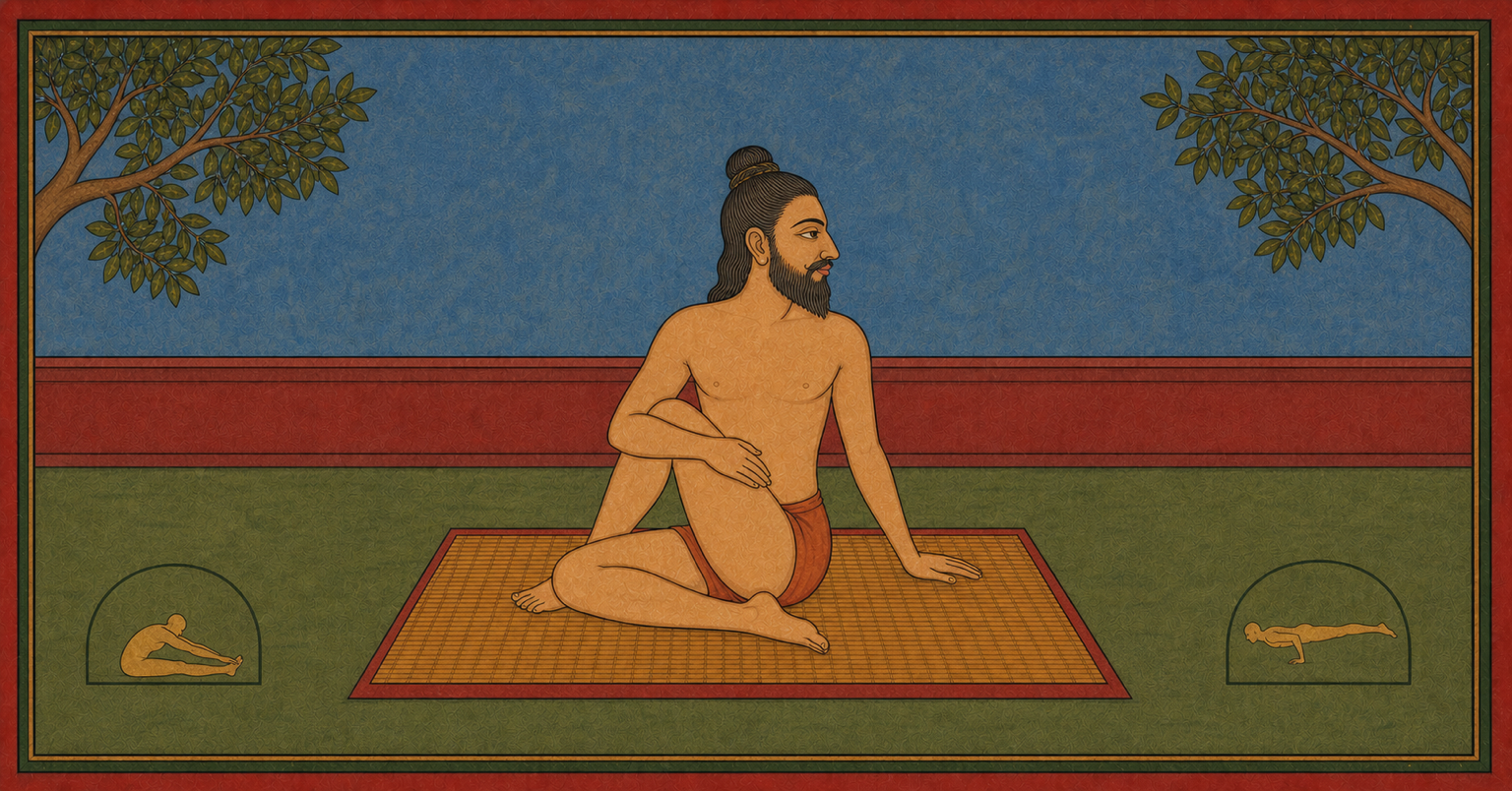

Brahmānanda distinguishes the named authorities by their primary emphasis. Vasiṣṭha and similar sages emphasize contemplation, while Matsyendra and the Nāth yogis emphasize Haṭha practice. Both groups know both approaches; the separate naming indicates only their respective main orientation. The text describes a selection of especially good Āsanas.
Brahmānanda describes Dhanurāsana as an asymmetrical posture. One hand and the leg it holds remain extended, while the other hand draws the other big toe toward the ear. This creates the action of an archer.
vāmoru-mūlārpita-dakṣa-pādaṃ; jānor bahir-veṣṭita-dakṣa-doṣṇā | Analysis ▾ Analysis ▴
pragṛhya tiṣṭhet parivartitāṅgaḥ; śrī-matsya-nāthoditam āsanaṃ syāt ||26|| Analysis ▾ Analysis ▴
Brahmānanda makes the crossed grip more precise. The hand taken behind the back holds the foot resting on the opposite thigh, while the other hand reaches past the front of the knee and grasps the other foot by its big toe. He explicitly describes the mirrored execution on the other side as well.
matsyendra-pīṭhaṃ jaṭhara-pracaṇḍa; picaṇḍa-ruṅ-maṇḍala-khaṇḍanāstram | Analysis ▾ Analysis ▴
abhyāsataḥ kuṇḍalinī-prabodhaṃ; daṇḍa-sthiratvaṃ ca dadāti puṃsām ||27|| Analysis ▾ Analysis ▴
Brahmānanda locates the moon above the palate. Matsyendrāsana is said to stop its continual dripping. At the same time, Kuṇḍalinī, resting at the “base,” awakens from sleep. The verse thus connects the physical twisting posture with two processes in the subtle yogic body.
prasārya pādau bhuvi daṇḍa-rūpau; dorbhyāṃ padāgra-dvitayaṃ gṛhītvā | Analysis ▾ Analysis ▴
According to Brahmānanda, the heels should touch during the forward bend and the legs should remain extended like a staff. The big toes are drawn firmly with the curved index fingers, without lifting the areas below the knees from the floor. The forehead finally rests on the knees.
iti paścimatāṇam āsanāgryaṃ; pavanaṃ paścima-vāhinaṃ karoti | Analysis ▾ Analysis ▴
udayaṃ jaṭharānalasya kuryād; udare kārśyam arogatāṃ ca puṃsām ||29|| Analysis ▾ Analysis ▴
Brahmānanda explicitly identifies the “western path” with Suṣumṇā, the middle channel. Paścimatāna is said to lead Prāṇa into this central yogic channel.
dharām avaṣṭabhya kara-sthalābhyāṃ; tat kūrpara-sthāpita-nābhi-pārśvaḥ | Analysis ▾ Analysis ▴
uccāsano daṇḍavad utthitaḥ khe; mayūram etat pravadanti pīṭham ||30|| Analysis ▾ Analysis ▴
harati sakala-rogān, āśu gulmodarādīn; abhibhavati ca doṣān, āsanaṃ śrī-mayūram | Analysis ▾ Analysis ▴
|
harati
|
removes, eliminates | |
|
sakala
|
all, every | |
|
rogān
|
diseases | |
|
āśu
|
quickly | |
|
gulma
|
abdominal swelling | |
|
udara
|
abdominal disorders | |
|
ādīn
|
and the like | |
|
abhibhavati
|
overpowers, overcomes | |
|
ca
|
and | |
|
doṣān
|
doṣas, disorders | |
|
āsanam
|
āsana | |
|
śrī
|
glorious | |
|
mayūram
|
peacock |
bahu-kadaśana-bhuktaṃ, bhasma kuryād aśeṣaṃ; janayati jaṭharāgniṃ, jārayet kāla-kūṭam ||31|| Analysis ▾ Analysis ▴
Brahmānanda softens the claim that Mayūrāsana can digest Kālakūṭa poison into a comparison: it refers to food that is harmful like Kālakūṭa. The Āsana is said to increase digestive power sufficiently to process even food that is difficult to digest or unwholesome.
tu śavāsanam MBHDL2026 ] tac chavāsanam NS1882
sarvāsanaśrāntiharaṃ cittaviśrāntisādhanam MBHDL2026 ] śavāsanaṃ śrāntiharaṃ cittaviśrāntikārakam NS1882
Continue with AYI Free
Illustrations: AI-generated.

Please log in to write a message. Go to login
No messages yet.