DYS 87–88: Oṃ
DYS 87–88: Oṃ

Dattātreyayogaśāstra 87–88: Three-Mora Oṃ Recitation to Preserve Bindu

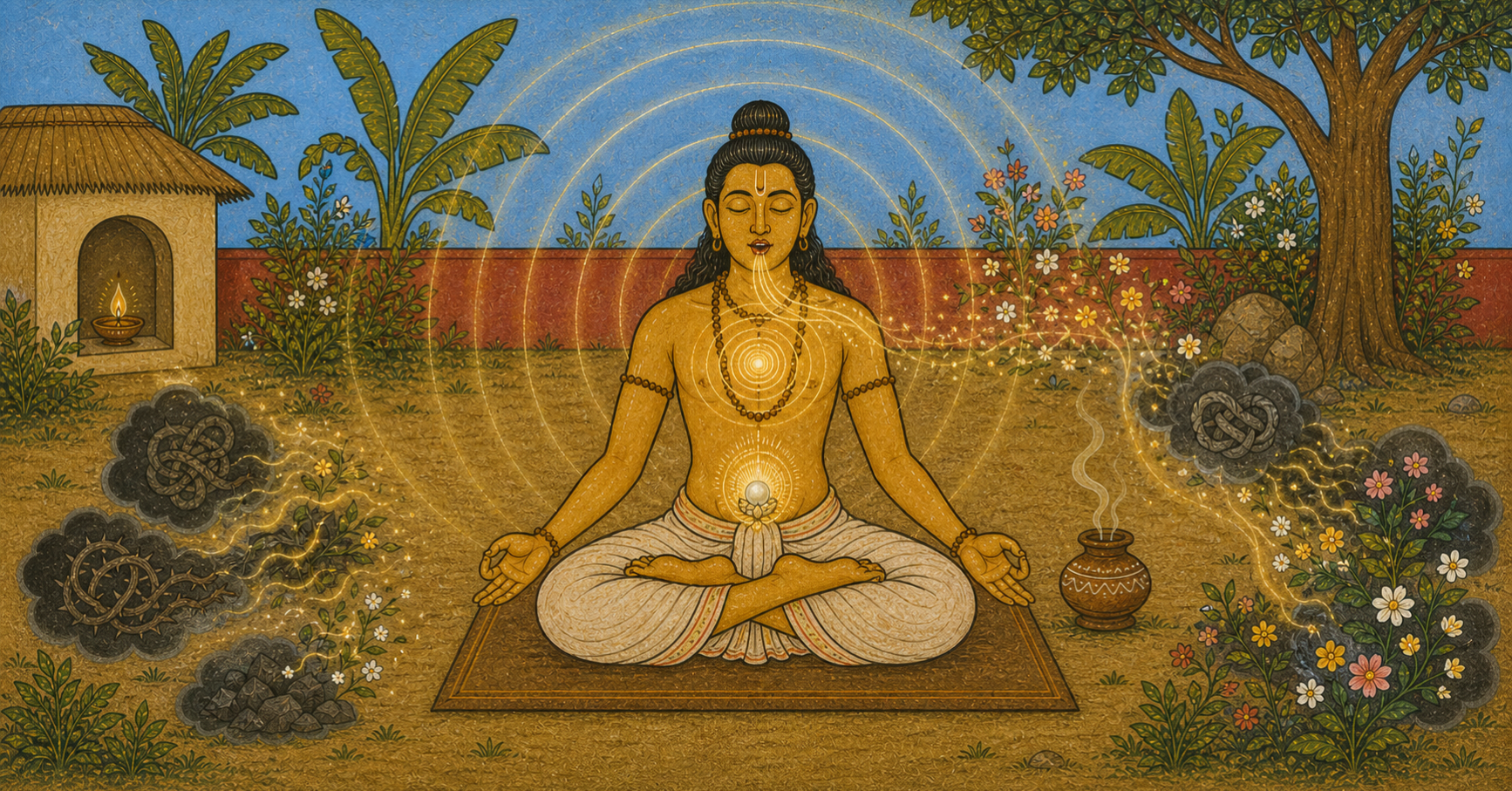
Because bindu must be protected with every effort, the yogi sits in a secluded place and recites Oṃ with a three-mora *pluta* extension. The recitation is said to destroy earlier wrongdoing and remove every obstacle and fault.

Dr. Ronald Steiner Dr. Ronald Steiner Nils Jacob Liersch Nils Jacob Liersch
Dattātreyayogaśāstra 87
तस्मात्सर्वप्रयत्नेन बिन्दू रक्ष्यो हि योगिना |
tasmāt sarva-prayatnena; bindū rakṣyo hi yoginā | Analysis ▾ Analysis ▴
tasmāt
ablative singular neuter
pronoun
therefore, for that reason
sarva
karmadhāraya-compound
pronoun quant
all
prayatnena
instrumental case singular
substantive masculine
carefully
binduḥ
nominative singular
substantive masculine
semen
rakṣyaḥ
nominative singular masculine future participle passive
verbal root
to be preserved
hi
particle
indeed
yoginā
instrumental case singular
substantive masculine
by the yogi
ततो रहस्युपाविष्टः प्रणवं प्लुतमात्रया ||87||
tato rahasy upāviṣṭaḥ; praṇavaṃ pluta-mātrayā ||87|| Analysis ▾ Analysis ▴
tataḥ
adverb
then
rahasi
lokative singular
substantive neuter
in seclusion
upāviṣṭaḥ
nominative singular masculine past participle passive
previx
previx
verbal root
having sat down
praṇavam
accusative singular
substantive masculine
the syllable Oṃ
pluta
karmadhāraya-compound
adjective
prolonged
mātrayā
instrumental case singular
substantive feminine
by a measure
Metre: Anuṣṭubh
Therefore (tasmāt | abl sg n), the yogi (yoginā | ins sg) should make every effort (sarvaprayatnena | ins sg) to preserve (rakṣyaḥ | nom sg m pfp) his semen (binduḥ | nom sg). Then (tataḥ), having sat down (upāviṣṭaḥ | nom sg m ppp) in a secluded place (rahasi | loc sg), [he should chant] the syllable Oṃ (praṇavam | acc sg) with threefold prolongation (plutamātrayā | ins sg).
Dr. Ronald Steiner - 2026 - historically literal
The yogi protects this power with every effort, then sits in a secluded place and chants Oṃ with a threefold extension.
Dr. Ronald Steiner - 2026 - modern transfer
Dattātreyayogaśāstra 88
जपेत्पूर्वार्जितानां तु पापानां नाशहेतवे |
japet pūrvārjitānāṃ tu; pāpānāṃ nāśa-hetave | Analysis ▾ Analysis ▴
japet
3rd person singular aktive optative
verbal root
should recite
pūrva
karmadhāraya-compound
adjective
previously, earlier
arjitānām
genitive plural neuter past participle passive
verbal root
previously accumulated
tu
particle
but
pāpānām
genitive plural
substantive neuter
of bad deeds
nāśa
tatpuruṣa-compound ablative
substantive masculine
destruction
hetave
dative singular
substantive masculine
for the purpose
सर्वविघ्नहरश्चायं प्रणवः सर्वदोषहा ||88||
sarva-vighna-haraś cāyaṃ; praṇavaḥ sarva-doṣa-hā ||88|| Analysis ▾ Analysis ▴
sarva
karmadhāraya-compound
pronoun quant
all
vighna
tatpuruṣa-compound genitive
substantive masculine
obstacle
haraḥ
nominative singular
substantive masculine
removing
ca
particle
and
ayam
nominative singular masculine
pronoun
this
praṇavaḥ
nominative singular
substantive masculine
the syllable Oṃ
sarva
karmadhāraya-compound
pronoun quant
all
doṣa
tatpuruṣa-compound genitive
substantive masculine
fault
hā
nominative singular
substantive masculine
destroying
Metre: Anuṣṭubh
He should chant it (japet | 3p sg act opt) in order to destroy (nāśahetave | dat sg) previously accumulated (pūrvārjitānām | gen pl n ppp) bad deeds (pāpānām | gen pl). This (ayam | nom sg m) syllable Oṃ (praṇavaḥ | nom sg) removes every obstacle (sarvavighnaharaḥ | nom sg) and destroys every fault (sarvadoṣahā | nom sg).
Dr. Ronald Steiner - 2026 - historically literal
Oṃ is said to clear earlier harmful actions, remove obstacles, and destroy every fault.
Dr. Ronald Steiner - 2026 - modern transfer
tu JM2024 ] ca DYŚ
Critical Apparatus

Continue with AYI Free

Illustrations: AI-generated.

Editor

Dr. Ronald Steiner

From Ulm

The "Yoga Doc" - Dr. Ronald Steiner is the founder of the AYI method. This method links traditional Ashtanga Yoga with innovative Yogatherapy and living Philosophy. This forms a practice that is personal for each and... more ›

Nils Jacob Liersch

Meine Begeisterung für Yoga, indische Philosophie und Sanskrit führte mich zum Studium der Indologie und Religionswissenschaft an der Universität Heidelberg. Seit 2004 befinde ich mich auf meinem persönlichen Yogaweg... more ›

Messages and ratings
2 messages

Please log in to write a message. Go to login

Ist diese Aussage jetzt 1:1 zu nehmen oder eher im übertragenden Sinn zu verstehen?
Hallo Andreas,
ja, da steckt eine ganze Welt von tantrischer Philosophie und Techniken dahinter. Die Sätze für sich sind kaum einordenbar. Letztendlich geht es um die Energie des Schöpfens und ob diese in die Welt geht, oder für die göttliche Erfahrung genutzt wird.
Viel Freude beim Erfahren wünscht Dir
Ronald