

Haṭhatattvakaumudī 10.12
स्थित्वाब्जे समकन्धरोदरतनुः संयम्य यत्नान् मुखं घ्राणेनाशु सुपूर्य संश्लिषति हृत्कण्ठे कपालावधि |
sthitvābje sama-kandharodara-tanuḥ, saṃyamya yatnān mukhaṃ; ghrāṇenāśu supūrya saṃśliṣati hṛt,-kaṇṭhe kapālāvadhi | Analysis ▾ Analysis ▴
|
sthitvā
|
having stood, having sat | |
|
abje
|
in the lotus | |
|
sama
|
straight | |
|
kandhara
|
neck | |
|
udara
|
belly | |
|
tanuḥ
|
having a body | |
|
saṃyamya
|
having closed | |
|
yatnāt
|
with care | |
|
mukham
|
the mouth | |
|
ghrāṇena
|
through the nose | |
|
āśu
|
quickly | |
|
supūrya
|
having filled well | |
|
saṃśliṣati
|
it clings | |
|
hṛt
|
heart | |
|
kaṇṭhe
|
in the throat | |
|
kapāla
|
skull | |
|
avadhi
|
avadhi
|
up to |
सम्यग्धृतं यया विरिच्य पुनर् अप्य् आपूर्य वेगादनु हृत्य प्रावधि केवलं पुनर् अपि त्यक्त्वा पुनः पूरयेत् ||12||
samyag dhṛtaṃ yayā viricya punar apy, āpūrya vegād anu; hṛtya prāvadhi kevalaṃ punar api, tyaktvā punaḥ pūrayet ||12|| Analysis ▾ Analysis ▴
|
samyak
|
proper | |
|
dhṛtam
|
held | |
|
yayā
|
through which | |
|
viricya
|
having released | |
|
punar
|
again | |
|
api
|
also | |
|
āpūrya
|
having filled | |
|
vegāt
|
with force | |
|
anu
|
afterwards | |
|
hṛtya
|
having brought in | |
|
prā
|
|
unclear |
|
avadhi
|
|
unclear |
|
kevalam
|
alone | |
|
punar
|
again | |
|
api
|
also | |
|
tyaktvā
|
having let go | |
|
punaḥ
|
again | |
|
pūrayet
|
one should fill |
Metre: Śārdūlavikrīḍita
Having taken a seat (sthitvā | abs) in the lotus [posture] (abje | loc sg), with neck, abdomen and trunk straight (sama-kandharodara-tanuḥ | nom sg m), [and] carefully (yatnāt | abl sg) closed (saṃyamya | abs) the mouth (mukham | acc sg), [one should] quickly (āśu) fill [the body] well (supūrya | abs) through the nose (ghrāṇena | ins sg). [The breath] makes contact (saṃśliṣati | 3p sg act pres) in the heart and throat (hṛt-kaṇṭhe | loc sg), as far as the skull (kapālāvadhi).
Having released (viricya | abs) the properly (samyak) held [breath] (dhṛtam | acc sg m ppp) through that [nostril] (yayā | ins sg f), [one should] also (api) fill [it] in (āpūrya | abs) again (punar) with force (vegāt | abl sg), afterwards (anu) bring [it] in (hṛtya | abs) alone (kevalam), also (api) let [it] go (tyaktvā | abs) again (punar), [and] fill [the body] (pūrayet | 3p sg act opt caus) again (punaḥ).
Having released (viricya | abs) the properly (samyak) held [breath] (dhṛtam | acc sg m ppp) through that [nostril] (yayā | ins sg f), [one should] also (api) fill [it] in (āpūrya | abs) again (punar) with force (vegāt | abl sg), afterwards (anu) bring [it] in (hṛtya | abs) alone (kevalam), also (api) let [it] go (tyaktvā | abs) again (punar), [and] fill [the body] (pūrayet | 3p sg act opt caus) again (punaḥ).
I supply the breath as the subject of saṃśliṣati and connect feminine yayā with an implied nostril. I connect “alone” with bringing the breath in.
As you sit, sense the relationship between your neck, trunk and abdomen. Then follow your natural breath, noticing how one movement gives way to the next.
sthitvābje GDJ2007 ] sthitvā'jye GDJ2007-b
ghrāṇenāśu GDJ2007 ] ghrāṇenāpyu GDJ2007-b
saṃśliṣati GDJ2007 ] saṃśliṣyati GDJ2007-b
samyag dhṛtaṃ GDJ2007 ] samyadṛdhanta(?) GDJ2007-a
yayā GDJ2007 ] yathā GDJ2007-b
prāvadhi ke(?) GDJ2007 ] śarvādhake GDJ2007-b
ghrāṇenāśu GDJ2007 ] ghrāṇenāpyu GDJ2007-b
saṃśliṣati GDJ2007 ] saṃśliṣyati GDJ2007-b
samyag dhṛtaṃ GDJ2007 ] samyadṛdhanta(?) GDJ2007-a
yayā GDJ2007 ] yathā GDJ2007-b
prāvadhi ke(?) GDJ2007 ] śarvādhake GDJ2007-b
Haṭhatattvakaumudī 10.13
इत्थं शश्वदुपाचरेदिति यथा भस्त्रेव सञ्चालयेद्देहस्थं पवनं तथैव मतिना सञ्चालयेद्बुद्धिमान् |
itthaṃ śaśvad upācared iti yathā, bhastreva sañcālayed; deha-sthaṃ pavanaṃ tathaiva matinā, sañcālayed buddhimān | Analysis ▾ Analysis ▴
|
ittham
|
in this way | |
|
śaśvat
|
constant | |
|
upācaret
|
one should proceed | |
|
iti
|
thus | |
|
yathā
|
as | |
|
bhastrā
|
bellows | |
|
iva
|
as | |
|
sañcālayet
|
one should move | |
|
deha
|
body | |
|
stham
|
situated | |
|
pavanam
|
the breath | |
|
tathā
|
thus | |
|
eva
|
indeed | |
|
matinā
|
|
unclear: with full attention in context |
|
sañcālayet
|
one should move | |
|
buddhimān
|
intelligent |
श्रान्तिः स्याद्तु यदा तदा निजतनौ सूर्येण संपूरयेत्पूर्णं स्वोदरम् आकलय्य मरुता मन्दं तथा पूरयेत् ||13||
śrāntiḥ syād tu yadā tadā nija-tanau, sūryeṇa saṃpūrayet; pūrṇaṃ svodaram ākalayya marutā, mandaṃ tathā pūrayet ||13|| Analysis ▾ Analysis ▴
|
śrāntiḥ
|
fatigue | |
|
syāt
|
it may occur | |
|
tu
|
but | |
|
yadā
|
when | |
|
tadā
|
then | |
|
nija
|
one's own | |
|
tanau
|
in the body | |
|
sūryeṇa
|
through the sun | |
|
saṃpūrayet
|
one should fill completely | |
|
pūrṇam
|
filled | |
|
sva
|
sva
|
one's own |
|
udaram
|
belly | |
|
ākalayya
|
having envisaged | |
|
marutā
|
with breath | |
|
mandam
|
mandam
|
slowly |
|
tathā
|
likewise | |
|
pūrayet
|
one should fill |
Metre: Śārdūlavikrīḍita
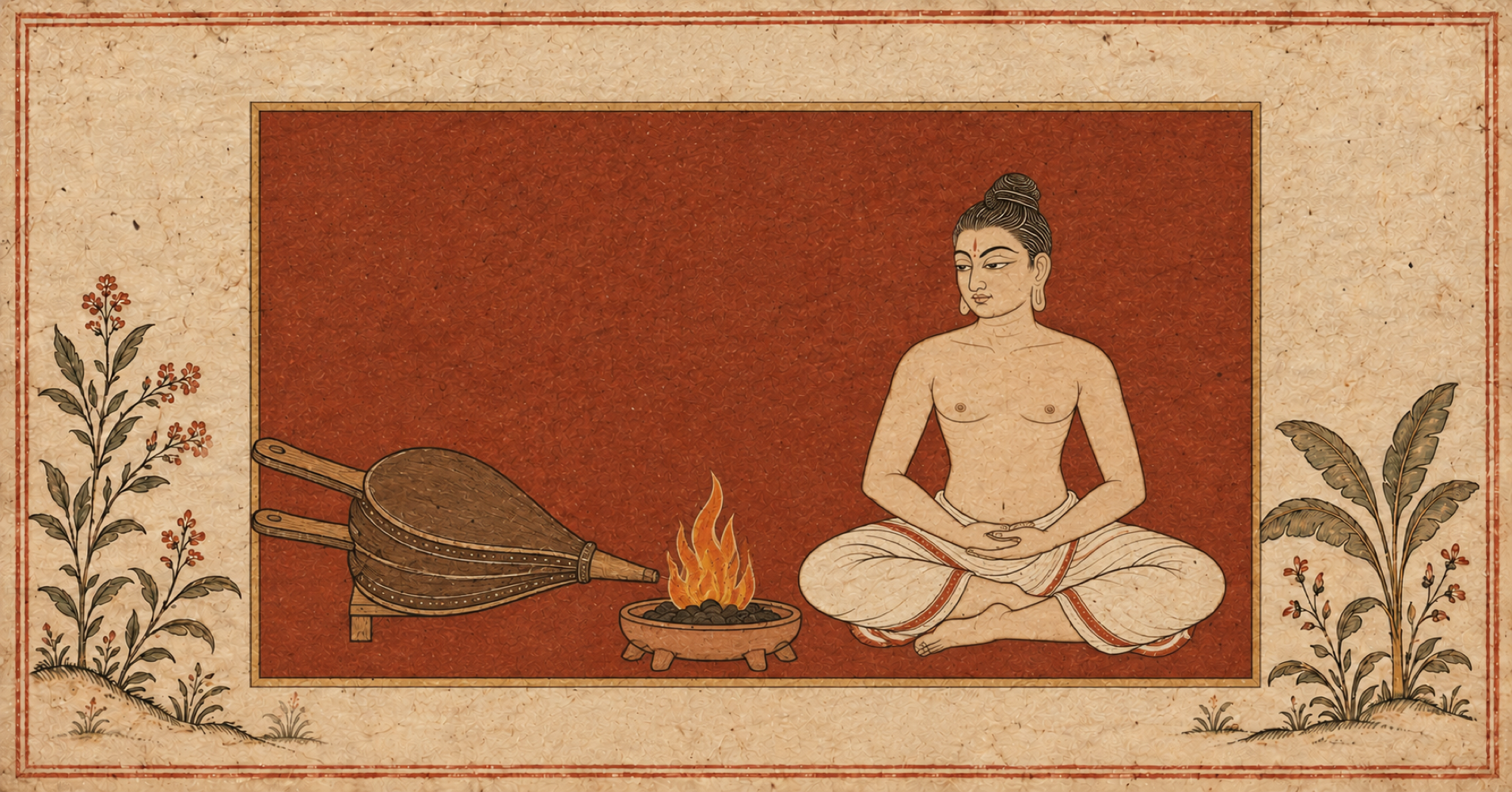
[One] should continually (śaśvat) proceed (upācaret | 3p sg act opt) in this way (ittham), thus (iti) [runs the instruction]: as (yathā) a bellows (bhastrā | nom sg) would, as it were (iva), set [air] in motion (sañcālayet | 3p sg act opt caus), just so (tathaiva) the intelligent person (buddhimān | nom sg m) should move (sañcālayet | 3p sg act opt caus) the breath (pavanam | acc sg) within the body (deha-stham | acc sg m), with full attention (matinā). But (tu) when (yadā) fatigue (śrāntiḥ | nom sg) arises (syāt | 3p sg act opt) in one's own body (nija-tanau | loc sg), then (tadā) [one] should inhale fully (saṃpūrayet | 3p sg act opt caus) through the sun [the right nostril] (sūryeṇa | ins sg): having envisaged (ākalayya | abs) one's own belly (svodaram | acc sg) as full (pūrṇam | acc sg n ppp), [one] should thus (tathā) fill [it] (pūrayet | 3p sg act opt caus) slowly (mandam) with breath (marutā | ins sg).
The proximity of buddhimān supports interpreting matinā as “with full attention”; the regular instrumental of mati would be matyā.
The final pūrayet elaborates the same inhalation. I understand ākalayya as mentally anticipating the complete filling.
Take tiredness during practice seriously as feedback. Allow yourself to slow down or finish the exercise.
śaśvadupācarediti GDJ2007 ] śaśvaḍyācarediti GDJ2007-b
matinā sañcālayed GDJ2007 ] matinā stañcālayed GDJ2007-b
saṃpūrayet conj. ed. ] saṃrecayet GDJ2007
matinā sañcālayed GDJ2007 ] matinā stañcālayed GDJ2007-b
saṃpūrayet conj. ed. ] saṃrecayet GDJ2007
Haṭhatattvakaumudī 10.14
नासामध्यमम् अन्तरेण सुदृढं स तर्जनीभ्यां ततः कुम्भं पूर्ववदाविधाय पवनं तं रेचयेद्वामया |
nāsā-madhyamam antareṇa sudṛḍhaṃ, sa tarjanībhyāṃ tataḥ; kumbhaṃ pūrvavad āvidhāya pavanaṃ, taṃ recayed vāmayā | Analysis ▾ Analysis ▴
|
nāsā
|
of the nose | |
|
madhyamam
|
middle, central region | |
|
antareṇa
|
without | |
|
sudṛḍham
|
sudṛḍham
|
very firmly |
|
saḥ
|
he | |
|
tarjanībhyām
|
with the index and middle fingers | |
|
tataḥ
|
afterwards | |
|
kumbham
|
breath retention | |
|
pūrvavat
|
as before | |
|
āvidhāya
|
having performed | |
|
pavanam
|
the breath | |
|
tam
|
that | |
|
recayet
|
one should release | |
|
vāmayā
|
through the left |
भस्त्राख्यः खलु कुम्भकः स्यति कफं पित्तं समीरं सुषुम्णाङ्गस्थं दुःकफम् अग्निदस्त्रिगुणजग्रन्थित्रयोद्भेदकः ||14||
bhastrākhyaḥ khalu kumbhakaḥ syati kaphaṃ, pittaṃ samīraṃ suṣumṇā;ṅga-sthaṃ duḥ-kapham agni-das tri-guṇa-ja,-granthi-trayodbhedakaḥ ||14|| Analysis ▾ Analysis ▴
|
bhastrā
|
bellows | |
|
ākhyaḥ
|
called | |
|
khalu
|
certainly | |
|
kumbhakaḥ
|
breath retention | |
|
syati
|
it removes | |
|
kapham
|
phlegm | |
|
pittam
|
bile | |
|
samīram
|
wind | |
|
suṣumnā
|
suṣumnā
|
of Suṣumṇā, the central channel |
|
aṅga
|
region | |
|
stham
|
situated | |
|
duḥ
|
dus
|
bad |
|
kapham
|
phlegm | |
|
agni
|
digestive fire (according to Meulenbeld 1974, p. 437) | |
|
daḥ
|
giving | |
|
tri
|
three | |
|
guṇa
|
fundamental quality | |
|
ja
|
arisen | |
|
granthi
|
of the knot | |
|
traya
|
triad | |
|
udbhedakaḥ
|
udbhedaka
|
breaking open |
Metre: Śārdūlavikrīḍita; pāda 3: one extra Guru syllable (at the end)
Then (tataḥ) he (saḥ | nom sg m) [should hold] the middle of the nose (nāsā-madhyamam | acc sg) very firmly (sudṛḍham) [closed], without (antareṇa) the index finger [and the middle finger] (tarjanībhyām | ins du). Having performed (āvidhāya | abs) the breath retention (kumbham | acc sg) as before (pūrvavat), [he] should release (recayet | 3p sg act opt caus) that (tam | acc sg m) breath (pavanam | acc sg) through the left [side] (vāmayā | ins sg f). The breath retention (kumbhakaḥ | nom sg) called the bellows (bhastrākhyaḥ | nom sg m) certainly (khalu) removes (syati | 3p sg act pres) phlegm (kapham | acc sg), bile (pittam | acc sg), wind (samīram | acc sg) [and] bad phlegm (duḥ-kapham | acc sg) situated in the region of Suṣumṇā (suṣumṇāṅga-stham | acc sg m). [It] produces digestive fire (agni-daḥ | nom sg m) [and] breaks open the three knots arising from the three fundamental qualities (tri-guṇa-ja-granthi-trayodbhedakaḥ | nom sg m).
Antareṇa, “without”, normally takes an accusative; here I take it with the instrumental dual tarjanībhyām. Drawing on HP 2.65 (MBHDL2024), I interpret this as an associative dual: the index and middle fingers.
The image of knots can suggest tension you are holding. As you sit, explore where you brace unnecessarily and where you can yield a little.
Haṭhatattvakaumudī 10.14*1
इति सर्वदोषमलशोषणः सर्वपीडाहर आमाजीर्णजारणो भस्त्रिकाकुम्भकः |
iti sarva-doṣa-mala-śoṣaṇaḥ sarva-pīḍā-hara āmājīrṇa-jāraṇo bhastrikā-kumbhakaḥ | Analysis ▾ Analysis ▴
|
iti
|
thus | |
|
sarva
|
all | |
|
doṣa
|
of the doṣa, the pathogenic factor (according to Meulenbeld 1974, pp. 469–470) | |
|
mala
|
impurity (according to Meulenbeld 1974, pp. 488–489) | |
|
śoṣaṇaḥ
|
drying up | |
|
sarva
|
all | |
|
pīḍā
|
distress | |
|
haraḥ
|
removing | |
|
āma
|
undigested matter | |
|
ajīrṇa
|
indigestion (according to Meulenbeld 1974, pp. 264–268) | |
|
jāraṇaḥ
|
jāraṇa
|
digesting |
|
bhastrikā
|
bellows | |
|
kumbhakaḥ
|
breath retention |
Metre: none
Thus (iti) [is described] the bellows breath retention (bhastrikā-kumbhakaḥ | nom sg), which dries up the impurities of all pathogenic factors (sarva-doṣa-mala-śoṣaṇaḥ | nom sg m), removes all distress (sarva-pīḍā-haraḥ | nom sg m) [and] digests undigested matter [and] remedies indigestion (āmājīrṇa-jāraṇaḥ | nom sg m).
Give yourself time to absorb an intense experience. An exercise also needs an ending before you turn to the next task.
Continue with AYI Free
Illustrations: AI-generated.

Please log in to write a message. Go to login
No messages yet.