
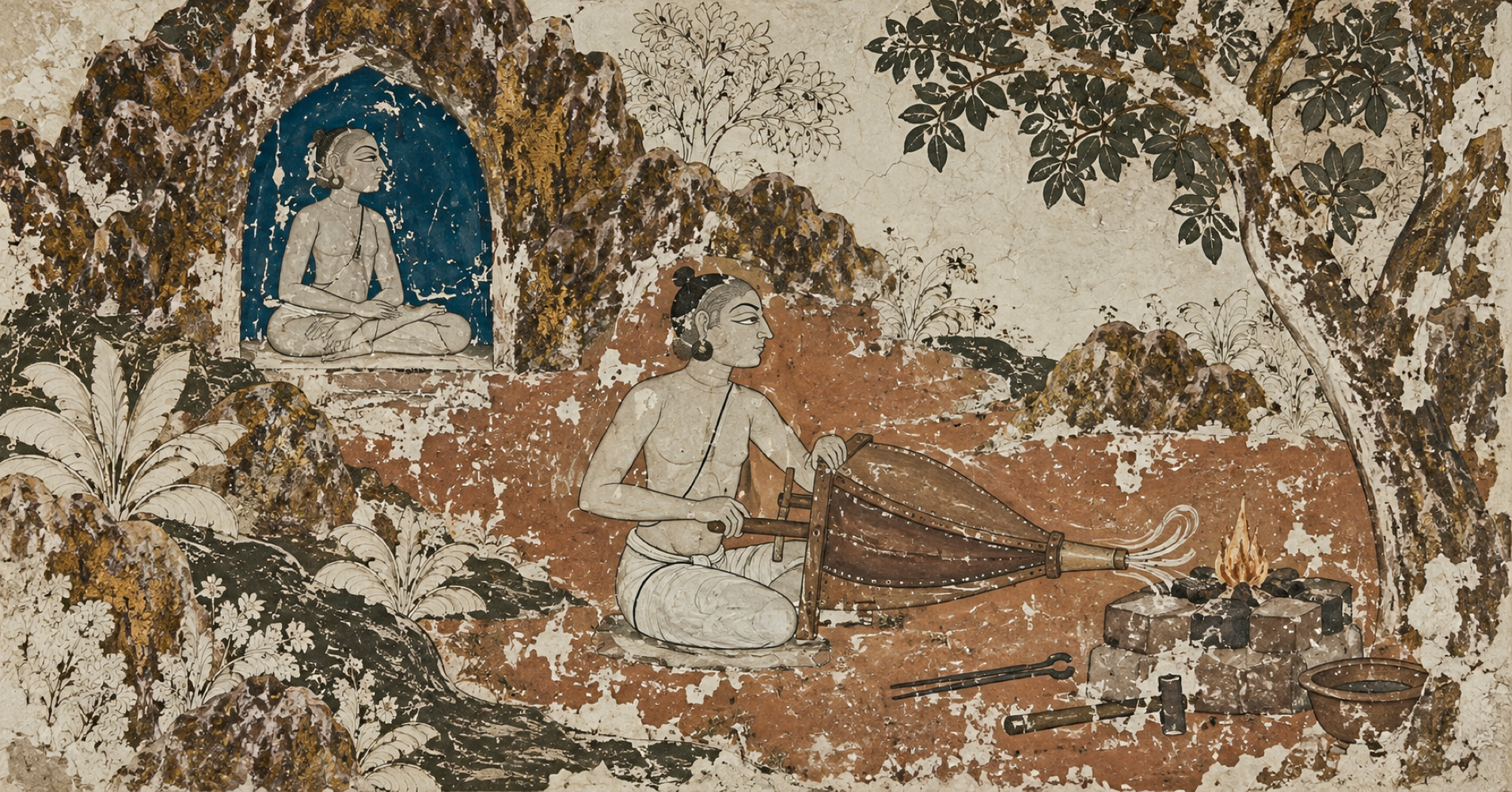
Bellows and a small forge fire before a seated figure.

Gorakṣaśataka 42–49: Rhythm, Fire and the Power of Breath

The blacksmith’s image shapes bellows breathing. The text connects it with fire, Kuṇḍalinī and the piercing of inner knots.

Dr. Ronald Steiner Dr. Ronald Steiner
Gorakṣaśataka (Original) 42
मुखं संयम्य यत्नेन प्राणं घ्राणेन रेचयेत् |
mukhaṃ saṃyamya yatnena; prāṇaṃ ghrāṇena recayet | Analysis ▾ Analysis ▴
mukham
accusative singular
substantive neuter
the opening
saṃyamya
absolutus
previx
verbal root
having closed
yatnena
instrumental case singular
substantive masculine
with effort
prāṇam
accusative singular
substantive masculine
breath
ghrāṇena
instrumental case singular
substantive neuter
through the nose
recayet
3rd person singular aktive optative causative
verbal root
one should release
यथा लगति कण्ठात्तु कपाले सस्वनं ततः ||42||
yathā lagati kaṇṭhāt tu; kapāle sa-svanaṃ tataḥ ||42|| Analysis ▾ Analysis ▴
yathā
particle
as, so that
lagati
3rd person singular aktive present
verbal root
touches
kaṇṭhāt
ablative singular
substantive masculine
from the throat
tu
particle
however
kapāle
lokative singular
substantive neuter
in the skull
sa
bahuvrīhi-compund
previx
with
svanam
accusative singular neuter
substantive masculine
sounding
tataḥ
adverb
then
… having closed (saṃyamya | abs) the mouth (mukham | acc sg), should release (recayet | 3p sg act opt caus) the breath (prāṇam | acc sg) through the nose (ghrāṇena | ins sg) with effort (yatnena | ins sg), so that (yathā) it then (tataḥ), however (tu), touches (lagati | 3p sg act pres) [the region] in the skull (kapāle | loc sg) from the throat (kaṇṭhāt | abl sg), with a sound (sa-svanam | acc sg n).
Dr. Ronald Steiner - 2026 - historically literal
Breathing also has an audible aspect. Notice its sound without making it a measure of achievement.
Dr. Ronald Steiner - 2026 - modern transfer
kaṇṭhāt tu ] karṇān nu R7874apJM
Critical Apparatus

The description connects sound with a sensation from the throat to the skull. The verb lagati has no explicitly named object here; I retain the unusual connection.

Apparatus Comment
Gorakṣaśataka (Original) 43
वेगेन पूरयेत्किंचिथृत्पद्मावधि मारुतम् |
vegena pūrayet kiṃcit; hṛt-padmāvadhi mārutam | Analysis ▾ Analysis ▴
vegena
instrumental case singular
substantive masculine
with speed
pūrayet
3rd person singular aktive optative causative
verbal root
one should fill
kiṃcit
accusative singular neuter
pronoun inter
particle
a little
hṛt
tatpuruṣa-compound genitive
substantive neuter
of the heart
padmāvadhi
padmāvadhi
adverb
as far as the lotus
mārutam
accusative singular
substantive masculine
breath
पुनर् विरेचयेत्तद्वत्पूरयेच्च पुनः पुनः ||43||
punar virecayet tad-vat; pūrayec ca punaḥ punaḥ ||43|| Analysis ▾ Analysis ▴
punaḥ
adverb
again
virecayet
3rd person singular aktive optative causative
previx
verbal root
one should exhale
tad
avyayībhāva-compund
pronoun dem
thus
vat
suffix
like
pūrayet
3rd person singular aktive optative causative
verbal root
one should fill
ca
particle
and
punaḥ
adverb
again
punaḥ
adverb
again
One should rapidly (vegena | ins sg) draw in (pūrayet | 3p sg act opt caus) a little (kiṃcit | acc sg n) breath (mārutam | acc sg) as far as the heart-lotus (hṛt-padmāvadhi), then exhale (virecayet | 3p sg act opt caus) again (punaḥ) in the same way (tad-vat), and (ca) inhale (pūrayet | 3p sg act opt caus) again (punaḥ) and again (punaḥ).
Dr. Ronald Steiner - 2026 - historically literal
Rhythm emerges through movement in both directions. Notice how each direction prepares the other.
Dr. Ronald Steiner - 2026 - modern transfer

kiṃ cit indicates a small quantity or degree. hṛtpadma, the heart-lotus, is an image within the yogic model of the body.

Apparatus Comment
Gorakṣaśataka (Original) 44
यथैव लोहकाराणां भस्त्रां वेगेन चालयेत् |
yathaiva loha-kārāṇāṃ; bhastrāṃ vegena cālayet | Analysis ▾ Analysis ▴
yathā
particle
like
eva
particle
indeed; precisely
loha
tatpuruṣa-compound genitive
substantive neuter
iron
kārāṇām
genitive plural
substantive masculine
of the workers
bhastrām
accusative singular
substantive feminine
bellows
vegena
instrumental case singular
substantive masculine
with speed
cālayet
3rd person singular aktive optative causative
verbal root
one should move
तथैव स्वशरीरस्थं चालयेत्पवनं सुधीः ||44||
tathaiva sva-śarīra-sthaṃ; cālayet pavanaṃ sudhīḥ ||44|| Analysis ▾ Analysis ▴
tathā
adverb
thus
eva
particle
indeed; precisely
sva
karmadhāraya-compound
adjective
own
śarīra
tatpuruṣa-compound lokative
substantive neuter
body
stham
accusative singular masculine
adjective
situated
cālayet
3rd person singular aktive optative causative
verbal root
one should move
pavanam
accusative singular
substantive masculine
wind
sudhīḥ
nominative singular masculine
adjective
the wise practitioner
Just (eva) as (yathā) one would move (cālayet | 3p sg act opt caus) a blacksmith’s (loha-kārāṇām | gen pl) bellows (bhastrām | acc sg) rapidly (vegena | ins sg), just (eva) so (tathā) should the wise practitioner (sudhīḥ | nom sg m) move (cālayet | 3p sg act opt caus) the wind (pavanam | acc sg) within their own body (sva-śarīra-stham | acc sg m).
Dr. Ronald Steiner - 2026 - historically literal
A useful image can make a movement easier to understand. Let the bellows suggest rhythm, without treating your breath as a tool that has to perform.
Dr. Ronald Steiner - 2026 - modern transfer
bhastrāṃ ] bhastrā R7874apJM
Critical Apparatus

The bellows explain the name and the alternating movement. I retain Mallinson’s bhastrāṃ as the object of cālayet.

Apparatus Comment
Gorakṣaśataka (Original) 45
यदा श्रमो भवेद्देहे तदा सूर्येण पूरयेत् |
yadā śramo bhaved dehe; tadā sūryeṇa pūrayet | Analysis ▾ Analysis ▴
yadā
particle
if; when
śramaḥ
nominative singular
substantive masculine
fatigue
bhavet
3rd person singular aktive optative
verbal root
it would be
dehe
lokative singular
substantive masculine
in the body
tadā
adverb
then
sūryeṇa
instrumental case singular
substantive masculine
through the sun
pūrayet
3rd person singular aktive optative causative
verbal root
one should fill
यथोदरं भवेत्पूर्णं पवनेन तथा लघु ||45||
yathodaraṃ bhavet pūrṇaṃ; pavanena tathā laghu ||45|| Analysis ▾ Analysis ▴
yathā
particle
like
udaram
nominative singular
substantive neuter
belly
bhavet
3rd person singular aktive optative
verbal root
it would be
pūrṇam
nominative singular neuter past participle passive
verbal root
filled
pavanena
instrumental case singular
substantive masculine
with wind
tathā
adverb
likewise
laghu
adverb
swiftly
When (yadā) fatigue (śramaḥ | nom sg) should arise (bhavet | 3p sg act opt) in the body (dehe | loc sg), one should then (tadā) inhale (pūrayet | 3p sg act opt caus) through the sun (sūryeṇa | ins sg), in such a way (tathā) that (yathā) the belly (udaram | nom sg) is (bhavet | 3p sg act opt) quickly (laghu) filled (pūrṇam | nom sg n ppp) with wind (pavanena | ins sg).
Dr. Ronald Steiner - 2026 - historically literal
Fatigue is valuable feedback. Let it sharpen your attention and inform what you do next.
Dr. Ronald Steiner - 2026 - modern transfer

The historical instruction follows fatigue with an inhalation through the solar channel. The contemporary rendering takes up awareness of fatigue, without prescribing a particular response to it.

Apparatus Comment
Gorakṣaśataka (Original) 46
धारयन् नासिकामध्यं तर्जनीभ्यां विना दृढं |
dhārayan nāsikā-madhyaṃ; tarjanībhyāṃ vinā dṛḍhaṃ | Analysis ▾ Analysis ▴
dhārayan
nominative singular masculine present participle active causative
verbal root
holding
nāsikā
tatpuruṣa-compound genitive
substantive feminine
nose
madhyam
accusative singular
substantive neuter
the centre
tarjanībhyām
instrumental case dual
substantive feminine
with the index fingers
vinā
particle
without
dṛḍham
adverb
firmly
कुम्भकं पूर्ववत्कृत्वा रेचयेदिडयानिलम् ||46||
kumbhakaṃ pūrva-vat kṛtvā; recayed iḍayānilam ||46|| Analysis ▾ Analysis ▴
kumbhakam
accusative singular
substantive masculine
breath retention
pūrva
avyayībhāva-compund
adjective
before
vat
suffix
like
kṛtvā
absolutus
verbal root
having performed
recayet
3rd person singular aktive optative causative
verbal root
one should release
iḍayā
instrumental case singular
substantive feminine
through Iḍā
anilam
accusative singular
substantive masculine
breath
While holding (dhārayan | nom sg m pca caus) the middle of the nose (nāsikā-madhyam | acc sg) firmly (dṛḍham), without (vinā) the index fingers (tarjanībhyām | ins du), having performed (kṛtvā | abs) breath retention (kumbhakam | acc sg) as before (pūrva-vat), one should let out (recayet | 3p sg act opt caus) the breath (anilam | acc sg) through Iḍā (iḍayā | ins sg).
Dr. Ronald Steiner - 2026 - historically literal
A familiar hand position can offer orientation. Keep noticing how it affects your breath.
Dr. Ronald Steiner - 2026 - modern transfer
dhārayan ] dhārayen R7874apJM
Critical Apparatus

tarjanībhyām is instrumental dual. The passage excludes the index fingers but does not describe every detail of a hand position.

Apparatus Comment
Gorakṣaśataka (Original) 47
कण्ठोत्थितानलहरं शरीराग्निविवर्धनम् |
kaṇṭhotthitānala-haraṃ; śarīrāgni-vivardhanam | Analysis ▾ Analysis ▴
kaṇṭha
tatpuruṣa-compound genitive
substantive masculine
of the throat
utthita
karmadhāraya-compound past participle passive
previx
verbal root
risen
anala
upapada-compound
substantive masculine
fire
haram
nominative singular neuter
adjective
removing
śarīra
tatpuruṣa-compound genitive
substantive neuter
body
agni
upapada-compound
substantive masculine
fire
vivardhanam
nominative singular neuter
adjective
increasing
कुण्डलीबोधकं वज्रं पापघ्नं शुभदं सुखम् ||47||
kuṇḍalī-bodhakaṃ vajraṃ; pāpa-ghnaṃ śubha-daṃ sukham ||47|| Analysis ▾ Analysis ▴
kuṇḍalī
upapada-compound
substantive feminine
Kuṇḍalī
bodhakam
nominative singular neuter
adjective
awakening
vajram
nominative singular
substantive neuter
thunderbolt
pāpa
upapada-compound
substantive neuter
wrongdoing
ghnam
nominative singular neuter
adjective
destroying
śubha
upapada-compound
substantive neuter
well-being
dam
nominative singular neuter
adjective
giving
sukham
nominative singular neuter
adjective
pleasant
[This retention] removes the fire that has risen into the throat (kaṇṭha-utthita-anala-haram | nom sg n), increases the bodily fire (śarīra-agni-vivardhanam | nom sg n) and awakens Kuṇḍalī (kuṇḍalī-bodhakam | nom sg n). It is a thunderbolt (vajram | nom sg), destroys wrongdoing (pāpa-ghnam | nom sg n), brings well-being (śubha-dam | nom sg n) and is pleasant (sukham | nom sg n).
Dr. Ronald Steiner - 2026 - historically literal
Powerful images can motivate you. Keep checking whether your practice feels appropriate and sustainable.
Dr. Ronald Steiner - 2026 - modern transfer

The compounds are rendered as statements about the breath retention just described. The working text’s kaṇṭhotthitānalaharam names fire arising in the throat; Mallinson’s translation (2012, p. 269) instead refers to removing bile from the throat. For this expression I follow the Sanskrit working text. I understand vajram, “thunderbolt”, as a forceful image of efficacy. The effects attributed to the method belong to the historical text.

Apparatus Comment
Gorakṣaśataka (Original) 48
ब्रह्मनाडीमुखान्तस्थकफाद्यर्गलनाशनम् |
brahma-nāḍī-mukhānta-stha;-kaphādy-argala-nāśanam | Analysis ▾ Analysis ▴
brahma
tatpuruṣa-compound genitive
substantive neuter
Brahman
nāḍī
tatpuruṣa-compound genitive
substantive feminine
channel
mukha
tatpuruṣa-compound genitive
substantive neuter
entrance
antaḥ
tatpuruṣa-compound lokative
adverb
within
stha
karmadhāraya-compound
adjective
situated
kapha
tatpuruṣa-compound genitive
substantive masculine
phlegm
ādi
karmadhāraya-compound
substantive masculine
and other things
argala
tatpuruṣa-compound genitive
substantive masculine
barrier
nāśanam
nominative singular neuter
adjective
removing
गुणत्रयसमुद्भूतग्रन्थित्रयविभेदकम् ||48||
guṇa-traya-samudbhūta;-granthi-traya-vibhedakam ||48|| Analysis ▾ Analysis ▴
guṇa
tatpuruṣa-compound genitive
substantive masculine
qualities
traya
tatpuruṣa-compound genitive
substantive neuter
three
samudbhūta
karmadhāraya-compound past participle passive
previx
previx
verbal root
arisen
granthi
tatpuruṣa-compound genitive
substantive masculine
knot
traya
tatpuruṣa-compound genitive
substantive neuter
three
vibhedakam
nominative singular neuter
adjective
piercing
It removes the barriers of phlegm and other [substances] situated inside the entrance to the Brahman-channel (brahma-nāḍī-mukha-antaḥ-stha-kapha-ādi-argala-nāśanam | nom sg n), and pierces the three knots that arise from the three qualities (guṇa-traya-samudbhūta-granthi-traya-vibhedakam | nom sg n).
Dr. Ronald Steiner - 2026 - historically literal
Some obstacles feel like a closed entrance. Explore what opens it and which inner connections become apparent.
Dr. Ronald Steiner - 2026 - modern transfer

The Brahman-channel is understood in connection with Suṣumnā. The three knots and three guṇas belong to the historical explanatory model of the subtle body. Their names are described in the later account of ascent.

Apparatus Comment
Gorakṣaśataka (Original) 49
विशेषेणैव कर्तव्यं भस्त्र्याख्यं कुंभकं त्व् इदं |
viśeṣeṇaiva kartavyaṃ; bhastry-ākhyaṃ kuṃbhakaṃ tv idaṃ | Analysis ▾ Analysis ▴
viśeṣeṇa
instrumental case singular
substantive masculine
especially
eva
particle
indeed; precisely
kartavyam
nominative singular neuter future participle passive
verbal root
to be done
bhastrī
upapada-compound
substantive feminine
bellows
ākhyam
nominative singular neuter
adjective
called
kumbhakam
nominative singular
substantive masculine
breath retention; used as neuter
tu
particle
however
idam
nominative singular neuter
pronoun dem
this
बन्धत्रयम् अथेदानीं प्रवक्ष्यामि समासतः ||49||
bandha-trayam athedānīṃ; pravakṣyāmi samāsataḥ ||49|| Analysis ▾ Analysis ▴
bandha
tatpuruṣa-compound genitive
substantive masculine
lock
trayam
nominative singular
substantive neuter
three
atha
particle
now
idānīm
adverb
now
pravakṣyāmi
1st person singular aktive future
previx
verbal root
I shall explain
samāsataḥ
adverb
briefly
Indeed (eva), this (idam | nom sg n) breath retention (kumbhakam | nom sg) called the bellows (bhastrī-ākhyam | nom sg n) should, however (tu), be practised (kartavyam | nom sg n pfp) with particular attention (viśeṣeṇa | ins sg). Next (atha), I shall now (idānīm) explain (pravakṣyāmi | 1p sg act fut) briefly (samāsataḥ) the three locks (bandha-trayam | nom sg).
Dr. Ronald Steiner - 2026 - historically literal
Movement can lead towards focused attention. Notice how your attention changes as you enter a new quality of practice.
Dr. Ronald Steiner - 2026 - modern transfer
kartavyaṃ ] vaktavyaṃ R7874apJM
bhastryākhyaṃ ] bhastrākhyaṃ R7874apJM
Critical Apparatus

Bellows breathing ends at 49ab. 49cd introduces the three bandhas, or locks. The working numbering therefore overlaps a thematic section boundary.

Apparatus Comment

Continue with AYI Free

Illustrations: AI-generated.

Editor

Dr. Ronald Steiner

From Ulm

The "Yoga Doc" - Dr. Ronald Steiner is the founder of the AYI method. This method links traditional Ashtanga Yoga with innovative Yogatherapy and living Philosophy. This forms a practice that is personal for each and... more ›

Messages and ratings
0 messages

Please log in to write a message. Go to login

No messages yet.