
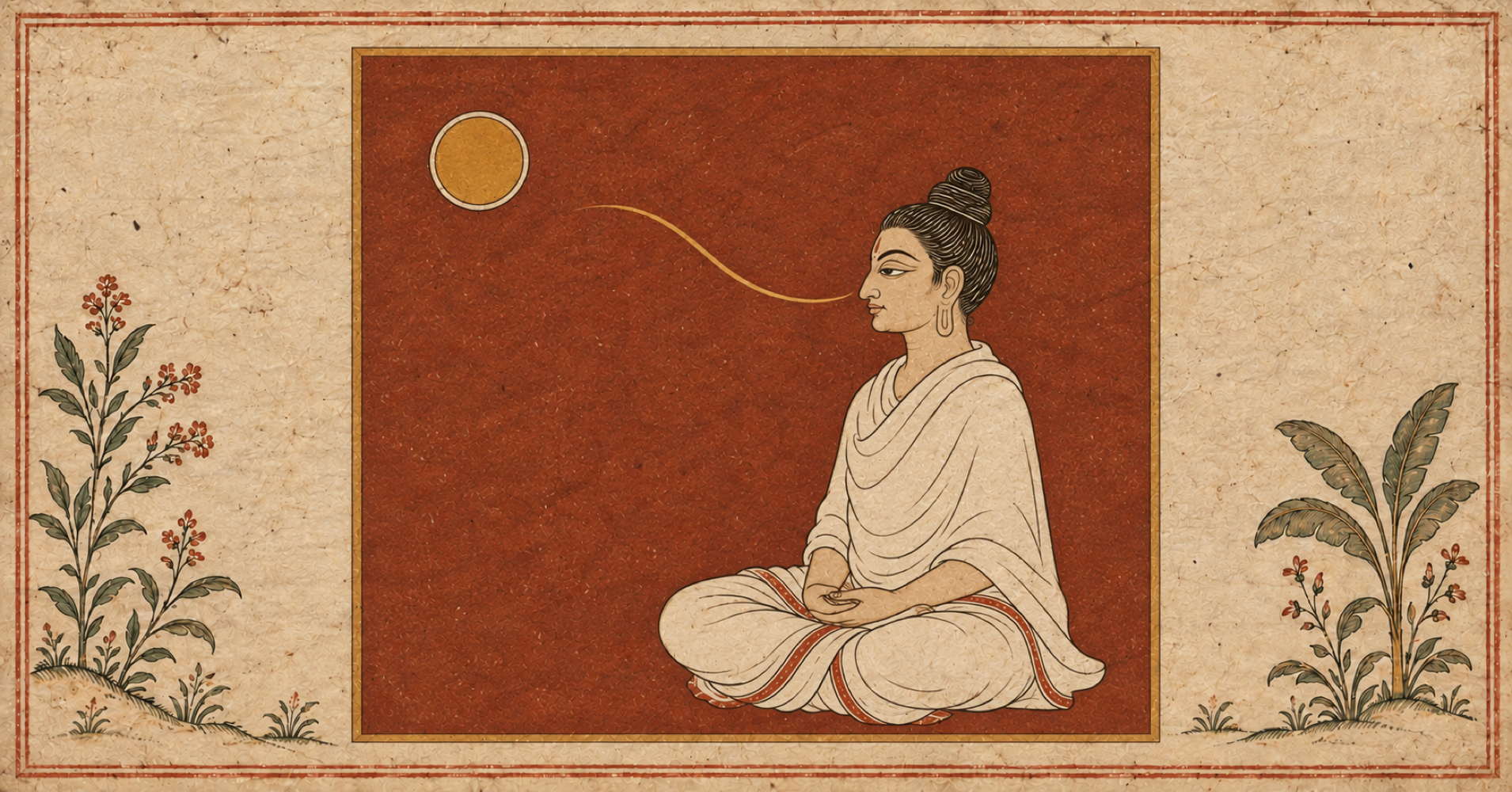

Haṭhatattvakaumudī 10.6
बद्ध्वा वज्रासनं प्रागनु पवनम् उपाकृष्य बाह्याभिवाहम् मन्दं मार्तण्डनाड्यां तदनु कचनखाग्रान्तम् आकुम्भयेच्च |
baddhvā vajrāsanaṃ prāg, anu pavanam upā,kṛṣya bāhyābhivāham; mandaṃ mārtaṇḍa-nāḍyāṃ, tad anu kaca-nakhā,grāntam ākumbhayec ca | Analysis ▾ Analysis ▴
|
baddhvā
|
having assumed | |
|
vajra
|
of the vajra | |
|
āsanam
|
seated posture | |
|
prāk
|
first | |
|
anu
|
afterwards | |
|
pavanam
|
the breath | |
|
upākṛṣya
|
having drawn in | |
|
bāhya
|
external | |
|
abhivāham
|
abhivāha
|
flowing towards |
|
mandam
|
mandam
|
slowly |
|
mārtaṇḍa
|
of the sun | |
|
nāḍyām
|
in the channel | |
|
tat
|
this | |
|
anu
|
after | |
|
kaca
|
hair | |
|
nakha
|
of the nail | |
|
agra
|
of the tip | |
|
antam
|
up to the end | |
|
ākumbhayet
|
one should retain | |
|
ca
|
and |
रुद्धं नाड्योदयातं पवनम् अनु शनैः रेचयेदेतदुक्तं वातघ्नं भालसंशोधनम् असकृदहो सूर्यभेदं विधेयम् ||6||
ruddhaṃ nāḍyodayātaṃ, pavanam anu śanaiḥ, recayed etad uktaṃ; vāta-ghnaṃ bhāla-saṃśo,dhanam asakṛd aho, sūrya-bhedaṃ vidheyam ||6|| Analysis ▾ Analysis ▴
|
ruddham
|
restrained | |
|
nāḍyā
|
through the energy channel | |
|
udayātam
|
risen | |
|
pavanam
|
the breath | |
|
anu
|
afterwards | |
|
śanaiḥ
|
slowly | |
|
recayet
|
one should release | |
|
etat
|
this | |
|
uktam
|
called | |
|
vāta
|
wind | |
|
ghnam
|
removing | |
|
bhāla
|
of the forehead | |
|
saṃśodhanam
|
purifying | |
|
asakṛt
|
repeatedly | |
|
aho
|
indeed | |
|
sūrya
|
of the sun | |
|
bhedam
|
piercing | |
|
vidheyam
|
to be performed |
Metre: Sragdharā
Having first (prāk) assumed (baddhvā | abs) Vajrāsana (vajrāsanam | acc sg), [one should] then (anu) draw in (upākṛṣya | abs) the breath (pavanam | acc sg) flowing in from outside (bāhyābhivāham | acc sg m), slowly (mandam), in the solar channel (mārtaṇḍa-nāḍyām | loc sg). And (ca) after (anu) that [inhalation] (tat | acc sg n), [one] should retain [it] (ākumbhayet | 3p sg act opt denom) as far as the ends of the hair and nail tips (kaca-nakhāgrāntam | acc sg).
Afterwards (anu), [one] should slowly (śanaiḥ) release (recayet | 3p sg act opt caus) the retained (ruddham | acc sg m ppp) breath (pavanam | acc sg), [which has] risen (udayātam) through the energy channel (nāḍyā | ins sg). This (etat | nom sg n) Sūryabheda (sūrya-bhedam | nom sg) is described (uktam | nom sg n ppp) [as a procedure] that removes wind (vāta-ghnam | nom sg n) [and] purifies the forehead (bhāla-saṃśodhanam | nom sg n). [It is] indeed (aho) to be performed (vidheyam | nom sg n pfp) repeatedly (asakṛt).
Afterwards (anu), [one] should slowly (śanaiḥ) release (recayet | 3p sg act opt caus) the retained (ruddham | acc sg m ppp) breath (pavanam | acc sg), [which has] risen (udayātam) through the energy channel (nāḍyā | ins sg). This (etat | nom sg n) Sūryabheda (sūrya-bhedam | nom sg) is described (uktam | nom sg n ppp) [as a procedure] that removes wind (vāta-ghnam | nom sg n) [and] purifies the forehead (bhāla-saṃśodhanam | nom sg n). [It is] indeed (aho) to be performed (vidheyam | nom sg n pfp) repeatedly (asakṛt).
I connect nāḍyā with udayātam and understand the phrase as “risen through the energy channel”.
I take sūryabhedam as a neuter name for the practice because of etad uktam and vidheyam.
Notice your breath in a quiet seated position, including your whole body in your awareness. The image of hair and fingertips encourages attention to reach the body's edges.
ruddhaṃ nāḍyodayātaṃ GDJ2007-b ] ruddhe nāḍye yātam GDJ2007
Haṭhatattvakaumudī 10.6*1
इति कफवातरोगकृमिदोषशैत्यविकारहर उष्णवीर्यः सूर्यभेदकुम्भकः |
iti kapha-vāta-roga-kṛmi-doṣa-śaitya-vikāra-hara uṣṇa-vīryaḥ sūrya-bheda-kumbhakaḥ | Analysis ▾ Analysis ▴
|
iti
|
thus | |
|
kapha
|
phlegm, Kapha | |
|
vāta
|
wind, Vāta | |
|
roga
|
disease | |
|
kṛmi
|
worm (according to Meulenbeld 1974, p. 622) | |
|
doṣa
|
disorder | |
|
śaitya
|
cold | |
|
vikāra
|
ailment | |
|
haraḥ
|
removing | |
|
uṣṇa
|
hot | |
|
vīryaḥ
|
having potency | |
|
sūrya
|
of the sun | |
|
bheda
|
piercing | |
|
kumbhakaḥ
|
breath retention |
Metre: none
Thus (iti) [is described] the Sūryabheda breath retention (sūrya-bheda-kumbhakaḥ | nom sg), which removes diseases of Kapha and Vāta, worm disorders and ailments of cold (kapha-vāta-roga-kṛmi-doṣa-śaitya-vikāra-haraḥ | nom sg m), [and] has heating potency (uṣṇa-vīryaḥ | nom sg m).
After practising, notice whether you feel warmth and how you experience it. Little or no change is also part of your observation.
uṣṇavīryaḥ GDJ2007 ] ruṣṇavīryaḥ GDJ2007-b
Continue with AYI Free
Illustrations: AI-generated.

Please log in to write a message. Go to login
No messages yet.