

vāra वार – time; round; repetition
adjective · substantive masculine · substantive neuter · Word type unspecified
Dictionary sources
AYI dictionary substantive masculine
time; round; repetition
Cappeller 1891 substantive masculine · Word type unspecified
Original text · English · substantive masculine
vā́ra1 ·m. tail-hair, esp. of a horse; m. n. sgl. & pl. a hair-sieve.
Original text · English · substantive masculine
vā́ra3 ·m. good, treasure; appointed time or place, one's turn, alternation, succession, change, time (w. numerals, vāraṃ vāram many a time, often); day (of a week). -- f. vārā courtezan.
Original text · English · Word type unspecified
vāra2 ·-> durvāra.
Monier-Williams 1872 substantive masculine · Word type unspecified
Original text · English · substantive masculine
1. vāra, as, m. (for 2. see p. 905, col. 1), anything which covers or surrounds, a cover; a multitude, quan- tity, heap; a flock, herd, troop; time; a day of the week [cf. ravi-v˚, soma-v˚, maṅgala-v˚, budha-v˚, guru-v˚, śukra-v˚, śani-v˚]; a moment, occasion, op- portunity; turn, time (used adverbially like the English ‘times,’ or like the French ‘fois,’ e. g. vāreṇa or bahu-vāram or vāraṃ vāram, many times, repeat- edly, often); N. of Śiva; anything which causes an obstruction, a gate, door, door-way; the plant Achy- ranthes Aspera (= kubja); the opposite bank of a river or of the sea, (for pāra); (am), n. a vessel for holding spirituous liquor; [cf. Gr. ἦρα: Hib. vair, ‘an hour, time;’ air uairibh, ‘sometimes;’ Cambro- Brit. aur; Old Island. var in tvis-var, ‘twice;’ thris-var, ‘thrice:’ Old Germ. or, o, in zuir-or, zuir-o, twice:’ Pers. بار bār, ‘time;’ بارى bāre, ‘once;’ ber in September, October, &c.]
Original text · English · substantive masculine
vāra 2 . vāra, as, m., Ved. for vāla = bāla, a tail; the tail (of sheep &c.) used to filter Soma juice, (also am, n.); (ās), m. pl. the hairs of a tail.
Original text · English · Word type unspecified
1. vāra; add — (ā), f. a harlot, prostitute.
Petersburger 1855 adjective · substantive masculine · substantive neuter · Word type unspecified
Original text · German · adjective
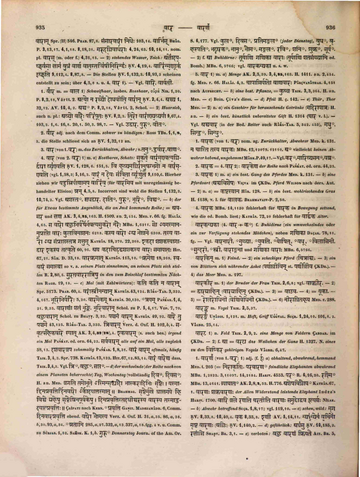
2. vā́ra adj. nach dem Comm. schwer zu bändigen: Ross TBR. 1,1,8,3. die Stelle schliesst sich an ṚV. 1,32,12 an.
Original text · German · substantive masculine
1. vā́ra m. = vāla 1〉 Schweifhaar, insbes. Rosshaar, οὐρά NIR. 1,20. P. 8,2,18, Vārtt. 2. atyo̱ na rathyò dodhavīti̱ vārā̀n ṚV. 2,4,4. aśvya ṚV. 1,32,12. AV. 10,4,2. aśva˚ P. 8,2,18, Vārtt. 2, Schol. — 2〉 Haarsieb, auch n. pl.: avyo̱ vārai̱ḥ parìpūtaḥ ṚV. 8,2,2. ti̱ro vārā̀ṇya̱vyayā̀ ṚV. 9,67,4. ṚV. 9,103,2. ṚV. 9,1,6. ṚV. 9,16,8. ṚV. 9,20,1. ṚV. 9,50,3. ṚV. 9,98,7. — Vgl. udvāra, puru˚, vīta˚.
Original text · German · substantive masculine
3. vāra (von 1. var) m. das Zurückhalten, Abwehr; s. tanu˚, durvāra, bāṇa˚.
Original text · German · substantive masculine
4. vāra (von 2. var) 1〉 m. a〉 Kostbares, Schatz: su̱kṛte̱ vāràmṛṇvatya̱gnirdvārā̱ vyṛ̀ṇvati ṚV. 1,128,6. ṚV. 1,151,5. vi ha̱vyama̱gnirā̀nu̱ṣagbhago̱ na vāràmṛṇvati (vgl. ṚV. 1,58,3) ṚV. 5,16,2. vā̱raṃ na de̱vaḥ sàvi̱tā vyū̀rṇute ṚV. 9,110,6. Hierher ziehen wir yadu̱sriyā̀ṇā̱mapa̱ vārìva̱ (für vāramiva mit unregelmässig behandelter Elision) vran ṚV. 4,5,8. Incorrect sind wohl die Stellen ṚV. 1,132,3. ṚV. 10,74,2. Vgl. aśasta˚, ṛdhadvāra, dāti˚, puru˚, bhūri˚, viśva˚. — b〉 der für Etwas bestimmte Augenblick, die an Jmd kommende Reihe; = avasara und kṣaṇa AK. 3,4,25,163. H. 1509. H. an. 2,454. MED. r. 66. fg. HALĀY. 4,65. sa vāro bahubhirvarṣairbhavatyasukaro naraiḥ MBH. 1,6211. so 'yamasmānanuprāpto vāraḥ kulavināśanaḥ MBH. 1,6218. kasya vāro 'dya bhojane MBH. 1,6308. tasya vāro 'dya saṃprāptastatra gantum KATHĀS. 18,270. KATHĀS. 22,208. ekadā śaśakasyāgādvāra ekasya tatkṛte KATHĀS. 60,96. atha kadācidvṛddhaśaśakasya vāraḥ samāyātaḥ HIT. 67,21. SĀH. D. 33,18. vārakramāt KATHĀS. 115,10. ˚krameṇa KATHĀS. 18,268. svavāraṃ samāsthā so v. a. seinen Platz einnehmen, an seinen Platz sich stellen R. 2,80,5. suratavārarātriṣu in den zum Beischlaf bestimmten Nächten RAGH. 19,18. — c〉 Mal (mit Zahlwörtern): kati kati na vārān Spr. 5173. PRAB. 60,4. varāṃstrīnanyān KATHĀS. 43,124. RĀJA-TAR. 3,332. RĀJA-TAR. 4,167. bhūribhirvāraiḥ RĀJA-TAR. 5,20. vāramekam KATHĀS. 30,130. ˚trayam PAÑCAR. 1,4,21. PAÑCAR. 1,9,35. vārāṇāṃ śataṃ bhuṅkte, bhūrivārān Schol. zu P. 5,4,17. VOP. 7,70. bahuvārān Schol. zu BHAṬṬ. 3,32. pañcamaṃ vāram KATHĀS. 49,92. vāre tu pañcame KATHĀS. 43,125. RĀJA-TAR. 3,333. trivāram Verz. d. Oxf. H. 102,b,4. sakṛtsahaikavāre syāt AK. 3,4,32 (28), 4. ekavāram (s. auch bes.) irgend ein Mal PAÑCAT. ed. orn. 64,22. sarvavāram alle auf ein Mal, alle zugleich PAÑCAT. ed. orn. 58,15. daśavārajapa zehnmalig PAÑCAR. 1,8,31. vāraṃ vāram oftmals, häufig TRIK. 3,4,3. Spr. 738. KATHĀS. 13,132. HIT. 67,12. HIT. 85,14. vāraṃ vāreṇa dass. TRIK. 3,4,3. Vgl. tri˚, bahu˚, sapta˚. — d〉 der wechselnde (der Reihe nach von einem Planeten beherrschte) Tag, Wochentag (vollständig diva˚, divasa˚) H. an. MED. jagati tamobhūte 'sminsṛṣṭyādau bhāskarādibhiḥ sṛṣṭaiḥ . yasmāddinapravṛttirdinavāro 'rkodayāttasmāt .. BRAHMAG. sṛṣṭermukhe dhvāntamaye hi viśve graheṣu sṛṣṭeṣvinapūrvakeṣu . dinapravṛttistṛdadhīśvarasya vārasya tasmādudayātpravṛttiḥ .. ŚRĪPATI nach KERN. ˚pravṛtti GAṆIT. MADHYAMĀDH. 6, Comm. dinavārapravṛtti ebend. vāro bhaumasya Verz. d. Oxf. H. 31,a,35. Verz. d. Oxf. H. 86,a,38. Verz. d. Oxf. H. 86,b,30. Verz. d. Oxf. H. 93,a,34. ˚vratāni Verz. d. Oxf. H. 285,a,27. Verz. d. Oxf. H. 332,a,13. Verz. d. Oxf. H. 337,a,18. fgg. Verz. d. Oxf. H. 337,a,4 v. u. Comm. zu SŪRYAS. 1,52. SAṂSK. K. 1,b. guru˚ Donnerstag Journ. of the Am. Or. S. 6,177. Vgl. kula˚, divasa˚, pratimaṅgala˚ (jeder Dienstag), budha˚, bṛhaspati˚, bhaṭṭāraka˚, bhānu˚, bhauma˚, maṅgala˚, ravi˚, śani˚, śukra˚, sūrya˚. — 2〉 f. ā Buhldirne: tūryāṇi gaṇikā vārāḥ (tūryāṇi śatasaṃkhyāni ed. Bomb.) MBH. 6,5766; vgl. vārakanyakā u. s. w.
Original text · German · substantive masculine · substantive neuter
5. vāra 1〉 m. a〉 Menge AK. 2,5,39. AK. 3,4,25,163. H. 1411. H. an. 2,454. fg. MED. r. 66. HALĀY. 4,2. cāpānniryāto bāṇavāraḥ PĀRŚVANĀTHAK. 4,151 nach AUFRECHT. — b〉 eine best. Pflanze, = kubja TRIK. 3,3,364. H. an. MED. — c〉 Bein. Śivaʼs diess. — d〉 Pfeil H. ś. 142. — e〉 Thür, Thor MED. — 2〉 n. a〉 ein Geschirr für berauschende Getränke (madirāpātra) H. an. — b〉 ein best. künstlich zubereitetes Gift H. 1314 (cāra v. l.). — Vgl. aśvavāra (in der Bed. Reiter auch RĀJA-TAR. 5,342. RĀJA-TAR. 5,453), madhu˚, sindu˚, sindhu˚.
Original text · German · Word type unspecified
5. vāra 1〉 vairi˚ HEM. YOGAŚ. 1,1.
Böhtlingk 1879 adjective · substantive masculine · substantive neuter
Original text · German · adjective
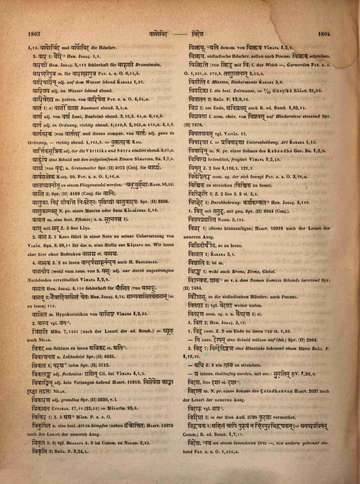
2. vā́ra — 1〉 Adj. nach dem Comm. schwer zu bändigen. — 2〉 am Ende eines Comp. das Zurückhalten, Abwehr.
Original text · German · substantive masculine · substantive neuter
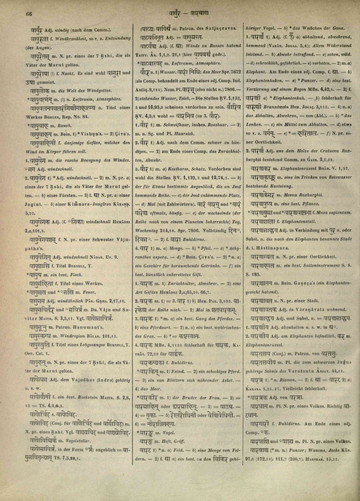
1. vā́ra — 1〉 m. Schweifhaar, insbes. Rosshaar. — 2〉 m. n. Sg. und Pl. Haarsieb.
Original text · German · substantive masculine
3. vā́ra — 1〉 m. — a〉 Kostbares, Schatz. Verdorben sind wohl die Stellen ṚV. 1,132,3 und ṚV. 10,74,2. — b〉 der für Etwas bestimmte Augenblick, die an Jmd kommende Reihe. — c〉 der Jmd zukommende Platz. — d〉 Mal (mit Zahlwörtern). vāraṃ vāram und vāraṃ vāreṇa oftmals, häufig. — e〉 der wechselnde (der Reihe nach von einem Planeten beherrschte) Tag, Wochentag Chr. 214,18. Spr. 7806. Vollständig dina˚, divasa˚. — 2〉 f. vārā Buhldirne.
Original text · German · substantive masculine · substantive neuter
4. vāra — 1〉 m. — a〉 Menge. — b〉 *Pfeil. — c〉 *Achyranthes aspera. — d〉 *Bein. Śivaʼs. — 2〉 *n. — a〉 ein Geschirr für berauschende Getränke. — b〉 ein best. künstlich zubereitetes Gift.
Apte 1890 substantive masculine · substantive neuter
Original text · English · substantive masculine · substantive neuter
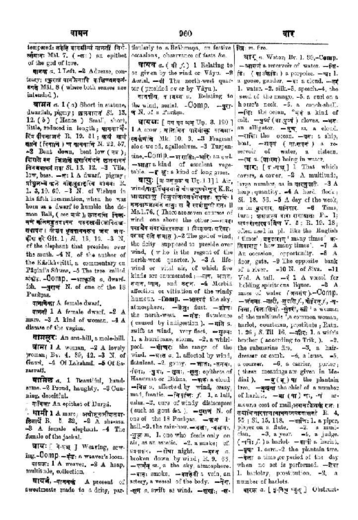
vāraḥ [vṛ-ghañ] 1 That which covers, a cover. 2 A multitude, large number; as in vārayuvati. 3 A heap; quantity. 4 A herd, flock; Śi. 18. 56. 5 A day of the week; as in budhavāra, śanivāra. 6 Time, turn; śaśakasya vāraḥ samāyātaḥ Pt. 1; apsarāvāraparyāyeṇa V. 5; R. 19. 18; often used in pl. like the English ‘times’; bahuvārān ‘many times’ kativārān ‘how many times’. 7 A An occasion, opportunity. 8 A door, gate. 9 The opposite bank of a river. 10 N. of Śiva. 11 Ved. A tail. — raṃ 1 A vessel for holding spirituous liquor. 2 A mass of water (jalasaṃgha). Comp. — aṃganā, -nārī, -yuvati f., yoprit f., — vanitā, vilāsinī, -suṃdarī, -strī ‘a woman of the multitude’, a common woman, harlot, courtezan, prostitute; Ratn. 1. 26; Ś. Til. 16. — kīraḥ 1 a wife's brother (according to Trik.). 2 the submarine fire. 3 a hairdresser or comb. 4 a louse. 5 a courser. 6 a carrier, porter; (these meanings are given in Medinī). — bu (bū) ṣā the plantain tree. — mukhyā the chief of a number of harlots. — bā (vā) ṇaḥ, -ṇaṃ armour, a coat of mail; agamatkaitakaṃ rajaḥ . tadyāghevāravāṇānāmayatnapaṭavāsatāṃ R. 4. 55; Śi. 15. 118. — vāṇiḥ 1 a piper, player on a flute. 2 a musician. 3 a year. 4 a judge. ( — ṇiḥ f.) a harlot. — vāṇī a harlot. — vṛṣā 1 corn. 2 the plantain tree. — velā a time or period of the day when no act is performed. — sevā 1 harlotry, prostitution. 2 a number of harlots.
Cappeller 1887 substantive masculine
Original text · German · substantive masculine
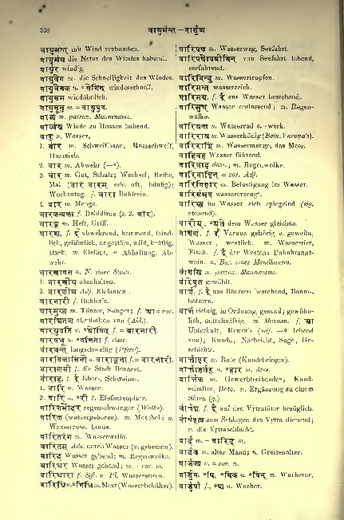
1. vā́ra m. Schweifhaar, Rossschweif, Haarsieb.
Original text · German · substantive masculine
2. vāra m. Abwehr (—˚).
Original text · German · substantive masculine
3. vā́ra m. Gut, Schatz; Wechsel, Reihe, Mal (vāraṃ vāram adv. oft, häufig); Wochentag. f. vārā Buhlerin.
Original text · German · substantive masculine
4. vāra m. Menge.
Burnouf 1866 substantive masculine
Original text · French · substantive masculine
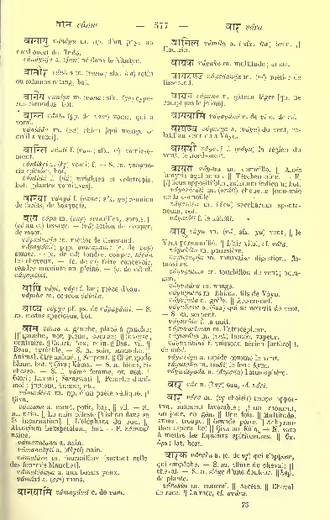
vāra vāra m. (vṛ choisir) temps opportun, moment favorable; un moment, un jour, en gén. Une fois. Multitude, amas, troupe. Grande porte. Achyranthes aspera, bot Śiva ou Kāla. — N. vase à mettre les liqueurs spiritueuses. Gr. ὥρα; lat. hora.
Occurrences in source texts (11)
DYS 5 occurrences
HP 1 occurrence
HTK 1 occurrence
HTK 10.30–33*1: Nāḍī-viśudhy-ākhyaka-kumbha and Nāḍīśuddhi 1 occurrence
Direct occurrences
-
HTK 10.33*1 Segment 5
SiSa 4 occurrences
Continue with AYI Free
Image source: AYI archive.