
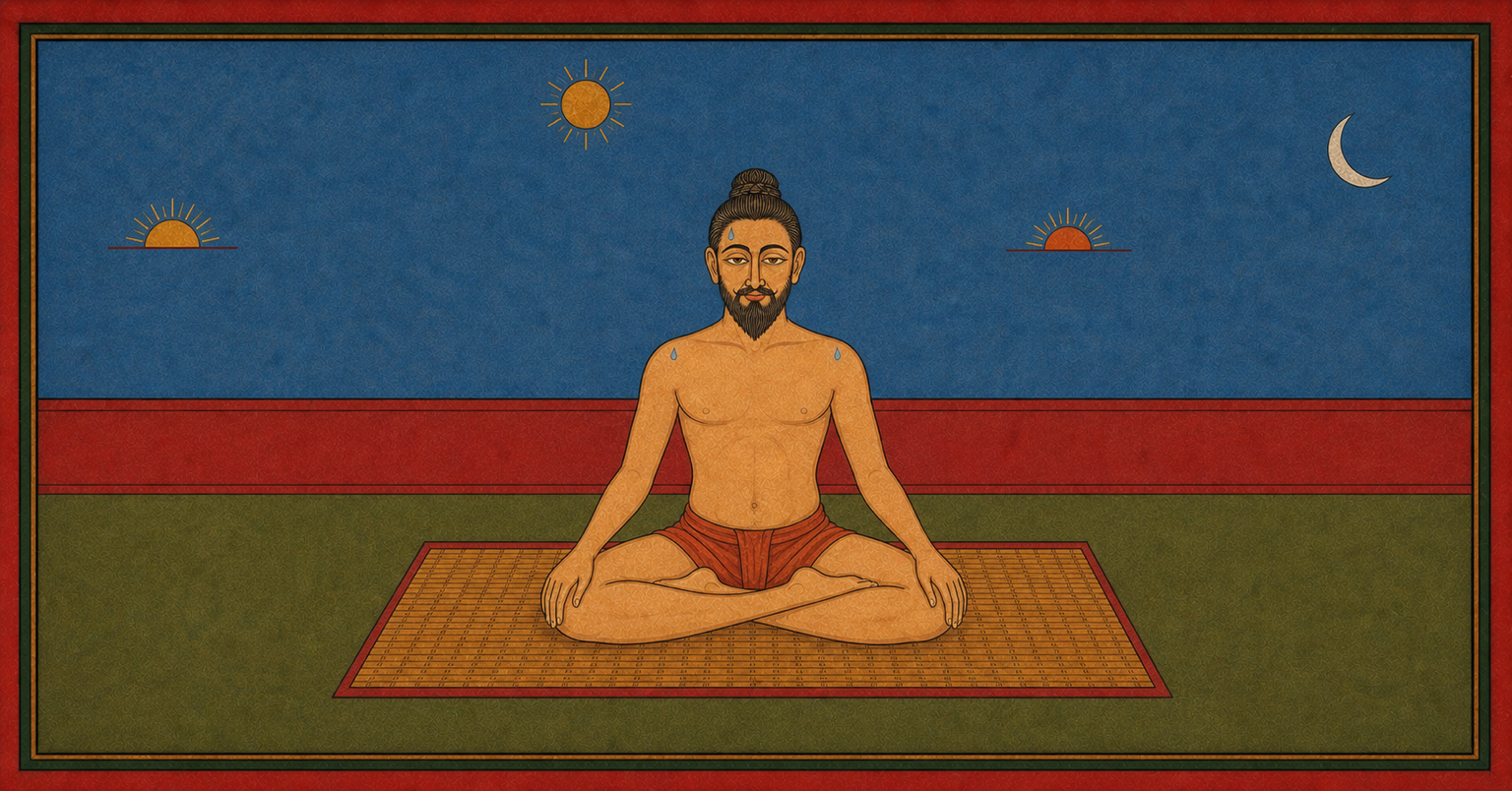
Illustration for the Haṭha Pradīpikā section “HP 2.11-2.14: Measure of Practice”.

Haṭha Pradīpikā 2.11-2.14: Measure of Practice and Initial Signs

Four daily practice times, stages of effect, the massaging of perspiration, and initial dietary rules structure the early practice.

Dr. Ronald Steiner Dr. Ronald Steiner
Haṭha Pradīpikā 2.11
प्रातर्मध्यंदिने सायम् अर्धरात्रे च कुम्भकान् |
prātar madhyaṃdine sāyam; ardha-rātre ca kumbhakān | Analysis ▾ Analysis ▴
prātar
adverb
in the morning, at sunrise
madhyaṃdine
lokative singular
substantive neuter
at midday
sāyam
adverb
in the evening, at sunset
ardha
tatpuruṣa-compound genitive
substantive neuter
half
rātre
lokative singular
substantive neuter
in the night
ca
particle
and
kumbhakān
accusative plural
substantive masculine
kumbhakas, breath retentions
शनैरशीतिपर्यन्तं चतुर्वारं समभ्यसेत् ||11||
śanair aśīti-paryantaṃ; catur-vāraṃ samabhyaset ||11|| Analysis ▾ Analysis ▴
śanaiḥ
adverb
slowly, gradually
aśīti
dvigu-compound
numeral
eighty
paryantam
accusative singular
substantive neuter
limit, up to
catur
dvigu-compound
numeral
four
vāram
accusative singular
substantive masculine
times, practice rounds
samabhyaset
3rd person singular aktive optative
previx
verbal root
he should practise thoroughly
Metre: Anuṣṭubh
In the morning (prātaḥ), at midday (madhyaṃdine | loc sg), in the evening (sāyam), and (ca) at midnight (ardha-rātre | loc sg), he should gradually (śanaiḥ) practise thoroughly (samabhyaset | 3p sg act opt) the retentions (kumbhakān | acc pl), up to eighty (aśīti-paryantam | acc sg), across four practice sessions (catur-vāram | acc sg).
Dr. Ronald Steiner - 2026 - historically literal
The Kumbhakas should be practised carefully at four times of day: morning, noon, evening, and midnight. The daily total is gradually increased to eighty.
Dr. Ronald Steiner - 2026 - modern transfer

Brahmānanda defines the four practice times more precisely as dawn, noon, dusk, and midnight. At each session, the number is gradually to rise to 80, making a total of 320 breathing cycles. According to his tradition, one who cannot practise at midnight uses the three transitional times and completes 240.

Brahmānanda's Jyotsnā - 19th c.
Kumbhakas should be performed gradually 4 times during day and night, i.e., (morning, noon, evening and midnight), till the number of Kumbhakas for one time is 80 and for day and night together it is 320.
Pancham Sinh - 1915
He should perform Kumbhakas four times a day—in the early morning, midday, evening and midnight-till he increases the number to Eighty.
Srinivasa Iyangar - 1893
Morgens, Mittags, Abends und um Mitternacht soll man langsam viermal achtzig Kumbhaka ausführen.
Hermann Walter - 1893
Haṭha Pradīpikā 2.12
कनीयसि भवेत्स्वेदः कम्पो भवति मध्यमे |
kanīyasi bhavet svedaḥ; kampo bhavati madhyame | Analysis ▾ Analysis ▴
kanīyasi
lokative singular neuter comperative
adjective
at the lower stage
bhavet
3rd person singular aktive optative
verbal root
it should occur, happens
svedaḥ
nominative singular
substantive masculine
sweat
kampaḥ
nominative singular
substantive masculine
trembling
bhavati
3rd person singular aktive present
verbal root
arises, occurs
madhyame
lokative singular neuter
adjective
at the middle stage
उत्तिष्ठत्युत्तमे प्राणरोधे पद्मासने मुहुः ||12||
uttiṣṭhaty uttame prāṇa;-rodhe padmāsane muhuḥ ||12|| Analysis ▾ Analysis ▴
uttiṣṭhati
3rd person singular aktive present
previx
verbal root
he rises, moves upward
uttame
lokative singular neuter superlative
adjective
at the highest stage
prāṇa
tatpuruṣa-compound lokative
substantive masculine
of the breath
rodhe
lokative singular
substantive neuter
in stopping, retaining
padma
tatpuruṣa-compound lokative
substantive neuter
in lotus
āsane
lokative singular
substantive neuter
in the posture
muhuḥ
adverb
repeatedly
Metre: Anuṣṭubh
At the lesser stage (kanīyasi | loc sg n), sweat (svedaḥ | nom sg) arises (bhavet | 3p sg act opt); at the middle stage (madhyame | loc sg n), trembling (kampaḥ | nom sg) occurs (bhavati | 3p sg act pres); and at the highest (uttame | loc sg n), during retention of the breath (prāṇa-rodhe | loc sg), he repeatedly (muhuḥ) rises up (uttiṣṭhati | 3p sg act pres) in the lotus pose (padmāsane | loc sg).
Dr. Ronald Steiner - 2026 - historically literal
At first, sweating often occurs; later, trembling may arise. During very intense retentions, the body in the lotus posture may sometimes repeatedly rise as if by itself.
Dr. Ronald Steiner - 2026 - modern transfer

Brahmānanda cites different measures for short, intermediate, and highest retention, indirectly warning against the appearance of a single unambiguous duration. What matters is his sequence of stages. As the duration and stability of Prāṇa held in the region of the crown increase, the same process is successively called Pratyāhāra, Dhāraṇā, Dhyāna, and Samādhi. The higher limbs of yoga thus appear as deepening forms of Prāṇāyāma.

Brahmānanda's Jyotsnā - 19th c.
uttiṣṭhaty uttame prāṇarodhe padmāsane muhuḥ MBHDL2026 ] uttame sthānam āpnoti tato vāyuṃ nibandhayet NS1882
Critical Apparatus
In the beginning there is perspiration, in the middle stage there is quivering, and in the last or the 3rd stage one obtains steadiness; and then the breath should be made steady or motionless.
Pancham Sinh - 1915
In the first stage, the body perspires; in the second, a tremor is felt throughout the body, and in the highest stage, the Prana goes to the Brahmarandhra; so one should perform Pranayama.
Srinivasa Iyangar - 1893
(Es gibt drei Grade des Prânâyâma:) Im geringeren wird Schweiss erzeugt, im mittleren entsteht Zittern, im höchsten erreicht der Athem das Brahmarandhra (nach Com. sthana = brahmarandhra); dann lasse man den Athem wieder heraus.
Hermann Walter - 1893
Haṭha Pradīpikā 2.13
जलेन श्रमजातेन गात्रमर्दनमाचरेत् |
jalena śrama-jātena; gātra-mardanam ācaret | Analysis ▾ Analysis ▴
jalena
instrumental case singular
substantive neuter
with water, here fluid or sweat
śrama
tatpuruṣa-compound ablative
substantive neuter
from exertion
jātena
instrumental case singular neuter past participle passive
verbal root
arisen, produced
gātra
tatpuruṣa-compound genitive
substantive neuter
of the limbs, body
mardanam
accusative singular
substantive neuter
rubbing, massaging
ācaret
3rd person singular aktive optative
previx
verbal root
should perform
दृढता लघुता चापि तेन गात्रस्य जायते ||13||
dṛḍhatā laghutā cāpi; tena gātrasya jāyate ||13|| Analysis ▾ Analysis ▴
dṛḍhatā
nominative singular
substantive feminine
firmness
laghutā
nominative singular
substantive feminine
lightness, mobility
ca
particle
and
api
particle
also
tena
instrumental case singular
pronoun dem
thereby
gātrasya
genitive singular
substantive neuter
of the body, limbs
jāyate
3rd person singular medial present
verbal root
arises, becomes
Metre: Anuṣṭubh
One should perform (ācaret | 3p sg act opt) a rubbing of the body (gātra-mardanam | acc sg) with (jalena | ins sg) the fluid produced by exertion (śrama-jātena | ins sg); through this (tena | ins sg) arise (jāyate | 3p sg med pres) firmness (dṛḍhatā | nom sg) and also (cāpi) lightness (laghutā | nom sg) of the body (gātrasya | gen sg).
Dr. Ronald Steiner - 2026 - historically literal
After practice, gently rub the perspiration into the skin and massage the body with it. This is said to foster both stability and lightness.
Dr. Ronald Steiner - 2026 - modern transfer

The perspiration produced by exertion is not to be wiped away. Brahmānanda has it rubbed into the body as in an oil massage; this is said to produce firmness and lightness. The commentary thus treats perspiration as part of the historical practice.

Brahmānanda's Jyotsnā - 19th c.
cāpi MBHDL2026 ] caiva NS1882
Critical Apparatus
The perspiration exuding from exertion of practice should be rubbed into the body (and not wiped), as by so doing the body becomes strong.
Pancham Sinh - 1915
Rub well on the body the perspiration given out. This gives firmness and lightness to the whole constitution.
Srinivasa Iyangar - 1893
Mit dem Schweiss, den die Anstrengung hervorbringt, reibe man den Körper ein. Dadurch entsteht Festigkeit und Leichtigkeit des Körpers.
Hermann Walter - 1893
Haṭha Pradīpikā 2.14
अभ्यासकाले प्रथमे शस्तं क्षीराज्यभोजनम् |
abhyāsa-kāle prathame; śastaṃ kṣīrājya-bhojanam | Analysis ▾ Analysis ▴
abhyāsa
tatpuruṣa-compound lokative
substantive masculine
of practice
kāle
lokative singular
substantive masculine
at the time
prathame
lokative singular neuter
adjective
at the first stage, initially
śastam
nominative singular neuter
adjective
wholesome, recommended
kṣīra
dvandva-compound
substantive neuter
milk
ājya
dvandva-compound
substantive neuter
ghee, clarified butter
bhojanam
nominative singular
substantive neuter
food
ततो ऽभ्यासे दृढीभूते न तादृङ्नियमग्रहः ||14||
tato 'bhyāse dṛḍhī-bhūte; na tādṛṅ-niyama-grahaḥ ||14|| Analysis ▾ Analysis ▴
tataḥ
adverb
then, afterward
abhyāse
lokative absolutus singular
substantive masculine
in practice
dṛḍhī
karmadhāraya-compound
adjective
firm, established
bhūte
lokative absolutus singular masculine past participle passive
verbal root
having become, entered
na
particle
not
tādṛś
karmadhāraya-compound
adjective
such, of this kind
niyama
tatpuruṣa-compound genitive
substantive neuter
rule, prescription
grahaḥ
nominative singular
substantive masculine
taking up, observing
Metre: Anuṣṭubh
During the period of practice (abhyāsa-kāle | loc sg), at the first stage (prathame | loc sg n), a diet of milk and ghee (kṣīra-ājya-bhojanam | nom sg) is recommended (śastam | nom sg n); afterwards (tataḥ), when the practice has become firmly established (abhyāse dṛḍhī-bhūte | loc sg), there is no clinging to such rules (na tādṛṅ-niyama-grahaḥ | nom sg).
Dr. Ronald Steiner - 2026 - historically literal
At the beginning, simple and nourishing food, such as milk and ghee, is helpful. Once your practice is stable, you no longer need to cling so strictly to such instructions.
Dr. Ronald Steiner - 2026 - modern transfer

According to Brahmānanda, the initial diet of milk and ghee remains binding until the practice is established in Kevala Kumbhaka. “Established practice” denotes the already attained spontaneous suspension of breath.

Brahmānanda's Jyotsnā - 19th c.
During the first stage of practice the food consisting of milk and ghee is wholesome. When the practice becomes established, no such restriction is necessary.
Pancham Sinh - 1915
In the early stages of practice he should take food mixed with milk and ghee. But when he has advanced he need not observe such restrictions.
Srinivasa Iyangar - 1893
Für die erste Uebungszeit werden Milch und zerlassene Butter für geeignete Nahrung gehalten. Ist man aber in der Uebung sicher geworden, so braucht man diese Beschränkung nicht mehr.
Hermann Walter - 1893

Continue with AYI Free

Illustrations: AI-generated.

Editor

Dr. Ronald Steiner

From Ulm

The "Yoga Doc" - Dr. Ronald Steiner is the founder of the AYI method. This method links traditional Ashtanga Yoga with innovative Yogatherapy and living Philosophy. This forms a practice that is personal for each and... more ›

Messages and ratings
0 messages

Please log in to write a message. Go to login

No messages yet.