
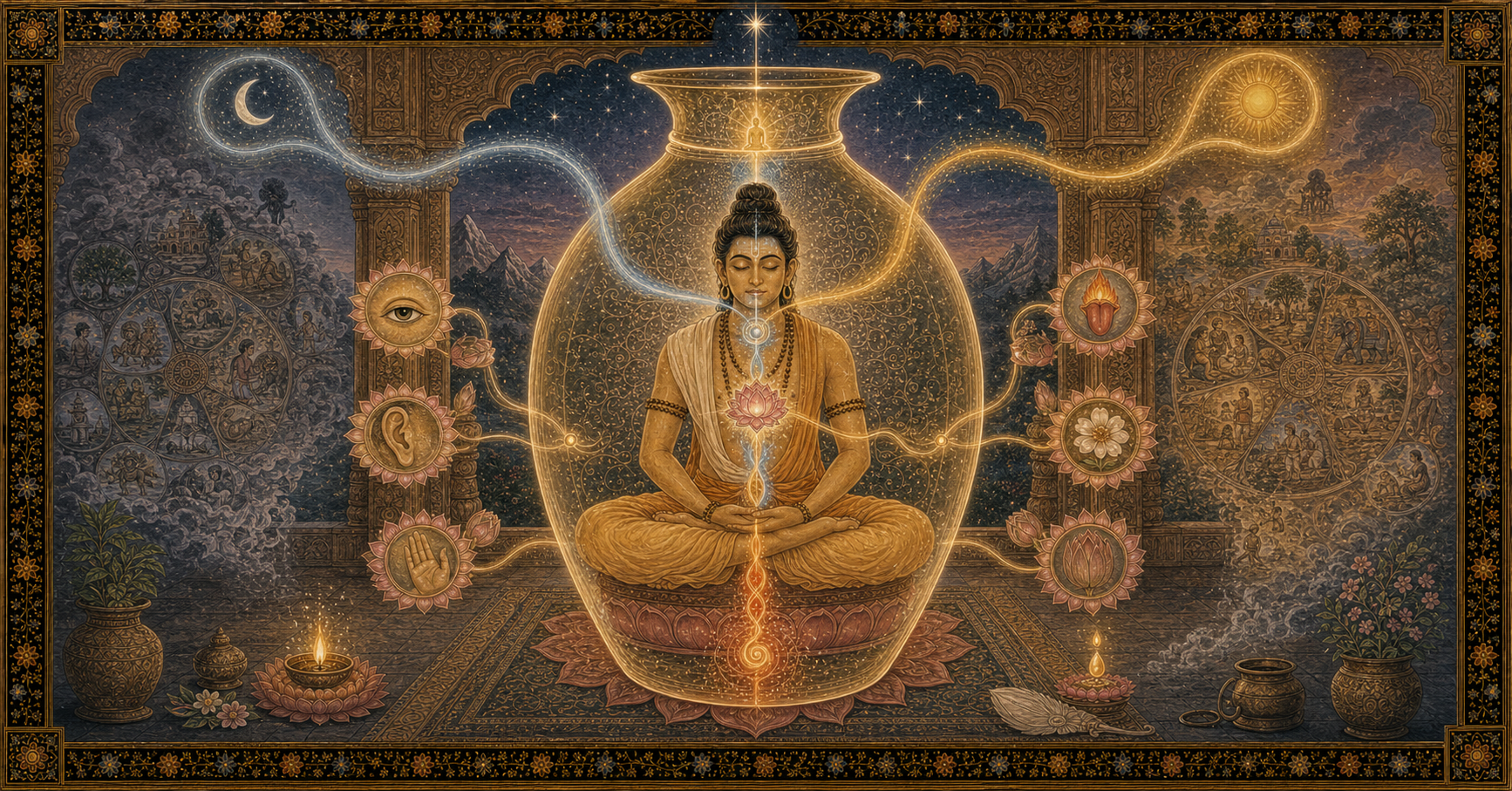
SiSa 3.55-3.60: Ghaṭāvasthā

Śiva Saṃhitā 3.55-3.60: Ghaṭāvasthā, Pratyāhāra und Übergang zu Paricaya

Ghaṭa verbindet die vitalen und subtilen Prinzipien; längeres Halten führt zu Pratyāhāra und bereitet die Paricaya-Stufe vor.

Dr. Ronald Steiner Dr. Ronald Steiner
Śiva Saṃhitā 3.55
यदा भवेद्घटावस्था पवनाभ्यासने परा |
yadā bhaved ghaṭāvasthā; pavanābhyāsane parā | Analysis ▾ Analysis ▴
yadā
adverb
wenn
bhavet
3rd person singular aktive optative
verbal root
entsteht, wird
ghaṭa
tatpuruṣa-compound genitive
substantive masculine
des Ghaṭa
avasthā
nominative singular
substantive feminine
Zustand, Stufe
pavana
tatpuruṣa-compound genitive
substantive masculine
des Atems
abhyāsane
lokative singular
abhyāsana
substantive neuter
in der Übung
parā
nominative singular feminine
adjective
höchste, große
तदा संसारचक्रे ऽस्मिन्नास्ति यन्न साधयेत् ||3.55||
tadā saṃsāra-cakre 'smin; nāsti yan na sādhayet ||3.55|| Analysis ▾ Analysis ▴
tadā
adverb
dann
saṃsāra
tatpuruṣa-compound genitive
substantive masculine
des Saṃsāra
cakre
lokative singular
substantive neuter
im Rad
asmin
lokative singular neuter
pronoun dem
in diesem
na
particle
nicht
asti
3rd person singular aktive present
verbal root
es gibt
yat
nominative singular neuter
pronoun rel
was
na
particle
nicht
sādhayet
3rd person singular aktive optative causative
verbal root
vollbringen, verwirklichen könnte
Wenn (yadā) die höchste Ghaṭa-Stufe (ghaṭāvasthā parā | nom sg) in der Atemübung (pavana-abhyāsane | loc sg) entsteht (bhavet | 3p sg act opt), dann (tadā) gibt es (asti | 3p sg act pres) in diesem Saṃsāra-Rad (saṃsāra-cakre 'smin | loc sg) nicht (na), was (yat | nom sg n) er nicht (na) vollbringen könnte (sādhayet | 3p sg act opt caus).
Dr. Ronald Steiner - 2026 - historically literal
Wenn die große Ghaṭa-Stufe in der Atemübung erreicht ist, gibt es im Kreislauf des Saṃsāra nichts mehr, was der Yogi nicht verwirklichen könnte.
Dr. Ronald Steiner - 2026 - modern transfer
Śiva Saṃhitā 3.56
प्राणापाननादबिन्दु जीवात्मपरमात्मनः |
prāṇāpāna-nāda-bindu; jīvātma-paramātmanaḥ | Analysis ▾ Analysis ▴
prāṇa
dvandva-compound
substantive masculine
Prāṇa
apāna
dvandva-compound
substantive masculine
Apāna
nāda
dvandva-compound
substantive masculine
Nāda
bindu
nominative singular
substantive masculine
Bindu, Punkt
jīva
tatpuruṣa-compound genitive
substantive masculine
des Lebendigen, individuellen Lebens
ātman
dvandva-compound
substantive masculine
Selbst
parama
karmadhāraya-compound
adjective
höchst
ātmanaḥ
genitive singular
substantive masculine
Selbst
मिलित्वा घटते यस्मात् तस्माद्वै घट उच्यते ||3.56||
militvā ghaṭate yasmāt; tasmād vai ghaṭa ucyate ||3.56|| Analysis ▾ Analysis ▴
militvā
absolutus
verbal root
zusammengekommen
ghaṭate
3rd person singular medial present
verbal root
verbindet sich, fügt sich zusammen
yasmāt
yasmāt
adverb
weil, da
tasmāt
adverb
deshalb
vai
particle
wahrlich
ghaṭaḥ
nominative singular
substantive masculine
Ghaṭa, Topf, Verbindung
ucyate
3rd person singular passive present
verbal root
wird genannt
Weil (yasmāt) Prāṇa-Apāna-Nāda-Bindu (prāṇa-apāna-nāda-bindu | nom sg) und Jīvātman-Paramātman (jīvātma-paramātmanaḥ | gen sg) zusammengekommen (militvā | abs) sich verbinden (ghaṭate | 3p sg med pres), deshalb (tasmāt) wird es wahrlich (vai) Ghaṭa (ghaṭaḥ | nom sg) genannt (ucyate | 3p sg pas pres).
Dr. Ronald Steiner - 2026 - historically literal
Diese Stufe heißt Ghaṭa, weil sich Prāṇa und Apāna, Nāda und Bindu sowie individuelles Selbst und höchstes Selbst in ihr verbinden.
Dr. Ronald Steiner - 2026 - modern transfer
Śiva Saṃhitā 3.57
याममात्रं यदा धर्तुं समर्थः स्यात्तदाऽद्भुतः |
yāma-mātraṃ yadā dhartuṃ; samarthaḥ syāt tadā'dbhutaḥ | Analysis ▾ Analysis ▴
yāma
tatpuruṣa-compound genitive
substantive masculine
eines Yāma
mātram
accusative singular
substantive neuter
Maß, Dauer
yadā
adverb
wenn
dhartum
infinitive
verbal root
zu halten
samarthaḥ
nominative singular masculine
adjective
fähig
syāt
3rd person singular aktive optative
verbal root
wäre, ist
tadā
adverb
dann
adbhutaḥ
nominative singular masculine
adjective
wunderbar, erstaunlich
प्रत्याहारस्तदैव स्यान्नान्तरा भवति ध्रुवम् ||3.57||
pratyāhāras tadaiva syān; nāntarā bhavati dhruvam ||3.57|| Analysis ▾ Analysis ▴
pratyāhāraḥ
nominative singular
substantive masculine
Pratyāhāra, Zurückziehen der Sinne
tadā
adverb
dann
eva
particle
eben
syāt
3rd person singular aktive optative
verbal root
entsteht, ist
na
particle
nicht
antarā
adverb
anders, dazwischen, sonst
bhavati
3rd person singular aktive present
verbal root
entsteht, wird
dhruvam
adverb
gewiss
Wenn (yadā) [er] fähig (samarthaḥ | nom sg m) ist (syāt | 3p sg act opt), ein Yāma-Maß (yāma-mātram | acc sg) zu halten (dhartum | inf), dann (tadā) entsteht (syāt | 3p sg act opt) eben dann (tadaiva) wunderbarer Pratyāhāra (adbhutaḥ pratyāhāraḥ | nom sg); anders (antarā) geschieht (bhavati | 3p sg act pres) es gewiss (dhruvam) nicht (na).
Dr. Ronald Steiner - 2026 - historically literal
Erst wenn der Yogi den Atem ein volles Yāma lang halten kann, entsteht der erstaunliche Pratyāhāra; auf anderem Weg geschieht das sicher nicht.
Dr. Ronald Steiner - 2026 - modern transfer
Śiva Saṃhitā 3.58
यं यं जानाति योगीन्द्रस्तं तमात्मेति भावयेत् |
yaṃ yaṃ jānāti yogīndras; taṃ tam ātmeti bhāvayet | Analysis ▾ Analysis ▴
yam
accusative singular masculine
pronoun rel
welchen, was
yam
accusative singular masculine
pronoun rel
welchen auch immer, was auch immer
jānāti
3rd person singular aktive present
verbal root
erkennt, weiß
yogīndraḥ
nominative singular
substantive masculine
der Herr der Yogis
tam
accusative singular masculine
pronoun dem
diesen
tam
accusative singular masculine
pronoun dem
eben diesen
ātmā
nominative singular
substantive masculine
Selbst
iti
particle
so, als
bhāvayet
3rd person singular aktive optative causative
verbal root
soll betrachten, vergegenwärtigen
यैरिन्द्रियैर्यद्विधानस् तदिन्द्रियजयो भवेत् ||3.58||
yair indriyair yad-vidhānas; tad-indriya-jayo bhavet ||3.58|| Analysis ▾ Analysis ▴
yaiḥ
instrumental case plural neuter
pronoun rel
durch welche
indriyaiḥ
instrumental case plural
substantive neuter
Sinnesorgane
yad
karmadhāraya-compound
pronoun rel
welche
vidhānaḥ
nominative singular masculine
adjective
beschaffen, ausgerichtet
tad
karmadhāraya-compound
pronoun dem
dieser
indriya
tatpuruṣa-compound genitive
substantive neuter
des Sinnesorgans
jayaḥ
nominative singular
substantive masculine
Sieg, Beherrschung
bhavet
3rd person singular aktive optative
verbal root
entsteht, wird
Was (yaṃ | acc sg m) auch immer (yaṃ | acc sg m) der Herr der Yogis (yogīndraḥ | nom sg) erkennt (jānāti | 3p sg act pres), dieses (taṃ | acc sg m), eben dieses (tam | acc sg m), soll er als Selbst (ātmā | nom sg), so (iti), betrachten (bhāvayet | 3p sg act opt caus); durch welche Sinnesorgane (yair indriyaiḥ | ins pl) [er] jeweils ausgerichtet ist (yad-vidhānaḥ | nom sg m), davon entsteht (bhavet | 3p sg act opt) die Beherrschung dieses Sinnesorgans (tad-indriya-jayaḥ | nom sg).
Dr. Ronald Steiner - 2026 - historically literal
Was immer der Yogi wahrnimmt, soll er als Selbst erkennen. Indem er die Wahrnehmung eines Sinnesorgans so durchdringt, gewinnt er die Meisterschaft über dieses Sinnesorgan.
Dr. Ronald Steiner - 2026 - modern transfer
Śiva Saṃhitā 3.59
याममात्रं यदा पूर्णं भवेदभ्यासयोगतः |
yāma-mātraṃ yadā pūrṇaṃ; bhaved abhyāsa-yogataḥ | Analysis ▾ Analysis ▴
yāma
tatpuruṣa-compound genitive
substantive masculine
eines Yāma
mātram
accusative singular
substantive neuter
Maß, Dauer
yadā
adverb
wenn
pūrṇam
accusative singular neuter
adjective
voll, vollständig
bhavet
3rd person singular aktive optative
verbal root
entsteht, wird
abhyāsa
tatpuruṣa-compound genitive
substantive masculine
der Praxis
yogataḥ
ablative singular
substantive masculine
durch Anwendung
एकवारम् प्रकुर्वीत तदा योगी च कुम्भकम् ||
eka-vāram prakurvīta; tadā yogī ca kumbhakam || Analysis ▾ Analysis ▴
eka
dvigu-compound
numeral
ein
vāram
accusative singular
substantive masculine
Mal
prakurvīta
3rd person singular medial optative
previx
verbal root
soll ausführen, praktizieren
tadā
adverb
dann
yogī
nominative singular
substantive masculine
der Yogi
ca
particle
und
kumbhakam
accusative singular
substantive masculine
Kumbhaka, Atemhalten
दण्डाष्टकं यदा वायुर्निश्चलो योगिनो भवेत् |
daṇḍāṣṭakaṃ yadā vāyur; niścalo yogino bhavet | Analysis ▾ Analysis ▴
daṇḍa
dvigu-compound
substantive masculine
Daṇḍa
aṣṭakam
accusative singular
substantive neuter
Achtergruppe, acht
yadā
adverb
wenn
vāyuḥ
nominative singular
substantive masculine
Atem, Wind
niścalaḥ
nominative singular masculine
adjective
unbeweglich
yoginaḥ
genitive singular
substantive masculine
des Yogis
bhavet
3rd person singular aktive optative
verbal root
wird, ist
स्वसामर्थ्यात्तदाऽन्गुष्ठे तिष्ठेद्वातुलवत्सुधीः ||3.59||
sva-sāmarthyāt tadā'nguṣṭhe; tiṣṭhed vātulavat sudhīḥ ||3.59|| Analysis ▾ Analysis ▴
sva
karmadhāraya-compound
sva
pronoun poss
eigen
sāmarthyāt
ablative singular
substantive neuter
durch Kraft, Fähigkeit
tadā
adverb
dann
aṅguṣṭhe
lokative singular
substantive masculine
auf dem Daumen
tiṣṭhet
3rd person singular aktive optative
verbal root
soll stehen
vātulavat
vātulavat
adverb
wie aus Luft, windartig
sudhīḥ
nominative singular
substantive masculine
der Weise
Wenn (yadā) durch Anwendung der Praxis (abhyāsa-yogataḥ | abl sg) eine volle Yāma-Dauer (yāma-mātraṃ pūrṇam | acc sg) entsteht (bhavet | 3p sg act opt), dann (tadā) soll der Yogi (yogī | nom sg) auch (ca) Kumbhaka (kumbhakam | acc sg) einmal (eka-vāram | acc sg) praktizieren (prakurvīta | 3p sg med opt). Wenn (yadā) der Atem (vāyuḥ | nom sg) des Yogis (yoginaḥ | gen sg) für acht Daṇḍas (daṇḍa-aṣṭakam | acc sg) unbeweglich (niścalaḥ | nom sg m) wird (bhavet | 3p sg act opt), dann (tadā) soll der Weise (sudhīḥ | nom sg) aus eigener Kraft (sva-sāmarthyāt | abl sg) auf dem Daumen (aṅguṣṭhe | loc sg) wie aus Luft (vātulavat) stehen (tiṣṭhet | 3p sg act opt).
Dr. Ronald Steiner - 2026 - historically literal
Wenn der Yogi durch Übung ein volles Yāma halten kann, soll er Kumbhaka einmal täglich praktizieren. Wird sein Atem acht Daṇḍas lang völlig ruhig, kann er aus eigener Kraft leicht wie Luft auf dem Daumen stehen.
Dr. Ronald Steiner - 2026 - modern transfer
Śiva Saṃhitā 3.60
ततः परिचयावस्था योगिनो ऽभ्यासतो भवेत् |
tataḥ paricayāvasthā; yogino 'bhyāsato bhavet | Analysis ▾ Analysis ▴
tataḥ
adverb
danach, dann
paricaya
tatpuruṣa-compound genitive
substantive masculine
des Paricaya, der Vertrautheit
avasthā
nominative singular
substantive feminine
Zustand, Stufe
yoginaḥ
genitive singular
substantive masculine
des Yogis
abhyāsataḥ
ablative singular
substantive masculine
durch Praxis
bhavet
3rd person singular aktive optative
verbal root
entsteht, wird
यदा वायुश्चन्द्रसूर्यम् त्यक्त्वा तिष्ठति निश्चलम् ||
yadā vāyuś candra-sūryam; tyaktvā tiṣṭhati niścalam || Analysis ▾ Analysis ▴
yadā
adverb
wenn
vāyuḥ
nominative singular
substantive masculine
Atem, Wind
candra
dvandva-compound
substantive masculine
Mond
sūryam
accusative singular
substantive masculine
Sonne
tyaktvā
absolutus
verbal root
verlassen habend
tiṣṭhati
3rd person singular aktive present
verbal root
steht, verweilt
niścalam
niścalam
adverb
unbeweglich, still
वायुः परिचितो वायुः सुषुम्णाव्योम्नि संचरेत् ||3.60||
vāyuḥ paricito vāyuḥ; suṣumṇā-vyomni saṃcaret ||3.60|| Analysis ▾ Analysis ▴
vāyuḥ
nominative singular
substantive masculine
Atem, Wind
paricitaḥ
nominative singular masculine past participle passive
previx
verbal root
gesammelt, angehäuft
vāyuḥ
nominative singular
substantive masculine
Atem, Wind
suṣumṇā
tatpuruṣa-compound lokative
substantive feminine
in der Suṣumnā
vyomni
lokative singular
substantive neuter
im Raum
saṃcaret
3rd person singular aktive optative
previx
verbal root
soll wandern, sich bewegen
Danach (tataḥ) entsteht (bhavet | 3p sg act opt) für den Yogi (yoginaḥ | gen sg) durch Praxis (abhyāsataḥ | abl sg) die Paricaya-Stufe (paricaya-avasthā | nom sg), wenn (yadā) der Atem (vāyuḥ | nom sg), Mond und Sonne (candra-sūryam | acc sg) verlassen habend (tyaktvā), unbeweglich (niścalam) steht (tiṣṭhati | 3p sg act pres); der gesammelte Atem (vāyuḥ paricitaḥ | nom sg) soll sich als Atem (vāyuḥ | nom sg) im Raum der Suṣumnā (suṣumnā-vyomni | loc sg) bewegen (saṃcaret | 3p sg act opt).
Dr. Ronald Steiner - 2026 - historically literal
Danach entsteht durch Praxis die Paricaya-Stufe: Der Atem verlässt die Bahnen von Mond und Sonne, steht still und bewegt sich als gesammelte Kraft im inneren Raum der Suṣumnā.
Dr. Ronald Steiner - 2026 - modern transfer

Continue with AYI Free

Illustrationen: KI-generiert.

Editor

Dr. Ronald Steiner

From Ulm

The "Yoga Doc" - Dr. Ronald Steiner is the founder of the AYI method. This method links traditional Ashtanga Yoga with innovative Yogatherapy and living Philosophy. This forms a practice that is personal for each and... more ›

Messages and ratings
0 messages

Please log in to write a message. Go to login

No messages yet.