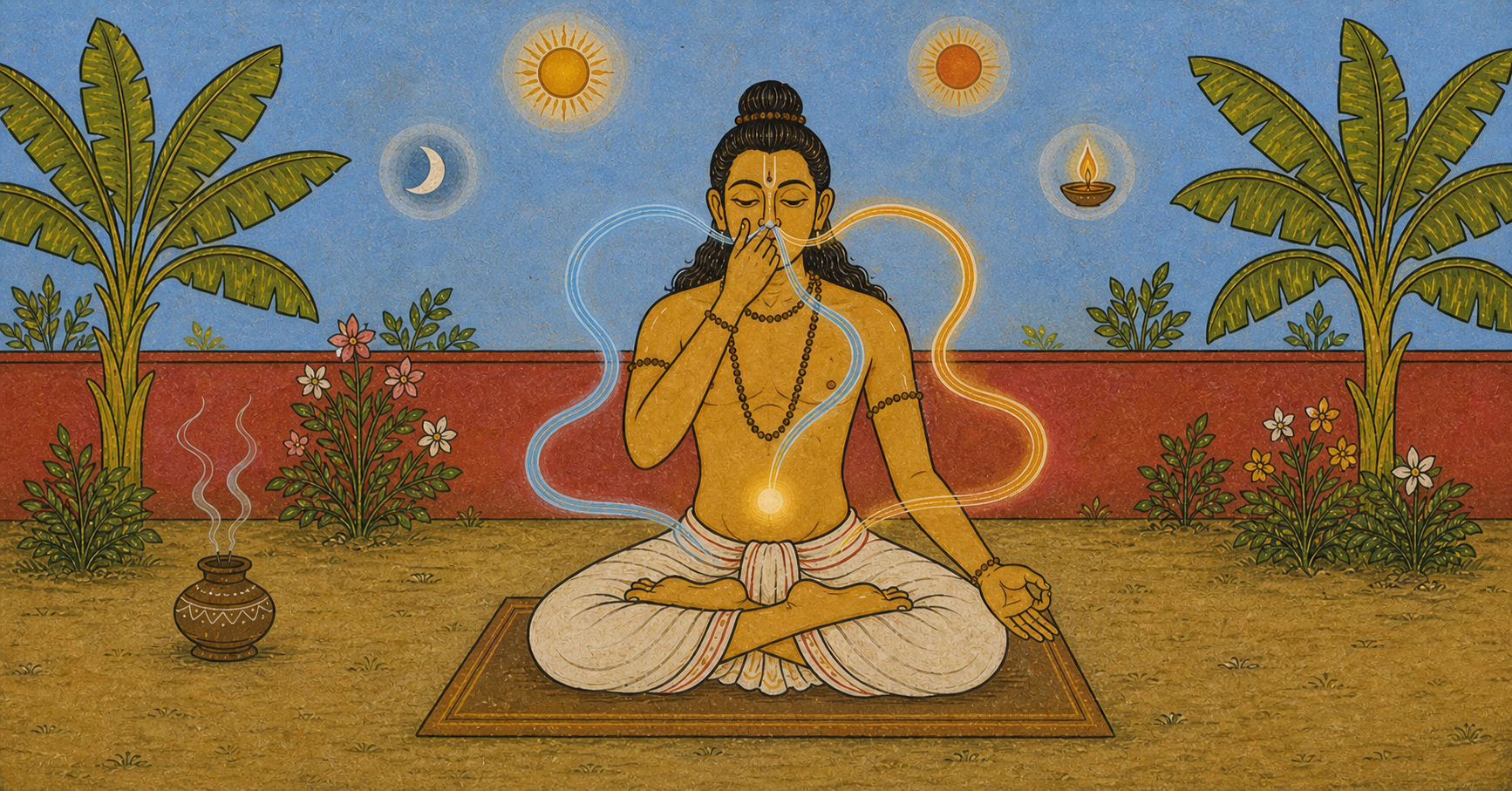
DYS 60–66: Prāṇāyāma

Dattātreyayogaśāstra 60–66: Alternate-Nostril Breathing at Four Daily Practice Times

The breath is alternately guided and held through both nostrils; twenty rounds at dawn, midday, sunset, and midnight gradually purify the channels.

Dr. Ronald Steiner Dr. Ronald Steiner Nils Jacob Liersch Nils Jacob Liersch
Dattātreyayogaśāstra 60
ततो दक्षिणहस्तस्य अङ्गुष्ठेन च पिङ्गलाम् |
tato dakṣiṇa-hastasya; aṅguṣṭhena ca piṅgalām | Analysis ▾ Analysis ▴
tataḥ
adverb
then
dakṣiṇa
karmadhāraya-compound
adjective
right
hastasya
genitive singular
substantive masculine
of the hand
aṅguṣṭhena
instrumental case singular
substantive masculine
with the thumb
ca
particle
and
piṅgalām
accusative singular
substantive feminine
the Piṅgalā channel
निरुध्य पूरयेद्वायुमिडया च शनैः सुधीः ||60||
nirudhya pūrayed vāyum; iḍayā ca śanaiḥ sudhīḥ ||60|| Analysis ▾ Analysis ▴
nirudhya
absolutus
previx
verbal root
having blocked
pūrayet
3rd person singular aktive optative causative
verbal root
he should fill, inhale
vāyum
accusative singular
substantive masculine
air, breath
iḍayā
instrumental case singular
substantive feminine
through the Iḍā channel
ca
particle
and
śanaiḥ
adverb
gently, slowly
sudhīḥ
nominative singular
substantive masculine
the wise man
Metre: Anuṣṭubh
Then (tataḥ) the wise man (sudhīḥ | nom sg) should block (nirudhya | abs) the Piṅgalā channel (piṅgalām | acc sg) with the thumb (aṅguṣṭhena | ins sg) of his right hand (dakṣiṇahastasya | gen sg), and (ca) should gently (śanaiḥ) inhale (pūrayet | 3p sg act opt caus) air (vāyum | acc sg) through Iḍā (iḍayā | ins sg).
Dr. Ronald Steiner - 2026 - historically literal
He closes the right channel with his right thumb and slowly inhales through the left channel.
Dr. Ronald Steiner - 2026 - modern transfer
aṅguṣṭhena ca JM2024 ] aṅguṣṭhenaiva DYŚ

sudhīḥ JM2024 ] śanaiḥ DYŚ
Critical Apparatus
Dattātreyayogaśāstra 61
यथाशक्त्यविरोधेन ततः कुर्याच्च कुम्भकम् |
yathā-śakty avirodhena; tataḥ kuryāc ca kumbhakam | Analysis ▾ Analysis ▴
yathā
avyayībhāva-compund
adverb
according to
śakti
substantive feminine
capacity, ability
avirodhena
instrumental case singular
substantive masculine
without discomfort, without resistance
tataḥ
adverb
then
kuryāt
3rd person singular aktive optative
verbal root
should perform
ca
particle
and
kumbhakam
accusative singular
substantive masculine
breath retention
पुनस्त्यजेत्पिङ्गलया शनैरेव न वेगतः ||61||
punas tyajet piṅgalayā; śanair eva na vegataḥ ||61|| Analysis ▾ Analysis ▴
punar
adverb
again, next
tyajet
3rd person singular aktive optative
verbal root
he should release, exhale
piṅgalayā
instrumental case singular
substantive feminine
through the Piṅgalā channel
śanaiḥ
adverb
gently, slowly
eva
particle
precisely
na
particle
not
vegataḥ
substantive masculine
suffix
forcefully, in a rush
Metre: Anuṣṭubh
Then (tataḥ) he should perform (kuryāt | 3p sg act opt) breath retention (kumbhakam | acc sg) according to his capacity (yathāśakti) and without discomfort (avirodhena | ins sg). Next (punar), he should exhale (tyajet | 3p sg act opt) through Piṅgalā (piṅgalayā | ins sg), gently (śanaiḥ), indeed (eva) not (na) forcefully (vegataḥ).
Dr. Ronald Steiner - 2026 - historically literal
He holds his breath only as long as remains comfortable, then exhales gently through the right channel without force.
Dr. Ronald Steiner - 2026 - modern transfer
avirodhena tataḥ kuryāc ca JM2024 ] anirodhena tataḥ kuryāt tu DYŚ
Critical Apparatus
Dattātreyayogaśāstra 62
पुनः पिङ्गलयापूर्य पूरयेदुदरं शनैः |
punaḥ piṅgalayāpūrya; pūrayed udaraṃ śanaiḥ | Analysis ▾ Analysis ▴
punaḥ
adverb
again
piṅgalayā
instrumental case singular
substantive feminine
through the Piṅgalā channel
āpūrya
absolutus
previx
verbal root
having inhaled, filled
pūrayet
3rd person singular aktive optative causative
verbal root
he should fill, inhale
udaram
accusative singular
substantive neuter
abdomen
śanaiḥ
adverb
gently, slowly
धारयित्वा यथाशक्ति रेचयेदिडया शनैः ||62||
dhārayitvā yathā-śakti; recayed iḍayā śanaiḥ ||62|| Analysis ▾ Analysis ▴
dhārayitvā
absolutus
verbal root
having held
yathā
avyayībhāva-compund
adverb
according to
śakti
substantive feminine
ability, capacity
recayet
3rd person singular aktive optative causative
verbal root
he should exhale
iḍayā
instrumental case singular
substantive feminine
through the Iḍā channel
śanaiḥ
adverb
gently, slowly
Metre: Anuṣṭubh
Again (punaḥ), having inhaled (āpūrya | abs) through Piṅgalā (piṅgalayā | ins sg), he should gently (śanaiḥ) fill (pūrayet | 3p sg act opt caus) his abdomen (udaram | acc sg). Having held [his breath] (dhārayitvā | abs) for as long as he can (yathāśakti), he should gently (śanaiḥ) exhale (recayet | 3p sg act opt) through Iḍā (iḍayā | ins sg).
Dr. Ronald Steiner - 2026 - historically literal
Next he inhales through the right channel, holds the breath appropriately, and exhales slowly through the left channel.
Dr. Ronald Steiner - 2026 - modern transfer
dhārayitvā yathāśakti recayed iḍayā śanaiḥ JM2024 ] om. DYŚ
Critical Apparatus
Dattātreyayogaśāstra 63
यया त्यजेत्तयापूर्य धारयेदविरोधतः |
yayā tyajet tayāpūrya; dhārayed avirodhataḥ | Analysis ▾ Analysis ▴
yayā
instrumental case singular feminine
pronoun
through which
tyajet
3rd person singular aktive optative
verbal root
he should release, exhale
tayā
instrumental case singular feminine
pronoun
through that same one
āpūrya
absolutus
previx
verbal root
having inhaled, filled
dhārayet
3rd person singular aktive optative causative
verbal root
he should hold
avirodhataḥ
adverb
without discomfort
एवं प्रातः समासीनः कुर्याद्विंशति कुम्भकान् |
evaṃ prātaḥ samāsīnaḥ; kuryād viṃśati kumbhakān | Analysis ▾ Analysis ▴
evam
adverb
thus
prātaḥ
adverb
in the morning
samāsīnaḥ
nominative singular masculine past participle passive
previx
verbal root
sitting
kuryāt
3rd person singular aktive optative
verbal root
should perform
viṃśati
accusative plural
numeral
twenty
kumbhakān
accusative plural
substantive masculine
breath retentions
कुम्भकः सहितो नाम सर्वग्रहविवर्जितः ||63||
kumbhakaḥ sahito nāma; sarva-graha-vivarjitaḥ ||63|| Analysis ▾ Analysis ▴
kumbhakaḥ
nominative singular
substantive masculine
breath retention
sahitaḥ
nominative singular masculine
adjective
Sahita (“accompanied”)
nāma
adverb
by name
sarva
karmadhāraya-compound
pronoun quant
all
graha
tatpuruṣa-compound ablative
substantive masculine
grasping, malign influence
vivarjitaḥ
nominative singular masculine past participle passive
previx
verbal root
completely free from
Metre: Anuṣṭubh
Through whichever [channel] (yayā | ins sg f) he exhales (tyajet | 3p sg act opt), through that same one (tayā | ins sg f) he should inhale (āpūrya | abs) and hold [his breath] (dhārayet | 3p sg act opt caus) without discomfort (avirodhataḥ). In this way (evam), seated (samāsīnaḥ | nom sg m) in the morning (prātaḥ), he should perform (kuryāt | 3p sg act opt) twenty (viṃśati | acc pl) breath retentions (kumbhakān | acc pl). The breath retention (kumbhakaḥ | nom sg) is called (nāma) “accompanied” (sahitaḥ | nom sg m) and is said to be entirely free from grasping or malign influence (sarvagrahavivarjitaḥ | nom sg m ppp).
Dr. Ronald Steiner - 2026 - historically literal
He inhales again through the same channel he used to exhale and holds without strain. In the morning he practises twenty such retentions; an additional line calls this accompanied kumbhaka free from every grasping or malign influence.
Dr. Ronald Steiner - 2026 - modern transfer
yayā tyajet tayāpūrya dhārayed avirodhataḥ JM2024 ] yathā tyajet tathā tena pūrayed anirodhataḥ DYŚ
Critical Apparatus
Dattātreyayogaśāstra 64
एवं मध्याह्नसमये कुर्याद्विंशति कुम्भकान् |
evaṃ madhyāhna-samaye; kuryād viṃśati kumbhakān | Analysis ▾ Analysis ▴
evam
adverb
thus
madhyāhna
tatpuruṣa-compound genitive
substantive masculine
midday
samaye
lokative singular
substantive masculine
at the time
kuryāt
3rd person singular aktive optative
verbal root
should perform
viṃśati
accusative plural
numeral
twenty
kumbhakān
accusative plural
substantive masculine
breath retentions
एवं सायं प्रकुर्वीत पुनर्विंशति कुम्भकान् ||64||
evaṃ sāyaṃ prakurvīta; punar viṃśati kumbhakān ||64|| Analysis ▾ Analysis ▴
evam
adverb
thus
sāyam
adverb
in the evening
prakurvīta
3rd person singular medial optative
previx
verbal root
he should perform
punaḥ
adverb
again
viṃśati
accusative plural
numeral
twenty
kumbhakān
accusative plural
substantive masculine
breath retentions
Metre: Anuṣṭubh
In this way (evam), at midday (madhyāhnasamaye | loc sg), he should perform (kuryāt | 3p sg act opt) twenty (viṃśati) breath retentions (kumbhakān | acc pl). Likewise (evam), in the evening (sāyam) he should again (punar) perform (prakurvīta | 3p sg med opt) twenty (viṃśati) breath retentions (kumbhakān | acc pl).
Dr. Ronald Steiner - 2026 - historically literal
At midday and again in the evening, he practises twenty breath retentions each time.
Dr. Ronald Steiner - 2026 - modern transfer
Dattātreyayogaśāstra 65
एवमेवार्धरात्रे कुर्याद्विंशति कुम्भकान् |
evam evārdha-rātre; kuryād viṃśati kumbhakān | Analysis ▾ Analysis ▴
evam
adverb
thus
eva
particle
precisely
ardha
karmadhāraya-compound
adjective
half, middle
rātre
lokative singular
substantive feminine
at night
kuryāt
3rd person singular aktive optative
verbal root
should perform
viṃśati
accusative plural
numeral
twenty
kumbhakān
accusative plural
substantive masculine
breath retentions
कुर्वीत रेचपूराभ्यां सहितान्प्रतिवासरम् ||65||
kurvīta reca-pūrābhyāṃ; sahitān prativāsaram ||65|| Analysis ▾ Analysis ▴
kurvīta
3rd person singular medial optative
verbal root
he should perform
reca
dvandva-compound
substantive masculine
exhalation
pūrābhyām
instrumental case dual
substantive masculine
with inhalation
sahitān
accusative plural masculine
adjective
accompanied, combined
prativāsaram
adverb
every day
Metre: Anuṣṭubh; pāda 1: 7 rather than 8 syllables
In precisely the same way (evam eva), at midnight (ardharātre | loc sg), he should perform (kuryāt | 3p sg act opt) twenty (viṃśati) breath retentions (kumbhakān | acc pl). Every day (prativāsaram), he should practise (kurvīta | 3p sg med opt) [retentions] accompanied (sahitān | acc pl m) by exhalation and inhalation (recapūrābhyām | ins du).
Dr. Ronald Steiner - 2026 - historically literal
At midnight too, he practises twenty retentions. Every day these accompanied kumbhakas include both exhalation and inhalation.
Dr. Ronald Steiner - 2026 - modern transfer
evārdharātre JM2024 ] evārdharātre ’pi DYŚ
Critical Apparatus
Dattātreyayogaśāstra 66
सहितो रेचपूराभ्यां तस्मात्सहितकुम्भकः |
sahito reca-pūrābhyāṃ; tasmāt sahita-kumbhakaḥ | Analysis ▾ Analysis ▴
sahitaḥ
nominative singular masculine
adjective
endowed
reca
dvandva-compound
substantive masculine
exhalation
pūrābhyām
instrumental case dual
substantive masculine
with inhalation
tasmāt
ablative singular neuter
pronoun
therefore, for that reason
sahita
karmadhāraya-compound
adjective
accompanied, combined
kumbhakaḥ
nominative singular
substantive masculine
breath retention
कुर्यादेवं चतुर्वारमनालस्यो दिने दिने ||66||
kuryād evaṃ catur-vāram; anālasyo dine dine ||66|| Analysis ▾ Analysis ▴
kuryāt
3rd person singular aktive optative
verbal root
should perform
evam
adverb
thus
catur
dvigu-compound
numeral
four
vāram
accusative singular
substantive masculine
times, rounds
anālasyaḥ
nominative singular masculine
adjective
energetic, untiring
dine
lokative singular
substantive masculine
day
dine
lokative singular
substantive masculine
day
Metre: Anuṣṭubh
Because it is accompanied (sahitaḥ | nom sg m) by exhalation and inhalation (recapūrābhyām | ins du), it is therefore (tasmāt | abl sg n) [called] accompanied breath retention (sahitakumbhakaḥ | nom sg). Energetically (anālasyaḥ | nom sg m), he should practise (kuryāt | 3p sg act opt) it in this way (evam) four times (caturvāram | acc sg) every day (dine dine | loc sg).
Dr. Ronald Steiner - 2026 - historically literal
Because the practice is accompanied by exhalation and inhalation, it is called sahita-kumbhaka. It is practised energetically four times each day.
Dr. Ronald Steiner - 2026 - modern transfer

Continue with AYI Free

Illustrations: AI-generated.

Editor

Dr. Ronald Steiner

From Ulm

The "Yoga Doc" - Dr. Ronald Steiner is the founder of the AYI method. This method links traditional Ashtanga Yoga with innovative Yogatherapy and living Philosophy. This forms a practice that is personal for each and... more ›

Nils Jacob Liersch

Meine Begeisterung für Yoga, indische Philosophie und Sanskrit führte mich zum Studium der Indologie und Religionswissenschaft an der Universität Heidelberg. Seit 2004 befinde ich mich auf meinem persönlichen Yogaweg... more ›

Messages and ratings
3 messages Ø

Please log in to write a message. Go to login

Mal abgesehen von dem Kuhdung sieht mein Yogaraum genau so aus!