

vajra वज्र – thunderbolt; diamond
adjective · substantive masculine · substantive neuter · Word type unspecified
Dictionary sources
AYI dictionary substantive masculine · substantive neuter
substantive masculine
thunderbolt; diamond
substantive neuter
thunderbolt; vajra; penis
Cappeller 1891 substantive masculine · substantive neuter
Original text · English · substantive masculine · substantive neuter
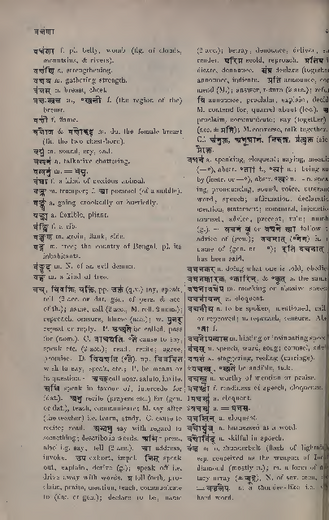
vájra ·m. n. thunderbolt (flash of lightning), esp. conceived as the weapon of Indra; diamond (mostly n.); m. a form of military array (±vyūha), N. of sev. men, also = vajralepa. n. a thunder-like i.e. very hard word.
Monier-Williams 1872 adjective
Original text · English · adjective
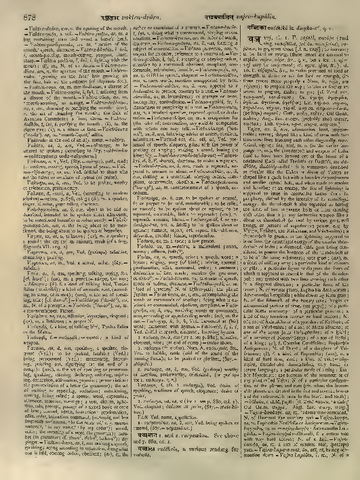
Vajra, as, ā, am, adamantine, hard, impene- trable; severe; shaped like a kind of cross with two transverse lines bisecting each other diagonally, cross, forked, zigzag; (as, am), m. n. (in the earlier lan- guage as, m.), the thunderbolt and weapon of Indra (said to have been formed out of the bones of a celebrated Ṛṣi called Dadhīca or Dadhīci, see da- dhīca, dadhīcy-asthi; it is sometimes described as circular like the Cakra or discus of Viṣṇu or shaped like a quoit but with a broader circumference and smaller central hole, and when made to revolve and launched at an enemy, the fire of lightning is supposed to issue in destructive flames from its periphery, elicited by the intensity of its centrifugal energy; the thunderbolt is also regarded as having the form of two transverse bolts or lines crossing each other thus X); any destructive weapon like a discus or thunderbolt (as used by various gods, evil beings, or persons of superhuman power, e. g. by Viṣṇu, Kṛṣṇa, the Rākṣasas, and Viśvā-mitra); a thunderbolt in general or the lightning supposed to issue from the centrifugal energy of the circular thun- derbolt of Indra; a diamond, (this gem being con- sidered to possess the hardness of the thunderbolt or to be of the same substance); sour gruel; (as), m. a form of military array; a particular kind of column or pillar; a particular figure or diagram the form of which is supposed to resemble that of the thunder- bolt; any symbol with two lines crossing each other in a diagonal direction; a particular form of the moon; N. of various plants, Euphorbia Antiquorum; Asteracantha Longifolia; white-flowering Kuśa grass; N. of the fifteenth of the twenty-seven Yogas or astronomical periods of time, (see yoga); of a parti- cular Soma ceremony; of a particular penance; a kind of very tenacious mortar or hard cement; N. of a son of Aniruddha or of a grandson of Kṛṣṇa; of a son of Viśvā-mitra; of a son of Manu Sāvarṇa; of one of the seven Jaina Daśa-pūrvins; of a Ṛṣi; of a minister of Narendrāditya; of a son of Bhūti; of a king; (ā), f. Cocculus Cordifolius; Euphorbia Antiquorum; N. of Durgā; of a daughter of Vai- śvānara; (ī), f. a kind of Euphorbia; (am), n. a kind of hard iron, steel; a kind of talc; = vāg- vajra, thunder-like denunciation, very harsh or severe language; a particular mode of sitting; Em- blic Myrobalan; the blossom of the sesamum or of any plant called Vajra; N. of a particular configura- tion of the planets and stars (viz. when the favour- able planets are situated in the first and seventh houses and the unfavourable ones in the fourth and tenth); = bālaka, a child, pupil; [cf. Zend vaz-ra, ‘a club;’ Old Germ. weggi; Angl. Sax. wœcg, wecg.]
Petersburger 1855 substantive masculine · substantive neuter
Original text · German · substantive masculine · substantive neuter
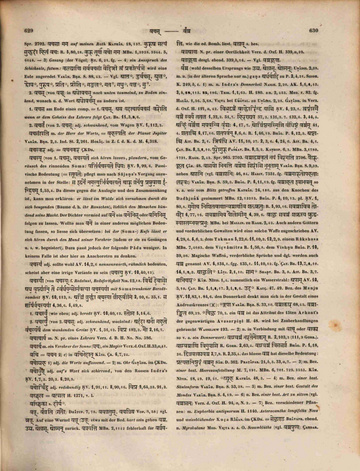
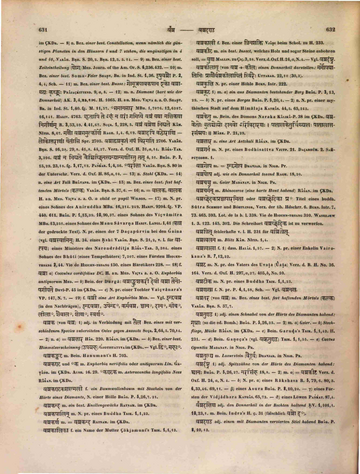
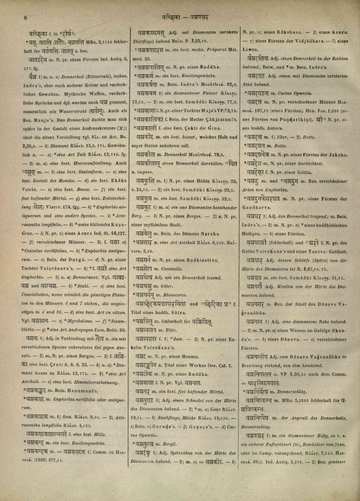
vájra (wohl desselben Ursprungs wie ugra, ojas, ojman) UṆĀDIS. 2,28. m.n. (in der älteren Sprache nur m.) gaṇa ardharcādi zu P. 2,4,31. SIDDH. K. 249,b,4. 1〉 m.n. Indraʼs Donnerkeil NAIGH. 2,20. AK. 1,1,1,42. AK. 3,4,18,115. AK. 3,4,15,186. TRIK. 1,1,62. H. 180. H. an. 2,453. MED. r. 82. fg. HALĀY. 1,56. HALĀY. 5,68. VIŚVA_bei_UJJVAL._zu_UṆĀDIS. 2,28. JAṬĀDH._in_Verz. d. Oxf. H. 191,a,42. bibhra̱dvajràṃ bā̱hvorìndra yāsi ṚV. 6,23,1. tvaṣṭā̀smai̱ vajràṃ sva̱ryàṃ tatakṣa ṚV. 1,32,2. ṚV. 1,51,7. hiraṇyaya ṚV. 57,2. ṚV. 131,3. ṚV. 1,7. ṚV. 132,6. ṚV. 3,44,4. ahi̱ṃ vajrèṇa maghava̱nvi vṛ̀ścaḥ ṚV. 4,17,7. ojìṣṭhamasmi̱nni vàdhiṣṭa̱ṃ vajràm ṚV. 4,41,4. śatāśri ṚV. 6,17,10. śataparvan ṚV. 8,6,6. R. 1,46,19. BHĀG. P. 6,12,3. aṣṭāśri AIT. BR. 2,1. triṣaṃdhi AV. 11,10,27. AV. 2,3,6. AV. 4,24,6. AIT. BR. 4,1. ŚAT. BR. 8,5,1,10. puroguru PAÑCAV. BR. 8,5,2. KAṬHOP. 6,2. MBH. 3,1780. MBH. 3,1791. RAGH. 2,42. Spr. 965. Spr. 2703. vajrādvajrakṛtaṃ bhayaṃ viramati Spr. 2706. pauruhūta ŚĀK. 48. vāsavo bhinatti vajreṇa śirāṃsi bhūbhṛtām VARĀH. BṚH. S. 9,39. neben aśani (vgl. vajrāśani) VARĀH. BṚH. S. 46,84. HARIV. 7551. fg. vajramārutopahatāḥ (taravaḥ) VARĀH. BṚH. S. 59,3. BHĀG. P. 6,11,19. fg. vajrāhata ivābhavat so v. a. wie vom Blitz getroffen KATHĀS. 24,180. aus den Knochen des Dadhyañc gezimmert MBH. 12,13213. BHĀG. P. 6,10,13. pl. ṚV. 1,80,8. mumoca niśitabāṇānvajrāṇīva śatakratuḥ R. 5,93,16. savajrāviva toyadau R. 6,77,16. savajrāmiva paulomīm R. 4,39,6. bāhu savajraṃ śakrasya kruddhasyāstambhayatprabhuḥ MBH._bei_MALLIN._zu_RAGH. 2,42. Auch andern Göttern und verderblichen Gewalten wird eine solche Waffe zugeschrieben AV. 4,28,6. AV. 6,6,2. dem Takman AV. 5,22,6. AV. 11,10,3. AV. 12,2,9. einem Rākṣasa MBH. 7,4083. dem Viśvāmitra R. 1,56,8. dem Viṣṇu BHĀG. P. 10,59,20. Magische Waffen, verderbliche Sprüche und dgl. werden auch vajra genannt AV. 6,134,1. fgg. AV. 6,135,1. fgg. AV. 11,10,12. fg. ŚAT. BR. 13,7,1,10. ŚAT. BR. 14,1,2,3. āhuti˚ LĀṬY. 2,1,10. sāma˚ ṢAḌV. BR. 3,8. AIT. BR. 3,7. abhicāra˚ KĀM. NĪTIS. 1,4. namentlich ein Wasserstrahl: a̱pām AV. 10,5,10. ŚAT. BR. 1,1,1,17. ŚAT. BR. 3,1,2,6. uda˚ KAUŚ. 47. KAUŚ. 49. Bez. des Manyu ṚV. 10,83,1. ṚV. 10,84,6. den Donnerkeil denkt man sich in der Gestalt eines Andreaskreuzes (☓): ˚rūpā VARĀH. BṚH. S. 33,10. vajrākāra VARĀH. BṚH. S. 68,45. vajrāṅkita VARĀH. BṚH. S. 69,29. ˚cihna VARĀH. BṚH. S. 70,2. ein vajra ist das Attribut des 15ten Arhantʼs der gegenwärtigen Avasarpiṇī H. 48. wird bei Zauberhandlungen gebraucht WASSILJEW 193. — 2〉 n. in Verbindung mit vāc oder vākya so v. a. ein Donnerwort: vāgvajraṃ bharatenoktam R. 2,103,2 (R. 2,111,9 GORR.). vāgvajrāṇi vimuñcasi R. GORR. 2,63,4. vāgvajraṃ visasarja BHĀG. P. 1,18,36. dvijavākyavajra BHĀG. P. 2,7,9. R. 2,35,4. das blosse vajra hat dieselbe Bedeutung: pratyakṣaniṣṭhuraṃ vajram SĀH. D. 362. PRATĀPAR. 21,b,3. PRATĀPAR. 33,a,7. — 3〉 m. Bez. einer best. Heeresaufstellung M. 7,191. MBH. 6,701. MBH. 6,729. MBH. 6,3553. KĀM. NĪTIS. 18,49. KĀM. NĪTIS. 19,51. ˚vyūha KATHĀS. 48,3. — 4〉 m. Bez. einer best. Säulenform VARĀH. BṚH. S. 53,28. — 5〉 m. Bez. einer best. Gestalt des Mondes VARĀH. BṚH. S. 4,19. — 6〉 n. Bez. einer best. Art zu sitzen (vgl. vajrāsana) Verz. d. Oxf. H. 94,a, N. 2. — 7〉 Bez. verschiedener Pflanzen: m. Euphorbia antiquorum H. 1140. Asteracantha longifolia Nees und weissblühender Kuśa RĀJAN._im_ŚKDR. = sehuṇḍa BHĀVAPR. ebend. n. Myrobalane MED. VIŚVA a. a. O. Sesamblüthe (vgl. vajrapuṣpa) ŚABDAR._im_ŚKDR. — 8〉 n. Bez. einer best. Constellation, wenn nämlich die günstigen Planeten in den Häusern 1 und 7 stehen, die ungünstigen in 4 und 10, VARĀH. BṚH. S. 20,2. BṚH. 12,3. BṚH. 12,5. BṚH. 12,14. — 9〉 m. Bez. einer best. Zeiteintheilung (yoga) MED. Journ. of the Am. Or. S. 6,236. Journ. of the Am. Or. S. 6,432. — 10〉 m. Bez. einer best. Soma-Feier ṢAḌV. BR._in_Ind. St. 1,36. iṣuvajrau P. 2,4,4, Sch. — 11〉 m. Bez. einer best. Busse: gomūtrayāvakapāna eko vajrākhyaḥ kṛcchraḥ PRĀYAŚCITTEND. 9,a,8. — 12〉 m.n. Diamant (hart wie der Donnerkeil) AK. 3,4,25,186. H. 1065. H. an. MED. VIŚVA a. a. O. ṢAḌV. BR._in_Ind. St. 1,40. fg. M. 11,57. ˚samānasāra MBH. 1,7076. MBH. 12,6387. MBH. 16,141. HARIV. 4763. hṛtāpi te 'haṃ na jarāṃ gamiṣye vajraṃ yathā makṣikayā nigīrṇam R. 3,53,59. R. 4,41,67. SUŚR. 1,228,5. vajraṃ vajreṇa bhidyate KĀM. NĪTIS. 8,67. maṇau vajrasamutkīrṇe RAGH. 1,4. RAGH. 6,19. vajrādapi kaṭhorāṇi — lokottarāṇāṃ cetāṃsi Spr. 2705. vajrādvajrakṛtaṃ bhayaṃ viramati Spr. 2706. VARĀH. BṚH. S. 16,28. VARĀH. BṚH. S. 29,8. VARĀH. BṚH. S. 41,8. VARĀH. BṚH. S. 44,27. Verz. d. Oxf. H. 31,a,14. RĀJA-TAR. 3,396. vajraṃ na bhidyate kaiścicchinattyanyānmaṇīṃstu tat RĀJA-TAR. 4,51. BHĀG. P. 3,15,29. fg. BHĀG. P. 3,23,18. fg. BHĀG. P. 5,17,12. PAÑCAR. 1,4,56. ˚parīkṣā VARĀH. BṚH. S. 80 in der Unterschr. Verz. d. Oxf. H. 86,a,10. — 13〉 n. Stahl ŚKDR. — 14〉 n. eine Art Talk BHĀVAPR._im_ŚKDR. — 15〉 m. Bez. eines best. fest haftenden Mörtels (kalka) VARĀH. BṚH. S. 57,6. — 16〉 n. = vālaka, bālaka H. an. MED. VIŚVA a. a. O. a child or pupil WILSON. — 17〉 m. N. pr. eines Sohnes des Aniruddha MBH. 16,214. MBH. 16,249. HARIV. 9204. fg. VP. 440. VP. 611. BHĀG. P. 1,15,39. BHĀG. P. 10,90,37. eines Sohnes des Viśvāmitra MBH. 13,251. eines Sohnes des Manu Sāvarṇa HARIV. LANGL. I, 41 (vāja der gedruckte Text). N. pr. eines der 7 Daśapūrvin bei den Jaina (vgl. vajrasvāmin) H. 34. eines Ṛṣi VARĀH. BṚH. S. 21,2, v. l. für vātsya; eines Ministers des Narendrāditya RĀJA-TAR. 3,384. eines Sohnes des Bhūti (eines Tempelhüters) RĀJA-TAR. 7,207. eines Fürsten HIOUEN-THSANG 2,44. Vie de HIOUEN-THSANG 150. eines Häretikers Vie de HIOUEN-THSANG 228. — 18〉 f. vajrā a〉 Cocculus cordifolius DC. H. an. MED. VIŚVA a. a. O. Euphorbia antiquorum MED. — b〉 Bein. der Durgā: vajrāṅkuśakarī devī vajrā tenopagīyate DEVĪ-P. 45_im_ŚKDR. — c〉 N. pr. einer Tochter Vaiśvānaraʼs VP. 147, N. 7. — 19〉 f. vajrī eine Art Euphorbia MED. — Vgl. indravajra (in den Nachträgen), indravajrā, upendra˚, karmavajra, jñāna˚, dāna˚, nīca˚, līlā˚, śaivāla˚, śoṇa˚, svarṇa˚.
Böhtlingk 1879 substantive masculine · substantive neuter
Original text · German · substantive masculine · substantive neuter
vájra — 1〉 m. n. — a〉 Donnerkeil (Blitzstrahl), insbes. Indraʼs, aber auch anderer Götter und verderblicher Gewalten. Mythische Waffen, verderbliche Sprüche und dgl. werden auch vajra genannt, namentlich ein Wasserstrahl (apā́m). Auch als Bez. Manyuʼs. Den Donnerkeil dachte man sich später in der Gestalt eines Andreaskreuzes (☓); über die ältere Vorstellung vgl. SĀY. zu AIT. BR. 2,35,5. — b〉 Diamant RĀJAN. 13,6. 174. Gewöhnlich n. — c〉 *eine Art Talk RĀJAN. 13,116. fg. — 2〉 m. — a〉 eine best. Heeresaufstellung. Auch ˚vyūha m. — b〉 eine best. Säulenform. — c〉 eine best. Gestalt des Mondes. — d〉 ein best. Ekāha VAITĀN. — e〉 eine best. Busse. — f〉 ein best. fest haftender Mörtel. — g〉 eine best. Zeiteintheilung (yoga) VĀSTUV. 174. fgg. — h〉 *Euphorbia antiquorum und eine andere Species. — i〉 *Asteracantha longifolia. — k〉 *weiss blühendes Kuśa-Gras. — l〉 N. pr. — α〉 eines Asura Ind. St. 14,127. — β〉 verschiedener Männer. — 3〉 f. vajrā — a〉 *Cocculus cordifolius. — b〉 *Euphorbia antiquorum. — c〉 Bein. der Durgā. — d〉 N. pr. einer Tochter Vaiśvānaraʼs. — 4〉 *f. vajrī eine Art Euphorbia. — 5〉 n. — a〉 Donnerwort. Vgl. vākyavajra und vāgvajra. — b〉 *Stahl. — c〉 eine best. Constellation, wenn nämlich die günstigen Planeten in den Häusern 1 und 7 stehen, die ungünstigen in 4 und 10. — d〉 eine best. Art zu sitzen. Vgl. vajrāsana. — e〉 *Myrobalane. — f〉 *Sesamblüthe. — g〉 *eine Art Andropogon ZACH. Beitr. 50.
Original text · German · substantive masculine
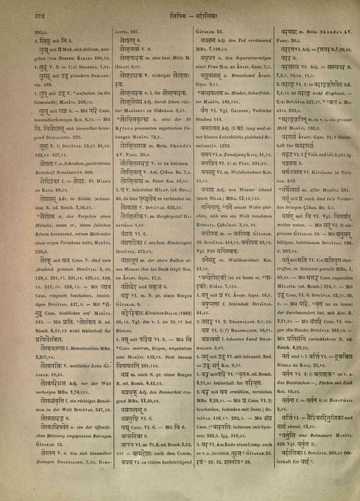
vajra m. auch N. pr. eines Berges R. ed. Bomb. 4,42,25. [Nachtrag, Band 7]
Apte 1890 adjective · substantive masculine · substantive neuter
Original text · English · adjective · substantive masculine · substantive neuter
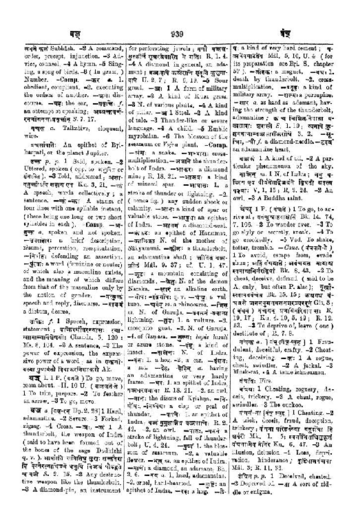
vajra a. [vaj-ran Uṇ. 2. 28] 1 Hard, adamantine. 2 Severe. 3 Forked, zigzag. 4 Cross. — jraḥ, -jraṃ 1 A thunderbolt, the weapon of Indra (said to have been formed out of the bones of the sage Dadhīci q. v.). āśaṃsaṃte samitiṣu surāḥ saktavairā hi daityairasyādhijye dhanuṣi vijayaṃ pauruhūte ca vajre Ś. 2. 15. 2 Any destructive weapon like the thunderbolt. 3 A diamond-pin, an instrument ([Page 0939-b]) for perforating jewels; maṇau vajrasamutkīrṇe sūtrasyevāsti me gatiḥ R. 1. 4. 4 A diamond in general, an adamant; vajrādapi kaṭhorāṇi mṛṃdūni kusumādapi U. 2. 7; R. 6. 19. 5 Sour gruel. — jraḥ 1 A form of military array. 2 A kind of Kuśa grass. 3 N. of various plants. 4 A kind of pillar. — jraṃ 1 Steel. 2 A kind of talc. 3 Thunder-like or severe language. 4 A child. 5 Emblic myrobalan. 6 The blossom of the sesamum or Vajra plant. Comp. — aṃgaḥ a snake. — abhyāsaḥ crossmultiplication. — aśaniḥ the thunderbolt of Indra. — ākaraḥ a diamond mine; R. 18. 21. — ākhyaḥ a kind of mineral spar. — āghātaḥ 1 a stroke of thunder or lightning. 2 (hence fig.) any sudden shock or calamity. — ābhaḥ a kind of spar or valuable stone. — āyudhaḥ an epithet of Indra. — āsanaṃ a diamond-seat. — kaṃkaṭaḥ an epithet of Hanumat. — kālikā N. of the mother of Śākyamuni. — kīlaḥ a thunderbolt, an adamantine shaft; jīvitaṃ vajrakīlaṃ Māl. 9. 37; cf. U. 1. 47. — kūṭaḥ a mountain consisting of diamonds. — ketuḥ N. of the demon Naraka. — kṣāraṃ an alkaline earth. — gopaḥ = iṃdragopaḥ q. v. — caṃcuḥ a vulture. — carman m. a rhinoceros. — jit m. N. of Garuḍa. — jvalanaṃ -jvālā lightning. — tuṃḍaḥ 1 a vulture. 2 mosquito gnat. 3 N. of Garuḍa. 4 of Gaṇeśa. — tulyaḥ lapis lazuli or azure stone. — daṃṣṭraḥ a kind of insect. — dākṣiṇaḥ N. of Indra. — daṃtaḥ 1 a hog. 2 a car. — daṃśanaḥ a rat. — deha, -dehin a. having an adamantine or very hardy frame. — dharaḥ 1 an epithet of Indra; vajradharaprabhāvaḥ R. 18. 21. 2 an owl. — nābhaḥ the discus of Kṛṣṇa. — nirghoṣaḥ, -niṣpeṣaḥ a clap or peal of thunder. — pāṇiḥ 1 an epithet of Indra; vajraṃ mumukṣanniva vajrapāṇiḥ R. 2. 42. 2 an owl. — pātaḥ, -patanaṃ a stroke of lightning, fall of thunderbolt; U. 4. 24. — puṣpaṃ 1 the blossom of sesamum. 2 a valuable flower. — bhṛt m. an epithet of Indra. — maṇiḥ a diamond, an adamant; Bh. 2. 6. — maya a. 1 hard, adamantine. 2 cruel, hard-hearted. — muṣṭiḥ an epithet of Indra. — radaḥ a hog. ([Page 0939-c]) — lepaḥ a kind of very hard cement; vajralepaghaṭiteva Māl. 5. 10, U. 4 (for its preparation see Bṛ. S. chapter 57). — lohakaḥ a magnet. — vadhaḥ 1 death by thunderbolt. 2 crossmultiplication. — ṣyuhaḥ a kind of military array. — śalyaḥ a porcupine. — sāra a. as hard as adamant, having the strength of the thunderbolt, adamantine; kva ca niśitanipātā vajrasārāḥ śarāste Ś. 1. 10; tvamapi kusumabāṇānvajrasārīkaroṣi Ś. 3. 2. — sūciḥ, -cī f. a diamond-needle. — hṛdayaṃ an adamantine heart.
Cappeller 1887 substantive masculine · substantive neuter · Word type unspecified
Original text · German · substantive masculine · substantive neuter
vájra m. n. Donnerkeil (Blitzrahl), bes. Indra's; Diamant (meist n.), ein best. Mörtel (nur m.).
Original text · German · Word type unspecified
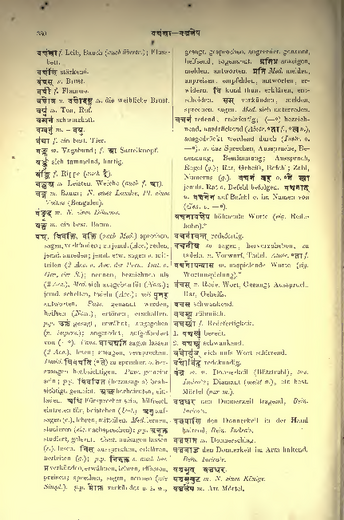
vájra auch Waffe überh.
Burnouf 1866 substantive masculine · substantive neuter
Original text · French · substantive masculine · substantive neuter
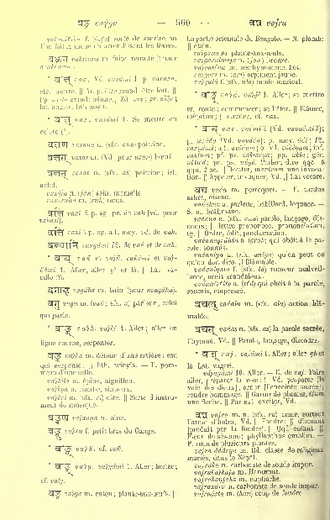
vajra vajra m. n. (sfx. ra) arme, surtout l'arme d'Indra, Vd. Foudre; diamant [produit par la foudre]. Qqf. enfant. Fleur de sésame; phyllanthus emblica. — F. nom de plusieurs plantes. vajra ācārya m. Bd. classe de religieux mariés, dans le Népâl. vajraka n. carbonate de soude impur. vajrakaṅkaṭa m. Hanumat. vajrakaṇṭaka m. euphorbe. vajrakṣāra n. carbonate de soude impur. vajraghata m. (han) coup de foudre. [Page561-1] vajrachedika n. np. d'un ouvrage buddhique. vajrajit m. (ji) Garuḍa, l'oiseau d'Indra. vajrajvālā f. le feu de la foudre. vajratuṇḍa m. vautour. Moustique. Garuḍa. Gaṇeśa; cf. vakratuṇḍa. vajradanta m. porc; rat. vajradaśana m. rat. vajradru, vajradruma m. euphorbe. vajradhara m. (dhṛ) Indra. vajranirghoṣa m. tonnerre. vajraniṣpeṣa m. (nis; piṣ) coup de foudre. vajrapāṇi m. Indra [dont la main tient la foudre]. vajrapuṣpa n. fleur de sésame. vajrarada m. porc. vajravallī f. héliotrope, bot. vajravārāhī f. personnification de la māyā ou illusion produite par les apparences Bd. vajraśṛṅkhalā f. une des Vidyādevīs des Jainas. vajrāṅga m. (aṅga) serpent. — F. [ī] coïx barbata, bot. vajrābha m. (ā; bhā) sorte de pierre précieuse, de couleur laiteuse. vajrāśani m. la foudre d'Indra. vājrāsana n. (ās) le siège miraculeux du Buddha [m à m. siège de diamant]. vajrin m. (sfx. in) Indra. Qqf. buffle.
Occurrences in source texts (13)
DYS 1 occurrence
GoS 4 occurrences
HP 4 occurrences
HTK 1 occurrence
PYS 1 occurrence
SiSa 2 occurrences
Continue with AYI Free
Image source: AYI archive.