
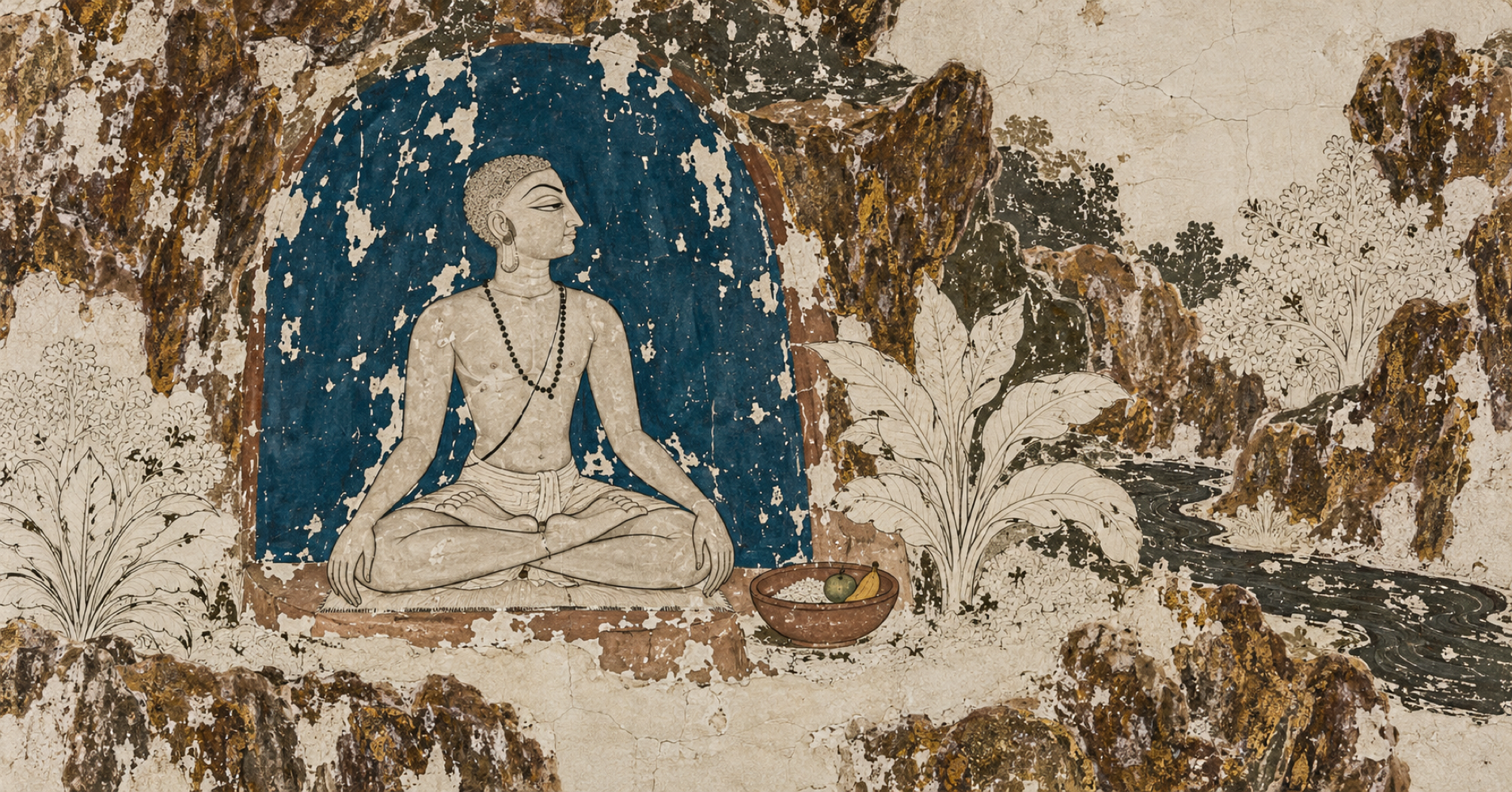
Upright seated figure and a bowl containing a simple meal.

Gorakṣaśataka 12–15: Food, the Lotus and the Thunderbolt Seat

The text begins with food and two seated postures. Its description of the thunderbolt seat follows a particular historical form.

Dr. Ronald Steiner Dr. Ronald Steiner
Gorakṣaśataka (Original) 12
एतेषां लक्षणं सम्यग्वक्ष्यमाणं क्रमेण तु |
eteṣāṃ lakṣaṇaṃ samyag; vakṣyamāṇaṃ krameṇa tu | Analysis ▾ Analysis ▴
eteṣām
genitive plural masculine
pronoun dem
of these
lakṣaṇam
nominative singular
substantive neuter
defining feature
samyak
adverb
accurately
vakṣyamāṇam
nominative singular neuter future participle medial
verbal root
to be explained
krameṇa
instrumental case singular
substantive masculine
in sequence
tu
particle
however
सुस्निग्धमधुराहारश्चतुर्थांशविवर्जितः ||12||
su-snigdha-madhurāhāraś; caturthāṃśa-vivarjitaḥ ||12|| Analysis ▾ Analysis ▴
su
karmadhāraya-compound
previx
good
snigdha
karmadhāraya-compound
adjective
unctuous, oily
madhura
karmadhāraya-compound
adjective
sweet
āhāraḥ
nominative singular
substantive masculine
food
caturthāṃśa
tatpuruṣa-compound instrumental case
substantive masculine
one quarter
vivarjitaḥ
nominative singular masculine past participle passive
previx
verbal root
left unfilled
The characteristics (lakṣaṇam | nom sg) of these (eteṣām | gen pl m) are now (tu) to be described (vakṣyamāṇam | nom sg n pfm) accurately (samyak) in sequence (krameṇa | ins sg): richly unctuous and sweet food (su-snigdha-madhura-āhāraḥ | nom sg), with one quarter left unfilled (caturthāṃśa-vivarjitaḥ | nom sg m ppp) …
Dr. Ronald Steiner - 2026 - historically literal
Moderation means receiving enough while leaving some space. Explore what measure supports your practice.
Dr. Ronald Steiner - 2026 - modern transfer

The sentence defining moderate eating continues in 13. “One quarter left unfilled” traditionally refers to space in the belly; the noun specifying this is not present here. vakṣyamāṇam remains an unusual form in the chosen wording.

Apparatus Comment
Gorakṣaśataka (Original) 13
भुज्यते शिवसंप्रीत्यै मिताहारः स उच्यते |
bhujyate śiva-saṃprītyai; mitāhāraḥ sa ucyate | Analysis ▾ Analysis ▴
bhujyate
3rd person singular passive present
verbal root
is eaten
śiva
tatpuruṣa-compound genitive
substantive masculine
of Śiva
saṃprītyai
dative singular
substantive feminine
for the pleasure
mita
karmadhāraya-compound past participle passive
verbal root
measured
āhāraḥ
nominative singular
substantive masculine
food
saḥ
nominative singular masculine
pronoun dem
that one
ucyate
3rd person singular passive present
verbal root
is called
आसनं द्विविधं प्रोक्तं पद्मं वज्रासनं तथा ||13||
āsanaṃ dvi-vidhaṃ proktaṃ; padmaṃ vajrāsanaṃ tathā ||13|| Analysis ▾ Analysis ▴
āsanam
nominative singular
substantive neuter
seated posture
dvi
dvigu-compound
numeral
two
vidham
nominative singular neuter
adjective
of kinds
proktam
nominative singular neuter past participle passive
previx
verbal root
taught
padmam
nominative singular
substantive neuter
lotus
vajra
karmadhāraya-compound
substantive neuter
thunderbolt
āsanam
nominative singular
substantive neuter
seated posture
tathā
adverb
likewise
… eaten (bhujyate | 3p sg pas pres) to please Śiva (śiva-saṃprītyai | dat sg): this (saḥ | nom sg m) is called (ucyate | 3p sg pas pres) moderate eating (mita-āhāraḥ | nom sg). The seated posture (āsanam | nom sg) is taught (proktam | nom sg n ppp) as being of two kinds (dvi-vidham | nom sg n): the lotus (padmam | nom sg) and (tathā) the thunderbolt posture (vajra-āsanam | nom sg).
Dr. Ronald Steiner - 2026 - historically literal
A simple foundation may be enough: eat attentively and find a steady seat. Variety is not an end in itself.
Dr. Ronald Steiner - 2026 - modern transfer

13ab completes the definition of eating begun in 12. padma and vajrāsana are the two named seats. Their specific historical descriptions follow in 14–15.

Apparatus Comment
Gorakṣaśataka (Original) 14
ऊर्वोर् उपरि चेद्धत्ते उभे पादतले तथा |
ūrvor upari ced dhatte; ubhe pāda-tale tathā | Analysis ▾ Analysis ▴
ūrvoḥ
genitive dual
substantive masculine
of both thighs
upari
adverb
above
cet
particle
if; when
dhatte
3rd person singular medial present
verbal root
places
ubhe
accusative dual neuter
ubha
pronoun quant
both
pāda
tatpuruṣa-compound genitive
substantive masculine
of the feet
tale
accusative dual
substantive neuter
the soles
tathā
adverb
likewise
पद्मासनं भवेत्सम्यक्सर्वपापप्रणाशनम् ||14||
padmāsanaṃ bhavet samyak; sarva-pāpa-praṇāśanam ||14|| Analysis ▾ Analysis ▴
padma
karmadhāraya-compound
substantive neuter
lotus
āsanam
nominative singular
substantive neuter
seated posture
bhavet
3rd person singular aktive optative
verbal root
it would be
samyak
adverb
accurately
sarva
karmadhāraya-compound
pronoun quant
all
pāpa
tatpuruṣa-compound genitive
substantive neuter
wrongdoing
praṇāśanam
nominative singular neuter
adjective
destroying
If (cet) one places (dhatte | 3p sg med pres) both (ubhe | acc du n) soles of the feet (pāda-tale | acc du) upon (upari) the thighs (ūrvoḥ | gen du) in this way (tathā), this would be (bhavet | 3p sg act opt) the proper (samyak) lotus posture (padma-āsanam | nom sg), which destroys all wrongdoing (sarva-pāpa-praṇāśanam | nom sg n).
Dr. Ronald Steiner - 2026 - historically literal
A steady seat gives your attention a place to rest. Its quality grows from how you inhabit it.
Dr. Ronald Steiner - 2026 - modern transfer
dhatte ubhe ] dhaste ebhe R7874apJM
Critical Apparatus

The text associates the lotus posture with removing pāpa, wrongdoing understood in religious terms. This is a historical attribution of efficacy. The translation does not turn it into a medical promise.

Apparatus Comment
Gorakṣaśataka (Original) 15
वामांघ्रिमूलं कन्दाधः अन्यं तदुपरि क्षिपेत् |
vāmāṃghri-mūlaṃ kandādhaḥ; anyaṃ tad-upari kṣipet | Analysis ▾ Analysis ▴
vāmāṅghri
tatpuruṣa-compound genitive
vāmāṅghri
substantive masculine
of the left foot
mūlam
accusative singular
substantive neuter
the root
kanda
avyayībhāva-compund
substantive masculine
bulb, bulb-like base
adhaḥ
adverb
downwards
anyam
accusative singular masculine
pronoun quant
the other
tad
avyayībhāva-compund
pronoun dem
above that
upari
adverb
above
kṣipet
3rd person singular aktive optative
verbal root
one should place
समग्रीवशिरःकायो वज्रासनम् इतीरितम् ||15||
sama-grīva-śiraḥ-kāyo; vajrāsanam itīritam ||15|| Analysis ▾ Analysis ▴
sama
bahuvrīhi-compund
adjective
aligned
grīva
dvandva-compound
substantive feminine
neck
śiraḥ
dvandva-compound
substantive neuter
head
kāyaḥ
nominative singular masculine
substantive masculine
with body
vajra
karmadhāraya-compound
substantive neuter
thunderbolt
āsanam
nominative singular
substantive neuter
seated posture
iti
particle
thus
īritam
nominative singular neuter past participle passive
verbal root
designated
One should place (kṣipet | 3p sg act opt) the left heel (vāmāṅghri-mūlam | acc sg) below the bulb (kanda-adhaḥ), and the other (anyam | acc sg m) above it (tad-upari), with neck, head and body aligned (sama-grīva-śiraḥ-kāyaḥ | nom sg m). This (iti) is called (īritam | nom sg n ppp) the thunderbolt posture (vajra-āsanam | nom sg).
Dr. Ronald Steiner - 2026 - historically literal
Arrange your seat so that head, neck and torso come into alignment. Stability can coexist with mobility.
Dr. Ronald Steiner - 2026 - modern transfer

tadupari is read as the adverbial expression “above it”. In the historical model of the body, kanda denotes a bulb-like base; the passage establishes no equivalence with modern anatomy. The vajrāsana described here cannot simply be identified with the kneeling posture widely known today.

Apparatus Comment

Continue with AYI Free

Illustrations: AI-generated.

Editor

Dr. Ronald Steiner

From Ulm

The "Yoga Doc" - Dr. Ronald Steiner is the founder of the AYI method. This method links traditional Ashtanga Yoga with innovative Yogatherapy and living Philosophy. This forms a practice that is personal for each and... more ›

Messages and ratings
0 messages

Please log in to write a message. Go to login

No messages yet.