
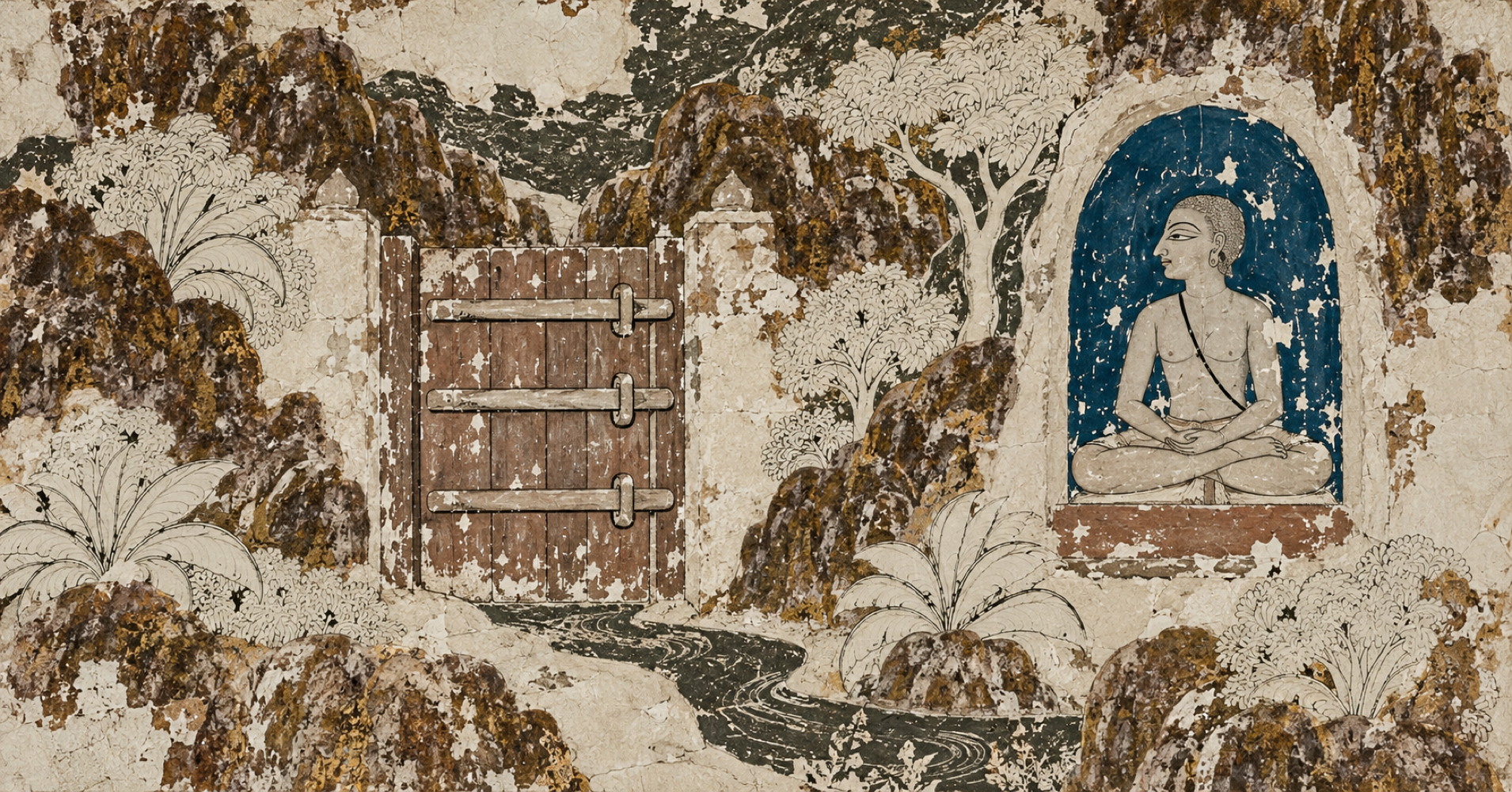

The names are Mūlabandha, Uḍḍīyana and, in the following half-verse, Jālandhara. Spellings of Uḍḍīyana vary in the working text; I do not silently regularise its Sanskrit wording.
teṣāṃ lakṣaṇam ucyate ] lakṣaṇaṃ kathayamy ataḥ R7874apJM
Apāna denotes the downward-directed vital wind. adhogatim is grammatically unusual but is read in context as qualifying apānam. The sentence ends in 53.
mūlabandho is nominative, although the connection with taṃ prāhuḥ would suggest an accusative. I retain the form and translate the recognisable naming construction.
vāyunāhatā ] vāyur āhatā R7874apJM
vahnyapānau ] vahyamānau R7874apJM
The passage develops the interaction of wind and fire within its own model of the body. The continuation in 55 is elliptical.
The first half-verse lacks a finite verb; “is kindled” is supplied from context. The feminine participles of the second half refer to Kuṇḍalinī.
The working text’s bhujaṃgīvā is irregular in place of the expected sequence bhujaṅgī iva. I mark the analysis as uncertain and translate the recognisable snake image. The image does not justify a violent approach to practice.
The passage moves from Mūlabandha to Uḍḍīyana. It explicitly sets the timing at the end of breath retention and the beginning of exhalation.
The name is explained through the verb uḍḍīyate, “flies upwards”. The variant spelling uḍḍīyaṇa is retained in the base text.
The exact location of kanda is not fixed anatomically. The position of this pair of half-verses within the account of Uḍḍīyana still requires explanation; I do not move it.
I translate dhṛdaye as “in the heart”, understanding it as a scribal error for hṛdaye. The adjacent bodily locations, belly and throat, and Mallinson’s translation “heart” (2012, p. 270) support this. The working text’s form remains in the Sanskrit; its uncertain analysis is not thereby presented as a regular word form. tundasandhi literally denotes a junction of the belly. Its exact location remains open.
61ab continues the preceding account of the abdominal pull; 61cd begins Jālandhara. The working text specifies the end of inhalation as the time for it.
The second half-verse leads into the interaction of the locks in 63. Mallinson’s parallel reference gives a different connection here; I retain the supplied main text.
63ab concludes the account of the locks; 63cd introduces samādhi, absorption. The shortened form nāḍi in the compound is retained in the Sanskrit.
Continue with AYI Free
Illustrations: AI-generated.

Please log in to write a message. Go to login
No messages yet.