
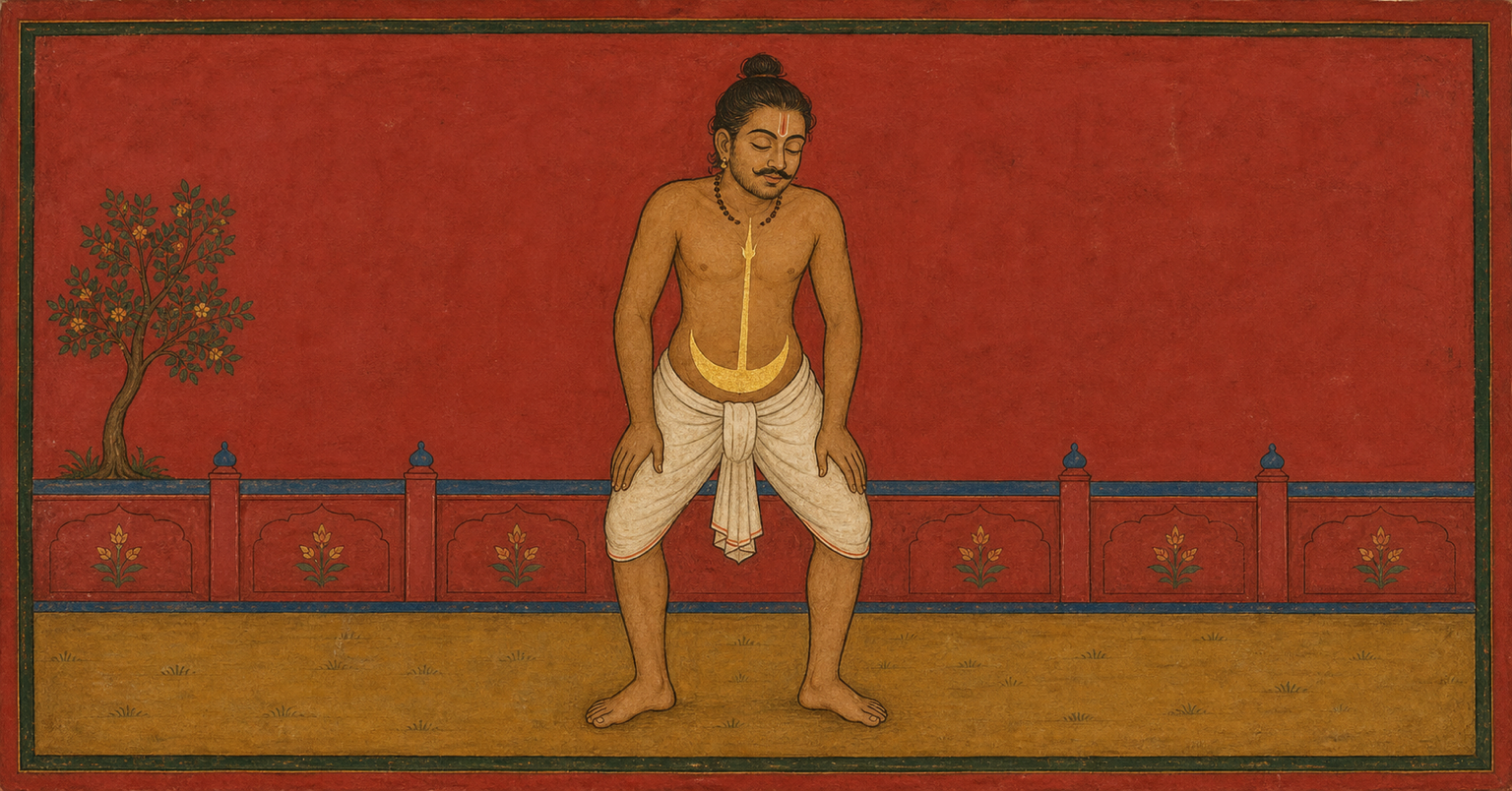
Illustration for the Haṭha Pradīpikā section “HP 3.58-3.65: Uḍḍiyāna Bandha”.

Haṭha Pradīpikā 3.58-3.65: Uḍḍiyāna Bandha

Uḍḍiyāna is explained as the upward-flying path of Prāṇa in Suṣumṇā and described as an easy Bandha that nevertheless depends on the Guru.

Dr. Ronald Steiner Dr. Ronald Steiner
Haṭha Pradīpikā 3.58
बद्धो येन सुषुम्णायां प्राणस्तूड्डीयते यतः |
baddho yena suṣumṇāyāṃ; prāṇas tūḍḍīyate yataḥ | Analysis ▾ Analysis ▴
baddhaḥ
nominative singular masculine past participle passive
verbal root
bound
yena
instrumental case singular masculine
pronoun
by which
suṣumṇāyām
lokative singular
substantive feminine
in Suṣumṇā
prāṇaḥ
nominative singular
substantive masculine
prāṇa
tu
particle
but, now
uḍḍīyate
3rd person singular passive present
previx
verbal root
flies upward
yataḥ
adverb
because, whereby
तस्मादुड्डीयणाख्यो ऽयं योगिभिः समुदाहृतः ||58||
tasmād uḍḍīyaṇākhyo 'yaṃ; yogibhiḥ samudāhṛtaḥ ||58|| Analysis ▾ Analysis ▴
tasmāt
ablative singular
pronoun
therefore
uḍḍīyaṇa
tatpuruṣa-compound
substantive neuter
Uḍḍīyaṇa, flying upward
ākhyaḥ
nominative singular masculine
adjective
called
ayam
nominative singular masculine
pronoun
this
yogibhiḥ
instrumental case plural
substantive masculine
by yogins
samudāhṛtaḥ
nominative singular masculine past participle passive
previx
previx
previx
verbal root
designated, explained
Metre: Anuṣṭubh
Because (yataḥ), when bound (baddhaḥ | nom sg m ppp) by it (yena | ins sg m), Prāṇa (prāṇaḥ | nom sg) now (tu) flies upward (uḍḍīyate | 3p sg pas pres) in Suṣumṇā (suṣumṇāyām | loc sg), therefore (tasmāt | abl sg) this (ayam | nom sg m) is named and declared (samudāhṛtaḥ | nom sg m ppp) by yogis (yogibhiḥ | ins pl) as Uḍḍīyaṇa (uḍḍīyaṇa-ākhyaḥ | nom sg m).
Dr. Ronald Steiner - 2026 - historically literal
Uḍḍīyaṇa receives its name because bound Prāṇa flies upward through Suṣumṇā.
Dr. Ronald Steiner - 2026 - modern transfer

Brahmānanda derives Uḍḍīyāna from “flying upward.” Bound Prāṇa is the great bird that flies upward without interruption through Suṣumṇā. The name emphasizes the intended effect of the retraction on the direction of the breath current.

Brahmānanda's Jyotsnā - 19th c.
baddho yena suṣumṇāyāṃ prāṇas tūḍḍīyate … mṛtyuṃ jayaty eva na saṃśayaḥ MBHDL2026 ] transp. NS1882 ante HP 3.49

sarveṣām eva bandhānām uttamo hy uḍḍiyāṇakaḥ uḍḍīyāṇe dṛḍhe bandhe muktiḥ svābhāvikī bhavet MBHDL2026 ] transp. NS1882 ante HP 3.49
Critical Apparatus
Uḍḍiyâna is so called by the Yogîs, because by its practice the Prâṇa (Vâyu,) flies (flows) in the Suṣumnâ.
Pancham Sinh - 1915
Weil durch diesen Bandha der in der Sushumnâ gebundene Athem auffliegt, wird derselbe von den Yogin Uddîyana genannt.
Hermann Walter - 1893
Haṭha Pradīpikā 3.59
उड्याणं कुरुते यस्माद् अविश्रान्तं महाखगः |
uḍyāṇaṃ kurute yasmād; aviśrāntaṃ mahā-khagaḥ | Analysis ▾ Analysis ▴
uḍyāṇam
accusative singular neuter
substantive neuter
flying upward
kurute
3rd person singular medial present
verbal root
causes
yasmāt
ablative singular
pronoun
because
aviśrāntam
adverb
tirelessly
mahā
karmadhāraya-compound
adjective
great
khagaḥ
nominative singular
substantive masculine
bird, sky-goer
उड्डीयाणं तदेव स्यात् तत्र बन्धो विधीयते ||59||
uḍḍīyāṇaṃ tad eva syāt; tatra bandho vidhīyate ||59|| Analysis ▾ Analysis ▴
uḍḍīyāṇam
nominative singular
substantive neuter
Uḍḍīyāṇa, flying upward
tat
nominative singular neuter
pronoun
that
eva
particle
indeed
syāt
3rd person singular aktive optative
verbal root
is, may be
tatra
adverb
there, therein
bandhaḥ
nominative singular
substantive masculine
bandha
vidhīyate
3rd person singular passive present
previx
verbal root
is prescribed
Metre: Anuṣṭubh
Because (yasmāt | abl sg) the great bird (mahā-khagaḥ | nom sg) tirelessly (aviśrāntam) performs (kurute | 3p sg med pres) the upward flight (uḍyāṇam | acc sg n), this (tat | nom sg n) is (syāt | 3p sg act opt) precisely (eva) Uḍḍīyāṇa (uḍḍīyāṇam | nom sg); there (tatra) the lock (bandhaḥ | nom sg) is prescribed (vidhīyate | 3p sg pas pres).
Dr. Ronald Steiner - 2026 - historically literal
The image is of a great bird flying tirelessly upward; for this reason, the practice is called Uḍḍīyāṇa.
Dr. Ronald Steiner - 2026 - modern transfer
uḍyāṇaṃ MBHDL2026 ] uḍḍīnaṃ NS1882
Critical Apparatus
Uḍḍiyâna is so called, because the great bird, Prâṇa, tied to it, flies without being fatigued. It is explained below.
Pancham Sinh - 1915
Wodurch der grosse Vogel (d. h. der Athem) unermüdlich auffliegt, das ist das Uddîyana; hier wird es Bandha genannt.
Hermann Walter - 1893
Haṭha Pradīpikā 3.60
उदरे पश्चिमं ताणं नाभेरूर्ध्वं च कारयेत् |
udare paścimaṃ tāṇaṃ; nābher ūrdhvaṃ ca kārayet | Analysis ▾ Analysis ▴
udare
lokative singular
substantive neuter
in the abdomen
paścimam
accusative singular masculine
adjective
posterior, westward
tāṇam
accusative singular
substantive neuter
stretch, pull
nābheḥ
ablative genitive singular
substantive feminine
from the navel
ūrdhvam
adverb
upward
ca
particle
and
kārayet
3rd person singular causative optative
verbal root
should cause to be performed
उड्डीयाणो ह्यसौ बन्धो मृत्युमातङ्गकेसरी ||60||
uḍḍīyāṇo hy asau bandho; mṛtyu-mātaṅga-kesarī ||60|| Analysis ▾ Analysis ▴
uḍḍīyāṇaḥ
nominative singular
substantive masculine
Uḍḍīyāṇa
hi
particle
indeed, namely
asau
nominative singular masculine
pronoun
this
bandhaḥ
nominative singular
substantive masculine
bandha
mṛtyu
tatpuruṣa-compound genitive
substantive masculine
death
mātaṅga
tatpuruṣa-compound genitive
substantive masculine
elephant
kesarī
nominative singular
substantive masculine
lion
Metre: Anuṣṭubh
In the abdomen (udare | loc sg), one should cause (kārayet | 3p sg caus opt) the backward stretch (paścimam tāṇam | acc sg) to be drawn upward (ūrdhvam) from the navel (nābheḥ | abl gen sg); this (asau | nom sg m) lock (bandhaḥ | nom sg) is indeed (hi) Uḍḍīyāṇa (uḍḍīyāṇaḥ | nom sg), the lion against the elephant of death (mṛtyu-mātaṅga-kesarī | nom sg).
Dr. Ronald Steiner - 2026 - historically literal
Uḍḍīyāṇa is the backward and upward drawing of the abdomen from the navel. It is described as a lion that overcomes the elephant of death.
Dr. Ronald Steiner - 2026 - modern transfer

According to Brahmānanda, in Uḍḍīyānabandha the regions above and below the navel are drawn backward until they approach the back. His commentary explicitly includes the lower abdomen; the Bandha is therefore not merely a retraction above the navel.

Brahmānanda's Jyotsnā - 19th c.
The belly above the navel is pressed backwards towards the spine. This Uḍḍiyâna Bandha is like a lion for the elephant of death.
Pancham Sinh - 1915
Am Bauch führe man sowohl oberhalb des Nabels (als auch unterhalb, Com.) den Pascimatâna aus (d. h. man ziehe an diesen Stellen den Bauch ein). Dies ist der Uddîyanabandha, der den Todeselephanten abhält.
Hermann Walter - 1893
Haṭha Pradīpikā 3.61
उड्डीयाणं तु सहजं गुरुणा कथितं सदा |
uḍḍīyāṇaṃ tu sahajaṃ; guruṇā kathitaṃ sadā | Analysis ▾ Analysis ▴
uḍḍīyāṇam
nominative singular
substantive neuter
Uḍḍīyāṇa
tu
particle
but
sahajam
nominative singular neuter
adjective
natural, easy, innate
guruṇā
instrumental case singular
substantive masculine
by the guru
kathitam
nominative singular neuter past participle passive
verbal root
taught
sadā
adverb
always
अभ्यसेदस्ततन्द्रस्तु वृद्धो ऽपि तरुणो भवेत् ||61||
abhyased astatandras tu; vṛddho 'pi taruṇo bhavet ||61|| Analysis ▾ Analysis ▴
abhyaset
3rd person singular aktive optative
previx
verbal root
should practise
a-tatandraḥ
nominative singular masculine
adjective
tireless, alert
tu
particle
but
vṛddhaḥ
nominative singular masculine
adjective
old
api
particle
even
taruṇaḥ
nominative singular masculine
adjective
young
bhavet
3rd person singular aktive optative
verbal root
becomes
Metre: Anuṣṭubh
Uḍḍīyāṇa (uḍḍīyāṇam | nom sg), however (tu), is easy (sahajam | nom sg n) and always (sadā) taught (kathitam | nom sg n ppp) by the guru (guruṇā | ins sg). If one practises it (abhyaset | 3p sg act opt) tirelessly (a-tatandraḥ | nom sg m), even (api) an old person (vṛddhaḥ | nom sg m) becomes (bhavet | 3p sg act opt) young (taruṇaḥ | nom sg m).
Dr. Ronald Steiner - 2026 - historically literal
Uḍḍīyāṇa is simple, but it belongs under the guidance of the guru. One who practises it attentively and persistently is rejuvenated.
Dr. Ronald Steiner - 2026 - modern transfer
abhyased astatandras tu MBHDL2026 ] abhyaset satataṃ yas tu NS1882
Critical Apparatus
Uḍḍiyâna is always very easy, when learnt from a guru. The practiser of this, if old, becomes young again.
Pancham Sinh - 1915
Wer dieses dem Lehrer speziell gehörende und immer von ihm gelehrte Uddîyâna fortwährend übt, wird, selbst wenn er alt ist, wieder jung.
Hermann Walter - 1893
Haṭha Pradīpikā 3.62
नाभेरूर्ध्वमधश्चापि ताणं कुर्यात्प्रयत्नतः |
nābher ūrdhvam adhaś cāpi; tāṇaṃ kuryāt prayatnataḥ | Analysis ▾ Analysis ▴
nābheḥ
ablative genitive singular
substantive feminine
from the navel
ūrdhvam
adverb
upward
adhaḥ
adverb
downward
ca
particle
and
api
particle
also
tāṇam
accusative singular
substantive neuter
stretch, pull
kuryāt
3rd person singular aktive optative
verbal root
should perform
prayatnataḥ
adverb
carefully
षण्मासमभ्यसन्मृत्युं जयत्येव न संशयः ||62||
ṣaṇ-māsam abhyasan mṛtyuṃ; jayaty eva na saṃśayaḥ ||62|| Analysis ▾ Analysis ▴
ṣaṣ
dvigu-compound
numeral
six
māsam
accusative singular
substantive neuter
months
abhyasan
nominative singular masculine present participle active
previx
verbal root
practising
mṛtyum
accusative singular
substantive masculine
death
jayati
3rd person singular aktive present
verbal root
conquers
eva
particle
certainly
na
particle
not
saṃśayaḥ
nominative singular
substantive masculine
doubt
Metre: Anuṣṭubh
From the navel (nābheḥ | abl gen sg), one should carefully (prayatnataḥ) perform (kuryāt | 3p sg act opt) the stretch (tāṇam | acc sg) upward (ūrdhvam), downward (adhaḥ), and also (cāpi). One who practises (abhyasan | nom sg m pca) for six months (ṣaṇ-māsam | acc sg) certainly (eva) conquers (jayati | 3p sg act pres) death (mṛtyum | acc sg); there is no (na) doubt (saṃśayaḥ | nom sg).
Dr. Ronald Steiner - 2026 - historically literal
Carefully draw the abdominal region upward and downward from the navel. Six months of practice are said to conquer death.
Dr. Ronald Steiner - 2026 - modern transfer
ṣaṇmāsam abhyasan mṛtyuṃ MBHDL2026 ] ṣaṇmāsam abhyasen mṛtyuṃ NS1882
Critical Apparatus
The portions above and below the navel, should be drawn backwards towards the spine. By practising this for six months one can undoubtedly conquer death.
Pancham Sinh - 1915
Oberhalb wie unterhalb des Nabels übe man fleissig den Tâna sechs Monate lang, so wird man sicher den Tod besiegen.
Hermann Walter - 1893
Haṭha Pradīpikā 3.63
सति वज्रासने पादौ कराभ्यां धारयेद्दृढम् |
sati vajrāsane pādau; karābhyāṃ dhārayed dṛḍham | Analysis ▾ Analysis ▴
sati
lokative singular neuter present participle active
verbal root
when established, situated
vajra
tatpuruṣa-compound genitive
substantive neuter
vajra
āsane
lokative singular
substantive neuter
posture, āsana
pādau
accusative dual
substantive masculine
both feet
karābhyām
instrumental case dual
substantive masculine
with both hands
dhārayet
3rd person singular aktive optative
verbal root
should grasp
dṛḍham
adverb
firmly
गुल्फदेशसमीपे च कन्दं तत्र प्रपीडयेत् ||63||
gulpha-deśa-samīpe ca; kandaṃ tatra prapīḍayet ||63|| Analysis ▾ Analysis ▴
gulpha
tatpuruṣa-compound genitive
substantive masculine
ankle
deśa
tatpuruṣa-compound genitive
substantive neuter
place, region
samīpe
lokative singular
substantive neuter
nearby
ca
particle
and
kandam
accusative singular
substantive neuter
kanda, root bulb
tatra
adverb
there
prapīḍayet
3rd person singular causative optative
previx
verbal root
should press
Metre: Anuṣṭubh
While seated (sati | loc sg n pca) in Vajrāsana (vajra-asane | loc sg), one should firmly (dṛḍham) hold (dhārayet | 3p sg act opt) both feet (pādau | acc du) with both hands (karābhyām | ins du), and (ca) there (tatra), close to the region of the ankles (gulpha-deśa-samīpe | loc sg), press (prapīḍayet | 3p sg caus opt) the Kanda (kandam | acc sg).
Dr. Ronald Steiner - 2026 - historically literal
In Vajrāsana, hold the feet firmly with the hands and apply deliberate pressure to the Kanda near the ankles.
Dr. Ronald Steiner - 2026 - modern transfer
sati vajrāsane pādau karābhyāṃ dhārayed dṛḍham gulphadeśasamīpe ca kandaṃ tatra prapīḍayet MBHDL2026 ] transp. NS1882 post HP 3.95*2
Critical Apparatus
Keeping the feet in Vajra-âsana (Padma-âsana), hold them firmly with the hands. The position of the bulb then will be near the ankle joint, where it should be pressed.
Pancham Sinh - 1915
Man nehme die Stellung des Vajrasana ein, halte mit den Händen beide Füsse in der Nähe der Fussknöchel fest und drücke den Kanda stark.
Hermann Walter - 1893
Haṭha Pradīpikā 3.64
पश्चिमं ताणमुदरे कारयेद्धृदये गले |
paścimaṃ tāṇam udare; kārayed dhṛdaye gale | Analysis ▾ Analysis ▴
paścimam
accusative singular masculine
adjective
posterior
tāṇam
accusative singular
substantive neuter
stretch, pull
udare
lokative singular
substantive neuter
in the abdomen
kārayet
3rd person singular causative optative
verbal root
should perform
hṛdaye
lokative singular
substantive neuter
in the chest, heart
gale
lokative singular
substantive neuter
in the throat
शनैः शनैर्यथा प्राणस् तुन्दसंधिं न गच्छति ||64||
śanaiḥ śanair yathā prāṇas; tunda-saṃdhiṃ na gacchati ||64|| Analysis ▾ Analysis ▴
śanaiḥ
adverb
slowly
śanaiḥ
adverb
slowly
yathā
adverb
so that
prāṇaḥ
nominative singular
substantive masculine
prāṇa
tunda
tatpuruṣa-compound genitive
substantive neuter
abdomen
saṃdhim
accusative singular
substantive neuter
connection, contact
na
particle
not
gacchati
3rd person singular aktive present
verbal root
goes, reaches
Metre: Anuṣṭubh
One should gradually (śanaiḥ), gradually (śanaiḥ), cause (kārayet | 3p sg caus opt) the backward stretch (paścimam tāṇam | acc sg) in the abdomen (udare | loc sg), chest (dhṛdaye | loc sg), and throat (gale | loc sg), so that (yathā) Prāṇa (prāṇaḥ | nom sg) does not (na) go (gacchati | 3p sg act pres) into the junction of the abdomen (tunda-saṃdhim | acc sg).
Dr. Ronald Steiner - 2026 - historically literal
Guide the backward extension very gently through the abdomen, chest, and throat, so that Prāṇa does not fall back into contact with the abdomen.
Dr. Ronald Steiner - 2026 - modern transfer
paścimaṃ tāṇam udare kārayed dhṛdaye gale śanaiḥ śanair yathā prāṇas tundasaṃdhiṃ na gacchati MBHDL2026 ] om. NS1882
Critical Apparatus
Haṭha Pradīpikā 3.65
सर्वेषामेव बन्धानाम् उत्तमो ह्युड्डियाणकः |
sarveṣām eva bandhānām; uttamo hy uḍḍiyāṇakaḥ | Analysis ▾ Analysis ▴
sarveṣām
genitive plural
adjective
of all
eva
particle
indeed
bandhānām
genitive plural
substantive masculine
bandhas, locks
uttamaḥ
nominative singular masculine
adjective
the highest, best
hi
particle
indeed, namely
uḍḍiyāṇakaḥ
nominative singular
substantive masculine
Uḍḍiyāṇaka
उड्डीयाणे दृढे बन्धे मुक्तिः स्वाभाविकी भवेत् ||65||
uḍḍīyāṇe dṛḍhe bandhe; muktiḥ svābhāvikī bhavet ||65|| Analysis ▾ Analysis ▴
uḍḍīyāṇe
lokative singular
substantive neuter
in Uḍḍīyāṇa
dṛḍhe
lokative singular masculine
adjective
firm
bandhe
lokative singular
substantive masculine
bandha
muktiḥ
nominative singular
substantive feminine
liberation
svābhāvikī
nominative singular feminine
adjective
naturally, by itself
bhavet
3rd person singular aktive optative
verbal root
becomes
Metre: Anuṣṭubh
Among all (sarveṣām | gen pl) locks (bandhānām | gen pl), Uḍḍiyāṇaka (uḍḍiyāṇakaḥ | nom sg) alone (eva) is the highest (uttamaḥ | nom sg m), indeed (hi). When the lock (bandhe | loc sg) in Uḍḍīyāṇa (uḍḍīyāṇe | loc sg) is firm (dṛḍhe | loc sg m), liberation (muktiḥ | nom sg) becomes (bhavet | 3p sg act opt) natural (svābhāvikī | nom sg f).
Dr. Ronald Steiner - 2026 - historically literal
Uḍḍīyāṇa is regarded as the best of all Bandhas. Once it is firmly established, liberation becomes natural.
Dr. Ronald Steiner - 2026 - modern transfer

Brahmānanda explains “liberation arising by itself” through the path of Prāṇa. Once Uḍḍīyānabandha is firmly mastered, Prāṇa rises like a bird through Suṣumṇā to the crown. This ascent leads into Samādhi, from which liberation arises. “Natural” here means a consequence of the perfected technique, not an event without prerequisites.

Brahmānanda's Jyotsnā - 19th c.
sarveṣām eva bandhānām uttamo hy uḍḍiyāṇakaḥ uḍḍīyāṇe dṛḍhe bandhe muktiḥ svābhāvikī bhavet MBHDL2024 ] transp. NS1882 post HP 3.62, ante HP 3.49

bandhānām em. ed. ] bandhānāum MBHDL2026
Critical Apparatus
Of all the Bandhas, Uḍḍiyâna is the best; for by binding it firmly liberation comes spontaneously.
Pancham Sinh - 1915
Von allen Bandha ist das Uddîyana der höchste; ist man mit dem Uddîyanabandha vertraut, so erlangt man seine eigene Erlösung.
Hermann Walter - 1893

Continue with AYI Free

Illustrations: AI-generated.

Editor

Dr. Ronald Steiner

From Ulm

The "Yoga Doc" - Dr. Ronald Steiner is the founder of the AYI method. This method links traditional Ashtanga Yoga with innovative Yogatherapy and living Philosophy. This forms a practice that is personal for each and... more ›

Messages and ratings
0 messages

Please log in to write a message. Go to login

No messages yet.