

gandha गन्ध – Geruch; Duft
Substantiv Maskulin · Substantiv Neutrum · Worttyp nicht bestimmt
Wörterbuchquellen
AYI Wörterbuch Substantiv Maskulin
Geruch; Duft
Cappeller 1891 Substantiv Maskulin
Originaltext · Englisch · Substantiv Maskulin
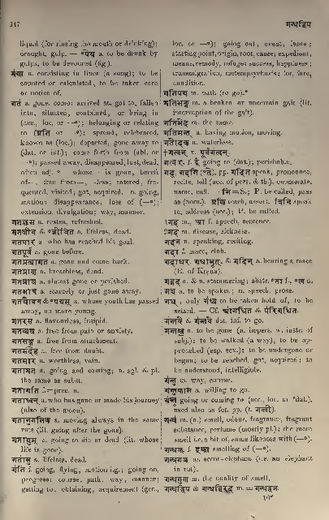
gandhá ·m. (n.) smell, odour, fragrance, fragrant substance, perfume (mostly pl.); the mere smell i.e. a bit of, some likeness with (--°).
Monier-Williams 1872 Substantiv Maskulin
Originaltext · Englisch · Substantiv Maskulin
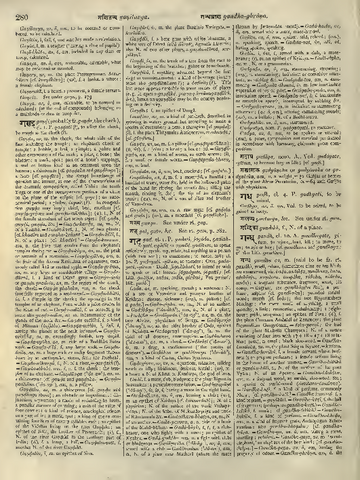
gandha gandha as, m. (said to be fr. rt. gandh), smell, odour, (sometimes nine or ten kinds are enumerated, viz. iṣṭa, aniṣṭa, madhura, kaṭu, nirhārin, saṃhata, snigdha, rūkṣa, viśada, amla); a fragrant substance, fragrance, scent, (in comp. = fragrant, see gandhāmbu &c.), a per- fume; sulphur [cf. gandhaka]; pounded sandal- wood; myrrh [cf. bala]; the tree Hyperanthera Moringa; the mere smell of anything, a small quantity, a little; connection, relationship; a neigh- bour; pride, arrogance; an epithet of Śiva; (ā), f. the plant Curcuma Amhaldi or Zerumbet; the plant Desmodium Gangeticum, = śāla-parṇī; the bud of the plant Michelia Champaca; N. of a metre consisting of four lines with 17 + 18 + 17 + 18 sylla- bles; (am), n. smell; black aloe-wood.
Petersburger 1855 Substantiv Maskulin · Substantiv Neutrum · Worttyp nicht bestimmt
Originaltext · Deutsch · Substantiv Maskulin · Substantiv Neutrum
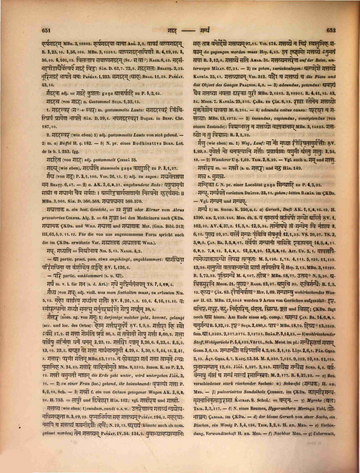
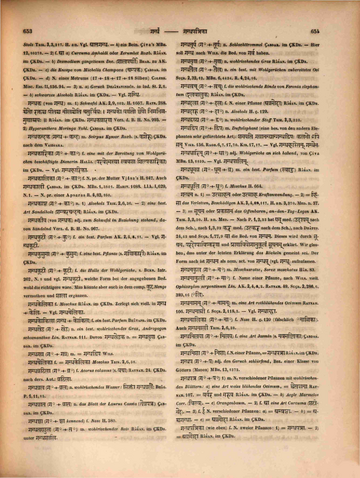
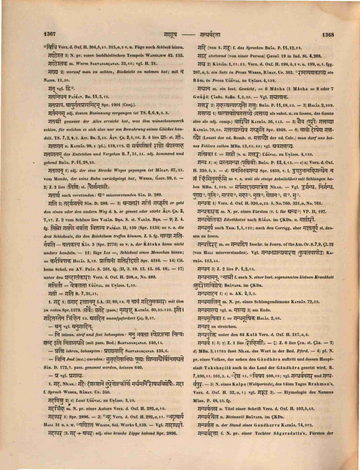
gandhá 1〉 m. SIDDH. K. 250,a,4. a〉 Geruch, Duft AK. 1,1,4,16. AK. 1,1,4,19. H. 1390. H. an. 2,239. H. an. 2,240. MED. dh. 5. ya ā̱masyà kra̱viṣò ga̱ndho astì ṚV. 1,162,10. AV. 4,37,2. AV. 11,3,8. AV. 12,5,34. tānòṣadhe̱ tvaṃ ga̱ndhena̱ vi nā̀śaya AV. 8,6,10. puṇya AV. 4,10,27. yastè ga̱ndhaḥ pṛ̀thivi saṃba̱bhūvà AV. 12,1,23. VS. 20,27. TS. 2,3,9,9. ŚAT. BR. 3,5,2,17. sarveṣāṃ gandhānāṃ nāsike ekāyanam ŚAT. BR. 14,5,4,11. ŚAT. BR. 14,6,2,2. ŚAT. BR. 14,7,3,12. ŚAT. BR. 9,4,1,4. ŚAT. BR. 10,5,2,20. ŚAT. BR. 12,8,3,16. AIT. UP. 5,1. yāvannāpaityamedhyāktādgandho lepaśca tatkṛtaḥ M. 5,126. M. 1,78. M. 4,111. M. 5,128. M. 11,149. M. 12,98. mānuṣyo balavāngandho ghrāṇaṃ tarpayatīva me HIḌ. 2,12. MBH. 3,16199. R. 5,73,59. pūtigandhe M. 4,107. tīvra˚ MBH. 18,77. uttama˚ N. 5,38. adhikasurabhi MEGH. 21. puṇya˚ RAGH. 12,27. aśuci RAGH. 12,30. havirgandhaiḥ R. 1,5,15. havya˚ ŚĀK. 83. dīpanirvāṇa˚ HIT. I, 69. gandhāmbu wohlriechendes Wasser H. 63. MBH. 12,6848 werden 9 Arten von Gerüchen aufgezählt: iṣṭa, aniṣṭa, madhura, kaṭu, nirhārin, saṃhata, snigdha, rūkṣa und viśada; ŚKDR. fügt noch amla hinzu. Am Ende eines adj. comp.: agandha ŚAT. BR. 14,6,8,8. caturgandha R. 5,32,12. iṣṭa˚ SUŚR. 2,480,5. pāpa˚ MBH. 18,70. divya˚ MBH. 13,2349. fem. ā MBH. 1,2398. MBH. 2,317. MBH. 2,2174. MBH. 3,12721. BHĀG. P. 9,14,25. — b〉 wohlriechender Stoff, Wohlgerüche P. 5,4,135, Vārtt., Sch. Meist im pl.: gandhairukṣaṇaṃ gavām GOBH. 3,6,13. gandhānagnau, kariṣyāmi GOBH. 4,2,26. GOBH. 3,1,12. LĀṬY. 2,6,1. PĀR. GṚHY. 2,13. ĀŚV. GṚHY. 4,7. KAUŚ. 13. KAUŚ. 54. M. 4,250. M. 7,131. M. 9,329. M. 10,88. M. 11,168. śubhāngandhān M. 12,65. YĀJÑ. 1,297. YĀJÑ. 2,245. mālyaiśca gandhaiśca SUND. 4,4. varjayenmadhu māṃsaṃ ca gandhaṃ mālyaṃ rasānstriyaḥ M. 2,177. R. 6,37,23. — c〉 Bez. verschiedener stark riechender Sachen: α〉 Schwefel (gandhaka) H. an. MED. — β〉 pulverisirtes Sandelholz ŚUDDHIT._im_ŚKDR. kāśmīragandhamṛganābhikṛtāṅgarāgā CAURAP. 9. Schol.: = candana. — γ〉 Myrrhe (bala) TRIK. 3,3,217. — δ〉 N. eines Baumes, Hyperanthera Moringa Vahl. (śobhāñjana) ŚABDAR._im_ŚKDR. — d〉 der blosse Geruch von einer Sache, ein Bischen, ein Wenig P. 5,4,136. TRIK. 3,2,8. H. an. MED. — e〉 Verbindung, Verwandtschaft H. an. MED. — f〉 Nachbar MED. — g〉 Uebermuth, Stolz TRIK. 3,3,217. H. an. Vgl. āttagandha. — h〉 ein Bein. Śivaʼs MBH. 12,10378. — 2〉 f. ā a〉 Curcuma Amhaldi oder Zerumbet Roxb. RĀJAN._im_ŚKDR. — b〉 Desmodium gangeticum Dec. (śālaparṇī) BHAR._zu_AK. ŚKDR. — c〉 die Knospe von Michelia Champaca (campaka) ŚABDAR._im_ŚKDR. — d〉 N. eines Metrums (17 + 18 + 17 + 18 Silben) COLEBR. Misc. Ess. II, 156. COLEBR. Misc. Ess. II,94. — 3〉 n. a〉 Geruch DHYĀNAVINDŪP._in_Ind. St. 2,1. — b〉 schwarzes Aloeholz RĀJAN._im_ŚKDR. — Vgl. gandhi.
Originaltext · Deutsch · Worttyp nicht bestimmt
gandha 1〉a〉 grastagandhā (pṛthivī) BHĀG. P. 12,4,13. — c〉α〉 Verz. d. Oxf. H. 320,b,2. — d〉 anabhibhavagandha Spr. 1859, v. l. duṇḍubhānahigandhena na tvaṃ hiṃsitumarhasi so v. a. weil sie einige Aehnlichkeit mit Schlangen haben MBH. 1,989. = sarpasādṛśyamātreṇa NĪLAK. — Vgl. durgandha, nirgandha, puṇya˚, pūti˚, matsya˚, mahā˚, mukha˚, yojana˚, sa˚, su˚.
Böhtlingk 1879 Substantiv Maskulin · Substantiv Neutrum
Originaltext · Deutsch · Substantiv Maskulin · Substantiv Neutrum
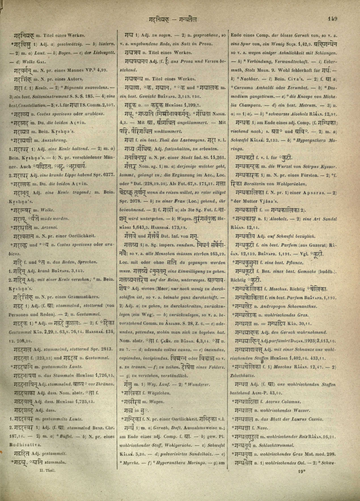
gandhá — 1〉 m. — a〉 Geruch, Duft. Ausnahmsweise n.; am Ende eines adj. Comp. f. ā. — b〉 gewöhnlich Pl. wohlriechender Stoff, Wohlgerüche. — c〉 Schwefel KĀLAC. 5,20. — d〉 pulverisirtes Sandelholz. — e〉 *Myrrhe. — f〉 *Hyperanthera moringa. — g〉 am [Page2-149-c] Ende eines Comp. der blosse Geruch von, so v. a. eines Spur von, ein Wenig SUŚR. 1,42,9. ahigandhena so v. a. wegen einiger Aehnlichkeit mit Schlangen. — h〉 *Verbindung, Verwandtschaft. — i〉 Uebermuth, Stolz MEGH. 9. Wohl fehlerhaft für gardha. — k〉 *Nachbar. — l〉 Bein. Śivaʼs. — 2〉 f. ā — a〉 *Curcuma amhaldi oder Curcuma zerumbet. — b〉 *Desmodium gangeticum. — c〉 *die Knospe von Michelia champaca. — d〉 ein best. Metrum. — 3〉 n. — a〉 = 1〉a〉. — b〉 *schwarzes Aloeholz RĀJAN. 12,91.
Cappeller 1887 Substantiv Maskulin · Substantiv Neutrum
Originaltext · Deutsch · Substantiv Maskulin · Substantiv Neutrum
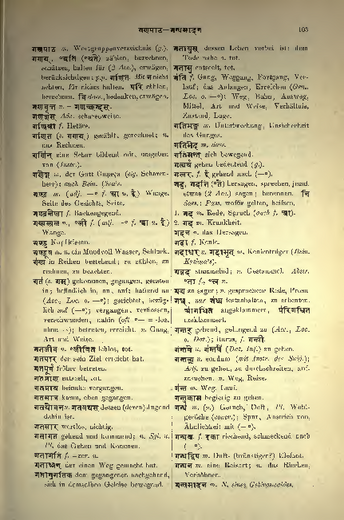
gandha m. (n.) Geruch, Duft, Pl. Wohlgerüche (concr.); Spur, Anstrich von, Ähnlichkeit mit (—˚).
Burnouf 1866 Substantiv Maskulin
Originaltext · Französisch · Substantiv Maskulin
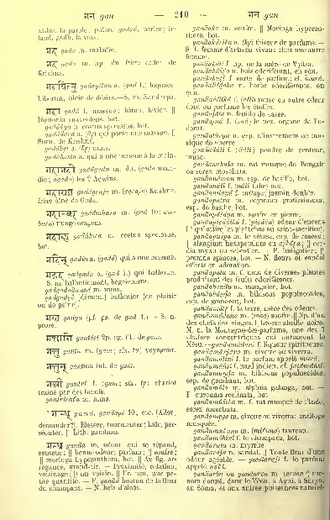
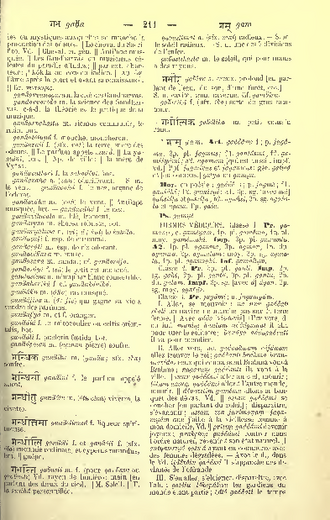
gandha gandha m. odeur qui se répand, senteur; bonne odeur; parfum; soufre; moringa hyperanthera, bot. Au fig. arrogance, grand-air. — Proximité, relation, voisinage; un voisin. Un peu, une petite quantité. — F. gandhā bouton de la fleur du champaca. — N. bois d'aloës. [Page210-2] gandhaka m. soufre. Moringa hyperanthera, bot. gandhakārika a. (kṛ) faiseur de parfums. — S. f. femme d'artisan vivant chez une autre femme. gandhakālī f. np. de la mère de Vyāsa. gandhakāṣṭha n. bois odoriférant, en gén. gandhakuṭī f. sorte de parfum; cf. murā. gandhakheḍaka n. herbe odoriférante, en gén. gandhacelikā f. (celi) musc ou autre odeur dont on parfume les étoffes. gandhajāta n. feuille de casse. gandhajñā f. (jñā) le nez, organe de l'odorat. gandhatūrya n. esp. d'instrument de musique de guerre. gandhadhūli f. (dhūli) poudre de senteur, musc. gandhanakula m. rat musqué du Bengale ou sorex moschata. gandhanāman m. esp. de basilic, bot. gandhanālī f. (nālī tube) nez. gandhanilayā f. (nilaya) jasmin double. gandhapatra m. ocymum gratissimum, esp. de basilic, bot. gandhapāṣāṇa m. soufre en pierre. gandhapiśācikā f. (piśāca) odeur d'encens [? qui attire les piśācas au saint-sacrifice]. gandhapuṣpa m. le vetasa, esp. de roseau; alangium hexapetalum ou aṅkoṭha; cordia myxa ou sebestier. — F. indigotier; premna spinosa, bot. — N. fleurs et sandal offerts en adoration. gandhaphala m. f. nom de diverses plantes produisant des fruits odoriférants. gandhabandhu m. manguier, bot. gandhabhāṇḍa m. hibiscus populneoïdes, esp. de gombaut, bot. gandhamātṛ f. la terre, mère des odeurs. gandhamādana m. (mad) soufre. Np. d'un des chefs des singes. Grosse abeille noire. M. n. la Montagne-des-parfums, une des 7 chaînes concentriques qui entourent le Meru. — gandhamādanī f. liqueur spiritueuse. gandhamārjāra m. civette ou viverra. gandhamālinī f. le parfum appelé murā. gandhamāṃsī f. nard indien, cf. jaṭāmāṃsī. gandhamuṇḍa m. hibiscus populneoïdes, esp. de gombaut, bot. gandhamūla m. alpinia galanga, bot. — F. curcuma reclinata, bot. gandhamūṣika m. f. rat musqué de l'Inde, sorex moschata. gandhamṛga m. civette ou viverra; antilope musquée. gandhamaithuna m. (mithuna) taureau. gandhamohinī f. le champaca, bot. gandharasa m. myrrhe. gandharāja n. sandal. Toute fleur d'une odeur agéable. — gandharājī f. le parfum appelé nakhī. gandharba ou gandarva m. (arvan?) surnom donné, dans le Veda, à Agni, à Sūrya, au Soma, et aux autres puissances naturelles [Page211-1] ou mystiques auxquelles se rattache la production des odeurs. Le cheval du Sacrifice, Vd. Cheval, en gén. Antilope musquée. Les Gandharvas ou musiciens célestes du paradis d'Indra; par ext. chanteur; kokila ou coucou indien. Au fig. l'âme après la mort et avant sa renaissance. Gr. ϰένταυρος. gandharvanagara n. la cité des Gandharvas. gandarvaveda m. la science des Gandharvas, c-à-d. la théorie et la pratique de la musique. gandharvahasta m. ricinus communis, le ricin, bot. gandhalolupā f. mouche, moucheron. gandhavatī f. (sfx. vat) la terre, mère des odeurs. Le parfum appelé murā. La yamānī, bot. Np. de ville; la mère de Vyāsa. gandhavallarī f. la sahadevī, bot. gandhavaha a. (vah) odoriférant. — S. m. le vent. — gandhavahā f. le nez, organe de l'odorat. gandhavāha m. (vah) le vent. Antilope musquée, bot. — gandhavāhā f. le nez. gandhavihvala m. blé, froment. gandhavṛkṣa m. shorea robusta, bot. gandhavyākula n. (vi; ā; kul) le kakola. gandhaśaṭī f. esp. de curcuma. gandhaśālī m. esp. de riz odorant. gandhaśekhara m. musc. gandhasāra m. sandal; cf. gandharāja. gandhasūyī f. (sū) le petit rat musqué. gandasoma n. nénuphar blanc comestible. gandhahārikā f. cf. gandhakārikā. gandhākhu m. (ākhu) rat musqué. gandhājīva a. (ā; jīv) qui gagne sa vie à vendre des parfums. gandhāṭhya m. et f. oranger. gandhālā f. le micocoulier ou celtis orientalis, bot. gandhālī f. pæderia fœtida bot. gandhāśman m. (aśman pierre) soufre.
Quelltextfundstellen (10)
DYS 2 Fundstellen
HP 4 Fundstellen
SiSa 3 Fundstellen
SVU 1 Fundstelle
Mit AYI Free weitermachen
Bildquelle: AYI Archiv.