

graha ग्रह – Ergreifen; Festhalten; Befolgen; böser Einfluss; Dämon
Adjektiv · Substantiv Maskulin · Worttyp nicht bestimmt
Wörterbuchquellen
AYI Wörterbuch Substantiv Maskulin
Ergreifen; Festhalten; Befolgen; böser Einfluss; Dämon
Cappeller 1891 Adjektiv
Originaltext · Englisch · Adjektiv
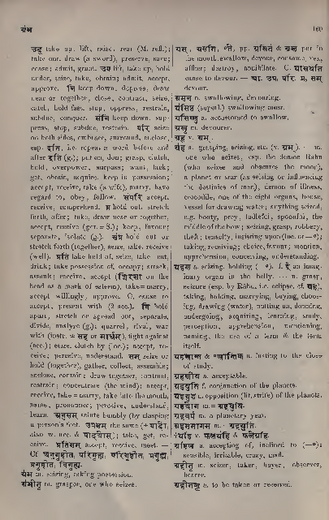
gráha ·a. grasping, seizing, etc. (v. grabh). -- m. one who seizes, esp. the demon Rāhu (who seizes and obscures the moon), a planet or star (as seizing or influencing the destinies of men), demon of illness, crocodile, one of the eight organs, house, vessel for drawing water; anything seized, e.g. booty, prey, ladleful, spoonful, the middle of the bow; seizing, grasp, robbery, theft, tenacity, insisting upon (loc. or --°); taking, receiving; choice, favour; mention, apprehension, conceiving, understanding.
Monier-Williams 1872 Adjektiv
Originaltext · Englisch · Adjektiv
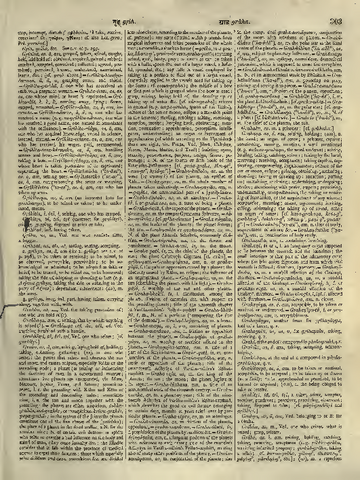
Graha, as, ā, am, seizing, laying hold of, holding; taking, collecting, gathering; (as), m. one who seizes; the power that seizes and obscures the sun and moon and causes eclipses, especially Rāhu or the ascending node; a planet (as seizing or influencing the destinies of men in a supernatural manner; sometimes five planets are enumerated, viz. Mars, Mercury, Jupiter, Venus, and Saturn; sometimes seven, i. e. the preceding with Rāhu and Ketu or the ascending and descending nodes; sometimes nine, i. e. the sun and moon together with the preceding: the planets are either auspicious, śubha- grahās, sad-grahās; or inauspicious, krūra-grahās, pāpa-grahās; in the system of the Jainas the planets constitute one of the five classes of the Jyotiṣka); the place of a planet in the fixed zodiac, a N. for the number nine; N. of certain evil demons or spirits who seize or exercise a bad influence on the body and mind of man, (they cause insanity &c.; the Hindūs consider that it falls within the province of medical science to expel these demons; those which especially seize children and cause convulsions &c. are divided into nine classes, according to the number of the planets, cf. pūtanā); any state of mind which proceeds from magical influences and takes possession of the whole man; a crocodile, a shark; a house (= gṛha, in a-gra- ha, khara-g˚, graha-druma, graha-pati); anything seized, spoil, booty, prey; as much as can be taken with a ladle, spoon &c. out of a larger vessel, a ladle- ful, spoonful, &c.; any ladle or vessel employed for taking up a portion of fluid out of a larger vessel, (especially applied to the vessels used for taking up the Soma; cf. soma-graha); the middle of a bow or that part which is grasped when the bow is used; grasp, seizing, laying hold of, the drawing up or taking up of water &c. [cf. nīra-graha]; seizure in general (e. g. aṅga-graha, spasm of the limbs), seizure of the sun or moon, eclipse; a movable point in the heavens; stealing, robbing; taking, receiving, reception, receipt; keeping back, obstructing; men- tion, nomination; apprehension, perception, intelli- gence, understanding; an organ or instrument of apprehension (of which according to the Upaniṣads there are eight, viz. Prāṇa, Vāc, Jihvā, Cakṣus, Śrotra, Manas, Hastau, and Tvac); insisting upon, tenacity, perseverance, purpose, design, favour, pa- tronage; a N. of the fourth or fifth book of the Śatapatha-Brāhmaṇa; [cf. guda-graha, śiro-gr˚, hanu-gr˚, hṛd-gr˚.]
Petersburger 1855 Adjektiv · Substantiv Maskulin · Worttyp nicht bestimmt
Originaltext · Deutsch · Adjektiv · Substantiv Maskulin
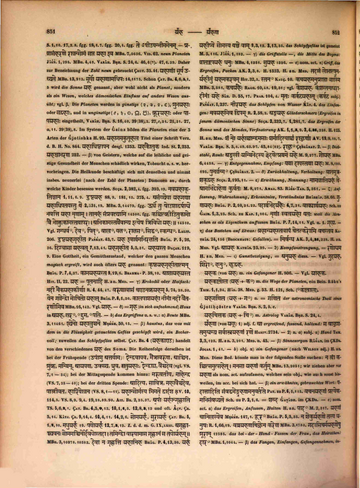
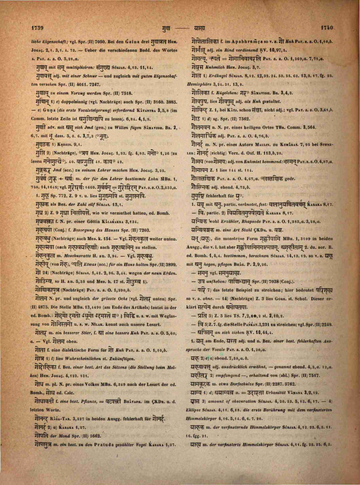
gráha (von grah) P. 3,3,58. gaṇa vṛṣādi zu P. 6,1,203. 1〉 adj. am Ende eines comp. P. 3,2,9, Vārtt. a〉 ergreifend, anfassend, haltend: tatpadagrahāvapatatām BHĀG. P. 3,15,35. Vgl. aṅkuśagraha, dhanurgraha u. s. w. — b〉 einsammelnd, zusammenscharrend: yūyaṃ phalagrahāḥ BHĀG. P. 8,6,23. vitta˚, śamala˚ BHĀG. P. 5,26,36. — 2〉 m. a〉 nom. ag. Ergreifer u. s. w.: α〉 von den Mächten, welche vorübergehend Sonne und Mond angreifen in den Eklipsen; insbes. von Rāhu; dann heissen auch überhaupt die Planeten so, weil sie den Menschen magisch ergreifen. AK. 3,4,31,238. H. 107. H. an. 2,597. MED. h. 3. mahadbhyāmiva saṃśliṣṭau grahābhyāṃ candrabhāskarau R. 5,73,48. śaśidivākarayorgrahapīḍanam BHARTṚ. 2,87. grahakaluṣendu MĀLAV. 74. RAGH. 12,28. abhyadhāvata saṃkruddhaḥ khe graho rohiṇīmiva R. 6,72,43. R. 6,72,59 citrāmiva grahagrastām R. 5,18,14. nakṣatragrahapīḍanāt R. 6,73,58. siṃhikā grahamātā HARIV. 11553. nakṣatrāṇi grahāstathā M. 1,24. M. 7,121. candrādityau grahāstārā nakṣatrāṇi MBH. 1,7677. R. 3,5,4. R. 3,5,10 SUŚR. 1,21,16. SUŚR. 1,118,21. grahā na viparītāstu MBH. 3,2555. śukro grahaḥ MBH. 1,2606. śveto grahaḥ MBH. 5,1376. MBH. 6,79. MBH. 6,83. HARIV. 11123. lohitāṅga iva grahaḥ R. 3,31,5. kṣīṇapuṇya iva grahaḥ MBH. 3,842. Bald werden fünf (Mars, Mercur, Jupiter, Venus u. Saturn), bald sieben (die vorigen nebst Rāhu u. Ketu, dem auf- und niedersteigenden Knoten), bald neun Planeten (die vorigen nebst Sonne und Mond) erwähnt. rākṣasaṃ dudruvuḥ saṃkhye grahāḥ pañca raviṃ yathā MBH. 6,4566. (pīḍitaḥ) yathā yugakṣaye ghore candramāḥ pañcabhirgrahaiḥ MBH. 6,4567. grahaistataḥ pañcabhiruccasaṃśrayairasūryagaiḥ sūcitabhāgyasaṃpadam (putram) RAGH. 3,13. R. 1,19,2. VARĀH. BṚH. S. 1,10. VARĀH. BṚH. S. 17,2. VARĀH. BṚH. S. 17,8. fgg. VARĀH. BṚH. S. 18,1. VARĀH. BṚH. S. 18,7. fgg. VARĀH. BṚH. S. 20,1. fgg. te 'pīḍayanbhīmamenam — prajāsaṃharaṇe rājansomaṃ sapta grahā iva MBH. 7,5636. VID. 62. neun Planeten YĀJÑ. 1,295. MBH. 4,48. VARĀH. BṚH. S. 24,6. VARĀH. BṚH. S. 46,6(7). 47,6. VARĀH. BṚH. S. 24,29. Daher zur Bezeichnung der Zahl neun gebraucht ŚRUT. 35. ŚRUT. 41. grahāṇāṃ sūrya ucyate MBH. 13,913. sūryo grahāṇāmadhipaḥ MBH. 14,1175. Schon ŚAT. BR. 4,6,5,1. ŚAT. BR. 4,6,5,5 wird die Sonne graha genannt, aber wohl nicht als Planet, sondern als ein Wesen, welches dämonischen Einfluss auf andere Wesen ausübt; vgl. β. Die Planeten werden in günstige (☿, ♃, ♀, ☾), śubhagrahāḥ oder sadgrahāḥ, und in ungünstige (♂, ♄, ☉, ☊, ☋), krūragrahāḥ oder pāpagrahāḥ eingetheilt, VARĀH. BṚH. S. 16,40. VARĀH. BṚH. S. 39(38),2. VARĀH. BṚH. S. 27,c,21. VARĀH. BṚH. S. 21,31. VARĀH. BṚH. S. 27,a,11. VARĀH. BṚH. S. 39(38),8. Im System der Jaina bilden die Planeten eine der 5 Arten der Jyotiṣka H. 92. grahāgamakutūhala Titel einer Schrift Verz. d. B. H. No. 844. grahādhiṣṭhāpana desgl. Verz. d. B. H. 1253. grahakautuka Ind. St. 2,253. grahajñābharaṇa Ind. St. 2,252. — β〉 von Geistern, welche auf die leibliche und geistige Gesundheit der Menschen schädlich wirken, Tobsucht u. s. w. hervorbringen. Die Heilkunde beschäftigt sich mit denselben und nimmt insbes. neunerlei (nach der Zahl der Planeten) Dämonen an, durch welche Kinder besessen werden. SUŚR. 2,382,4. fgg. SUŚR. 2,393,19. navagrahākṛtijñāna SUŚR. 1,11,6. SUŚR. 1,11,9. duṣṭagraha SUŚR. 88,9. SUŚR. 181,15. SUŚR. 375,4. asaṃkhyeyā grahagaṇā grahādhipatayastu ye SUŚR. 2,531. SUŚR. 2,19. MBH. 3,14479. fgg. ūrdhvaṃ tu ṣoḍaśādvarṣādye bhavanti grahā nṛṇām . tānahaṃ saṃpravakṣyāmi MBH. 3,14500. fgg. kaścitkrīḍitukāmo vai bhoktukāmastathāparaḥ . abhikāmastathaivānya ityeṣa trividho grahaḥ .. MBH. 3,14510. Vgl. gandharva˚, deva˚, pitṛ˚, bāla˚, yakṣa˚, rākṣasa˚, siddha˚, skandha˚. LALIT. 206. duṣṭagrahagṛhīta PAÑCAT. 43,7. graha ivārthamabhirakṣati BHĀG. P. 5,26,36. digvāsā grahavat BHĀG. P. 7,13,41. grahagṛhīta BHĀG. P. 5,5,31. grahagrasta DAŚAK. 119,9. Eine Gottheit, ein Gemüthszustand, welcher den ganzen Menschen magisch ergreift, wird auch öfters graha genannt: kṛṣṇagrahagṛhītātman BHĀG. P. 7,4,37. kāmagrahagrasta BHĀG. P. 9,19,6. BRAHMA-P. 58,10. āśāgrahagrasta HIT. II, 22. graha = pūtanādi H. an. MED. — γ〉 Krokodil oder Haifisch: nadī naikagrahākīrṇā R. 4,44,47. varuṇāvāsaṃ caṇḍanakragraham R. 5,74,28. R. 5,74,30. yena gajendro mocito grahāt BHĀG. P. 8,1,30. kālapāśagrahāṃ bhīmāṃ nadīṃ vaitaraṇīmiva MBH. 16,142. Vgl. grāha. — δ〉 = gṛha (in sich aufnehmend) Haus in agraha, khara˚, ˚druma, ˚pati. — b〉 das Ergriffene u. s. w.: α〉 Beute MBH. 3,11461. śyeno grahāluñcane MṚCCH. 50,15. — β〉 haustus, das was mit dem in die Flüssigkeit getauchten Gefäss geschöpft wird, ein Bechervoll; zuweilen das Schöpfgefäss selbst. ŚAT. BR. 4 (grahakāṇḍa) handelt von den verschiedenen graha des Soma. Die Reihenfolge derselben ist bei der Frühspende (upāṃśu antaryāma): aindravāyava, maitrāvaruṇa, āśvina, śukra, manthin, āgrayaṇa, ukthya, dhruva, ṛtugrahāḥ, aindrāgna, vaiśvadeva (vgl. VS. 7,1—VS. 7,34); bei der Mittagsspende kommen hinzu: marutvatīya, māhendra ( VS. 7,35—VS. 7,40); bei der dritten Spende: āditya, sāvitra, mahāvaiśvadeva, pātnīvata, hāriyojana ( VS. 8,1—VS. 8,11). grahā̱nsomàsya mimate̱ dvādàśa ṚV. 10,114,5. VS. 8,9. VS. 9,4. VS. 19,28. VS. 19,89. VS. 19,90. AIT. BR. 2,25. AIT. BR. 2,37. a̱pāṃ grahā̀ngṛhṇāti TS. 5,6,2,1. ŚAT. BR. 4,5,9,13. ŚAT. BR. 10,1,1,5. ŚAT. BR. 12,8,3,13 und oft. ĀŚV. ŚR. 5,14. KĀTY. ŚR. 9,14,4. KĀTY. ŚR. 10,4,11. KĀTY. ŚR. 14,2,6. somagrahá, surāgrahá ŚAT. BR. 5,1,2,10. madhugrahá ŚAT. BR. 19. payograhá ŚAT. BR. 12,7,3,12. Z. d. d. m. G. IX, LXIII. agṛhṇāccyavanaḥ somamaśvinordevayostadā . tamindro vārayāmāsa gṛhṇānaṃ sa tayorgraham .. MBH. 3,10378. MBH. 3,10383. devā na gṛhṇanti grahāniha BHĀG. P. 4,13,30. grahaṃ grahīṣye somasya yajñe vām BHĀG. P. 9,3,12. BHĀG. P. 3,13,35. das Schöpfgefäss ist gemeint M. 5,116. YĀJÑ. 1,182. — γ〉 die Griffstelle —, die Mitte des Bogens: jātarūpagrahaṃ dhanuḥ MBH. 4,1351. sugraha MBH. 4,1326. — c〉 nom. act. α〉 Griff, das Ergreifen, Packen AK. 3,3,8. H. 1523. H. an. MED. tadannaṃ lobhātpunargrahītuṃ grahamakaravam HIT. 32,5. stana˚ KAUŚ. 10. kacagrahamanuprāptā sāsmi MBH. 3,581. kacagrahaiḥ RAGH. 10,48. RAGH. 19,31; vgl. keśagraha. keśastanādharādīnāṃ grahe SĀH. D. 55,17. PRAB. 104,4. mṛtaḥ karkaṭagrahāt (karkaṭa subj.) PAÑCAT. I, 237. nīragraha das Schöpfen von Wasser CĀT. 4. das Einfangen: navagrahamiva dvipam R. 2,58,2. aṅgagraha Gliederschmerz (Ergreifen in jenem dämonischen Sinne) SUŚR. 2,232,7. SUŚR. 1,281,7. das Ergreifen der Sonne und des Mondes, Verfinsterung AK. 1,1,3,9. AK. 3,4,31,238. H. 125. H. an. MED. śaṃ no̱ grahā̀ścāndrama̱sāḥ śamā̀di̱tyāścà rā̱huṇā̀ AV. 19,9,10. AV. 19,9,7. VARĀH. BṚH. S. 5,8. VARĀH. BṚH. S. 5,49. VARĀH. BṚH. S. 5,63. VARĀH. BṚH. S. 5,97. VARĀH. BṚH. S. 45,84 (82). rāhu˚ ŚṚṄGĀRAT. 2. — β〉 Diebstahl, Raub: aṅgulī granthibhedasya chedayetprathame grahe M. 9,277. gograha MBH. 6,4458. — γ〉 Entgegennahme, Empfang: yathā dāyastathā grahaḥ M. 8,180. M. 8,195. punarjanma˚ ŚṚṄGĀRAT. 2. — δ〉 Zurückhaltung, Verhaltung: vātamūtraśakṛdgraha SUŚR. 2,195,11. — ε〉 Erwähnung, Nennung: nāmajātigrahaṃ tveṣāmabhidroheṇa kurvataḥ M. 8,271. AMAR. 83. RĀJA-TAR. 5,361. — ζ〉 Auffassung, Wahrnehmung, Erkenntniss, Verständniss BHĀṢĀP. 58. BHĀṢĀP. 60. guṇagrahaḥ BHĀG. P. 2,10,21. BHĀG. P. 2,10,22. padārthabhedagrahaiḥ BHĀG. P. 4,7,31. vākyārthagrahaḥ Sch. zu JAIM. 1,3,25. Sch. zu KAP. 1,104. nṛṇāṃ svatvagraho yataḥ weil die Menschen es als Eigenthum auffassen BHĀG. P. 7,14,11. Vgl. u. 1. gṛhya. — η〉 das Bestehen auf Etwas: brahmangrahastavāyaṃ cettatkaromi vacastava KATHĀS. 24,156 (BROCKHAUS: Gefallen). = nirbandha AK. 3,4,31,238. H. an. MED. Vgl. āgraha KATHĀS. 25,99. — ϑ〉 Kampfanstrengung, = raṇodyama H. an. MED. — ι〉 Gunstbezeigung, = anugraha diess. — Vgl. gudagraha, śiro˚, hanu˚, hṛdgraha.

Originaltext · Deutsch · Worttyp nicht bestimmt
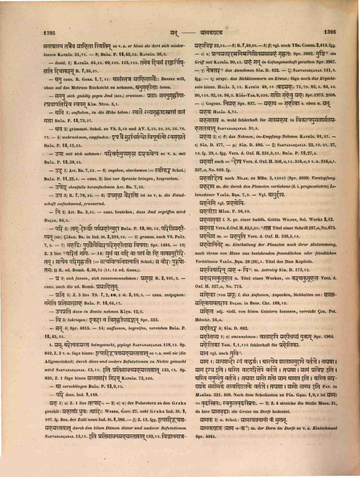
graha 1〉a〉 Z. 1 lies tatpāda-. — 2〉a〉α〉 der Polarstern zu den Graha gezählt: grahāṇāṃ dhruvaḥ (ādiḥ) WEBER, JYOT. 27. acht Graha Ind. St. 9,107. fg. Bez. der Zahl neun Ind. St. 8,386. — β〉 Z. 13. fgg. ityādidūṣaṇagrahagrastatvāt durch den bösen Dämon dieser und anderer Refutationen SARVADARŚANAS. 13,11. iti pratisādhanagrahagrastatvāt SARVADARŚANAS. 133,15. vijñānamātragrahāviṣṭa SARVADARŚANAS. 22,10. — δ〉 R. 7,40,30. — b〉β〉 vgl. noch TBR. Comm. 2,414. fgg. — c〉α〉 pratyagrakṣaradasramiśrapiśitagrāsagrahaṃ gṛhṇataḥ Spr. 3662. muṣṭi˚ ein Griff mit KATHĀS. 90,45. grahaṃ gam in Gefangenschaft gerathen Spr. 3987. — γ〉 netrantara˚ das Annehmen SĀH. D. 422. — ζ〉 SARVADARŚANAS. 111,6. fgg. — η〉 urspr. das Sichklammern an Etwas; füge noch das Erpichtsein hinzu. HALĀY. 5,55. KATHĀS. 49,16 (baddhagraha). KATHĀS. 71,79. KATHĀS. 83,4. KATHĀS. 84,40. KATHĀS. 90,138. KATHĀS. 92,58. KATHĀS. 94,3. RĀJA-TAR. 8,226. gāḍho gṛheṣu grahaḥ Spr. 1973. Spr. 2008. — ι〉 Gegens. nigraha Spr. 837. — grahāya = gṛhītvā s. oben u. grabh.
Originaltext · Deutsch · Worttyp nicht bestimmt
graha 2〉c〉ε〉 ebend. 7,58,a. b.
Böhtlingk 1879 Adjektiv · Substantiv Maskulin
Originaltext · Deutsch · Adjektiv · Substantiv Maskulin
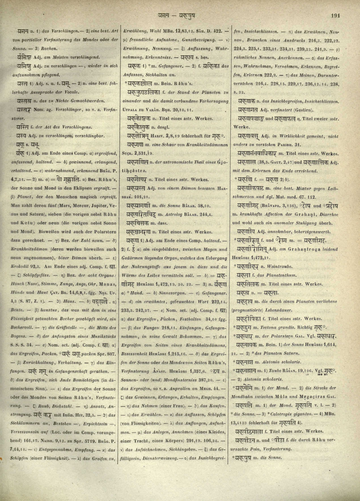
gráha — 1〉 Adj. am Ende eines Comp. — a〉 ergreifend, anfassend, haltend. — b〉 gewinnend, erlangend, erhaltend. — c〉 wahrnehmend, erkennend BHĀG. P. 4,7,31. — 2〉 m. — a〉 = yo gṛhṇāti — α〉 Bez. Rāhuʼs, der Sonne und Mond in den Eklipsen ergreift. — β〉 Planet, der den Menschen magisch ergreift. Man zählt deren fünf (Mars, Mercur, Jupiter, Venus und Saturn), sieben (die vorigen nebst Rāhu und Ketu) oder neun (die vorigen nebst Sonne und Mond). Bisweilen wird auch der Polarstern dazu gerechnet. — γ〉 Bez. der Zahl neun. — δ〉 Krankheitsdämon (deren werden bisweilen auch neun angenommen), böser Dämon überh. — ε〉 Krokodil Chr. 92,3. Am Ende eines adj. Comp. f. ā. — ζ〉 Schöpfgefäss. — η〉 Bez. der acht Organe: Hauch (Nase), Stimme, Zunge, Auge, Ohr, Manas, Hände und Haut ŚAT. BR. 14,6,2,1. fgg. NṚS. UP. 4,3 (S. 87, Z. 1). — ϑ〉 Haus. — b〉 yadgṛhyate. — α〉 Beute. — β〉 haustus, das was mit dem in eine Flüssigkeit getauchten Becher geschöpft wird, ein Bechervoll. — γ〉 die Griffstelle —, die Mitte des Bogens. — δ〉 der Anfangston eines Musikstücks S. S. S. 34. — c〉 Nom. act. (adj. Comp. f. ā) — α〉 das Ergreifen, Packen. ˚grahaṃ grah packen Spr. 807. — β〉 Zurückhaltung, Verhaltung. — γ〉 das Einfangen. grahaṃ gam in Gefangenschaft gerathen. — δ〉 das Ergreifen, sich Jmds Bemächtigen (in dämonischem Sinn). — ε〉 das Ergreifen der Sonne oder des Mondes von Seiten Rāhuʼs, Verfinsterung. — ζ〉 Raub, Diebstahl. — η〉 Ansatz, Anstrengung. grahaṃ kar mit Infin. HIT. 32,5. — ϑ〉 das Sichklammern an, Bestehen —, Erpichtsein —, Versessensein auf (Loc. oder im Comp. vorangehend) Chr. 161,17. NAIṢ. 9,12. zu Spr. 5719. BHĀG. P. 7,14,11. — ι〉 Entgegennahme, Empfang. — ϰ〉 das Schöpfen (einer Flüssigkeit). — λ〉 das Greifen zu, [Page2-191-b] Erwählung, Wahl MBH. 12,83,12. SĀH. D. 422. — μ〉 freundliche Aufnahme, Gunstbezeigung. — ν〉 Erwähnung, Nennung. — ξ〉 Auffassung, Wahrnehmung, Erkenntniss. — grahāya s. bes.
Apte 1890 Substantiv Maskulin
Originaltext · Englisch · Substantiv Maskulin
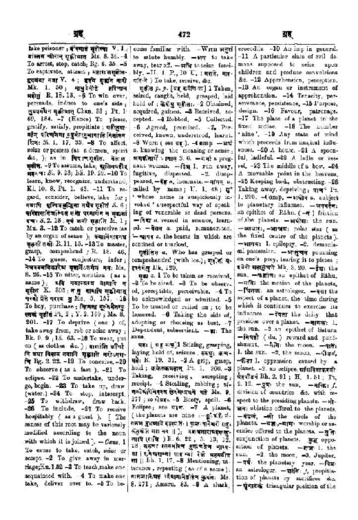
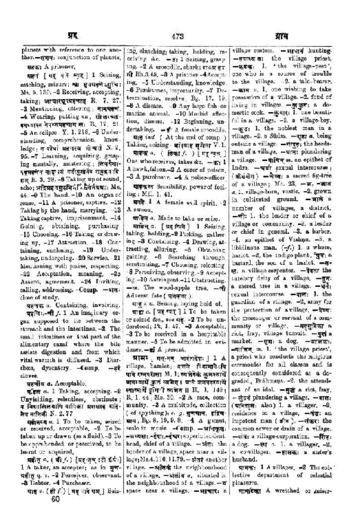
grahaḥ [grah ac] 1 Seizing, grasping, laying hold of, seizure, rurudhuḥ kacagrahaiḥ R. 19. 31. 2 A grip, grasp, hold; karkaṭakagrahāt Pt. 1. 260. 3 Taking, receiving, accepting; receipt. 4 Stealing, robbing; aṃgalīgraṃthibhedasya chedayetprathame grahe Ms. 9. 277; so gograhaḥ. 5 Booty, spoil. 6 Eclipse; see grahaṇa. 7 A planet, (the planets are nine: — sūryaścaṃdro maṃgalaśca budhaścāpi bṛhaspatiḥ . śukraḥ śanaiścaro rāhuḥ ketuśceti grahā nava ..); nakṣatratārāgrahasakulāpi (rātri) R. 6. 22, R. 3. 13; R. 12. 28; garuṇā stanabhareṇa mukhacaṃdreṇa bhāsvatā . śanaiścarābhyāṃ pāda bhyāṃ reje grahamayīva sā .. Bh. 1. 17. 8 Mentioning; utterance, repeating (as of a name); nāmajātigrahaṃ tveṣāmabhidroheṇa kurvataḥ Ms. 8. 271; Amaru. 83. 9 A shark, ([Page 0472-c]) crocodile. 10 An imp in general. 11 A particular class of evil demons supposed to seize upon children and produce convulsions &c. 12 Apprehension, perception. 13 An organ or instrument of apprehension. 14 Tenacity, perseverance, persistence. 15 Purpose, design. 16 Favour, patronage. 17 The place of a planet in the fixed zodiac. 18 The number ‘nine’. 19 Any state of mind which proceeds from magical influences. 20 A house. 21 A spoonful, ladleful. 22 A ladle or vessel. 23 The middle of a bow. 24 A moveable point in the heavens. 25 Keeping back, obstructing. 26 Taking away, depriving; prāṇa˚ Pt. 1. 295. Comp. — adhīna a. subject to planetary influence. — avamardanaḥ an epithet of Rāhu. — (naṃ) friction of the planets. — adhīśaḥ the sun. — ādhāraḥ, -āśrayaḥ polar star (as the fixed centre of the planets). — āmayaḥ 1 epilepsy. 2 demoniacal possession. — āluṃcanaṃ pouncing on one's prey, tearing it to pieces; śyeno grahāluṃcane Mk. 3. 20. — īśaḥ the sun. — kallālaḥ an epithet of Rāhu. — gatiḥ the motion of the planets. — ciṃtakaḥ an astrologer. — daśā the aspect of a planet, the time during which it continues to exercise its influence. — devatā the deity that presides over a planet. — nāyakaḥ 1 the sun. 2 an epithet of Saturn — nigrahau (du.) reward and punishment. — nemiḥ the moon. — patiḥ 1 the sun. 2 the moon. — pīḍanaṃ, — pīḍā 1 oppression caused by a planet. 2 an eclipse; śaśidivākarayorgrahapīḍanaṃ Bh. 2. 91; H. 1. 51; Pt. 2. 19. — puṣaḥ the sun. — bhaktiḥ f. division of countries &c. with respect to the presiding planets. — bhojanaḥ oblation offered to the planets. — maṃḍalaṃ, -lī the circle of the planets. — yajñaḥ, -yāgaḥ worship or sacrifice offered to the planets. — yutiḥ conjunction of planets. yuddha opposition of planets. — rājaḥ 1 the sun. 2 the moon. 3 Jupiter. — varṣaḥ the planetary year. — vipraḥ an astrologer. — śātiḥ f., propitiation of planets by sacrifices &c. — śṛṃgāṭakaṃ triangular position of the ([Page 0473-a]) planets with reference to one another. — saṃgamaḥ conjunction of planets.
Cappeller 1887 Worttyp nicht bestimmt
Originaltext · Deutsch · Worttyp nicht bestimmt
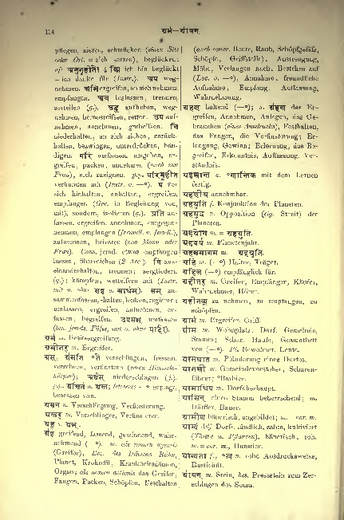
gráha greifend, fassend, gewinnend, wahrnehmend (—˚) m. als nomen agentis (Greifer), Bez. des Dämons Rāhu, Planet, Krokodil, Krankheitsdämon, Organ; als nomen actionis das Greifen, Fangen, Packen, Schöpfen, Festhalten [Page114-2] (auch concr. Beute, Raub, Schöpfgefäß, Schöpfe, Grifßtelle), Anstrengung, Mühe, Verlangen nach Bestehen auf (Loc. o. —˚), Annahme, freundliche Aufnahme, Empfang, Auffassung, Wahrnehmung.
Burnouf 1866 Substantiv Maskulin
Originaltext · Französisch · Substantiv Maskulin
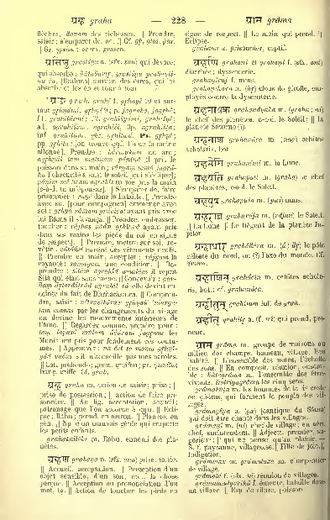
graha graha m. action de saisir; prise; prise de possession; action de faire prisonnier. Au fig. acceptation, accueil; patronage que l'on accorde à qqn. Eclipse; Rāhu; nœud, en astron. Planète, en gén. Np. d'un mauvais génie qui emporte les petits enfants. grahakallola m. Rāhu, ennemi des planètes.
Quelltextfundstellen (10)
DYS 1 Fundstelle
HP 3 Fundstellen
SiSa 6 Fundstellen
SiSa 3.41-3.48: Atemkraft und Hindernisse 2 Fundstellen
Direkt belegt
Mit AYI Free weitermachen
Bildquelle: AYI Archiv.