

pṛthivī पृथिवी – Erde; Erde hinaus
Substantiv Feminin · Worttyp nicht bestimmt
Wörterbuchquellen
AYI Wörterbuch Substantiv Feminin
Erde; Erde hinaus
Cappeller 1891 Substantiv Feminin
Originaltext · Englisch · Substantiv Feminin
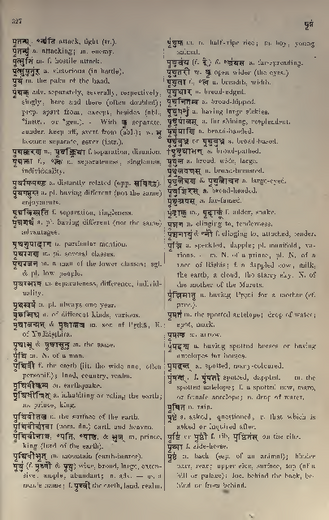
pṛthivī́ ·f. the earth (lit. the wide one, often personif.); land, country, realm.
Monier-Williams 1872 Substantiv Feminin · Worttyp nicht bestimmt
Originaltext · Englisch · Substantiv Feminin
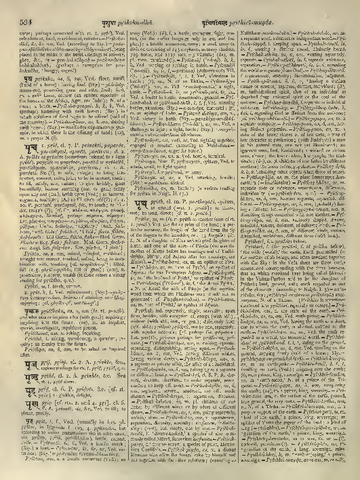
Pṛthivī, f. (for pṛthvī, f. of pṛthu below), ‘the wide (world),’ the earth, Earth personified (as the mother of all beings, and often invoked together with the Sky; in the Veda there are three earths enumerated corresponding with the three heavens, that on which mankind lives being called bhūmi; in the Viṣṇu-Purāṇa said to be the daughter of Pṛthu); land, ground, soil; earth regarded as one of the elements; (according to Naigh. I. 3) = anta- rikṣa, sky; pṛthivyā vratam or pṛthivyāḥ saṃ- sarpam, N. of a Sāman. [Pṛthivī is sometimes shortened into pṛthivi, especially in comps.]
Originaltext · Englisch · Worttyp nicht bestimmt
pṛthivī pṛthivī. See p. 594, col. 3.
Petersburger 1855 Substantiv Feminin · Worttyp nicht bestimmt
Originaltext · Deutsch · Substantiv Feminin
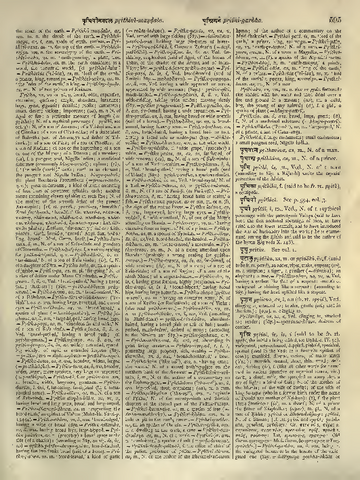
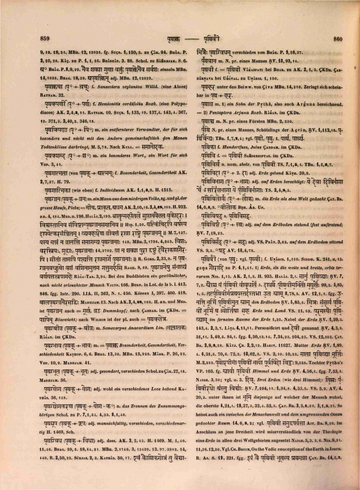
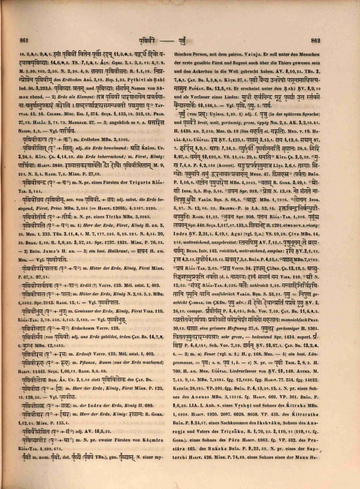
pṛthivī́ (von pṛthu; vgl. pṛthvī) f. UṆĀDIS. 1,150. SIDDH. K. 241,a,13. gaṇa gaurādi zu P. 4,1,41. 1〉 Erde, als die weite und breite, orbis terrarum NIR. 1,13. AK. 2,1,3. H. 935. HALĀY. 2,1. sānù pṛthi̱vyāḥ ṚV. 7,7,2. dyauśca̱ yaṃ pṛ̀thi̱vī vā̀vṛ̱dhātè 5. dā̱dharthà pṛthi̱vīma̱bhitò ma̱yūkhaìḥ ṚV. 99,3. ṚV. 5,85,1. ṚV. 7,5. tatpṛ̀thi̱vīmàprathaya̱stadàstabhnā u̱ta dyām ṚV. 8,78,5. AV. 12,1,1. fgg. u̱natti̱ bhūmìṃ pṛthi̱vīmu̱ta dyām den Erdboden ṚV. 5,85,4. mi̱traḥ sa̱ṃsṛjyà pṛthi̱vīṃ bhūmìṃ ca̱ jyotìṣā sa̱ha Erde und Land VS. 11,53. pa̱ra̱masyā̀ṃ pṛthi̱vyām im fernsten Raume der Erde VS. 1,25. Nabel der Erde ṚV. 1,59,2. ṚV. 1,143,4. ṚV. 2,3,7. LĀṬY. 4,11,11. Personificirt und devī genannt ṚV. 4,3,5. fgg. ṚV. 4,51,11. ṚV. 5,49,5. fgg. ṚV. 5,84,1. ṚV. 6,50,13. fgg. ṚV. 6,50,14. ṚV. 7,34,23. fgg. ṚV. 7,104,23. VS. 12,103. ŚAT. BR. 3,8,3,28. KĀTY. ŚR. 2,2,12. HARIV. 11627. Mutter Erde ṚV. 1,89,4. ṚV. 6,51,5. ṚV. 6,70,6. ṚV. 6,72,2. ṚV. 10,62,3. VS. 2,10. VS. 10,23. mātā pṛthivyā mūrtiḥ M. 2,225. pṛthorapīmāṃ pṛthivīṃ bhāryāṃ pūrvavido viduḥ M. 9,238. Tochter Pṛthuʼs VP. 103. fg. dyāvā̀ pṛthi̱vī Himmel und Erde ṚV. 4,56,1. fgg. ṚV. 7,53,1. NAIGH. 3,30; vgl. u. 3. div. Drei Erden (wie drei Himmel): ti̱sraḥ pṛ̀thi̱vīra̱dho àstu̱ viśvā̀ḥ ṚV. 7,104,11. ṚV. 1,34,8. ṚV. 4,53,5. VS. 5,9. AV. 4,20,2. unter ihnen ist bhūmi diejenige auf welcher der Mensch wohnt, die oberste AV. 6,21,1. AV. 19,27,3. AV. 19,32,4. AV. 19,53,5. ŚAT. BR. 3,5,1,31. ŚAT. BR. 5,1,5,21. So heisst auch ein zwischen der Menschenwelt und dem umgrenzenden Ocean gedachter Raum ŚAT. BR. 14,6,3,2; vgl. pṛthivī samudraparyantā AIT. BR. 8,20. Im Anschluss an jene Dreiheit wird missverständlich von der Theologie eine Erde in allen drei Weltgebieten angesetzt NAIGH. 5,3. NAIGH. 5,5. NAIGH. 5,6. NIR. 9,31. NIR. 11,36. NIR. 12,30. Vgl. CH. BRUCE, On the Vedic conception of the Earth in Journ. R. As. S. 19,321. fgg. iyaṃ vai pṛthivī bhūtasya prathamajā ŚAT. BR. 14,1,2,10. ŚAT. BR. 14,5,5,1. ŚAT. BR. 14,9,4,1. imāṃ pṛthivīṃ vittena pūrṇāṃ dadan ŚAT. BR. 11,5,6,3. yadūrdhvaṃ divo yadavākpṛthivyāḥ ŚAT. BR. 14,6,8,3. TS. 7,1,5,1. ĀŚV. GṚHY. 2,4. ĀŚV. GṚHY. 3,3. ĀŚV. GṚHY. 3,11. ĀŚV. GṚHY. 4,7. ĀŚV. GṚHY. 4,9. M. 1,99. M. 1,105. M. 2,20. N. 2,20. N. 4,9. kṣamayā pṛthivīsamaḥ R. 1,1,19. nighnanprothena pṛthivīm den Erdboden ARJ. 3,19. HIḌ. 1,33. Pṛthivi als Ṛṣi Ind. St. 3,223,b. pṛthivyā vratam und pṛthivyāḥ saṃsarpam Namen von Sāman ebend. — 2〉 Erde als Element: tatra pṛthivī dhāraṇabhāvena pravartamānā caturṇāmupakāraṃ karoti . śabdasparśarūparasagandhavatī pañcaguṇā pṛ˚ TATTVAS. 15. TATTVAS. 16. COLEBR. Misc. Ess. I, 374. SUŚR. 1,135,18. SUŚR. 1,313,19. PRAB. 27,19. HALĀY. 5,71. HALĀY. 5,73. MADHYAM. 57. — 3〉 angeblich so v. a. antarikṣa NAIGH. 1,3. — Vgl. pārthiva.
Originaltext · Deutsch · Worttyp nicht bestimmt
pṛthivī 2〉 ˚kāya SARVADARŚANAS. 35,12. ˚kāyaka 13. ˚jīva 14.
Böhtlingk 1879 Substantiv Feminin
Originaltext · Deutsch · Substantiv Feminin
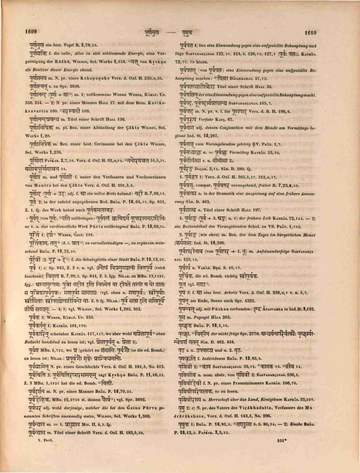
pṛthivī́ f. — 1〉 die Erde, als die weite und breite, orbis terrarum. Es wird von drei Erden (der von uns bewohnten und zwei darunter liegenden) geredet, von einer zwischen der Menschenwelt und dem umgrenzenden Ocean gelegenen, und schliesslich von einer in allen drei Weltgebieten. Die Erde wird auch als Göttin personificirt. — 2〉 Land, Reich. — 3〉 Erdboden. — 4〉 Erde als Element. — 5〉 *Luftraum.
Apte 1890 Substantiv Feminin
Originaltext · Englisch · Substantiv Feminin
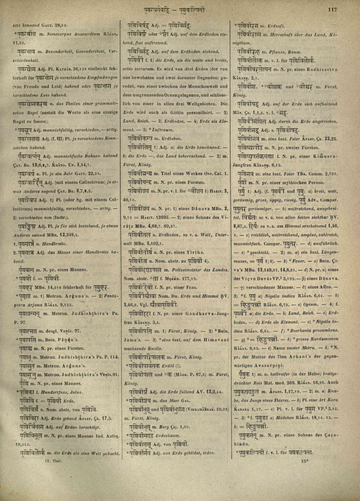
pṛthivī [cf. Uṇ. 1. 184] 1 The earth; (sometimes written pṛthivi also) 2 Ground, soil. 3 The earth considered as one of the nine substances or five primary elements. Comp. — iṃdraḥ, -īśaḥ, -kṣit m., — pālaḥ, — pālakaḥ, -bhuj m., — bhujaḥ, -śukraḥ a king. — talaṃ the surface of the earth. — patiḥ 1 a king. 2 Yama, the god of death. — bhaṃḍalaḥ, -laṃ the circuit of the earth. — ruhaḥ a tree: pavamānaḥ pṛthivīruhāniva R. 8. 9. — lokaḥ terrestrial world, the earth.
Cappeller 1887 Substantiv Feminin
Originaltext · Deutsch · Substantiv Feminin
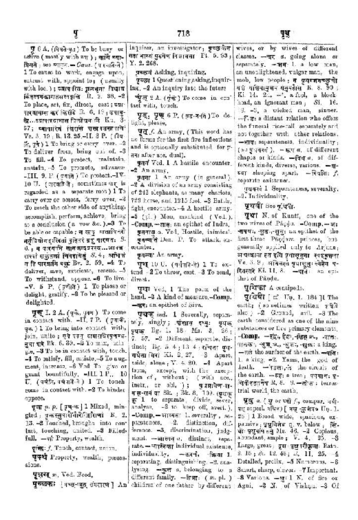
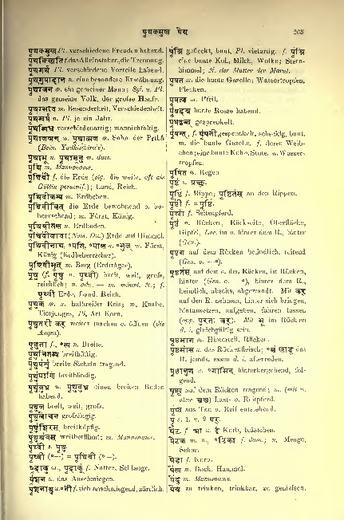
pṛthívī f. die Erde (eig. die weite, oft als Göttin personif.); Land, Reich.
Burnouf 1866 Worttyp nicht bestimmt
Originaltext · Französisch · Worttyp nicht bestimmt
pṛthivī pṛthivī (f. de pṛthu) la terre. pṛtivītala n. le sol. pṛthivīpati m. roi, maître de la terre. Yama. Sorte de drogue. [Page422-2] pṛthivīpāla m. (c. de pā) roi, gardien de la terre.

Quelltextfundstellen (11)
DYS 2 Fundstellen
HTK 1 Fundstelle
SiSa 5 Fundstellen
Mit AYI Free weitermachen
Bildquelle: AYI Archiv.