

rudra रुद्र – rudra
adjective · substantive masculine · Word type unspecified
Dictionary sources
AYI dictionary substantive masculine
rudra
Cappeller 1891 adjective
Original text · English · adjective
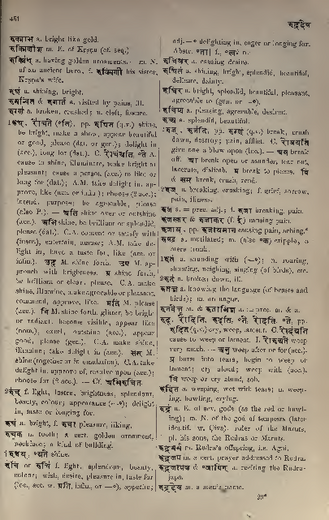
rudrá ·a. E. of sev. gods (as the red or howling); m. N. of the god of tempests (later identif. w. Śiva), ruler of the Maruts, pl. his sons, the Rudras or Maruts.
Monier-Williams 1872 adjective · Word type unspecified
Original text · English · adjective
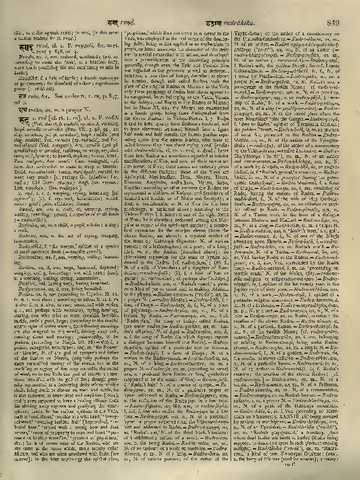
Rudra, as, ā, am (according to Uṇādi-s. II. 22. fr. rt. 1. rud above; according to others fr. rt. 1. ru + dra fr. rt. 2. dru, to run; connected with rodas, q. v., and perhaps with rudhira), crying, howling, roaring, one who cries or roars, dreadful, horrible, terrific, awful; great, large; (according to the fanciful etymologies of native writers, the following meanings are also assigned to this word), driving away evil; running about and roaring; praiseworthy, to be praised, (according to Naigh. III. 16) = stotṛ, a praiser, panegyrist, worshipper; (as), m. ‘the Roarer’ or ‘Howler,’ N. of the god of tempests and father of the Rudras or Maruts, (originally perhaps the mere personified roaring of the storms, but as the crackling or raging of fire may resemble the sound of wind, so in the Veda the god of storms is some- times identified with the god of fire; though gene- rally represented as a destroying deity whose terrible shafts bring death or disease on men and cattle, he is also addressed as benevolent and auspicious [śiva], and is even supposed to have a healing efficacy from his chasing away vapours and purifying the atmo- sphere; hence he has various epithets in the Veda, such as ‘multiform,’ ‘terrible as a wild beast,’ ‘tawny- coloured,’ ‘wearing braided hair’ [kapardin], ‘ce- lestial boar,’ ‘armed with a strong bow and fleet arrows,’ ‘cause of prosperity to man and beast,’ ‘pos- sessor of healing remedies,’ ‘greatest of physicians,’ &c.; he is of course ruler of the Rudras, who are the same as the storm winds, more usually called Maruts, and who are often associated with Indra [see marut]: in the later mythology the epithet śiva, ‘propitious,’ which does not occur as a name in the Veda, was employed as the real name of the destroy- ing deity, being at first applied as an euphemism to propitiate him: moreover the character of the deity lost its special connection with storms, and developed into a personification of the destroying principle generally, though even the Epic and Purānic Śiva was regarded as the generator as well as destroyer: moreover a new class of beings, described as eleven in number, though still called Rudras, took the place of the original Rudras or Maruts: in the Veda only three groupings of deities into classes appear to be recognised, Indra belonging to the Vasus, Varuṇa to the Ādityas, and Rudra to the Rudras or Maruts; but in Manu XI. 221. the Maruts are enumerated as a fourth group, being there distinguished from the eleven Rudras: in Viṣṇu-Purāṇa I. 7. Rudra is said to have sprung from Brahmā's forehead, and to have afterwards separated himself into a figure half male and half female, the former portion sepa- rating again into the eleven Rudras, who were so called because they ‘ran about crying aloud’ [ruda- nād drāvaṇāc-ca, cf. rts. 1. rud, 2. dru]; hence these later Rudras are sometimes regarded as inferior manifestations of Śiva, and most of their names are also names of Śiva; these names are variously given in the different Purāṇas; those of the Vāyu are Ajaikapād, Ahvi-bradhna, Hara, Nir-ṛta, Īśvara, Bhuvana, Aṅgāraka, Ardha-ketu, Mṛtyu, Sarpa, Kapālin: according to other accounts the Rudras are represented as children of Kaśyapa and Surabhī or of Brahmā and Surabhī or of Bhūta and Su-rūpā); a form or manifestation or N. of Śiva (in the later mythology, as explained above; according to the Viṣṇu-Purāṇa I. 8. Rudra is one of the eight forms of Śiva; he is elsewhere reckoned among the Dik- pālas as regent of the north-east quarter); a symbo- lical expression for the number eleven (from the eleven Rudras, see above); a mystical epithet of the letter e; Calotropis Gigantea; N. of various persons; of a lexicographer; of a poet; of a king; (ās), m. pl. the Rudras (described above); an abbreviated expression for the texts or hymns ad- dressed to the Rudras [cf. rudra-japa]; (ā), f., N. of a wife of Vasu-deva; of a daughter of Rau- drāśva; = rudra-jaṭā; (ī), f. a kind of lute or guitar; [cf. rudra-vīṇā; cf. perhaps also Gr. λύρα.]
Original text · English · Word type unspecified
rudra rudra. See p. 849, col. 1.
Petersburger 1855 adjective · substantive masculine
Original text · German · adjective · substantive masculine
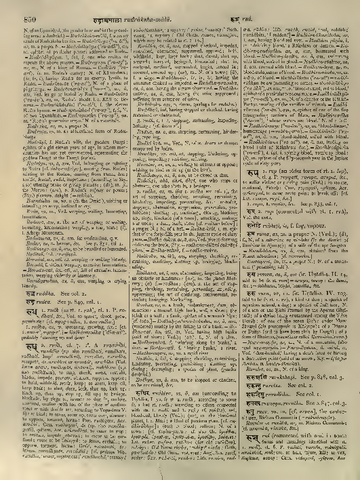
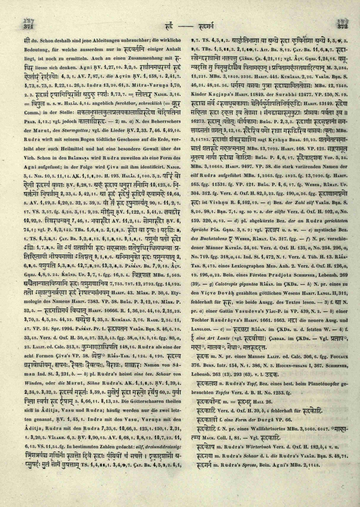
rudrá UṆĀDIS. 2,22. 1〉 adj. nach den Comm. von ru oder rud mit oder ohne dra (= dru) u. s. w. heulend, heulen machend, mit Gebrüll laufend, schrecklich; oder Uebel vertreibend, zu preisen u. s. w. Nach unserer Ansicht hängt das Wort wurzelhaft zusammen nicht bloss mit rodasī́, das die Comm. selbst als fem. zu rudra kennen, sondern auch mit ródasī du. Schon deshalb sind jene Ableitungen unbrauchbar; die wirkliche Bedeutung, für welche ausserdem nur in rudravartani einiger Anhalt liegt, ist noch zu ermitteln. Auch an einen Zusammenhang mit rudhira liesse sich denken. Agni ṚV. 1,27,10. ṚV. 3,2,5. rājā̀namadhva̱rasyà ru̱draṃ hotā̀ra̱ṃ rodàsyoḥ ṚV. 4,3,1. AV. 7,87,1. die Aśvin ṚV. 1,158,1. ṚV. 2,41,7. ṚV. 5,73,8. ṚV. 5,75,3. ṚV. 8,22,14. ṚV. 8,26,5. Indra ṚV. 13,20. ṚV. 61,3. Mitra-Varuṇa ṚV. 5,70,2. ṚV. 5,70,3. ru̱drāsà eṣāmiṣi̱rāsò a̱druha̱ spaśàḥ ṚV. 9,73,7. = stotar NAIGH. 3,16. = vipula u. s. w. HALĀY. 4,14. angeblich furchtbar, schrecklich (= krūra Comm.) in der Stelle: sakalabhūṣālakulapralayakālāgnirudreṇa cedipatinā PRAB. 4,12.; vgl. jedoch kālāgnirudra. — 2〉 m. a〉 N. des Beherrschers der Marut, des Sturmgottes; vgl. die Lieder ṚV. 2,33. ṚV. 7,46. ṚV. 6,49,10. Rudra wirft mit seinem Bogen tödtliche Geschosse auf die Erde, verleiht aber auch Heilmittel und hat eine besondere Gewalt über das Vieh. Schon in den BRĀHMAṆA wird Rudra zuweilen als eine Form des Agni aufgefasst; in der Folge wird Śiva mit ihm identificirt. NAIGH. 5,4. NIR. 10,5. NIR. 11,14. AK. 1,1,1,30. H. 195. HALĀY. 1,100. HALĀY. 5,2. parì vo he̱tī ru̱drasyà vṛjyāḥ ṚV. 6,28,7. a̱haṃ ru̱drāya̱ dhanu̱rā tànomi ṚV. 10,125,6. bhi̱ṣaktàmo bhi̱ṣajā̀m ṚV. 2,33,4. ṚV. 5,42,11. ā ru̱draṃ ru̱dreṣù ru̱driyàṃ havāmahe ṚV. 10,64,8. AV. 1,19,3. AV. 6,20,2. AV. 6,32,2. AV. 6,59,3. yāṃ tè ru̱dra iṣu̱māsyàt AV. 90,1. AV. 11,2,7. AV. 1,17. VS. 3,57. fg. VS. 4,20. VS. 5,11. fg. VS. 9,39. mīḍhvaṃs ṚV. 1,122,1. ṚV. 5,41,2. kṣayadvīra ṚV. 10,92,9. sthiradhanvan ṚV. 7,46,1. bhavārudrau AV. 11,2,14. somārudrau ṚV. 6,74,1; vgl. P. 6,2,142. TBR. 1,6,1,2. TBR. 2,1,1,3. ru̱dro vā e̱ṣaḥ . yada̱gniḥ TBR. 3,1. TS. 6,3,5,1. ŚAT. BR. 5,2,4,13. ŚAT. BR. 6,1,3,10. ŚAT. BR. 9,1,1,1. paśūnāṃ patī rudro 'gniḥ ŚAT. BR. 1,7,3,8. so 'yaṃ śataśīrṣā rudraḥ sahasrākṣaḥ śateṣudhiradhijyadhanvā pratihitāyī bhīṣayamāṇo 'tiṣṭhat ŚAT. BR. 9,1,1,6. abhimānuko rudraḥ paśūnsyāt ŚAT. BR. 2,6,2,6. paśupati ŚAT. BR. 5,3,3,6. ŚAT. BR. 12,7,3,20. ŚAT. BR. 13,3,4,3. PAÑCAV. BR. 7,9,18. ĀŚV. GṚHY. 4,8,9. ĀŚV. GṚHY. 4,8,24. CHĀND. UP. 3,7,1. fgg. CHĀND. UP. 3,16,3. fgg. CHĀND. UP. 3,7,4. virūpākṣa MBH. 1,569. adyaitānpātayiṣyāmi rudraḥ paśugaṇāniva MBH. 7,755. MBH. 7,787. MBH. 12,2792. fgg. MBH. 14,192. tato 'sṛjatpunarbrahmā rudraṃ roṣātmasaṃbhavam HARIV. 43. MĀRK. P. 50,6. Etymologie des Namens HARIV. 7583. VP. 58. BHĀG. P. 3,12,10. MĀRK. P. 52,5. — rudramagnimayaṃ vidyāt HARIV. 10666. R. 1,36,20. R. 1,44,10. R. 2,31,29. R. 3,70,2. R. 4,5,30. R. 4,44,52. amareśa R. 6,35,3. KUMĀRAS. 3,76. RAGH. 2,54. RAGH. 11,47. VP. 51. Spr. 1994. PAÑCAT. Pr. 1. rudrāyatana VARĀH. BṚH. S. 46,6. VARĀH. BṚH. S. 46,10. VARĀH. BṚH. S. 53,48. Verz. d. Oxf. H. 50,a,37. fgg. Verz. d. Oxf. H. 53,b,43. Verz. d. Oxf. H. 58,a,18. fgg. Verz. d. Oxf. H. 58,b,16. fgg. Verz. d. Oxf. H. 80,a,25. LALIT. ed. Calc. 313,8. kumbhāṇḍādhipati LALIT. ed. Calc. 148,16. Rudra als eine der acht Formen Śivaʼs VP. 58. jyeṣṭha˚ RĀJA-TAR. 1,124. RĀJA-TAR. 4,190. rudrasya jarābodhīyam, ṛṣabhaḥ, raivataḥ (raivatyaḥ), vairājaḥ, śākvaraḥ Namen von Sāman Ind. St. 3,231,b. — b〉 pl. Rudraʼs heisst eine bes. Schaar von Winden, oder die Marut, Söhne Rudraʼs. AK. 1,1,1,5. ṚV. 1,39,4. ṚV. 2,34,9. ṚV. 3,32,2. ru̱drasyà ma̱rutàḥ ṚV. 5,59,8. su̱kheṣù ru̱drā ma̱ruto̱ rathèṣu ṚV. 5,60,2. yuvā̀ pi̱tā svapā̀ ru̱dra èṣām ṚV. 5,60,5. ṚV. 6,66,11. ṚV. 8,13,28. Die Götterschaaren theilen sich in Āditya, Vasu und Rudra; häufig werden nur die zwei letzten genannt, ṚV. 1,45,1. Indra mit den Vasu, Varuṇa mit den Āditya, Rudra mit den Rudra ṚV. 7,35,6. ṚV. 10,66,3. ṚV. 10,125,1. ṚV. 10,150,1. ṚV. 2,31,1. ṚV. 3,20,5. VĀLAKH. 6,3. ṚV. 8,90,15. AV. 6,68,1. AV. 8,8,12. AV. 10,7,22. AV. 11,6,13. VS. 11,54. fg. In bestimmten Zahlen gedacht: eilf, dreiunddreissig: tri̱ṃśatrayàśca ga̱ṇinò ru̱janto̱ divàṃ ru̱drāḥ pṛ̀thi̱vīṃ cà sacante . e̱kā̱da̱śāsò apsu̱ṣadàḥ su̱taṃ somàṃ juṣantām TS. 1,4,11,1. TS. 3,4,9,7. ŚAT. BR. 4,5,7,2. ŚAT. BR. 6,1,2,7. TS. 4,5,1,2. āhùtibhāgā̱ vā a̱nye ru̱drā ha̱virbhā̀gā a̱nye TS. 5,5,9,3. TS. 5,5,2,6. TBR. 1,5,11,3. TBR. 2,1,10,1. AIT. BR. 8,12. ŚAT. BR. 11,6,3,7. rudrāstvendrarājāno bhakṣayantu ŚĀṄKH. ŚR. 4,21,11; vgl. ĀŚV. GṚHY. 1,24,16. vasūnvadanti tu pitṝnrudrāṃścaiva pitāmahān . prapitāmahāṃstathādityān M. 3,284. M. 11,221. MBH. 3,1840. MBH. 3,2356. HARIV. 441. KUMĀRAS. 2,26. VARĀH. BṚH. S. 46,31. VARĀH. BṚH. S. 48,26. VARĀH. BṚH. S. 48,56. dharmasya vasavaḥ putrā rudrāścāmitatejasaḥ MBH. 12,7540. Kinder Kaśyapaʼs HARIV. 11849. der Surabhi HARIV. 12477. VP. 150, N. 19. rudrāśca sarve 'ruṇadhūmrakāyāḥ śvetairyayurgopatibhirbṛhadbhiḥ HARIV. 13149. rudreṇa sahitā rudrā dahanta iva tejasā . saṃnaddhāścārumukuṭāḥ prāṃsavaḥ parvatā iva .. HARIV. 16273. rudrān (yajet) vīryakāmaḥ BHĀG. P. 2,3,3. rudrāṇāṃ rudrasṛṣṭānāṃ samantādgrasatāṃ jagat BHĀG. P. 3,12,16. rudrairiva yamo rājā marudbhiriva vāsavaḥ (vṛtaḥ) MBH. 3,14782. rudrāṇāṃ śaṃkaraścāsmi sagt Kṛṣṇa BHAG. 10,23. śatametatsamāmnātaṃ śatarudre mahātmanām MBH. 13,7092. HARIV. 168. VP. 121. sarūpāsūta bhūtasya bhāryā rudrāṃśca koṭiśaḥ BHĀG. P. 6,6,17. rudraikādaśaka VOP. 5,34. MBH. 3,10668. HARIV. 9497. VP. 58. die stark varirenden Namen der eilf Rudra aufgeführt MBH. 1,2565. fgg. MBH. 1,4825. fg. MBH. 13,7090. fg. HARIV. 165. fgg. HARIV. 11531. fg. VP. 121. BHĀG. P. 6,6,17. fg. WEBER, RĀMAT. UP. 304. WEBER, RĀMAT. UP. 312. fg. Verz. d. Oxf. H. 82,b,22. fgg. Verz. d. Oxf. H. 190,a,36. fgg. rudrāṇāmaṣṭamo rudraḥ ist Viṣṇu R. 6,102,19. — c〉 Bez. der Zahl eilf VARĀH. BṚH. S. 8,20. VARĀH. BṚH. S. 98,1. BṚH. 7,1. sg. so v. a. der eilfte Verz. d. Oxf. H. 102,a, No. 159. Verz. d. Oxf. H. 320,a,12. — d〉 pl. abgekürzte Bez. der an Rudra gerichteten Sprüche PĀR. GṚHY. 3,8. PĀR. GṚHY. 3,9; vgl. rudrajapa u. s. w. — e〉 mystische Bez. des Buchstabens e WEBER, RĀMAT. UP. 317. fgg. — f〉 N. pr. verschiedener Männer KATHĀS. 54,86. Verz. d. Oxf. H. 135,a, No. 254. fgg. Verz. d. Oxf. H. 296,a, No. 719. fgg. Verz. d. Oxf. H. 318,a,44. Ind. St. 1,472, N. 1. Verz. d. Tüb. H. 13. RĀJA-TAR. 8,475. eines Lexicographen MED. Anh. 2. Verz. d. Oxf. H. 126,a,19. Verz. d. Oxf. H. 196,a,22. Bein. eines Fürsten Pradyota SCHIEFNER, Lebensb. 269 (39). — g〉 Calotropis gigantea RĀJAN._im_ŚKDR. — h〉 N. pr. eines zu den Viśve Devāḥ. gezählten göttlichen Wesens HARIV. LANGL. II, 311, fehlerhaft für ruru, wie beide Ausgg. des Textes lesen. — 3〉 f. ā N. pr. a〉 einer Gattin Vasudevaʼs VĀYU-P._in_VP. 439, N. 2. — b〉 einer Tochter Raudrāśvaʼs HARIV. 1661. HARIV. 1663. bhadrā die neuere Ausg. und LANGLOIS. — c〉 = rudrajaṭā RĀJAN._im_ŚKDR. u. d. letzten W. — 4〉 f. ī eine Art Laute (vgl. rudravīṇā) ŚABDAR._im_ŚKDR. — Vgl. pratāpa˚, mahā˚, mālava˚, medhā˚, mattarudradatta.
Böhtlingk 1879 adjective · substantive masculine · Word type unspecified
Original text · German · adjective · substantive masculine
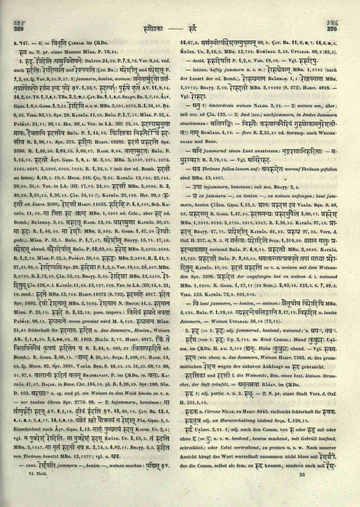
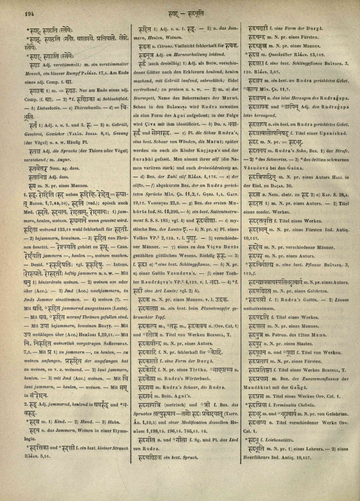
rudrá (auch dreisilbig) — 1〉 Adj. als Beiw. verschiedener Götter nach den Erklärern heulend, heulen machend, mit Gebrüll laufend, schrecklich; Uebel vertreibend; zu preisen u. s. w. — 2〉 m. — a〉 der Sturmgott, Name des Beherrschers der Marut. Schon in den BRĀHMAṆA wird Rudra zuweilen als eine Form des Agni aufgefasst; in der Folge wird Śiva mit ihm identificirt. — b〉 Du. s. bhavārudrá und somārudra. — c〉 Pl. die Söhne Rudraʼs, eine best. Schaar von Winden, die Marut; später werden sie auch als Kinder Kaśyapaʼs und der Surabhi gefasst. Man nimmt ihrer eilf (die Namen variiren stark) und auch dreiunddreissig an. — d〉 Bez. der Zahl eilf RĀJAN. 4,176. — e〉 der eilfte. — f〉 abgekürzte Bez. der an Rudra gerichteten Sprüche {{MĀN.ŚR.11,2,1.GṚHY.->MĀN. ŚR. 11,2,1. {{GṚHY.1,4.->MĀN.GṚHY.1,4.||20160118|Jim Funderburk.|https://github.com/sanskrit-lexicon/CORRECTIONS/issues/237|Inferred}} VASIṢṬHA 22,9. — g〉 Bez. des ersten Muhūrta Ind. St. 10,296. — h〉 ein best. Saiteninstrument S. S. S. 185; vgl. 4〉 und rudravīṇā. — i〉 mystische Bez. des Lautes e. — k〉 N. pr. — α〉 Pl. eines Volkes VP. 22,132. v. l. puṇḍra. — β〉 verschiedener Männer. — γ〉 eines zu den Viśve Devās gezählten göttlichen Wesens. Richtig ruru. — 3〉 f. rudrā — a〉 *eine best. Schlingpflanze. — b〉 N. pr. — α〉 einer Gattin Vasudevaʼs. — β〉 einer Tochter Raudrāśvaʼs VP. 24,129. v. l. bhadrā. — 4〉 *rudrī eine Art Laute; vgl. 2〉h〉.
Original text · German · Word type unspecified
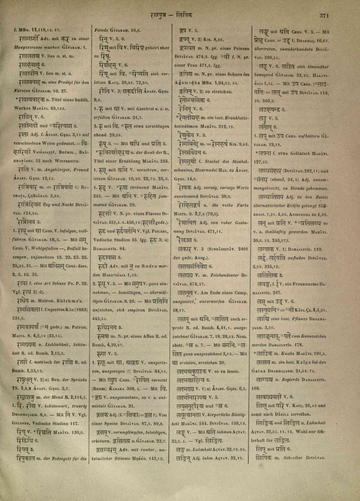
rudra und rudrávartani V. Vgl. PISCHEL, Vedische Studien 55. fgg. rudra 3〉a〉 DAMAYANTĪK. 84. [Nachtrag, Band 7]
Apte 1890 adjective · substantive masculine
Original text · English · adjective · substantive masculine
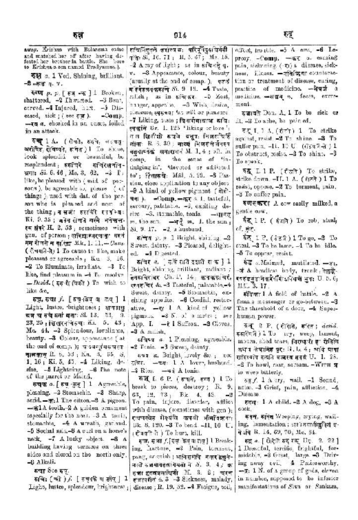
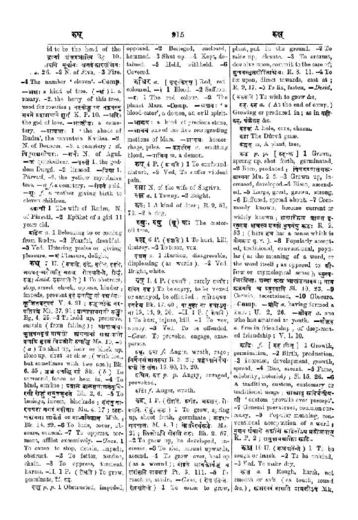
rudra a. [roditi rud-rak Uṇ. 2. 22] 1 Dreadful, terrific, frightful, formidable. 2 Great, large. 3 Driving away evil. 4 Praiseworthy. — draḥ 1 N. of a group of gods, eleven in number, supposed to be inferior manifestations of Śiva or Śaṅkara, ([Page 0915-a]) who is said to be the head of the group; rudrāṇāṃ śaṃkaraścāsmi Bg. 10. 23; rudrāṇāmapi mūrdhānaḥ kṣatahuṃkāraśaṃsinaḥ Ku. 2. 26. 2 N. of Śiva. 3 Fire. 4 The number ‘eleven’. Comp. — akṣaḥ a kind of tree. — (kṣaṃ) 1 a rosary. 2 the berry of this tree, used for rosaries; bhasmoddhūlana bhadramastu bhavate rudrākṣamāle śubhaṃ K. P. 10. — ariḥ the god of love. — ākrīḍaḥ a cemetery. — āvāsaḥ 1 ‘the abode of Rudra’, the mountain Kailāsa. 2 N. of Benares. 3 a cemetery; cf. pitṛsadmagocaraḥ. — garbhaḥ N. of Agni. — jaṃ quicksilver. — patnī 1 the goddess Durgā. 2 linseed. — priyā 1 Pārvatī. 2 the yellow myrobalan tree. — bhū f. a cemetery. — rodanaṃ gold. — sūḥ f. a mother giving birth to eleven children.
Cappeller 1887 substantive masculine
Original text · German · substantive masculine
rudrá m. N. des Sturmgotts (sp. = Śiva); Pl. dessen Söhne (meist mit den Marut identif.).

Burnouf 1866 substantive masculine
Original text · French · substantive masculine
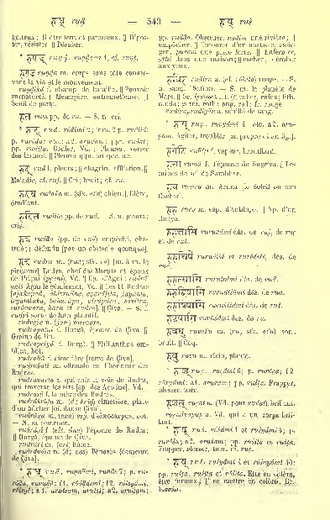
rudra rudra m. (rud; sfx. ra) [m à m. le pleureur] Rudra, chef des Maruts et époux de Pṛśni (pṛśni), Vd. Ép. d'Agni: rudro gnis Agni le gémissant, Vd. Les 11 Rudras [ajaikapad, ahivradhna, aparājita, jayanta, tryambaka, bahurūpa, virūpākṣa, savitra, sureśvara, hara et rudra]. Śiva. — S. f. rudrī sorte de luth plaintif. rudraja n. (jan) mercure. rudrapatnī f. Durgā, épouse de Śiva. Graine de lin. rudrapriyā f. Durgā. Phillanthus emblica, bot. rudrabhū f. cimetière [terre de Śiva]. rudrabali m. offrande en l'honneur des Rudras. rudravarta a. qui suit la voie de Rudra, qui traverse les airs [ép. des Aśvins], Vd. rudrasū f. la mère des Rudras. rudrākrīḍa m. (ā; krīḍ) cimetière, place d'un bûcher [où danse Śiva]. rudrākṣa m. (akṣa) esp. d'elæocarpus, bot. — N. sa semence. rudrāṇī f. (sfx. āna) l'épouse de Rudra; Durgā, épouse de Śiva. rudrāri m. (ari) Kāma. rudrāvāsa n. (ā; vas) Bénarès [demeure de Śiva].
Occurrences in source texts (13)
GoS 1 occurrence
HP 1 occurrence
MAN 1 occurrence
SiSa 1 occurrence
SVU 6 occurrences
Continue with AYI Free
Image source: AYI archive.