
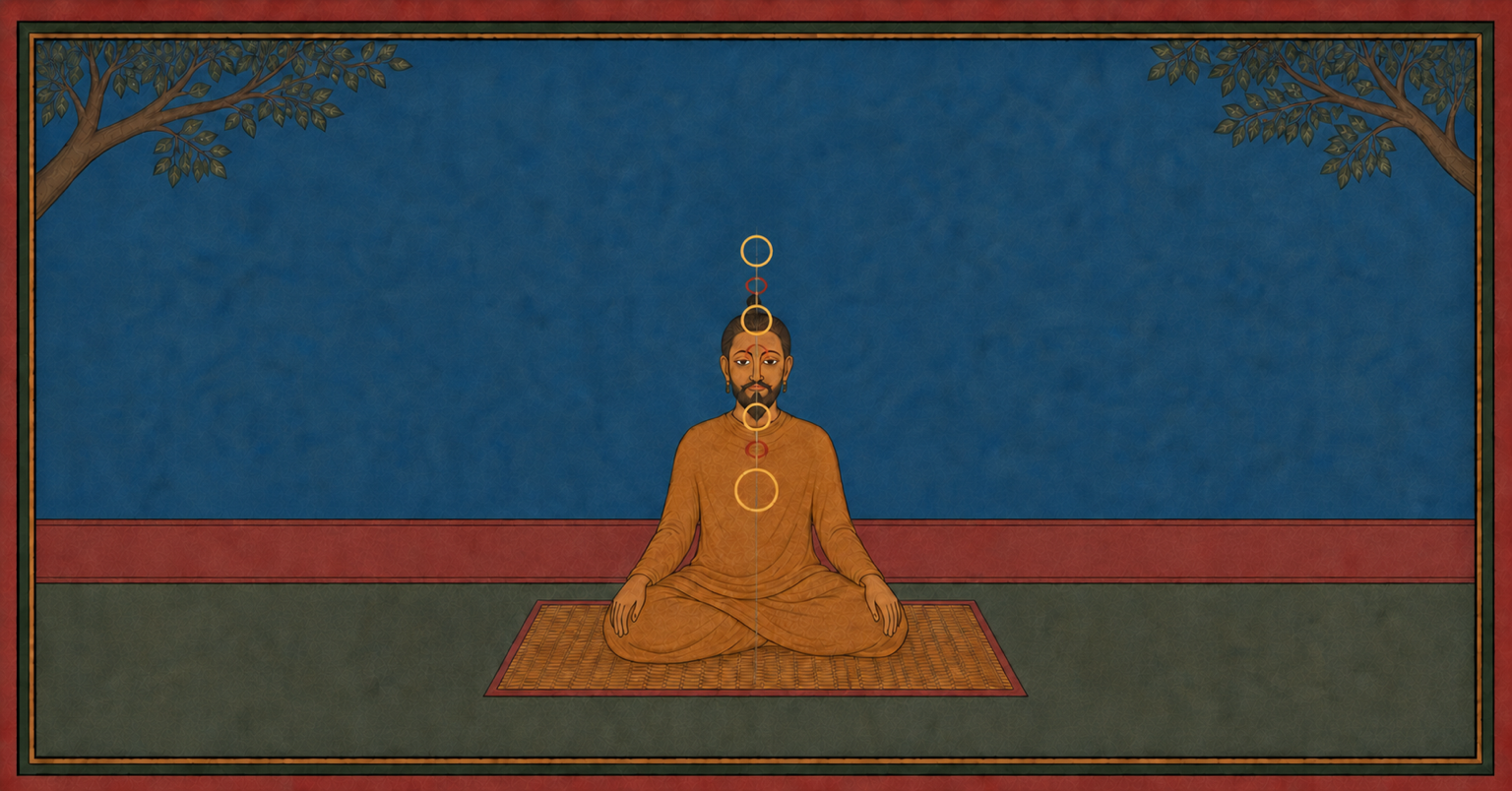

Ghaṭa, “vessel” or “integration,” denotes the coming together of Prāṇa and Apāna, Nāda and Bindu, and the individual and supreme self. The “middle” now means the Viśuddhi center at the throat. Firmness of body and knowledge is regarded as a consequence of these concentrated inner forces.
At the third stage, Paricaya, the practitioner hears the sound of a drum in the space between the eyebrows and reaches Mahāśūnya, the “great empty space.” Brahmānanda distinguishes three spaces: Śūnya in the heart, Atiśūnya in the throat, and Mahāśūnya at the forehead. The increasing “emptiness” thus follows an ascending inner topography.
Consummation begins with the piercing of the Rudra knot at the Ājñā center. According to Brahmānanda, Prāṇa first rises to Śiva's seat between the eyebrows and finally to Brahmarandhra; the sounds of flute and Vīṇā accompany this stage. When the mind becomes one-pointed within it, the commentary calls this state Rājayoga and also connects it with extraordinary abilities.
Continue with AYI Free
Illustrations: AI-generated.

Please log in to write a message. Go to login
No messages yet.