
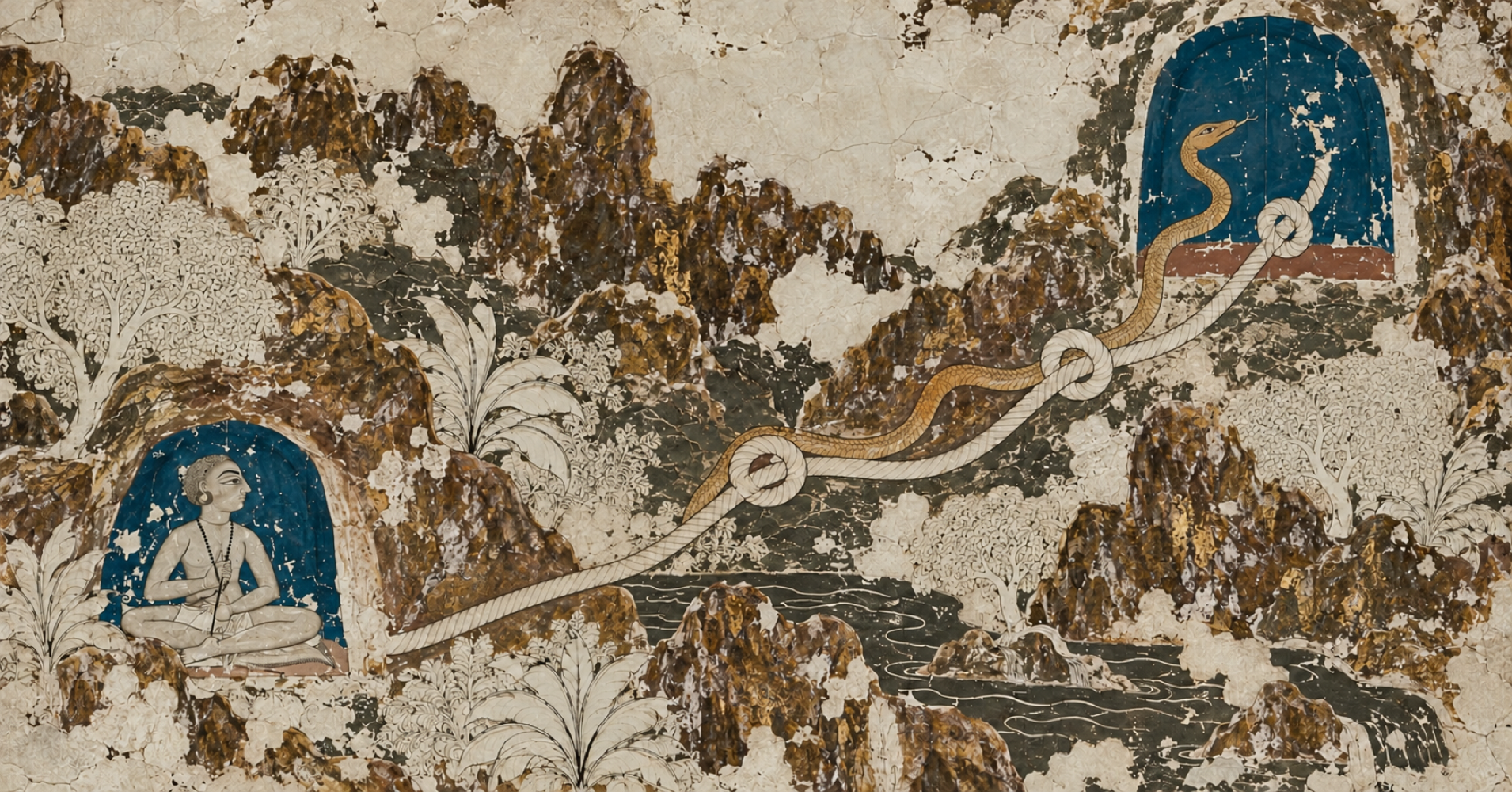

The definition repeats 52cd–53ab. I retain the repetition in its transmitted position; here it introduces a renewed account of the ascent.
The absolutive militvā at the beginning of 77 connects to fire, Prāṇa and Apāna at the end of 76. I join the two working numbers as “have … come together”, then begin a new sentence. The Sanskrit division is unchanged.
The syntax remains uneven: militvā connects to the powers named previously, whereas kuṇḍalī is the subject of yāti. I leave the transition recognisable without supplying a missing Sanskrit form.
I retain prasādhya, “having prepared”. Mallinson records prasārya, “having extended”, in the Yogakuṇḍalyupaniṣad. Rajas denotes the quality of activity. This parallel is used here only through his report of the variant.
saṃsthitā is feminine and, in the chosen wording, refers to Kuṇḍalī, not the masculine Viṣṇu-knot. This produces an unusual spatial connection.
The second half-verse is syntactically uneven. tadudbhavam, “arising from that”, lacks an unambiguous referent. For the working translation, I supply a connection indicating direction without changing the Sanskrit form.
Continue with AYI Free
Illustrations: AI-generated.

Please log in to write a message. Go to login
No messages yet.