

anvaya अन्वय – Nachfolge; Verbindung; Zusammenhang
Substantiv Maskulin · Substantiv Neutrum · Worttyp nicht bestimmt
Wörterbuchquellen
AYI Wörterbuch Substantiv Maskulin
Nachfolge; Verbindung; Zusammenhang
Herkunft
Cappeller 1891 Substantiv Maskulin
Originaltext · Englisch · Substantiv Maskulin
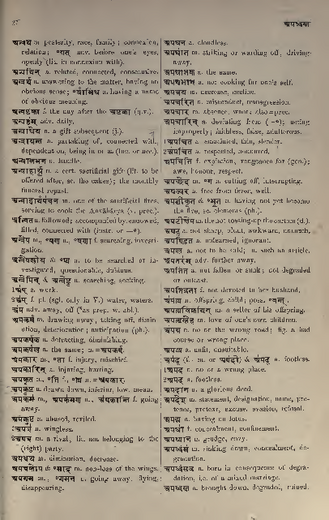
anvaya ·m. posterity, race, family; connexion, relation; °vat adv. before one's eyes, openly (lit. in connexion with).
Monier-Williams 1872 Substantiv Maskulin · Substantiv Neutrum · Worttyp nicht bestimmt
Originaltext · Englisch · Substantiv Maskulin · Substantiv Neutrum
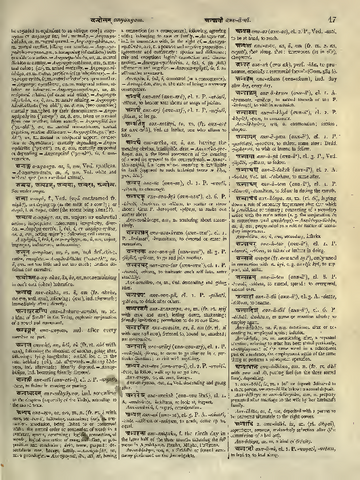
anvaya anv-aya, as, am, m. n. (fr. rt. i with anu, see anv-i), following, succession; (as), m. con- nection, association, being linked to or concerned with; the natural order or connection of words in a sentence, syntax, construing; logical connection of words; logical connection of cause and effect, or pro- position and conclusion; drift, tenor, purport; de- scendants, race, lineage, family.
Originaltext · Englisch · Worttyp nicht bestimmt
Anv-aya. See s. v., p. 47, col. 1.
Petersburger 1855 Substantiv Maskulin · Substantiv Neutrum · Worttyp nicht bestimmt
Originaltext · Deutsch · Substantiv Maskulin · Substantiv Neutrum
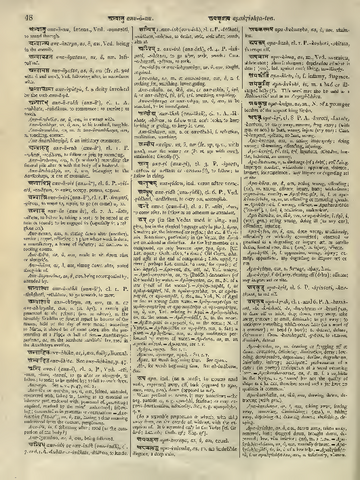
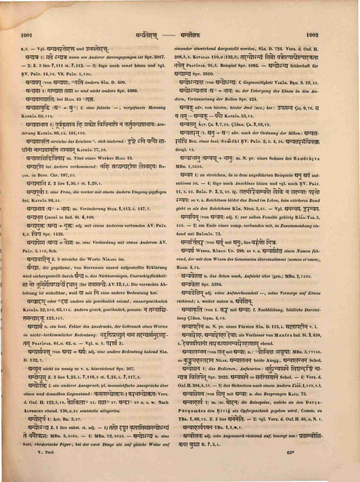
anvaya (von i mit anu) m.n. SIDDH. K. 249,a,16. 1〉 Nachtritt, Nachfolge: kāmavṛtto 'nvayaṃ lokaḥ kṛtsnaḥ samupavartate . yadvṛttāḥ santi rājānastadvṛttāḥ santi hi prajāḥ . R. 2,109,9. — 2〉 m. Nachkommenschaft YĀJÑ. 2,117. sānvayaḥ mit der N. M. 2,168. M. 3,205. PAÑCAT. 45,6. — 3〉 m. Familie, Geschlecht AK. 2,7,1. H. 503. śrotriyānvayajāḥ M. 3,184. dvijānvayapraṇītaṃ yo nityaṃ dharmaṃ niṣevate ŚĀK. 41,12. kṣatrānvaya adj. R. 1,1,96. kathamekānvayo mama ŚĀK. 104,8. raghūṇāmanvayaṃ vakṣye RAGH. 1,9. amaṃsta cānena — sthitimantamanvayam RAGH. 3,27. anvayagataṃ vairam PAÑCAT. 168,23. sānvaya (Gegens. niranvaya) von derselben Familie M. 8,198. Am Ende eines adj. comp. f. ā RAGH. 12,33: kathitānvayā, VID. 148: mahānvayā. — 4〉 Verbindung, das Verbundensein oder Verbundenwerden: guṇānvaya adj. (= guṇānvita) ŚVETĀŚV. UP. 5,7. hīnasattvabalānvayaiḥ adj. R. 3,4,27. gandhaḥ — kaṭukānvayaḥ R. 3,16,7. Gegens. vyatireka SĀH. D. 4,6. Z. d. d. m. G. VII, 289, N. 3. sānvaya der mit einem Andern in irgend einer Verbindung steht (Gegens. niranvaya) M. 8,331. — 5〉 der natürliche Zusammenhang der Dinge: aucityānvayarakṣā ca yathāśaktyabhidhīyate (in diesem Werke) KATHĀS. 1,11. — 6〉 die logische Verbindung eines Wortes mit einem andern im Satze und die auf die Nachweisung derselben gerichtete Thätigkeit, = padānāṃ parasparākāṅkṣā yogyatā ca DURGAD._im_ŚKDR. = parasparasaṃbandha RĀMATARKAV. ebend. = śabdānāṃ parasparamarthānugamanam H. 2, Sch. yogo 'nvayaḥ sa tu guṇakriyāsaṃbandhasaṃbhavaḥ H. 2. vākyārthe 'nvayasiddhaye SĀH. D. 11,20. padārthānvayabodhane SĀH. D. 22,3. daikyaṃ so (d. i. padaikyaṃ samāso) 'nvaye VOP. 6,1. iti pāṭhe 'yamanvayaḥ ŚĀK. 16, Sch. atra (im Beispiel tiṣṭhatu sarpiḥ) sarpiḥśabdasya sthitikriyāyāmanvayaḥ daselbst steht das Wort sarpiḥ in einer logischen Verbindung zum Verbalbegriff «stehen» P. 8,3,44, Sch. parasparanirapekṣasyānekasya ekasminnanvayaḥ samuccayaḥ SIDDH. K._zu_P. 2,2,29. (s. die Erklärer zu AK. 3,4,32,2.) Vgl. noch u. anuṣaṅga 6. — anvayabodhikā und anvayārthaprakāśikā Namen zweier Commentare GILD. Bibl. 237. COLEBR. Misc. Ess. I, 325. — Vgl. anvavāya.
Originaltext · Deutsch · Worttyp nicht bestimmt
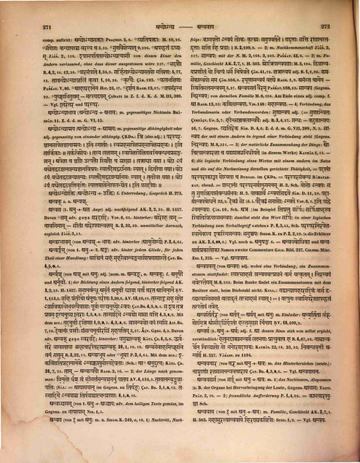
anvaya 1〉 zu streichen, da in dem angeführten Beispiele anu ayaṃ aufzulösen ist. — 4〉 füge noch Anschluss hinzu und vgl. noch ṚV. PRĀT. 11,5. ṚV. PRĀT. 11,22. BHĀG. P. 2,5,28. fg. lakṣmīrevānvayo loke na lakṣmyāḥ parato 'nvayaḥ so v. a. Reichthum bildet das Band im Leben, kein stärkeres Band giebt es als den Reichthum KĀM. NĪTIS. 5,61. — Vgl. ananvaya, duranvaya.
Böhtlingk 1879 Substantiv Maskulin
Originaltext · Deutsch · Substantiv Maskulin
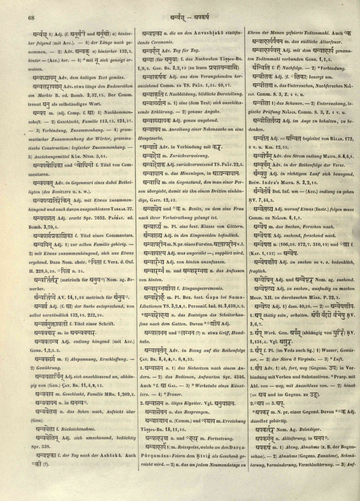
anvaya m. (adj. Comp. f. ā) — 1〉 Nachkommenschaft. — 2〉 Geschlecht, Familie Chr. 113,13. Chr. 124,27. — 3〉 Verbindung, Zusammenhang. — 4〉 grammatischer Zusammenhang der Wörter, grammatische Construction; logischer Zusammenhang. — 5〉 Anziehungsmittel KĀM. NĪTIS. 5,61.
Apte 1890 Substantiv Maskulin · Worttyp nicht bestimmt
Originaltext · Englisch · Substantiv Maskulin
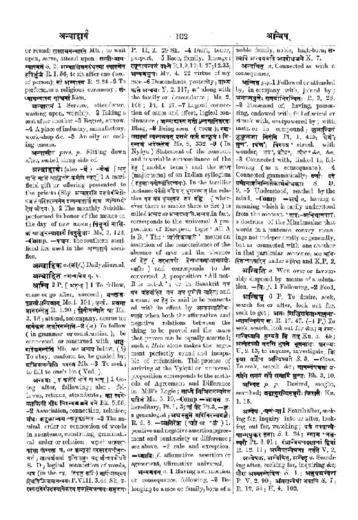
anvayaḥ [i kartari bhāve vā ac] 1 Going after, following; also, follower, retinue, attendants; kā tvamekākinī bhīru niranvayajane vane Bk. 5. 66. 2 Association, connection, relation; gaṃdhaḥ kaṭukānvayaḥ = kaṭukānvitaḥ. 3 The natural order or connection of words in a sentence, construing, grammatical order or relation; padānāṃ parasparākāṃkṣā yogyatā ca, or śabdānāṃ parasparamarthānugamanaṃ; tātparyākhyāṃ vṛttimāhuḥ padārthānvayabodhane S. D; logical connection of words, atra (in the ex. tiṣṭhatu sarpiḥ) sarpiḥśabdasya sthitikriyāyāmanvayaḥ P. VIII. 3. 44 Sk; parasparanirapekṣasyānekasya ekasminnanvayaḥ samuccayaḥ ([Page 0102-b]) P. II. 2. 29 Sk. 4 Drift, tenor, purport. 5 Race, family, lineage; raghūṇāmanvayaṃ vakṣye R. 1. 9, R. 1. 12; R. 3. 27; R. 12. 33; anvayaguṇaḥ Mv. 4. 22 virtue of my race. 6 Descendants, posterity; tābhya ṛte anvayaḥ Y. 2. 117; sa˚ along with the family or descendants; Ms. 2. 168; Pt. 1. 27. 7 Logical connection of cause and effect, logical continuance; janmādyasya yato'nvayāditarataḥ Bhāg. 8 Being seen (pratyakṣa); syātsāhasaṃ tvanvayavat prasabhaṃ karma yatkṛtaṃ . niranvayaṃ bhavetsteyaṃ Ms. 8. 332. 9 (In Nyāya) Statement of the constant and invariable concomitance of the hetu (middle term) and the sādhya (major term) of an Indian syllogism (hetusādhyayorvyāptiranvayaḥ). In the familiar instance parvato vahnimān dhūmavattvāt the relation yatra yatra dhūmastatra tatra vahniḥ (wherever there is smoke there is fire) is called anvaya or anvayavyāpti, anvaya, in fact, corresponds to the universal A proposition of European logic ‘All A is B.’ The ‘vyatirekavyāpti’ means an assertion of the concomitance of the absence of sādhya and the absence of hetu (tadabhāvayoḥ hetvabhāvasādhyābhāvayoḥ vyāptiḥ) and corresponds to the converted A proposition ‘All notB is not-A’; or in Sanskrit yatra yatra vahnirnāsti tatra tatra dhūmopi nāsti; and a cause or hetu is said to be connected with its effect by anvayavyatirekavyāpti when both the affirmative and negative relations between the thing to be proved and the cause that proves can be equally asserted; such a Hetu alone makes the argument perfectly sound and incapable of refutation. This process of arriving at the Vyāpti or universal proposition corresponds to the methods of Agreement and Difference in Mill's Logic; sādhye niścitamanvayena ghaṭitaṃ Mu. 5. 10. Comp. — āgata a. hereditary; Pt. 1, Pt. 3; ˚taṃ vairaṃ Pt. 3. — jñaḥ a genealogist; atha stute baṃdibhiranvayajñaiḥ R. 6. 8. — vyatireka (˚kau or ˚kaṃ) 1 positive and negative assertion; agreement and contrariety or difference; see above. 2 rule and exception. — vyāptiḥ f. affirmative assertion or agreement, affirmative universal.
Originaltext · Englisch · Worttyp nicht bestimmt
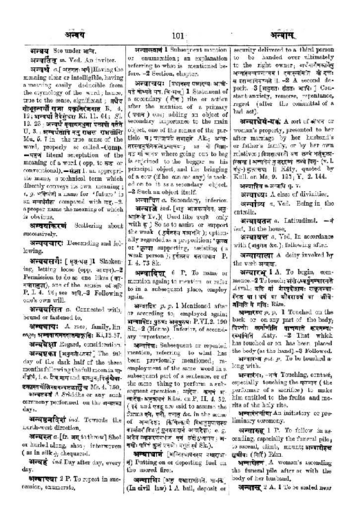
anvaya See under anvi.
Cappeller 1887 Substantiv Maskulin
Originaltext · Deutsch · Substantiv Maskulin
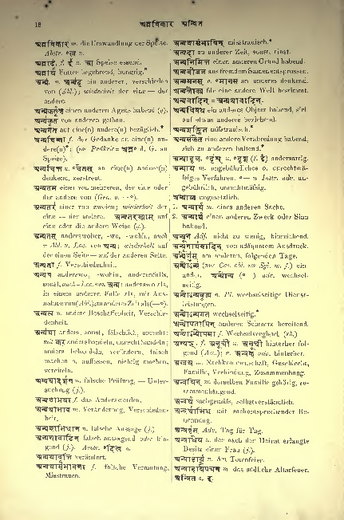
anvaya m. Nachkommenschaft, Geschlecht, Familie, Verbindung, Zusammenhang.
Burnouf 1866 Substantiv Maskulin
Originaltext · Französisch · Substantiv Maskulin
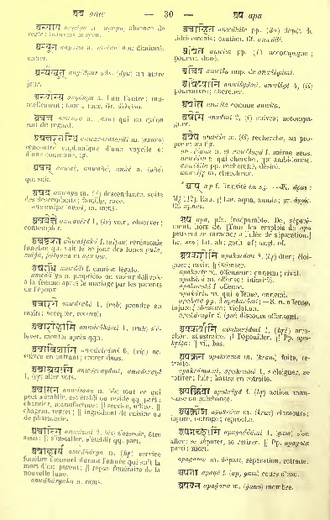
anvaya anvaya m. (i) descendance, suite des descendants; famille, race. anvavāya (ava-i) m. mms.
Quelltextfundstellen (4)
PYS 3 Fundstellen
SVU 1 Fundstelle
Mit AYI Free weitermachen
Bildquelle: AYI Archiv.