

citra चित्र – vielfarbig; mannigfaltig; wunderbar
Adjektiv · Substantiv Maskulin · Substantiv Neutrum · Worttyp nicht bestimmt
Wörterbuchquellen
AYI Wörterbuch Adjektiv
vielfarbig; mannigfaltig; wunderbar
Cappeller 1891 Adjektiv
Originaltext · Englisch · Adjektiv
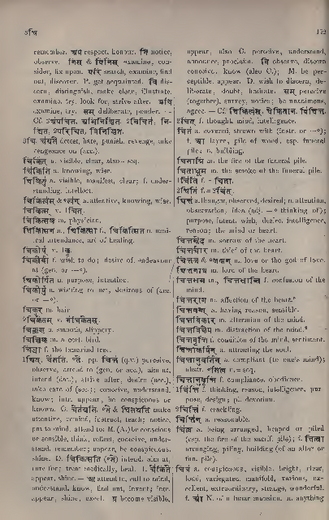
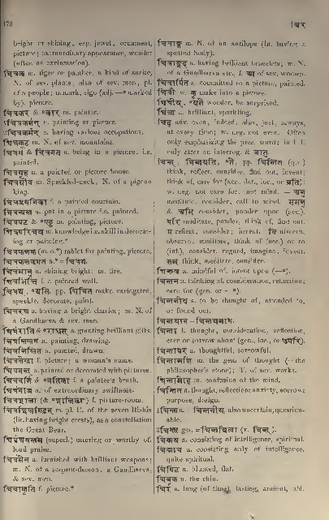
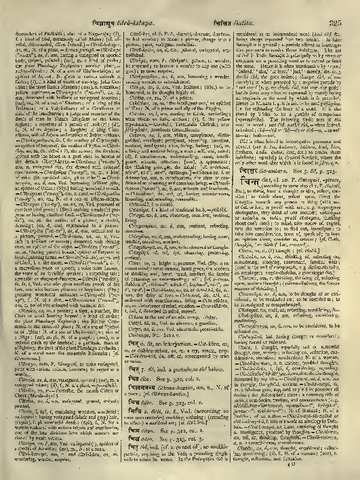
citrá ·a. conspicuous, visible, bright, clear, loud, variegated, manifold, various, excellent, extraordinary, strange, wonderful. f. ā́ N. of a lunar mansion. n. anything bright or shining, esp. jewel, ornament, picture; extraordinary appearance, wonder (often as exclamation).
Monier-Williams 1872 Adjektiv · Worttyp nicht bestimmt
Originaltext · Englisch · Adjektiv
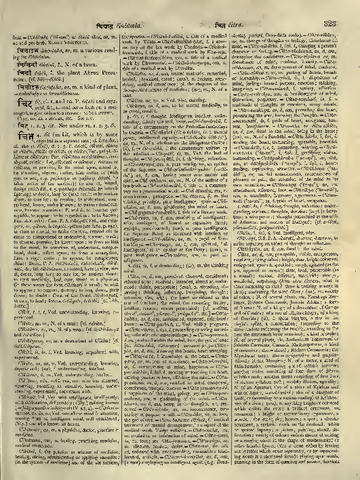
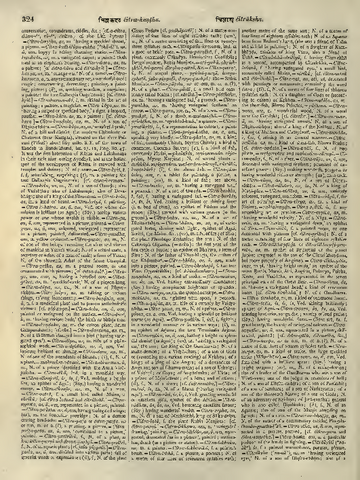
Citra, as, ā, am, perceptible, visible, conspicuous, excellent, distinguished; bright, clear, bright-coloured; variegated, spotted, speckled; rough, agitated (as the sea, opposed to sama); clear, loud, perceptible (as a sound); various, different, manifold; strange, wonderful, surprising, (kim atra citram, what is there surprising in that? there is nothing strange in that); containing the word citra; (as), m. variety of colour; N. of several plants, viz. Plumbago Zey- lanica, Ricinus Communis, Jonesia Aśoka; a form of Yama; N. of a king; of a descendant of Gaṅga and of Gauśra; of a son of Dhṛta-rāṣṭra; of a king of Draviḍa; (ā), f. Spica Virginis, a star in the virgin's spike, a constellation; (according to the more ancient reckoning the twelfth, according to the new the fourteenth lunar mansion); a kind of snake; N. of several plants, viz. Anthericum Tuberosum or Salvinia Cucculata, Cucumis Maderaspatanus, a kind of cucumber; also = dantī; Ricinus Communis; the Myrobalan tree; also = mṛgervāru and gaṇḍa- dūrvā; Rubia Munjista; N. of a metre, a kind of Mātrāsamaka, containing 4 × 16 syllabic instants; another metre consisting of four lines of fifteen syllables each; another metre consisting of four lines of sixteen syllables each; worldly illusion, unreality; N. of an Apsaras; also of a sister of Kṛṣṇa and wife of Arjuṇa, = su-bhadrā; also of a daughter of Gada, or (according to a various reading) of Kṛṣṇa; also of a river; (am), n. anything bright or coloured which strikes the eyes; a brilliant ornament, an ornament; a bright or extraordinary appearance, a wonder; the ether, sky, heaven; a spot; a circular ornament, a sectarial mark on the forehead; white or spotted leprosy; a picture, painting, sketch, de- lineation: variety of colour; various modes of writing or arranging verses in the shape of mathematical or other fanciful figures, (this is done either by leaving out syllables which occur repeatedly, or by represent- ing words in a shortened form); playing upon words, punning in the form of question and answer, facetious conversation, conundrums, riddles, &c.; [cf. a-citra, dānu-c˚, vi-c˚, caitra; cf. also Lith. kytras.]
Originaltext · Englisch · Worttyp nicht bestimmt
citra citra. See p. 323, col. 3.
Petersburger 1855 Adjektiv · Substantiv Maskulin · Substantiv Neutrum · Worttyp nicht bestimmt
Originaltext · Deutsch · Adjektiv · Substantiv Maskulin · Substantiv Neutrum
citrá (von 4. cit) Uṇ. 4,165. 1〉 adj. f. ā a〉 augenfällig; sichtbar, ausgezeichnet: ūti ṚV. 2,17,8. ṚV. 4,32,5. ṚV. 5,40,3. abhiṣṭi ṚV. 1,119,8. ṚV. 8,3,2. sa cìketa̱ sahī̀yasā̱gniści̱treṇa̱ karmàṇā ṚV. 8,39,5. varūtha ṚV. 8,56,3. grābha ṚV. 8,70,1. vakṣatha ṚV. 10,115,1. vasu ṚV. 9,19,1. rādhas ṚV. 1,22,7. ṚV. 1,44,1 u. s. w. draviṇa ṚV. 2,23,15. ṚV. 10,36,13. uṣo̱ vāja̱ṃ hi vaṃsva̱ yaści̱tro mānùṣe̱ janè ṚV. 1,48,11. ṚV. 4,22,10. ṚV. 4,36,9. sa cìtra ci̱traṃ ci̱tayàntama̱sme citràkṣatra ci̱tratàmaṃ vayo̱dhām . ca̱ndraṃ ra̱yiṃ gṛ̀ṇa̱te yùvasva ṚV. 6,6,7. ci̱traṃ ke̱tuṃ kṛ̀ṇute̱ cekìtānā ṚV. 1,93,15. ṚV. 1,94,5. ṚV. 1,113,1. ā cìtra ci̱triṇī̱ṣvā . ci̱traṃ kṛ̀ṇoṣyū̱tayè ṚV. 4,32,2. — b〉 hell, licht; hellfarbig: u̱ṣasàḥ ṚV. 7,75,3. ṚV. 6,60,2. agni ṚV. 1,71,1. ṚV. 4,7,1. jyotis ṚV. 5,63,4. sūro̱ na ci̱traḥ ṚV. 9,86,34. sa ci̱treṇà ciki̱te bhā̱sā ṚV. 2,3,5. ā yaḥ sva1̱̀rṇa bhā̱nunā̀ ci̱tro vi̱bhātya̱rciṣā̀ ṚV. 2,8,4. raśmi ṚV. 9,100,8. nakṣatra TBR. 3,1,2,1. Indra ṚV. 1,142,4. ṚV. 2,13,13 u. s. w. die Marut ṚV. 1,165,13. ṚV. 8,7,7. abhra ṚV. 5,63,3. ratha ṚV. 3,2,15. aśvā ṚV. 1,30,21. ṚV. 10,75,7. vastra ṚV. 1,134,4. rūpa ṚV. 5,52,11. — c〉 verschiedenfarbig, bunt, scheckig AK. 1,1,4,26. TRIK. 3,3,347. H. 1398. H. an. 2,418. MED. r. 34. srajaḥ N. 4,8. puṣpavatīṃ citrāṃ vanamālām R. 5,4,2. MṚCCH. 92,7. In Verb. mit einem instr. oder nach einem im instr. zu fassenden Worte im comp.: sauvarṇastvaṃ mṛgo bhūtvā citro rajatavindubhiḥ R. 3,44,16. kāñcanacitrakārmuka R. 3,8,25. vaidūryamaṇicitre — aṅgade R. 6,112,88. ratnacitra (ratha) VARĀH. BṚH. S. 42 (43), 6. mukuṭāṅgadacitrāṅgī R. 1,45,41. — d〉 bewegt (vom Meere), Gegens. sama R. 3,39,12. — e〉 hell, vernehmlich (von Tönen): vācàṃ pa̱rjanyàści̱trāṃ vàdati̱ tviṣī̀matīm ṚV. 5,63,6. arka ṚV. 6,66,9. ṚV. 10,112,9. pavàmāno ajījanaddi̱vaści̱traṃ na tànya̱tum ṚV. 9,61,16. — f〉 mannichfaltig, verschieden, allerlei: vanarājayaḥ R. 6,15,6. kathāḥ MBH. 1,3. R. 1,3,10. ˚bhāṣya MBH. 5,1240. vadhopāyaiḥ M. 9,248. YĀJÑ. 1,287. ARJ. 7,14. SUŚR. 1,237,17. SUŚR. 1,241,14. SUŚR. 2,93,6. PAÑCAT. I, 196. PAÑCAT. I,429. BHĀG. P. 1,6,12. BHĀG. P. 1,6,13. BHĀG. P. 3,19,6. adv.: citraṃ saṃkrīḍamānāstāḥ krīḍanairvividhaiḥ R. 1,9,14. vajracitrapariṣkṛte (aṅgade) R. 6,112,88. — g〉 wunderbar MED.; vgl. 4,b. — h〉 das Wort citra enthaltend: citre gāyati ŚAT. BR. 7,4,1,24. KĀTY. ŚR. 17,4,4. — 2〉 m. a〉 Buntheit BHAR._zu_AK. ŚKDR. — b〉 N. verschied. Pflanzen: α〉 Plumbago zeylanica Lin. RĀJAN._im_ŚKDR. MED. l. 11. — β〉 Ricinus communis. — γ〉 Jonesia Asoka (aśoka) Roxb. RĀJAN._im_ŚKDR. — c〉 eine Form des Yama TITHYĀDIT._im_ŚKDR. — d〉 N. pr. eines Königs (parox.) ṚV. 8,21,18. eines Gāṅgyāyani Ind. St. 1,395. Gauśrāyaṇi ebend. eines Sohnes des Dhṛtarāṣṭra MBH. 1,2730. MBH. 1,4543. MBH. 7,5594. eines Königs von Draviḍa PADMA-P._in_Verz. d. B. H. No. 457. — 3〉 f. ā a〉 Spica virginis, in der alten Reihe das 12te, in der neuen das 14te Mondhaus, COLEBR. Misc. Ess. II, 337. COLEBR. Misc. Ess. II,425. COLEBR. Misc. Ess. II,463. COLEBR. Misc. Ess. II,481. Ind. St. 1,99. TRIK. 3,3,347. H. 112. H. an. MED. AV. 19,7,3. TS. 2,4,6,1. ci̱trā nakṣàtra̱ṃ mitrò de̱vatā̀ TS. 4,4,10,2. TBR. 1,1,2,5. ŚAT. BR. 2,1,2,13. ŚAT. BR. 2,1,2,17. KAUŚ. 75. KĀTY. ŚR. 4,7,4. MBH. 5,4842. MBH. 6,79. MBH. 13,3268. MBH. 13,4261. HARIV. 4257. R. 3,23,11. R. 5,18,14. RAGH. 1,46. LALIT. 117. pl. VARĀH. BṚH. S. 11,58. citrāsvātī gaṇa rājadantādi zu P. 2,2,31. — b〉 eine Schlangenart H. an. MED. — c〉 N. verschied. Pflanzen: α〉 Anthericum tuberosum Roxb. oder Salvinia cucullata Roxb. = mūṣikaparṇī AK. 2,4,3,6. = ākhuparṇī H. an. MED. — β〉 Cucumis maderaspatanus AK. 2,4,5,22. H. an. MED. Koloquinthe RATNAM. 15. — γ〉 = dantī H. an. MED. RATNAM. 34. — δ〉 Ricinus communis RATNAM. 3. — ε〉 Myrobalanenbaum (āmalakī) RATNAM. 90. — ζ〉 = mṛgervāru. — η〉 gaṇḍadūrvā. — ϑ〉 Rubia Munjista (mañjiṣṭhā) Roxb. RĀJAN. — SUŚR. 1,144,14. SUŚR. 2,21,15. SUŚR. 2,23,2, wahrscheinlich in der Bed. β. — d〉 N. verschiedener Metra: α〉 eine Art Mātrāsamaka (4 Mal 16 Moren) COLEBR. Misc. Ess. II, 155 (2,4). 86. — β〉 4 Mal – – – – – – – – – ⏑ – – ⏑ – – ebend. 161 (X, 11). — γ〉 4 Mal – ⏑ – ⏑ – ⏑ – ⏑ – ⏑ – ⏑ – ⏑ – ⏑ ebend. 162 (XI, 3); hier bei COLEBR. citra. — e〉 Schein, Täuschung (māyā) MED. — f〉 N. pr. = citrāyāṃ jātā P. 4,3,34, Vārtt. 1. α〉 einer Apsaras H. an. — β〉 einer Schwester Kṛṣṇaʼs und Gemahlin Arjunaʼs, = subhadrā TRIK. H. an. MED. HARIV. 1952. — γ〉 einer Tochter Gadaʼs (v. l. Kṛṣṇaʼs) HARIV. 9194. — δ〉 eines Flusses MED. — 4〉 n. SIDDH. K. 249,b,2. a〉 eine helle, glänzende oder farbige Erscheinung; ein in die Augen fallender Gegenstand, daher auch funkelndes Geschmeide, Schmuck: ā re̱vatī̱ rodàsī ci̱tramàsthāt ṚV. 3,61,6. kadàsya ci̱traṃ cìkite ṚV. 4,23,2. sarvāṇi hi citrāṇyagniḥ (hierher oder zu b) ŚAT. BR. 6,1,3,20. ŚAT. BR. 7,4,1,24. na yāsù ci̱traṃ dadṛ̀śe na ya̱kṣam ṚV. 7,61,5. ā vàści̱tramā vò vra̱tamā vo̱ 'haṃ samìtiṃ dade ṚV. 10,166,4. nakṣàtravihitā̱sau (der Himmel) ci̱travìhite̱yam (die Erde) TS. 2,5,2,5. ci̱trāṇyaṅgairnakṣàtrāṇi rū̱peṇà (prīṇāmi) VS. 25,9. PAÑCAV. BR. 18,9. dakṣìṇāvatā̱midi̱mānì ci̱trā dakṣìṇāvatāṃ di̱vi sūryā̀saḥ ṚV. 1,125,6. uṣa̱stacci̱tramā bhàrā̱smabhyàm . yenà to̱kaṃ ca̱ tanàyaṃ ca̱ dhāmàhe bring uns den Schmuck, dass wir Kind und Enkel besitzen ṚV. 1,92,13. sā hīyaṃ (rātriḥ) saṃgṛhyeva citrāṇi vasati die Sterne als Edelsteine gedacht ŚAT. BR. 2,3,4,22. citraṃ paścātsyātprajā vai citraṃ citraṃ hyasya prajā bhavati ŚAT. BR. 13,8,1,13; nach dem Schol. zu KĀTY. ŚR. 21,3,23 und ṢAḌV. BR. 2,10 soll es hier = anekaprakāraṃ vanam verschiedenfarbiges oder — gestaltetes Gehölz sein. — b〉 eine ungewöhnliche Erscheinung, Wunder AK. 1,1,7,19. AK. 3,4,25,180. H. 303. H. an. MED. citraṃ vā abhūma ya iyataḥ sapatnānabadhiṣma ŚAT. BR. 2,1,2,17. taccitramiva me pratibhāti ŚĀK. 110,17. BHARTṚ. 3,39. PAÑCAT. 256,12. ŚṚṄGĀRAT. 21. BHĀG. P. 5,1,36. vākyamapratirūpaṃ hi na citraṃ strīṣu R. 3,51,32. BHĀG. P. 1,19,20. kimatra citraṃ yadi … ŚĀK. 35,21. naitaccitraṃ yadayam … ŚĀK. 35,48. KATHĀS. 18,359. fg. naitaccitraṃ — tvayi — yat HARIV. 9062. citraṃ badhiro nāma vyākaraṇamadhyeṣyate es wäre ein Wunder, wenn P. 3,3,151, Sch. citraṃ drakṣyati nāmāndhaḥ kṛṣṇaṃ paśyedyadīśvaram VOP. 25,15; vgl. VOP. 14 und P. 3,3,150. fg. yādavā iti citraṃ naḥ śaktāḥ sthātuṃ raṇe es wäre ein Wunder, wenn die Y. vermöchten HARIV. 15652. kṣipto 'pi nāpataccitram o Wunder! KATHĀS. 5,86. citraṃ kathaṃ tvayā jñātā sā saṃjñā KATHĀS. 7,73. RĀJA-TAR. 1,85 (mitten in den Satz eingeschoben). RĀJA-TAR. 4,586. — c〉 Luftraum, Himmel H. an. — d〉 Fleck: yathaiva sadṛśo rūpe mātāpitrorhi jāyate . vyāghraścitraiḥ MBH. 13,2605. — e〉 Sectenzeichen auf der Stirn TRIK. H. 653. H. an. MED. lalitavanitāḥ — sacitrāḥ MEGH. 65. — f〉 weisser Aussatz H. 466, falsche Lesart für śvitra; vgl. übrigens carmacitraka. — g〉 Bild, Gemälde; Malerei AK. 3,4,25,180. H. 922. H. an. MED. paṭe citramivārpitam MBH. 13,7692. citre 'pi cālikhatyaśvān SĀV. 2,13. citre niveśya ŚĀK. 42. ŚĀK. 141. ŚĀK. 89,2. citrairivārpitam (vgl. citrārpita) gemalt MBH. 13,2660. citraṃ yathāśrayamṛte SĀṂKHYAK. 41. ye ca citraṃ bhajanti vai und die sich mit der Malerei abgeben R. GORR. 2,90,23. sacitra bemalt HARIV. 4532. — h〉 Buntheit AK. 1,1,4,26. TRIK. H. 1398. H. an. MED. — i〉 Bez. verschiedener Arten, künstliche Verse u. s. w. in Form von allerlei Figuren durch Nichtwiederholung wiederkehrender Silben oder Wörter in abgekürzter Weise künstlich für das Auge darzustellen: padmādyākārahetutve varṇānāṃ citramucyate SĀH. D. 645; vgl. HAEB. Anth. 291. fgg., wo verschiedene solcher Figuren mitgetheilt werden. — k〉 ein Wortspiel in Form von Frage und Antwort: praśnottarāntarābhinnamuttaraṃ citramucyate KUVALAY. 145,b, mit dem Beispiele: ke dārapoṣaṇaratāḥ (dāra = kṣetra, als Antwort gilt kedāra˚) ke kheṭāḥ (khe'ṭāḥ) kiṃ calaṃ vayaḥ (Vögel und Alter). — Vgl. acitra, dānu˚, vi˚, su˚, caitra.
Originaltext · Deutsch · Worttyp nicht bestimmt
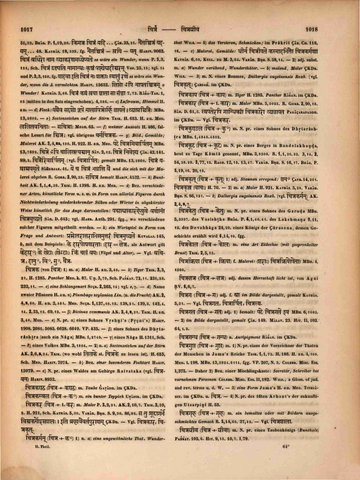
citra 1〉f〉 ˚ratāni Verz. d. Oxf. H. 215,b,29. citrā yogāḥ unter den Verz. d. Oxf. H. 64 Kalā Verz. d. Oxf. H. 217,a,4. Verz. d. Oxf. H. 216,a,11. ˚vadha eine qualificirte Todesstrafe DAŚAK._in_BENF. Chr. 193,4. citramenaṃ ghātayiṣyasi unter verschiedenen Martern BENF. Chr. 198,3. — g〉 namo 'stu citraprabhāvāya dhanāya tasmai Spr. 4777. — 2〉d〉 Gārgyāyaṇi Verz. d. Oxf. H. 276,a,30. — 3〉a〉 TS. 7,4,8,2. PAÑCAV. BR. 5,9,1. SŪRYAS. 8,21. SŪRYAS. 9,12. — d〉 vgl. Ind. St. 8,315. fg. — f〉ε〉 eines Felsens BHĀG. P. 12,8,17. — 4〉f〉 vgl. citrakuṣṭha. — g〉 (tām) citre likhitvā KATHĀS. 51,126. ˚rodanāntardhāna Verz. d. Oxf. H. 322,b,4. fg. — i〉 Verz. d. Oxf. H. 208,a,5 v. u. — k〉 Verz. d. Oxf. H. 211,b,9. — i〉 k〉 Wort- und Lautspiel: keciccitrākhyaṃ tṛtīyaṃ kāvyabhedamicchanti tadāhuḥ . śabdacitraṃ vācyacitramavyaṅgyaṃ tvavaraṃ smṛtam SĀH. D. 116,19. fg. śabdacitra, arthacitra, ubhayacitra PRATĀPAR. 12,b. 13,a.
Böhtlingk 1879 Adjektiv · Substantiv Maskulin · Substantiv Neutrum · Worttyp nicht bestimmt
Originaltext · Deutsch · Adjektiv · Substantiv Maskulin · Substantiv Neutrum
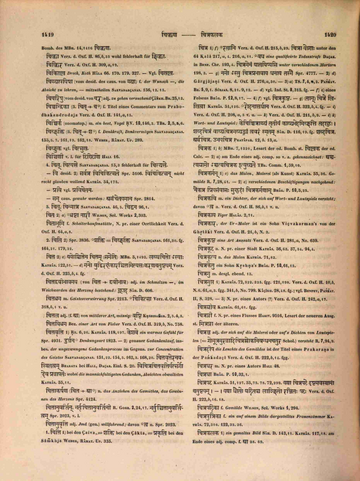
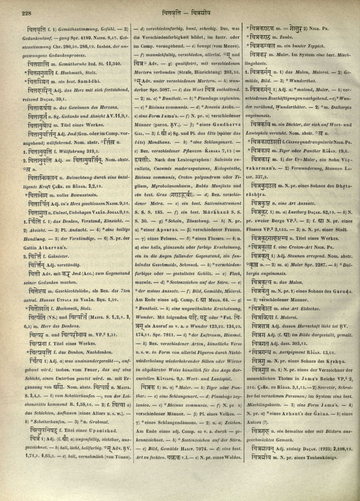
citrá — 1〉 Adj. (f. ā́) — a〉 augenfällig, sichtbar, ausgezeichnet. — b〉 hell, licht, hellfarbig. ˚m Adv. ṚV. 1,71,1. 6,65,2. — c〉 hell, vernehmlich (von Tönen). [Page2-228-b] — d〉 verschiedenfarbig, bunt, scheckig. Das, was die Verschiedenfarbigkeit bildet, im Instr. oder im Comp. vorangehend. — e〉 bewegt (vom Meere). — f〉 mannichfaltig, verschieden, allerlei. ˚m und citra˚ Adv. — g〉 qualificirt, mit verschiedenen Martern verbunden (Strafe, Hinrichtung) Chr. 203,26. ˚m Adv. unter verschiedenen Martern. — h〉 wunderbar. Spr. 5087. — i〉 das Wort citra enthaltend. — 2〉 m. — a〉 *Buntheit. — b〉 *Plumbago zeylanica. — c〉 *Ricinus communis. — d〉 *Jonesia asoca. — e〉 eine Form Yamaʼs. — f〉 N. pr. — α〉 verschiedener Männer (parox. ṚV.). — β〉 *eines Gandharva GAL. — 3〉 f. ā́ — a〉 Sg. und Pl. das 12te (später das 14te) Mondhaus. — b〉 *eine Schlangenart. — c〉 Bez. verschiedener Pflanzen CARAKA. 7,12. (= dravantī). Nach den Lexicographen: Salvinia cucullata, Cucumis maderaspatanus, Koloquinthe, Ricinus communis, Croton polyandrus oder Croton tiglium, Myrobalanenbaum, Rubia munjista und ein best. Gras (gaṇḍadūrvā). — d〉 Bez. verschiedener Metra. — e〉 ein best. Saiteninstrument S. S. S. 185. — f〉 ein best. Mūrchanā S. S. S. 30. — g〉 *Schein, Täuschung. — h〉 N. pr. — α〉 *einer Apsaras. — β〉 verschiedener Frauen. — γ〉 eines Felsens. — δ〉 *eines Flusses. — 4〉 n. — a〉 eine helle, glänzende oder farbige Erscheinung, ein in die Augen fallender Gegenstand, ein funkelndes Geschmeide, Schmuck. — b〉 *verschiedenfarbiges oder verschiedengestaltetes Gehölz. — c〉 Fleck, macula. — d〉 *Sectenzeichen auf der Stirn. — e〉 *der weisse Aussatz. — f〉 Bild, Gemälde, Malerei. Am Ende eines adj. Comp. f. ā MEGH. 64. — g〉 *Buntheit. — h〉 eine ungewöhnliche Erscheinung, Wunder. Mit folgenden yadi, yad oder *Fut. citram als Ausruf so v. a. o Wunder Chr. 123,22. Chr. 134,29. Chr. 174,11. Spr. 7811. — i〉 *der Luftraum, Himmel. — k〉 Bez. verschiedener Arten, künstliche Verse u. s. w. in Form von allerlei Figuren durch Nichtwiederholung wiederkehrender Silben oder Wörter in abgekürzter Weise künstlich für das Auge darzustellen KĀVYAPR. 9,8. Wort- und Lautspiel.
Originaltext · Deutsch · Worttyp nicht bestimmt
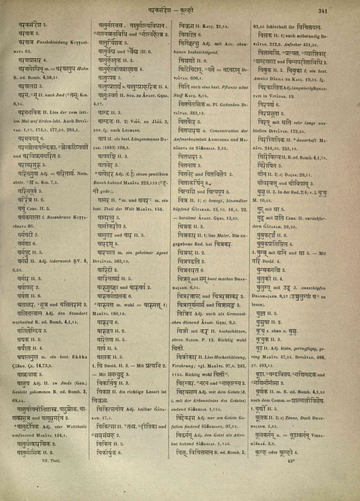
citra II. 1〉e〉 bewegt, hinundher hüpfend JĀTAKAM. 15,10. JĀTAKAM. 16,4. JĀTAKAM. 16,22. — berühmt ĀPAST. GṚHY. 13,20. [Nachtrag, Band 7]
Originaltext · Deutsch · Worttyp nicht bestimmt
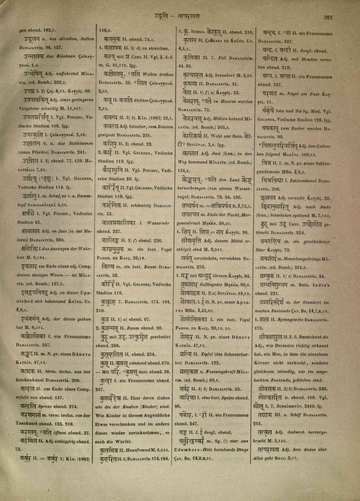
citra II. 7. m. N. pr. eines Schlangendämons MBH. 2,9,8. [Nachtrag, Band 7]
Apte 1890 Adjektiv · Substantiv Maskulin · Substantiv Neutrum
Originaltext · Englisch · Adjektiv · Substantiv Maskulin · Substantiv Neutrum
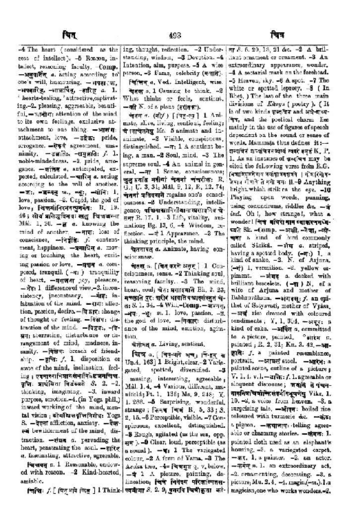
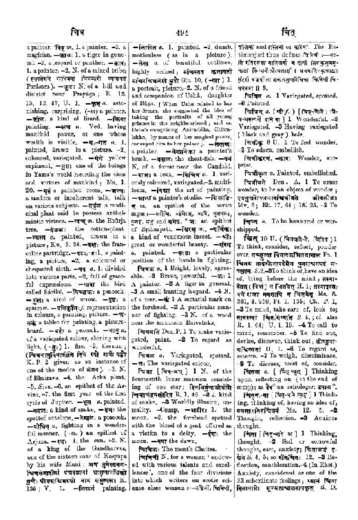
citra a. [citr-bhāve ac; ci-ṣṭran vā Uṇ. 4. 163] 1 Bright, clear. 2 Variegated, spotted, diversified. 3 Amusing, interesting, agreeable; Māl. 1. 4. 4 Various, different, manifold; Pt. 1. 136; Ms. 9. 248; Y. 1. 288. 5 Surprising, wonderful, strange; kimatra citraṃ R. 5. 33; Ś. 2. 15. 6 Perceptible, visible. 7 Conspicuous, excellent, distinguished. 8 Rough, agitated (as the sea, opp. sama). 9 Clear, loud, perceptible (as a sound). — traḥ 1 The variegated colour. 2 A form of Yama. 3 The Aśoka tree. 4 = citragupta q. v. below. — traṃ 1 A picture, painting, delineation; citre niveśya parikalpitasattvayogā Ś. 2. 9; punarapi citrīkṛtā ([Page 0493-c]) kāṃtā Ś. 6. 20, Ś. 6. 13, Ś. 6. 21 &c. 2 A brilliant ornament or ornament. 3 An extraordinary appearance, wonder. 4 A sectarial mark on the forehead. 5 Heaven, sky. 6 A spot. 7 The white or spotted leprosy. 8 (In Rhet.) The last of the three main divisions of Kāvya (poetry). It is of two kinds śabdacitra and artha-vācya-citra, and the poetical charm lies mainly in the use of figures of speech dependent on the sound or sense of words. Mammaṭa thus defines it: -śabdacitraṃ vācyacitramavyaṃgyaṃ tvavaraṃ smṛtaṃ K. P. 1. As an instance of śabdacitra may be cited the following verse from R. G. mitrātriputranetrāya trayīśātravaśatrave . gotrārigotrajaitrāya gotrātre te namo namaḥ ... 9 Anything bright which strikes the eye. 10 Playing upon words, punning, using conundrums, riddles &c. — traṃ ind. Oh!, how strange!, what a wonder! citraṃ badhiro nāma vyākaraṇamadhyeṣyate Sk. Comp. — akṣī, -netrā, — locanā a kind of bird commonly called Sārikā. — aṃga a. striped, having a spotted body. — (gaḥ) 1 a kind of snake. 2 N. of Arjuna. — (gaṃ) 1 vermilion. 2 yellow orpiment. — aṃgada a. decked with brilliant bracelets. — (dā) N. of a wife of Arjuna and mother of Babhruvāhana. — aṃgadasūḥ f. an epithet of Satvavatī, mother of Vyāsa. — annaṃ rice dressed with coloured condiments; Y. 1. 304. — apūpaḥ a kind of cake. — arpita a. committed to a picture, painted. ˚āraṃbha a. painted; R. 2. 31; Ku. 3. 42. — ākṛtiḥ f. a painted resemblance, portrait. — āyasaṃ steel. — āraṃbhaḥ a painted scene, outline of a picture; V. 1. 4. v. l. — uktiḥ f. 1 agreeable or eloquent discourse; jayaṃti te paṃcamanādamitracitroktisaṃdarbhavibhūṣaṇeṣu Vikr. 1. 10. 2 a voice from heaven. 3 a surprising tale. — odanaḥ boiled rice coloured with turmeric &c. — kaṃṭhaḥ a pigeon. — kathālāpaḥ telling agreeable or charming stories. — kaṃbalaḥ 1 painted cloth used as an elephant's housing. 2 a variegated carpet. — kara. 1 a painter. 2 an actor. — karman n. 1 an extraordinary act. 2 ornamenting, decorating. 3 a picture; Mu. 2. 4. 4 magic. ( — m.). 1 a magician, one who works wonders. 2 ([Page 0494-a]) a painter. ˚vid m. 1 a painter. 2 a magician. — kāyaḥ 1 a tiger in general. 2 a leopard or panther. — kāraḥ 1 a painter. 2 N. of a mixed tribe; (sthapaterapi gāṃdhikyāṃ citrakāro vyajāyata Parāśara). — kūṭaḥ N. of a hill and district near Prayāga; R. 12. 15, R. 13. 47, U. 1. — kṛt a. astonishing, surprising. ( — m.) a painter. — kolaḥ a kind of lizard. — kriyā painting. — kṣatra a. Ved. having manifold power, or one whose wealth is visible. — ga, -gata a. 1 painted, drawn in a picture. 2 coloured, variegated. — gaṃdhaṃ yellow orpiment. — guptaḥ one of the beings in Yama's world recording the vices and virtues of mankind; Mu. 1. 20. — gṛhaṃ a painted room. — jalpaḥ a random or incoherent talk, talk on various subjects. — taṃḍuṃla a medicinal plant said to possess anthelmintic virtues. — tvac m. the Bhūrja tree. — daṃḍakaḥ the cotton-plant. — nyasta a. painted, drawn in a picture; Ku. 2. 24. — pakṣaḥ the francoline partridge. — paṭaḥ, -ṭṭaḥ 1 a painting, a picture. 2 a coloured or chequered cloth. — pada a. 1 divided into various parts. 2 full of graceful expressions. — pādā the bird called Sārikā. — picchakaḥ a peacock. — puṃkhaḥ a kind of arrow. — pṛṣṭhaḥ a sparrow. — pratikṛtiḥ f. representation in colours, a painting, picture. — phalakaṃ a tablet for painting, a pictureboard. — barhaḥ a peacock. — bhānu a. of a variegated colour, shining with light. — (nuḥ) 1 fire. 2 the sun; (citrabhānurvibhātīti dine ravau rātrau vahnau K. P. 2 given as an instance of one of the modes of aṃjana). 3 N. of Bhairava. 4 the Arka plant. 5 Śiva. 6 an epithet of the Aśvins. 7 the first year of the first cycle of Jupiter. — bhūta a. painted. — maṃḍalaḥ a kind of snake. — mṛgaḥ the spotted antelope. — mekhalaḥ a peacock. — yodhin a. fighting in a wonderful manner. ( — m.) an epithet of Arjuna. — rathaḥ 1 the sun. 2 N. of a king of the Gandharvas, one of the sixteen sons of Kaśyapa by his wife Muni; atra munestanayaścitrasenādīnāṃ paṃcadaśānāṃ bhrātṝṇāmadhiko guṇaiḥ ṣoḍaśaścitraratho nāma samutpannaḥ K. 136; V. 1. — likhanaṃ painting. ([Page 0494-b]) — likhita a. 1 painted. 2 dumb, motionless (as in a picture). — lekha a. of beautiful outlines, highly arched; rucistava kalāvatī ruciracitralekhe bhruvau Gīt. 10. — (khā) 1 a portrait, picture. 2 N. of a friend and companion of Uṣā, daughter of Bāṇa. [When Uṣā related to her her dream, she suggested the idea of taking the portraits of all young princes in the neighbourhood; and on Uṣā's recognising Aniruddha, Chitralekhā, by means of her magical power, conveyed him to her palace]. — lekhakaḥ a painter. — lekhanikā a painter's brush. — vadālaḥ the sheat-fish. — vanaṃ N. of a forest near the Gaṇḍakī. — vājaḥ a cock. — vicitra a. 1 variously coloured, variegated. 2 multiform. — vidyā the art of painting. — śālā a painter's studio. — śikhaṃḍin m. an epithet of the seven sages:-marīci, aṃgiras, atri, pulastya, pulaha, kratu and vasiṣṭha. ˚jaḥ an epithet of Bṛhaspati. — śiras m., — śīrṣakaḥ a kind of venomous insect. — śrīḥ great or wonderful beauty. — saṃstha a. painted. — hastaḥ a particular position of the hands in fighting.
Cappeller 1887 Worttyp nicht bestimmt
Originaltext · Deutsch · Worttyp nicht bestimmt
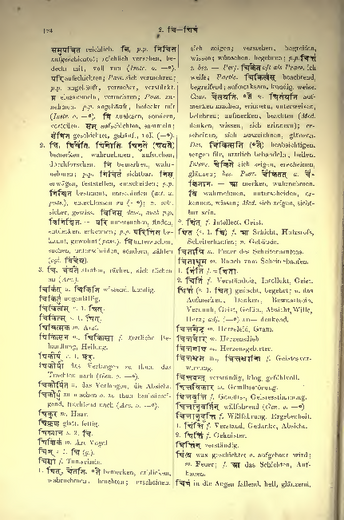
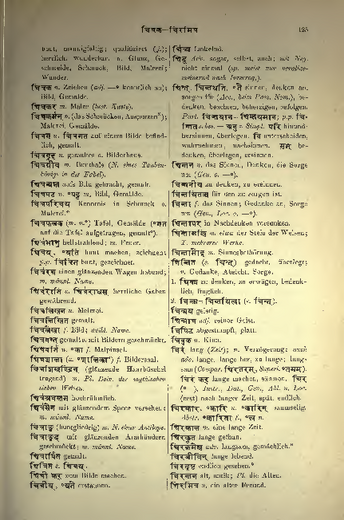
citrá in die Augen fallend, hell, glänzend, [Page125-1] bunt, mannigfaltig; qualifiziert (j.); herrlich,wunderbar. n. Glanz, Geschmeide, Schmuck, Bild, Malerei; Wunder.
Burnouf 1866 Adjektiv
Originaltext · Französisch · Adjektiv
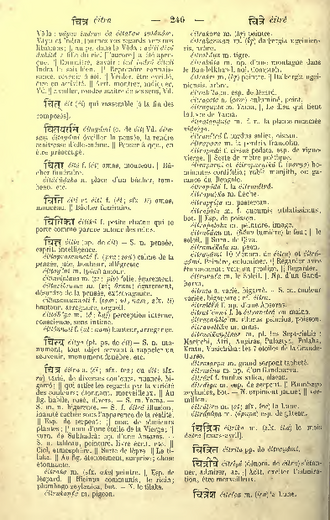
citra citra a. (ci; sfx. tra; ou cit; sfx. ra) varié, de diverses cou'eurs, nuancé, bigarré; qui attire les regards par la variété des couleurs; étonnant, merveilleux. Au fig. habile, rusé, divers. — S. m. Yama. — S. m. n. bigarrure. — S. f. citrā illusion, inanité cachée sous l'apparence de la réalité. Esp. de serpent; nom de plusieurs plantes; nom d'une étoile de la Vierge; surn. de Subhadrā; np. d'une Apsaras. — S. n. tableau, peinture, livre écrit, etc. Ciel, atmosphère. Sorte de lèpre Le tilaka. Au fig. étonnement, surprise; chose étonnante. citraka m. (sfx. aka) peintre. Esp. de léopard. Ricinus communis, le ricin; plumbago zeylanica, bot. — N. le tilaka. citrakoṇṭha m. pigeon. [Page246-2] citrakara m. (kṛ) peintre. citrakarman m. (kṛ) dalbergia ugeiniensis, arbre. citrakāya m. tigre. citrakūṭa m. np. d'une montagne dans le Bundelkhand, auj. Compteh. citrakṛt m. (kṛ) peintre. Dalbergia ugeiniensis, arbre. citrakola m. esp. de lézard. citragata a. (gam) enluminé, peint. citragupta m. Yama. Le dieu qui tient le livre de Yama. citrataṇḍula m. f. n. la plante nommée viḍaṅga. citranetrā f. turdus salica, oiseau. citrapakṣa m. la perdrix francolin. citrapadā f. cissus pedata. esp. de vigne vierge. Sorte de mètre poétique. citraparṇī et citraparṇikā f. (parṇa) hemionites cordifolia; rubia manjith, ou garance du Bengale. citrapādā f. la citranetrā. citrapuṅkha m. flèche. citrapṛṣṭa m. passereau. citraphala m. f. cucumis utilatissimus, bot. Esp. de poisson. citraphalaka m. peinture, image. citrabhānu m. (bhānu lumière) le feu; le soleil. Surn. de Śiva. citramekhala m. paon. citrayāmi 10 (dénom. de citra) et citrāyāmi. Peindre, enluminer. Regarder avec étonnement: voir un prodige. Regarder. citraratha m. le Soleil. Np. d'un Gandharva. citrala a. varié, bigarré. — S. m. couleur variée, bigarrure; cf. citra. citralekhā f. np. d'une Apsaras. citralīcanā f. la citranetrā ou maina. citravadāla m. silurus pelorius, poisson. citravallika m. mms. citracikhaṇḍinas m. pl. les Sept-rishis: Marīci, Atri, Aṅgiras, Pulastya, Pulaha, Kratu, Vasiṣṭha; les 7 étoiles de la GrandeOurse. citrasarpa m. grand serpent tacheté. citrasena m. np. d'un Gandharva. citrākṣī f. turdus salica, oiseau. citrāṅga m. esp. de serpent. Plumbago zeylanica, bot. — N. orpiment jaune; vermillon. citrāṭīra m. (at; sfx. īra) la Lune. citrāpūpa m. (āpupa) esp. de gâteau.
Quelltextfundstellen (9)
DYS 1 Fundstelle
HP 4 Fundstellen
HTK 1 Fundstelle
HTK 10.34*2–38*1: Asvaṅgaśṛṅkhalā und Kumbhāntaraśṛṅkhalā 1 Fundstelle
Direkt belegt
-
HTK 10.38 Segment 14
PYS 1 Fundstelle
Mit AYI Free weitermachen
Bildquelle: AYI Archiv.