

saṃhāra संहार – Vernichtung; Auflösung
Substantiv Maskulin · Substantiv Neutrum · Worttyp nicht bestimmt
Wörterbuchquellen
AYI Wörterbuch Substantiv Maskulin · Substantiv Neutrum
Cappeller 1891 Substantiv Maskulin
Originaltext · Englisch · Substantiv Maskulin
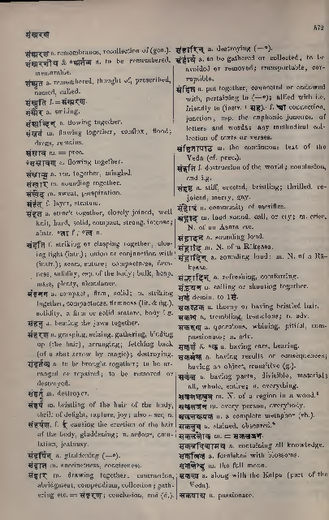
saṃhāra ·m. drawing together, contraction, abridgment, compendium, collection; gathering etc. = saṃharaṇa; conclusion, end (d.).
Monier-Williams 1872 Substantiv Maskulin · Worttyp nicht bestimmt
Originaltext · Englisch · Substantiv Maskulin
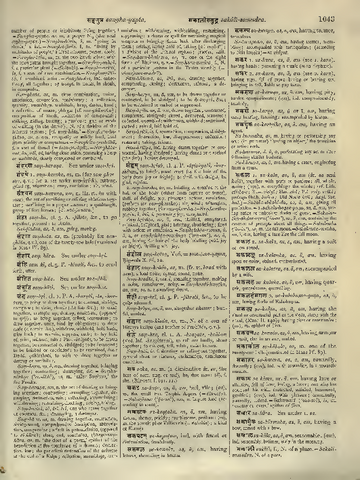
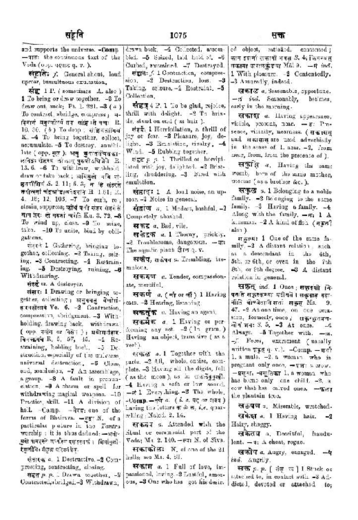
Saṃ-hāra, as, m. drawing together, contraction, abridgement, comprehensive description, abbrevia- tion, compression; a fault in pronunciation, (opposed to vi-hāra); close, end, conclusion, (kāvya-saṃ- hāra, as, m. ‘the close of a poem,’ epithet of the benediction at the conclusion of a drama); destruc- tion, loss; the periodical destruction of the universe at the end of a Kalpa; collection, assemblage, accu- mulation; withdrawing, withholding, restraining, suppressing; a charm or spell for restraining magical weapons or bringing them back after discharging them; seizing, laying hold of, taking [cf. veṇī-s˚]; a division of the infernal regions; practice, skill.
Originaltext · Englisch · Worttyp nicht bestimmt
saṃhāra saṃ-hāra. See under saṃ-hṛ.
Petersburger 1855 Substantiv Maskulin
Originaltext · Deutsch · Substantiv Maskulin
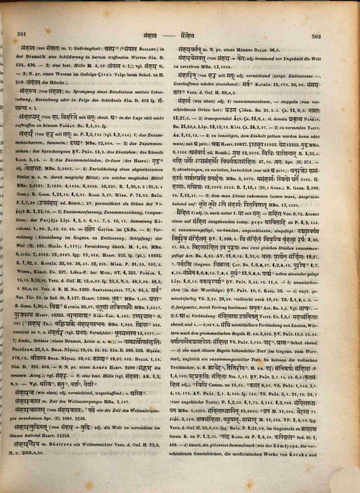
saṃhārá (von har mit sam) m. P. 3,3,122 (vgl. P. 6,2,144). 1〉 das Zusammenscharren, Sammeln: dravya˚ MBH. 12,608. — 2〉 das Zusammenziehen: der Sprachorgane ṚV. PRĀT. 14,2. das Einziehen: des Rüssels RAGH. 5,45. — 3〉 das Zusammenbinden, Ordnen (der Haare): mṛdu˚ adj. (keśapakṣa) MBH. 5,2903. — 4〉 Zurückholung eines abgeschossenen Pfeiles u. s. w. durch magische Mittel; ein solches magisches Mittel MBH. 1,5131. MBH. 3,1650. MBH. 4,1830. MBH. 6,3209. MBH. 10,691. R. 1,30,2. R. 1,30,3 (R. 31,2. R. 1,4 GORR.). R. GORR. 1,24,18. R. GORR. 6,4,21. RAGH. 5,57. MĀRK. P. 74,52. BHĀG. P. 1,7,20 (upasaṃhāra ed. Bomb.). 27. personificirt als Söhne der Vijayā R. 1,23,16. — 5〉 Zusammenfassung, Zusammenziehung, Compendium: der Paryāya LĀṬY. 6,2,5. LĀṬY. 6,6,14. LĀṬY. 6,7,8. LĀṬY. 6,10,17. Sammlung KĀLACAKRA 1,99. KĀLACAKRA 2,49. KĀLACAKRA 2,82. KĀLACAKRA 2,89. = saṃkṣepa JAṬĀDH._im_ŚKDR. — 6〉 Vernichtung (Einziehung im Gegens. zu Entlassung, Schöpfung) der Welt (H. 161. HALĀY. 1,117); Vernichtung überh. M. 1,80. MBH. 6,4462. fgg. MBH. 7,2042. MBH. 12,9167. fgg. MBH. 13,818. HARIV. 525. fg. (pl.). HARIV. 14935. R. 7,62,5. KATHĀS. 35,99. KATHĀS. 36,41. KATHĀS. 52,323. MĀRK. P. 81,53. MĀRK. P. 103,2. WEBER, RĀMAT. UP. 337. LIṄGA-P._bei_MUIR, ST. 4,325. PAÑCAR. 1,14,13. PAÑCAR. 3,15,19. Verz. d. Oxf. H. 12,a,39. fg. Verz. d. Oxf. H. 23,b, N. 3. Verz. d. Oxf. H. 48,b,39. fg. Verz. d. Oxf. H. 49,b,6. fg. Verz. d. Oxf. H. 80,a,23. Verz. d. B. H. No. 1365. SARVADARŚANAS. 77,9. SARVADARŚANAS. 84,5. sarva˚ NṚS. TĀP. UP._in_Ind. St. 9,137. HARIV. 13906. bhūta˚ MBH. 1,40. prajā˚ R. GORR. 1,30,4. viśva˚ KATHĀS. 50,57. bhṛgūṇāṃ kṣatriyādhamaiḥ MBH. 1,6847. puratrayasya HARIV. 16355. naranāgāśva˚ RĀJA-TAR. 4,445. ḍāmaragrāma˚ RĀJA-TAR. 6,354 (˚sahāra TR.). vahniścakre saṃhāramātmanaḥ MBH. 1,922. kriyā˚ MBH. 1,926. concret so v. a. saṃhartar (vgl. prabhava) Vernichter: bhūtagrāmasya MBH. 14,1577. — 7〉 Ende, Schluss (eines Dramas, Actes u. s. w.); = vākyārthopasaṃhṛtiḥ PRATĀPAR. 22,b,3. BHAR. NĀṬYAŚ. 19,68. BHAR. NĀṬYAŚ. 19,92. BHAR. NĀṬYAŚ. 19,95. SĀH. D. 388. SĀH. D. 556. MṚCCH. 178,15. bījasya BHAR. NĀṬYAŚ. 18,15. kāvya˚ NĀṬYAŚ. 19,67. NĀṬYAŚ. 19,102. DAŚAR. 1,48. SĀH. D. 391. SĀH. D. 404. — 8〉 N. pr. eines Asura HARIV. 2289 (saṃhrāda die neuere Ausg.); vgl. saṃhara. — 9〉 eine best. Hölle (vgl. saṃhāta) AK. 1,2,2,2. — Vgl. asthi˚, ṛtu˚, varṇa˚, veṇī˚.
Böhtlingk 1879 Substantiv Maskulin
Originaltext · Deutsch · Substantiv Maskulin
saṃhāra m. — 1〉 das Zusammenscharren, Sammeln. — 2〉 das Zusammenziehen (der Sprachorgane), Einziehen (des Rüssels). — 3〉 das Zusammenbinden, Ordnen (der Haare). — 4〉 Zurückholung eines abgeschossenen Pfeiles u. s. w. durch magische Mittel, eins solches magisches Mittel. — 5〉 Zusammenfassung, Zusammenziehung, Compendium; Sammlung. — 6〉 Vernichtung der Welt, Vernichtung überh. — 7〉 concret so v. a. saṃhartar Vernichter. — 8〉 Ende, Schluss (eines Schauspiels, Actes u. s. w.). — 9〉 *eine best. Hölle. — 10〉 N. pr. eines Asura. saṃhrāda v. l.
Apte 1890 Substantiv Maskulin
Originaltext · Englisch · Substantiv Maskulin
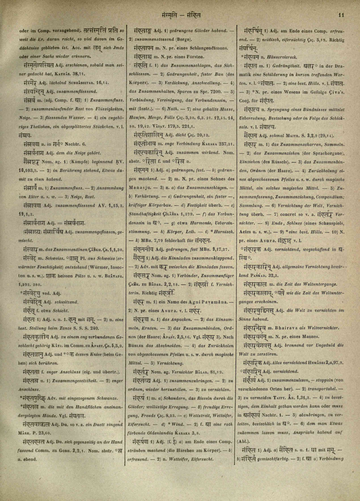
saṃhāraḥ 1 Drawing or bringing together, collecting; anubhavanu veṇīsaṃhāramahotsavaṃ Ve. 6. 2 Contraction, compression, abridgment. 3 Withholding, drawing back, withdrawal (opp. prayoga or vikṣepa); prayogasaṃha ravibhaktamaṃtraṃ R. 5. 57, R. 5. 45. 4 Restraining, holding back. 5 Destruction, especially of the universe, universal destruction. 6 Close, end, conclusion. 7 An assemblage, a group. 8 A fault in pronunciation. 9 A charm or spell for withdrawing magical weapons. 10 Practice, skill. 11 A division of hell. Comp. — bhairavaḥ one of the forms of Bhairava. — mudrā N. of a particular posture in the Tantra worship; it is thus defined:- avomukhe vāmahaste ūrdhvāsyaṃ dakṣahastakaṃ . kṣiptāṃgulīraṃgulībhiḥ saṃgṛhya parivartayet.
Cappeller 1887 Substantiv Maskulin
Originaltext · Deutsch · Substantiv Maskulin
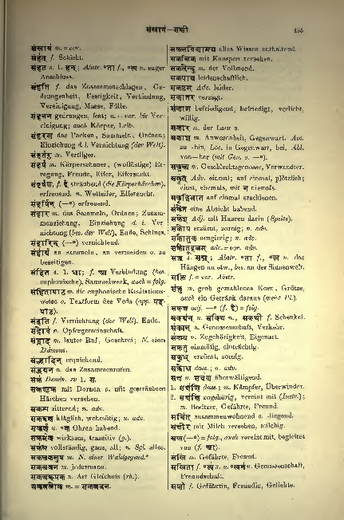
saṃhāra m. das Sammeln, Ordnen; Zusammenziehung, Einziehung d. i. Vernichtung (bes. der Welt), Ende, Schluss.
Burnouf 1866 Substantiv Maskulin
Originaltext · Französisch · Substantiv Maskulin
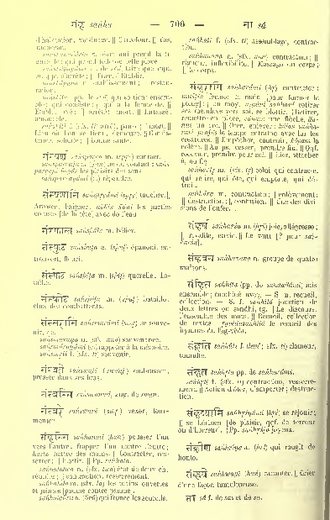
saṃhāra m. contraction; enlèvement; destruction; confusion. Une des divisions de l'enfer.
Quelltextfundstellen (10)
HP 2 Fundstellen
HTK 1 Fundstelle
PJH 1 Fundstelle
SiSa 2 Fundstellen
Mit AYI Free weitermachen
Bildquelle: AYI Archiv.