
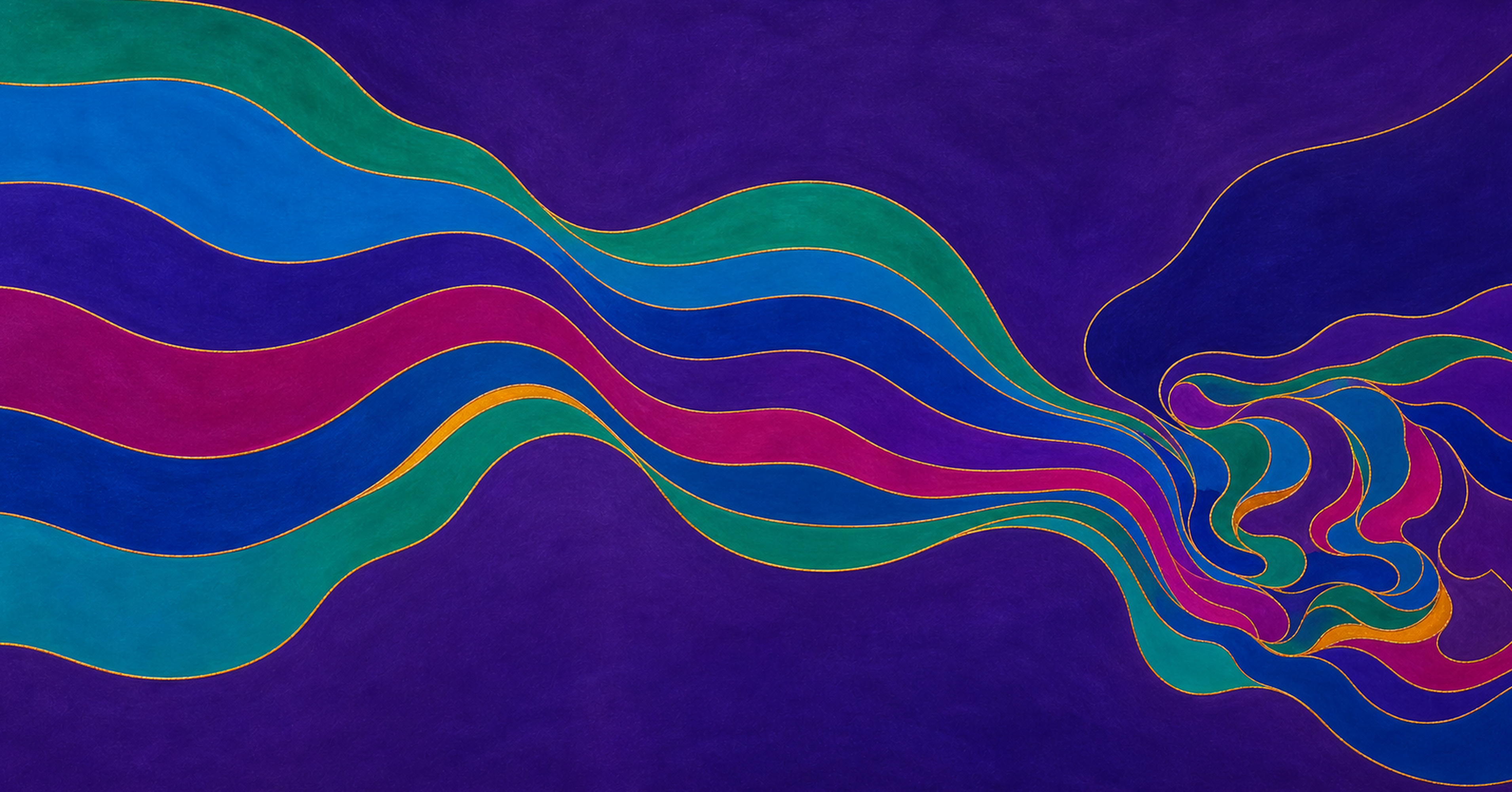
PJH 5-6: Die Kontraktion des Göttlichen

From citi through cetana to citta

Universal divine Awareness (citi) contracts through the individual self (cetana) into the human mind (citta).

Dr. Ronald Steiner Dr. Ronald Steiner Bärbel Münchow Bärbel Münchow
Pratyabhijñāhṛdaya 5
चितिरेव चेतनपदादवरूढा चेत्यसंकोचिनी चित्तम् ||5||
citir eva cetana-padād avarūḍhā cetya-saṃkocinī cittam ||5|| Analysis ▾ Analysis ▴
citiḥ
nominative singular
substantive feminine
universal awareness
eva
particle
indeed, precisely, alone
cetana
tatpuruṣa-compound genitive
substantive masculine
of the conscious being
padāt
ablative singular
substantive neuter
from the level, from the state
avarūḍhā
nominative singular feminine past participle passive
previx
verbal root
descended
cetya
tatpuruṣa-compound instrumental case
adjective
through the perceptible, in accordance with the object
saṃkocinī
nominative singular feminine
adjective
contracting, limiting
cittam
nominative singular
substantive neuter
mind, individual consciousness
Awareness (citiḥ | nom sg) herself (eva), having descended (avarūḍhā | nom sg f ppp) from the level of the conscious being (cetana-padāt | abl sg), contracts through the perceptible object (cetya-saṃkocinī | nom sg f) [and is] the mind (cittam | nom sg).
Dr. Ronald Steiner - 2026 - historically literal
When Awareness contracts around a single object, mind (citta) arises. Notice that narrowing and, at the same time, the open space in which it occurs.
Dr. Ronald Steiner - 2026 - modern transfer

Kṣemarāja answers the objection that a mind shaped by conceptual constructions cannot possibly be Śiva: Citta, the individual mind, is nothing other than Awareness in a doubly contracted condition.

Awareness conceals its own form and assumes different degrees of limitation. When its light predominates, higher forms of perception appear: pure luminosity without pronounced agency among the vijñānākalas, light with self-reference at the level of pure knowledge, and—as contraction diminishes further—the levels of Īśvara, Sadāśiva, and Anāśrita-Śiva. The ascendancy of Awareness gained in samādhi can likewise open progressively higher levels of perceivers along the pure path.

Where contraction predominates, by contrast, levels of perceivers arise from emptiness downwards. Awareness then descends from the level of the conscious perceiver (cetana), turns towards an object, and is restricted once more by that object—by blue or by a feeling of happiness, for example. The limitation of the perceiver and the limitation imposed by the perceived together constitute citta.

The three qualities sattva, rajas, and tamas are likewise not an unconscious substance existing alongside Awareness. Kṣemarāja understands them as severely contracted manifestations of its powers of knowledge, action, and Māyā in the state of the bound being.

Thus the light of one’s own nature is not lost even amid conceptual differentiation (vikalpa). One who is oriented towards the highest reality can follow that light even within thought.

Kṣemarāja's Pratyabhijñāhṛdayavṛtti
Das Citta ist nur die von der Stufe des Cetana herabgestiegene, durch das Wahrnehmungsobjekt in den Zustand der Beschränkung geratene Citi.
Emil Baer - 1926
Pratyabhijñāhṛdaya 6
तन्मयो मायाप्रमाता ||6||
tan-mayo māyā-pramātā ||6|| Analysis ▾ Analysis ▴
tad
tatpuruṣa-compound instrumental case
pronoun dem
from that, consisting of that
mayaḥ
nominative singular masculine
adjective
consisting of, filled with
māyā
tatpuruṣa-compound genitive
substantive feminine
of Māyā, of the differentiating power of appearance
pramātā
nominative singular
substantive masculine
perceiver, knowing subject
Someone who consists [only] of this [mind] (tan-mayaḥ | nom sg m) becomes the perceiver of Māyā [duality] (māyā-pramātā | nom sg).
Dr. Ronald Steiner - 2026 - historically literal
When you identify entirely with the limited mind, the world appears only as something opposite you. Take separation seriously without mistaking it for the whole truth.
Dr. Ronald Steiner - 2026 - modern transfer

For Kṣemarāja, the perceiver limited by Māyā consists of citta. Body and vital energy are shaped by this mind. Even an apparently empty condition bears mental impressions; otherwise a person could not resume unfinished tasks after returning from it.

This also explains the differing statements of two Śivasūtras. From the highest perspective, the text says, “Consciousness is the Self” (caitanyam ātmā). When describing the perceiver limited by Māyā, it says instead, “The mind is the Self” (cittam ātmā). The second statement describes a bound level of perceivers, not another ultimate reality.


Kṣemarāja's Pratyabhijñāhṛdayavṛtti
Aus ihm besteht der Mâyâpramâtar.
Emil Baer - 1926

Illustrations: AI-generated.

Editor

Dr. Ronald Steiner

From Ulm

The "Yoga Doc" - Dr. Ronald Steiner is the founder of the AYI method. This method links traditional Ashtanga Yoga with innovative Yogatherapy and living Philosophy. This forms a practice that is personal for each and... more ›

Bärbel Münchow

Practising since 2003 Pratyabhijñāhṛdayam From Hamburg Ashtanga YogaYoga therapyPhilosophy & Sanskrit

2003 entdeckte ich Yoga für mich – damals noch als neue „Sportart“, weil meine Knie und mein Rücken Tennis und Laufen nicht mehr mochten. Was zunächst als körperlicher Ausgleich begann, ist längst zu einer großen... more ›

Messages and ratings
0 messages

Please log in to write a message. Go to login

No messages yet.