

hetu हेतु – reason; cause
substantive masculine · substantive neuter · Word type unspecified
Dictionary sources
AYI dictionary substantive masculine · substantive neuter
Cappeller 1891 substantive masculine
Original text · English · substantive masculine
hetú ·m. impulse, motive, cause, reason (gen., dat., loc., or --°), argument, proof; means (instr. --° by means of); condition; mode, manner, way; also concr. mover, impeller, esp. the agent of the causative (g.); adj. --° caused by. Abl. gen., instr., dat., & loc. by reason, on account, or for the sake of (gen. or --°). Abstr. °tāÅ f., °tvaÅ n.
Monier-Williams 1872 substantive masculine · Word type unspecified
Original text · English · substantive masculine
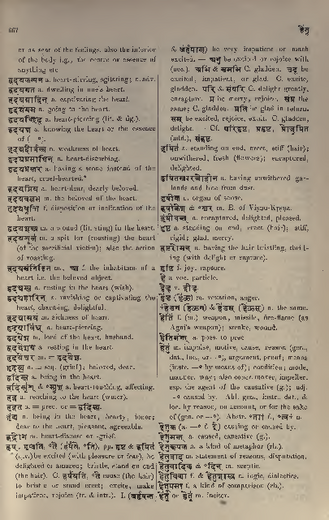
Hetu, us, m. (according to Uṇādi-s. I. 73. fr. rt. 1. hi), impulse, motive; cause, reason, object, pur- pose (e. g. anena hetunā, for this reason; mṛtyu- hetave, in order to kill; hetur alaukikaḥ, a super- natural cause); a logical reason, the reason for an inference (constituting the second Avayava or mem- ber of the five-membered Nyāya syllogism, e. g. 1. ‘this hill is fiery,’ 2. ‘because it smokes;’ see ny- āya, p. 519; 2. prati-jñā, p. 613); any logical deduc- tion or argument, proof; reasoning, logic (in general); excuse, sophistry; means, instrument; law, condition; source, origin; a particular figure of speech, (in the drama) a brief speech giving a reason; (hetunā or hetau or hetos), ind. by reason of, because of, on account of, for the sake of, (generally after a gen. or at the end of a comp., e. g. mama hetoḥ or mad- dhetoḥ, on account of me.)
Original text · English · Word type unspecified
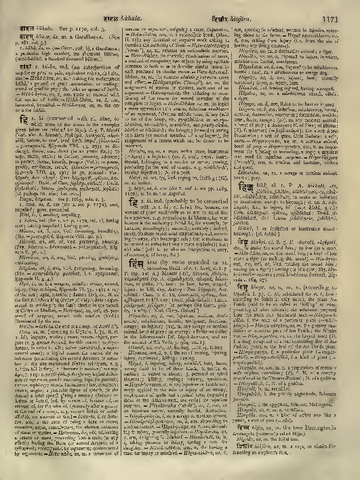
Hetu. See p. 1171, col. 1.
Petersburger 1855 substantive masculine
Original text · German · substantive masculine
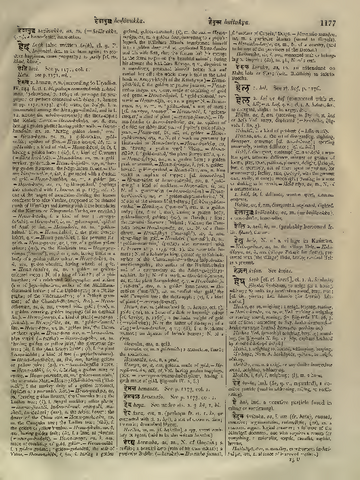
hetú (von 1. hi) UṆĀDIS. 1,73. m. 1〉 wer oder was Etwas veranlasst, — bewirkt, Veranlassung, Ursache AK. 1,1,4,6. TRIK. 3,2,10. H. 1513. HALĀY. 2,457. ṚV. PRĀT. 11,12. ṚV. PRĀT. 11,23. P. 2,3,23. P. 3,3,156. MBH. 1,67. MBH. 2,564 (pl.). hetvahetubhiḥ MBH. 12,10511. R. 2,21,14. SĀṂKHYAK. 1. SĀṂKHYAK. 31. kālo hetuṃ vikurute Spr. (II) 1709. ˚vigama Spr. (II) 5888. vinā hetumapi dvaṃdvam Spr. (II) 6360. na hetuṃ kaṃcidīkṣante Spr. (II) 7513. praṇamya hetumīśvaram Verz. d. Oxf. H. 240,a, No. 583. einer Krankheit Verz. d. Oxf. H. 305,b,18. Verz. d. Oxf. H. 312,a, No. 745. hetuṃ kṛtvā pitṛvadham BHĀG. P. 9,16,18. niyama˚ eine regulirende Ursache SARVADARŚANAS. 16,13. fg. nahyekaḥ sādhako hetuḥ svalpasyāpīha karmaṇaḥ Spr. (II) 1685. mit gen. P. 2,3,26. sa hetuḥ sarvavidyānāṃ dharmasya ca dhanasya ca Spr. (II) 2357. na khalu vayastejaso hetuḥ Spr. (II) 7040. BHĀG. P. 12,7,18. mit dat. ŚVETĀŚV. UP. 6,17. mit loc. ĀŚV. ŚR. 12,15,12. BHAG. 13,20. R. 2,58,25. tatra RAGH. 1,63. atra Spr. (II) 3536. Spr. (II) 7044. na jāne ko heturdalati śatadhā yanna hṛdayam Spr. (II) 2071. in comp. mit dem was bewirkt wird: sargasvargāpavarga˚ MAITRYUP. 6,30. ṚV. PRĀT. 11,2. MEGH. 3. pitaro janmahetavaḥ RAGH. 1,24. RAGH. 2,44. ādhi˚ ŚĀK. 59. fg. Spr. (II) 1326. dharmārthakāmamokṣāṇāṃ prāṇāḥ saṃsthitihetavaḥ Spr. (II) 3121. Spr. (II) 5709. Spr. (II) 5875. VARĀH. BṚH. S. 28,4. fg. VARĀH. BṚH. S. 75,5. VARĀH. BṚH. S. 78,10. fg. VARĀH. BṚH. S. 95,30. KATHĀS. 23,93. AK. 3,4,27,212. RĀJA-TAR. 6,185. HIT. 38,11. kalaye 'dharmahetave BHĀG. P. 1,17,28. BHĀG. P. 2,2,6. BHĀG. P. 3,17,4. BHĀG. P. 3,33,24. BHĀG. P. 5,20,39. SARVADARŚANAS. 29,16. fg. SARVADARŚANAS. 35,19. SARVADARŚANAS. 37,14. fg. SARVADARŚANAS. 39,16. SARVADARŚANAS. 40,6. fgg. SARVADARŚANAS. 180,11. śākalā ācāryaśāstrāparilopahetavaḥ ṚV. PRĀT. 1,16 (ṚV. PRĀT. 1,26). te śiṣṭā brāhmaṇā jñeyāḥ śrutipratyakṣahetavaḥ M. 12,109. RAGH. 1,10. na guṇāḥ phalahetavaḥ Spr. (II) 2129. matsyā mama jīvanahetavaḥ HIT. 113,22. BHĀG. P. 3,12,21. na śarāḥ stambhahetavaḥ die Pfeile sind nicht dazu da um den (Köcher) vollzustopfen R. 2,23,31 (R. 2,30,36 GORR.). am Ende eines adj. comp. — zur Ursache habend so v. a. bewirkt durch: tamasā karmahetunā M. 1,49. angetrieben —, angelockt durch: kravyādā māṃsahetavaḥ MBH. 10,496. mā karmaphalaheturbhūḥ BHAG. 2,47. BHAG. 2,49. Alle obliquen casus in der Bed. von einer Ursache wegen, in Veranlassung von gebraucht Vārtt. zu P. 2,3,23. a〉 abl. oder gen.: kasmāddhetoḥ oder kasya hetorvasati PAT._in_MAHĀBH. lith. Ausg. 2,385,a. a̱kṣasyà ṚV. 10,34,2. asya ŚAT. BR. 2,5,2,2. abhrasya ŚAT. BR. 11,1,4,1. CHĀND. UP. 1,3,5. SĀV. 1,13. MBH. 1,7728. MBH. 5,7026. R. 2,52,26 (R. 2,49,22 GORR.). R. 2,98,17 (R. 2,107,7 GORR.). RAGH. 2,47. Spr. (II) 7226. KATHĀS. 18,73. KATHĀS. 26,166. BHĀG. P. 1,14,7. BHĀG. P. 4,17,4. BHĀG. P. 7,15,40. kuto 'pi hetoḥ KATHĀS. 27,59. tato 'pi hetoḥ DHŪRTAS. 92,16. iti hetoḥ Z. d. d. m. G. 14,573,13. in comp. mit der Ergänzung: vṛtti˚ M. 4,11. MBH. 2,562. MBH. 10,496. R. 1,7,12. R. 1,16,33. R. 2,59,21. R. 2,101,17. R. 3,49,39. R. 3,69,16. R. 5,32,44. KĀM. NĪTIS. 14,28. MEGH. 26. MEGH. 44. MEGH. 79. MEGH. 105. ŚĀK. 50,8. ŚĀK. CH. 2,9. Spr. (II) 1224. Spr. (II) 2641. Spr. (II) 6221. Spr. (II) 7328. KATHĀS. 18,348. KATHĀS. 19,57. KATHĀS. 22,88. RĀJA-TAR. 5,216. — b〉 instr.: divyena MBH. 1,4919. yadṛcchayā hetunā vā BHĀG. P. 2,8,7. anena MBH. 1,7640. fg. tena R. 5,64,14. SĀH. D. 2,16. kena M. 8,161. R. GORR. 1,38,4. Schol. zu P. 2,3,27. BHĀG. P. 1,4,3. kenāpi RĀJA-TAR. 4,460. putra˚ R. GORR. 1,24,7. māna˚ Spr. (II) 1838. śāstravijñāna˚ Spr. (II) 2574. — c〉 dat.: kasmai hetave vasati PAT. a. a. O. mūḍhairvidhīyate hiṃsā sāpi durgatihetave HEM. YOGAŚ. 2,47. sukha˚ BHĀG. P. 3,30,2. mṛtyu˚ BHĀG. P. 7,1,41. naraka˚ BHĀG. P. 9,10,28. prasaraṇaṃ tṛṇakāṣṭhādi˚ H. 791. — d〉 loc. indecl. gaṇa svarādi zu P. 1,1,37. kasminhetau vasati PAT. a. a. O. kāmārthahetau ca kuru prayatnam um — Willen R. 4,29,25. — e〉 acc.: kaṃ hetuṃ vasati PAT. a. a. O. — Auch soll man ko heturvasati sagen können ebend. — 2〉 Grund, Argument, Beweis AK. 3,4,13,56. ataḥśabdo hetvarthaḥ SARVADARŚANAS. 56,14. SARVADARŚANAS. 71,11. ato hetau HALĀY. 5,92. hi desgl. HALĀY. 95. iti desgl. HALĀY. 101. deśadṛṣṭaiśca śāstradṛṣṭaiśca hetubhiḥ M. 8,3. hetubhirmokṣadarśibhiḥ MBH. 1,522. MBH. 1,583. MBH. 3,3018. vākyamarthavaddhetubhūṣitam MBH. 13,298. vākyaṃ hetvarthasaṃhitam R. 2,85,1. R. 3,56,31. R. 3,71,4. R. 5,33,15. R. 6,79,28. R. 7,94,8. tiṣṭhettu matimānāgame na tu hetuṣu SUŚR. 1,150,20. Spr. (II) 7413. RĀJA-TAR. 3,332. HIT. 15,22. SARVADARŚANAS. 9,11. SARVADARŚANAS. 12,4. SARVADARŚANAS. 18,9. SARVADARŚANAS. 119,11. SARVADARŚANAS. 119,17. pratiṣedha˚ SARVADARŚANAS. 114,8. KUVALAY. 196,b. in der Logik (auch Bez. des 2ten Theiles im Syllogismus) COLEBR. Misc. Ess. 1,292. KAṆ. 10,1,2. NYĀYAS. 1,1,32. NYĀYAS. 1,1,34. TARKAS. 32. TARKAS. 41. TARKAS. 45. SARVADARŚANAS. 113,20. BHĀṢĀP. 68. — 3〉 Mittel: hetumātraṃ tu rāmo vai jayamūlaṃ vibhīṣaṇaḥ R. 6,95,55. R. 7,38,23. HIT. 55,5 (hetunā mit den Hdschrr. zu lesen). pādajñānasya ṚV. PRĀT. 17,16. daśa jīvanahetavaḥ M. 10,116. vidyā jīvanahetuḥ Spr. (II) 6089, v. l. tisro viśrāntihetavaḥ Spr. (II) 6637, v. l. ko mokṣahetuḥ Spr. (II) 6638. rakṣā˚ HIT. 114,7. jayalābhāya hetū dvau Spr. (II) 7436. dīnnārāṇāṃ daśaśatī pañcāśatyadhikābhavat . dhānyakhārīkraye hetuḥ so v. a. Preis RĀJA-TAR. 5,71. jīvo nityo heturasya tvanityaḥ so v. a. der Körper Spr. (II) 3718. instr. am Ende eines comp. so v. a. vermittelst, durch: yo na hiṃsati sattvāni manovākkarmahetubhiḥ Spr. (II) 5609. YĀJÑ. 2,92. — 4〉 Bedingung: jīvituṃ cecchase mūḍha hetuṃ me gadataḥ śṛṇu MBH. 3,15786. — 5〉 Art und Weise: vadhyatāṃ kena hetunā MBH. 13,19. dvāvāharaṇahetū bhavataḥ pratilomo 'nulomaśca SUŚR. 1,100,11. — 6〉 in der Grammatik der Agens des causativen Verbums P. 1,4,55. P. 1,3,68. P. 7,3,40. — 7〉 bei den Buddhisten Grundursache, Hauptursache (im Gegensatz zu den pratyayāḥ den hinzukommenden Ursachen) SARVADARŚANAS. 7,19. SARVADARŚANAS. 14,19. SARVADARŚANAS. 19,12. SARVADARŚANAS. 20,22. fgg. — 8〉 bei den Pāśupata dasjenige was das Gebundensein der Seele bewirkt, die Natur, die Sinnenwelt SARVADARŚANAS. 74,20. SARVADARŚANAS. 94,17; vgl. SARVADARŚANAS. 95,1. — 9〉 bei den Rhetorikern ein arthālaṃkāra Verz. d. Oxf. H. 208,b,3. — 10〉 im Drama eine kurze Rede, welche die zur Erreichung eines Ziels erforderlichen Bedingungen angiebt, SĀH. D. 439. SĀH. D. 434. — Vgl. nimitta˚, nirhetu, mada˚, yaddhetos, viśva˚.
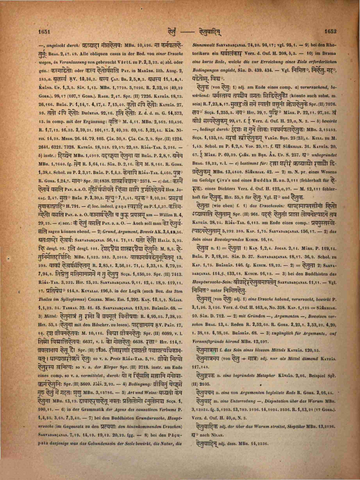
Böhtlingk 1879 substantive masculine
Original text · German · substantive masculine
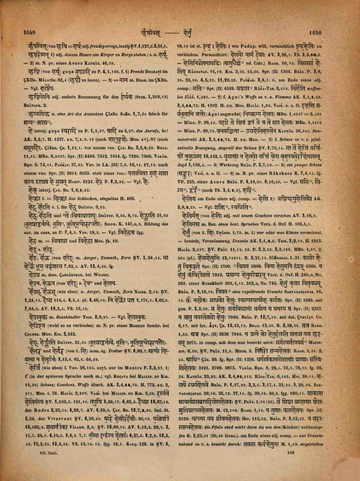
hetú m. — 1〉 wer oder was Etwas veranlasst, — bewirkt, Veranlassung, Ursache, — von (Gen., Dat., Loc. oder im Comp. vorangehend). na śarāḥ stambhahetavaḥ so v. a. die Pfeile sind nicht dazu da um den (Köcher) vollzustopfen. hetos (Abl., Gen.), hetunā, hetave, hetau und *hetúm einer Ursache wegen, in Veranlassung von Etwas, um — Willen, wegen; die Ergänzung im Gen. oder im Comp. vorangehend. Angeblich sagt man auch ko heturvasati in der Bed. von weshalb. Am Ende eines adj. Comp. — zur Ursache habend, bewirkt durch —; angetrieben, angelockt durch —, — 2〉 Grund, Argument, Beweis. In der Logik auch Bez. des 2ten Theils im Syllogismus. — 3〉 Mittel. Instr. am Ende eines Comp. so v. a. vermittelst, durch. — 4〉 Preis, pretium. — 5〉 Bedingung Chr. 160,23. — 6〉 Art und Weise. — 7〉 bei den Grammatikern der Agens des causativen verbums. — 8〉 bei den Buddhisten Grundursache, Hauptursache im Gegensatz zu pratyaya eine hinzukommende Ursache. — 9〉 bei den Pāśupata das was das Gebundensein der Seele bewirkt, die Natur, die Sinnenwelt. — 10〉 im Drama eine kurze Rede, welche die zur Erreichung eines Zieles erforderlichen Bedingungen angiebt.
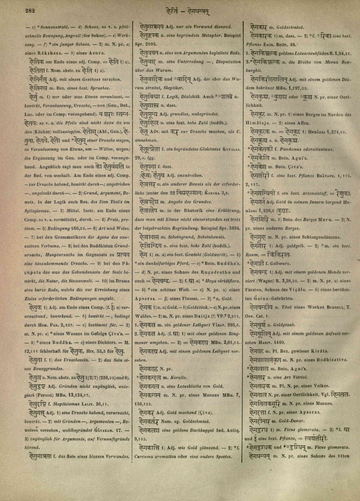
Apte 1890 substantive masculine
Original text · English · substantive masculine
hetuḥ [hi-tun Uṇ. 1. 73] 1 Cause, reason, object, motive; iti hetustadudbhave K. P. 1; Māl. 1. 23, R. 1. 10; Me. 25; Ś. 3. 12. 2 Source, origin; sa pitā pitarastāsāṃ kevalaṃ janmahetavaḥ R. 1. 24 ‘authors of their being’. 3 A means or instrument. 4 The logical reason, the reason for an ([Page 1175-b]) inference, middle term (forming the second member of the five-membered syllogism). 5 Logic, science of reasoning. 6 Any logical proof or argument. 7 A rhetorical reason (regarded by some writers as a figure of speech); it is thus defined: -hetorhetu matā sārdhamabhedo heturucyate. (N. B. The forms hetunā, hetoḥ, rarely hetau, are used adverbially in the sense of ‘by reason of’, ‘on account of’, ‘because of’, with gen. or in comp. śāstravijñānahetunā; alpasya hetorbahu hātumicchan R. 2. 47; vismṛtaṃ kasya hetoḥ Mu. 1. 1. &c.). Comp. — apadeśaḥ adducing the hetu (in the form of the five-membered syllogism). — ābhāsaḥ ‘the semblance of a reason.’ a fallacious middle term, fallacy; (it is of five kinds: — savyabhicāra or anaikāṃtika, viruddha, asiddha, satpratipakṣa and bādhita). — upakṣepaḥ -upanyāsaḥ adducing a reason, statement of an argument. — vādaḥ disputation, controversy. — śāstraṃ a logically-treated work, any heretical work questioning the authority of Smṛtis or revelation; Ms. 2. 11. — hetumat m. du. cause and effect. ˚bhāvaḥ the relation existing between cause and effect.
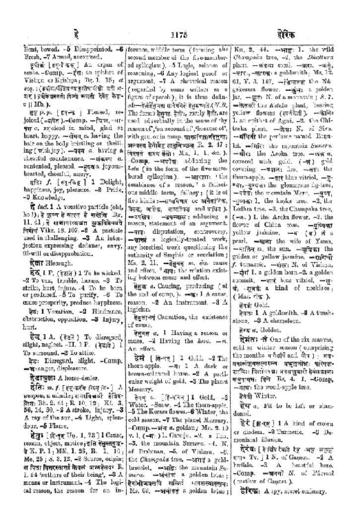
Cappeller 1887 substantive masculine
Original text · German · substantive masculine
hetú m. Veranlassung, Ursache, Grund, Beweis; auch Veranlasser, bes. der Agens beim Causativ (g.). Adj. —bewirkend o. bewirkt durch (—˚). Abl., Gen., Instr. (Dat., Loc., Acc.) wegen, aus, um-willen (meist —˚).
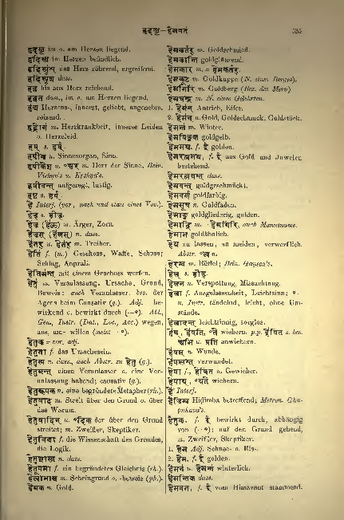
Burnouf 1866 substantive masculine
Original text · French · substantive masculine
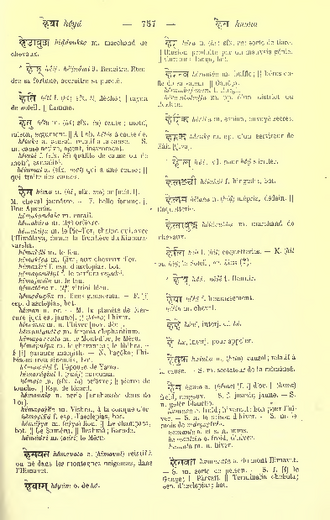
hetu hetu m. (hi; sfx. tu) cause; motif, raison, argument. À l'ab. hetos à cause de. hetuka a. causal, relatif à la cause. — S. m. cause active, agent, instrument. hetutā f. (sfx. tā) qualité de cause ou de motif, causalité. hetumat a. (sfx. mat) qui a une cause; qui traite des causes.
Derived words
Occurrences in source texts (18)
DYS 1 occurrence
GoS 1 occurrence
HP 1 occurrence
PJH 1 occurrence
PJH 1-2: A Description of Universal or Divine Awareness 1 occurrence
Direct occurrences
-
PJH 1 Segment 5
PYS 6 occurrences
PYS 2.23–26: From Avidyā to Kaivalya 2 occurrences
Direct occurrences
SiSa 2 occurrences
SS 1 occurrence
SVU 5 occurrences
Continue with AYI Free
Image source: AYI archive.