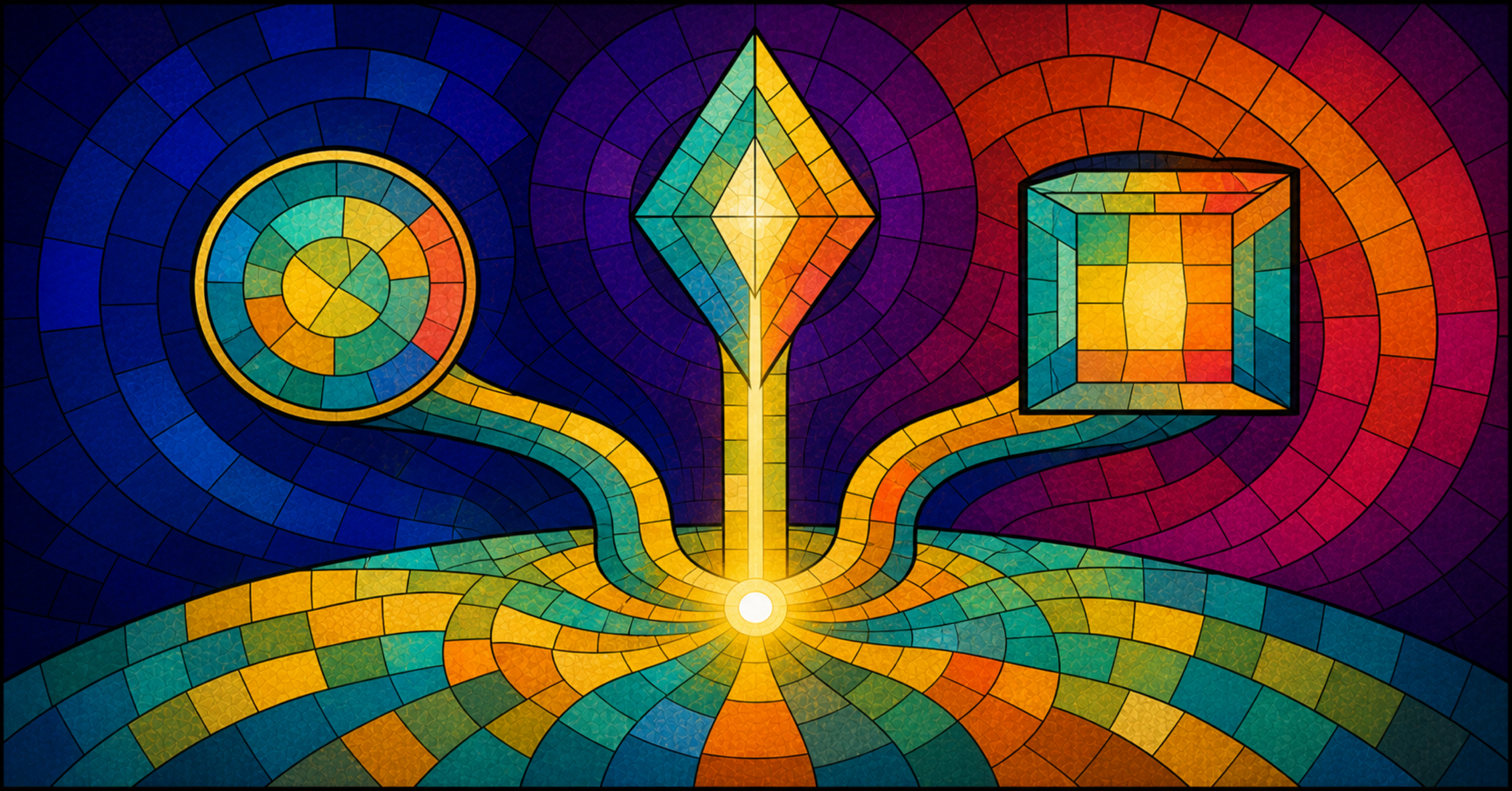
PYS 3.15–16: Abfolge der Wandlung

Yogaśāstra 3.15–16: Past and Future

Different sequences produce different transformations. Saṃyama on changes of property, temporal mark, and state reveals past and future.

Dr. Ronald Steiner Dr. Ronald Steiner Laura von Ostrowski Laura von Ostrowski
Patañjali Yoga Sūtra 3.15
क्रमान्यत्वं परिणामान्यत्वे हेतुः ||15||
kramānyatvaṃ pariṇāmānyatve hetuḥ ||15|| Analysis ▾ Analysis ▴
krama
tatpuruṣa-compound genitive
substantive masculine
sequence, course
anyatvam
nominative singular
substantive neuter
Difference
pariṇāma
tatpuruṣa-compound genitive
substantive masculine
transformations
anyatve
lokative singular
substantive neuter
Difference
hetuḥ
nominative singular
substantive masculine
cause, reason
A difference in sequence (kramānyatvam | nom sg) [is] the cause (hetuḥ | nom sg) of a difference in transformation (pariṇāmānyatve | loc sg).
Dr. Ronald Steiner - 2026 - historically literal
Both what you do and the order (krama) in which you do it change the result. Arrange practice and daily life so that one step prepares the next.
Dr. Ronald Steiner - 2026 - modern transfer

Different sequences (krama) account for different transformations, according to the Vyāsa-Bhāṣya. Clay illustrates the order of powder, lump, jar, shards, and dust, as well as temporal and age-related change. In Citta, the commentary distinguishes manifest cognitions from seven properties known only by inference: cessation, property (dharma), imprint, transformation, life, movement, and power.

Yoga Śāstra Vyāsa-Bhāṣya
The altered state of the order (of the threefold modification just defined) is indicative of the variety of the modifications (which the same Dharmī is to undergo).
James R. Ballantyne - 1852
The change of order is the cause of the versatility (or changeableness) of modifications.
Ganganatha Jha - 1907
Eine Abweichung in der Reihenfolge würde eine Abweichung von den Umwandlungsakten zur Folge haben.
Paul Deussen - 1908
The order of the sequence (krama) is the reason for the order of the mutations.
James Haughton Woods - 1914
Patañjali Yoga Sūtra 3.16
परिणामत्रयसंयमादतीतानागतज्ञानम् ||16||
pariṇāma-traya-saṃyamād atītānāgata-jñānam ||16|| Analysis ▾ Analysis ▴
pariṇāma
tatpuruṣa-compound genitive
substantive masculine
transformation
traya
tatpuruṣa-compound lokative
numeral
three, number three
saṃyamāt
ablative singular
substantive masculine
Meditation, binding together
atīta
dvandva-compound
adjective
past
anāgata
tatpuruṣa-compound genitive
adjective
future, not yet come
jñānam
nominative singular
substantive neuter
Knowledge, understanding
Through Saṃyama on the three transformations [of property, temporal characteristic, and state] (pariṇāma-traya-saṃyamāt | abl sg) [arises] knowledge of the past and future (atītānāgata-jñānam | nom sg).
Dr. Ronald Steiner - 2026 - historically literal
Follow a sensation through its whole transformation (pariṇāma): Where did it come from, what does it feel like now, and where might it be going? In this way, past and future become readable as traces and possibilities in the body here and now.
Dr. Ronald Steiner - 2026 - modern transfer

The Vyāsa-Bhāṣya relates this Sūtra to the three transformations explained above:

  • dharma-pariṇāma: transformation of a characteristic,
  • lakṣaṇa-pariṇāma: transformation of its temporal mark,
  • avasthā-pariṇāma: transformation of its state.

Through saṃyama on these three transformations, the yogin gains knowledge of the past and future. The Vyāsa-Bhāṣya recalls that dhāraṇā, dhyāna, and samādhi together are called saṃyama.

Yoga Śāstra Vyāsa-Bhāṣya
A knowledge of past and future events (comes to an ascetic) from (his rendering) Sanyama– restraint– about the three modifications (just explained).
James R. Ballantyne - 1852
The knowledge of the past and future (is acquired) through sanyama over the three modifications.
Ganganatha Jha - 1907
Aus der durch die drei Umwandlungsakte [geläuterten] Allzucht erfolgt Wissen des Vergangenen und Zukünftigen.
Paul Deussen - 1908
As a result of constraint upon the three mutations [there follows] the knowledge of the past and the future.
James Haughton Woods - 1914

Continue with AYI Free

Illustrations: AI-generated.

Editor

Dr. Ronald Steiner

From Ulm

The "Yoga Doc" - Dr. Ronald Steiner is the founder of the AYI method. This method links traditional Ashtanga Yoga with innovative Yogatherapy and living Philosophy. This forms a practice that is personal for each and... more ›

Laura von Ostrowski

Ich bin 2004 das erste Mal mit Yoga in Berührung gekommen und habe seitdem unendlich viele Facetten kennengelernt. Einerseits die vielfältigen praktischen Seiten von Yoga - in Form verschiedener Ausbildungen (500 h... more ›

Messages and ratings
0 messages

Please log in to write a message. Go to login

No messages yet.