
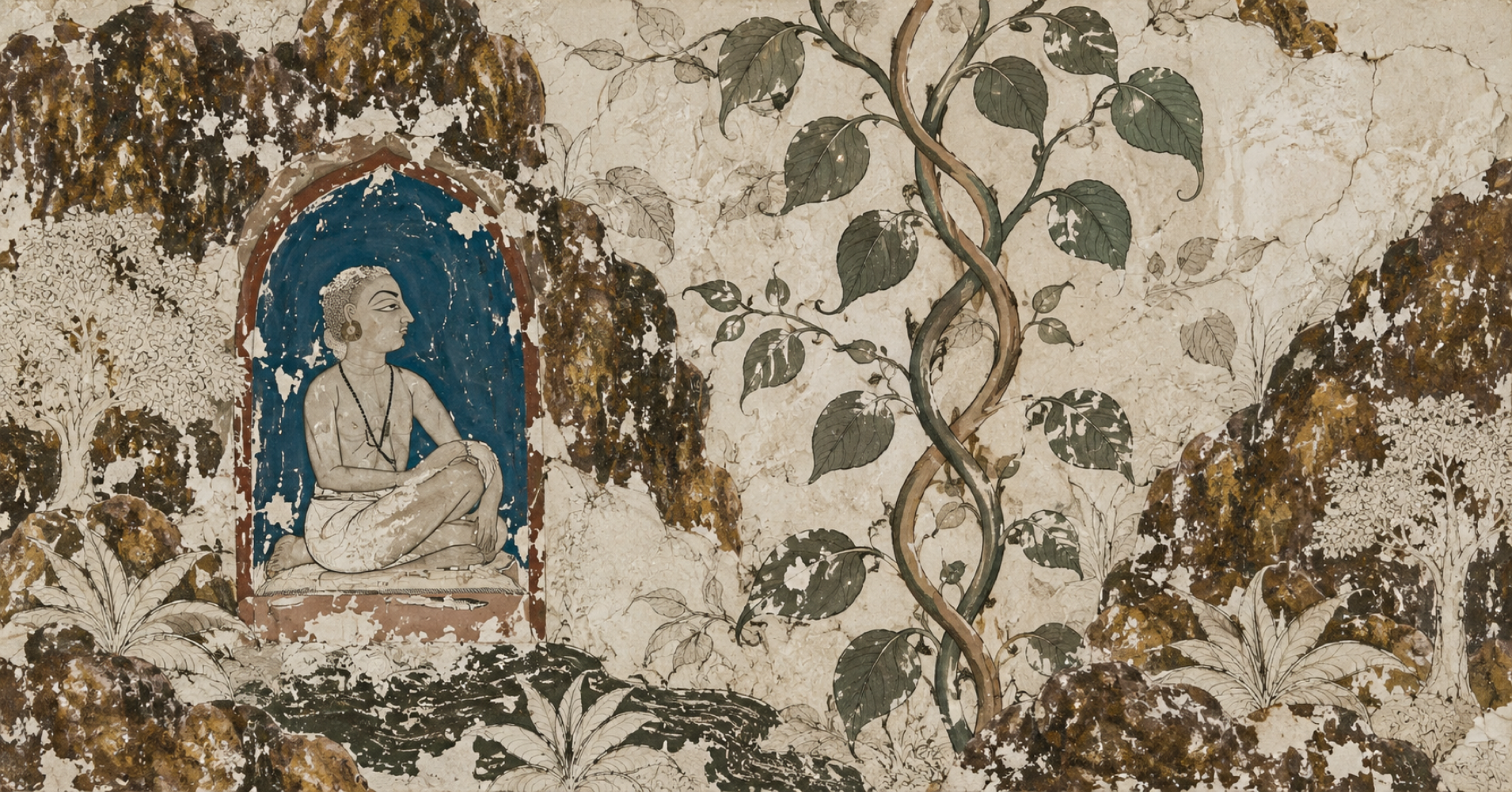
Seated figure beside two intertwined plant stems.

Gorakṣaśataka 9–11: Two Causes, Three Means of Practice

Mental conditioning and breath are connected. Moderate eating, a seated posture and moving the power are named as three approaches.

Dr. Ronald Steiner Dr. Ronald Steiner
Gorakṣaśataka (Original) 9
हेतुद्वयञ् च चित्तस्य वासना च समीरणः |
hetu-dvayañ ca cittasya; vāsanā ca samīraṇaḥ | Analysis ▾ Analysis ▴
hetu
tatpuruṣa-compound genitive
substantive masculine
of causes
dvayam
nominative singular
substantive neuter
pair
ca
particle
and
cittasya
genitive singular
substantive neuter
of the mind
vāsanā
nominative singular
substantive feminine
conditioning
ca
particle
and
samīraṇaḥ
nominative singular
substantive masculine
breath
तयोर् विनष्ट एकस्मिंस्तौ द्वाव् अपि विनश्यतः ||9||
tayor vinaṣṭa ekasmiṃs; tau dvāv api vinaśyataḥ ||9|| Analysis ▾ Analysis ▴
tayoḥ
genitive dual masculine
pronoun dem
of these two
vinaṣṭe
lokative absolutus singular masculine past participle passive
previx
verbal root
when ceased
ekasmin
lokative singular masculine
numeral
one
tau
nominative dual masculine
pronoun dem
these two
dvau
nominative dual masculine
numeral
both
api
particle
also
vinaśyataḥ
3rd person dual aktive present
previx
verbal root
cease
And (ca) the mind (cittasya | gen sg) has two causes (hetu-dvayam | nom sg): conditioning (vāsanā | nom sg) and (ca) breath (samīraṇaḥ | nom sg). When one (ekasmin | loc sg m) of the two (tayoḥ | gen du m) has ceased (vinaṣṭe | loc absl sg m ppp), these (tau | nom du m) two (dvau | nom du m) both (api) cease (vinaśyataḥ | 3p du act pres).
Dr. Ronald Steiner - 2026 - historically literal
Habits and breathing can keep thoughts moving. A change through one of these approaches may also change the other.
Dr. Ronald Steiner - 2026 - modern transfer
tau dvāv api vinaśyataḥ ] tasmai dvāv api naśyataḥ R7874apJM
Critical Apparatus

vāsanā denotes an enduring disposition or tendency. Mallinson reconstructs the second half-verse with reference to the Haṭhapradīpikā. The dual verb vinaśyataḥ refers to both causes.

Apparatus Comment
Gorakṣaśataka (Original) 10
तयोर् आदौ समीरस्य जयं च कुरु सम्मतः |
tayor ādau samīrasya; jayaṃ ca kuru sammataḥ | Analysis ▾ Analysis ▴
tayoḥ
genitive dual masculine
pronoun dem
of these two
ādau
lokative singular
substantive masculine
at the outset
samīrasya
genitive singular
substantive masculine
of the breath
jayam
accusative singular
substantive masculine
mastery
ca
particle
and
kuru
2nd person singular aktive imperative
verbal root
accomplish
sammataḥ
nominative singular masculine past participle passive
previx
verbal root
esteemed
यथा त्वं पुरुषो मुक्तो भवेर् मुक्तो जनादिभिः ||10||
yathā tvaṃ puruṣo mukto; bhaver mukto janādibhiḥ ||10|| Analysis ▾ Analysis ▴
yathā
particle
as, so that
tvam
nominative singular
pronoun pers 2p
you
puruṣaḥ
nominative singular
substantive masculine
the person
muktaḥ
nominative singular masculine past participle passive
verbal root
liberated
bhaveḥ
2nd person singular aktive optative
verbal root
you may become
muktaḥ
nominative singular masculine past participle passive
verbal root
liberated
jana
tatpuruṣa-compound genitive
substantive masculine
of people
ādibhiḥ
instrumental case plural
substantive masculine
from these and other things
And (ca), esteemed one (sammataḥ | nom sg m ppp), first (ādau | loc sg) accomplish (kuru | 2p sg act imp) mastery (jayam | acc sg) of the breath (samīrasya | gen sg) among these two (tayoḥ | gen du m), so that (yathā) you (tvam | nom sg) may become (bhaveḥ | 2p sg act opt) a liberated (muktaḥ | nom sg m ppp) person (puruṣaḥ | nom sg), released (muktaḥ | nom sg m ppp) from people and other [ties] (jana-ādibhiḥ | ins pl).
Dr. Ronald Steiner - 2026 - historically literal
Begin with something you can experience directly: your breath. This can open up greater independence in your response to outside influences.
Dr. Ronald Steiner - 2026 - modern transfer
bhaver ] bhaven R7874apJM
Critical Apparatus

sammataḥ is formally nominative; the translation provisionally treats it as a predicative form of address. janādibhiḥ remains broad: people and other ties.

Apparatus Comment
Gorakṣaśataka (Original) 11
मरुज्जयस्य तस्योक्तं साधनत्रयम् उत्तमम् |
maruj-jayasya tasyoktaṃ; sādhana-trayam uttamam | Analysis ▾ Analysis ▴
marut
tatpuruṣa-compound genitive
substantive masculine
of the breath
jayasya
genitive singular
substantive masculine
of mastery
tasya
genitive singular masculine
pronoun dem
of this
uktam
nominative singular neuter past participle passive
verbal root
called
sādhana
tatpuruṣa-compound genitive
substantive neuter
of means
trayam
nominative singular
substantive neuter
three
uttamam
nominative singular neuter
adjective
excellent
मिताहारश्चासनं च शक्तिचालस्तृतीयकः ||11||
mitāhāraś cāsanaṃ ca; śakti-cālas tṛtīyakaḥ ||11|| Analysis ▾ Analysis ▴
mita
karmadhāraya-compound past participle passive
verbal root
measured
āhāraḥ
nominative singular
substantive masculine
food
ca
particle
and
āsanam
nominative singular
substantive neuter
seated posture
ca
particle
and
śakti
tatpuruṣa-compound genitive
substantive feminine
of the power
cālaḥ
nominative singular
substantive masculine
moving
tṛtīyakaḥ
nominative singular masculine
adjective
third
Three excellent (uttamam | nom sg n) means (sādhana-trayam | nom sg) are taught (uktam | nom sg n ppp) for this (tasya | gen sg m) mastery of the breath (marut-jayasya | gen sg): moderate eating (mita-āhāraḥ | nom sg), and (ca) a seated posture (āsanam | nom sg), and (ca), third (tṛtīyakaḥ | nom sg m), moving the power (śakti-cālaḥ | nom sg).
Dr. Ronald Steiner - 2026 - historically literal
Practice needs a supportive daily life, a suitable posture and a conscious relationship with your energy. These three aspects support each other.
Dr. Ronald Steiner - 2026 - modern transfer

The list explicitly names three means. In the following section, śakticāla means moving Kuṇḍalinī, the power imagined as coiled. This should not automatically be equated with a modern idea of bodily “energy”.

Apparatus Comment

Continue with AYI Free

Illustrations: AI-generated.

Editor

Dr. Ronald Steiner

From Ulm

The "Yoga Doc" - Dr. Ronald Steiner is the founder of the AYI method. This method links traditional Ashtanga Yoga with innovative Yogatherapy and living Philosophy. This forms a practice that is personal for each and... more ›

Messages and ratings
0 messages

Please log in to write a message. Go to login

No messages yet.