
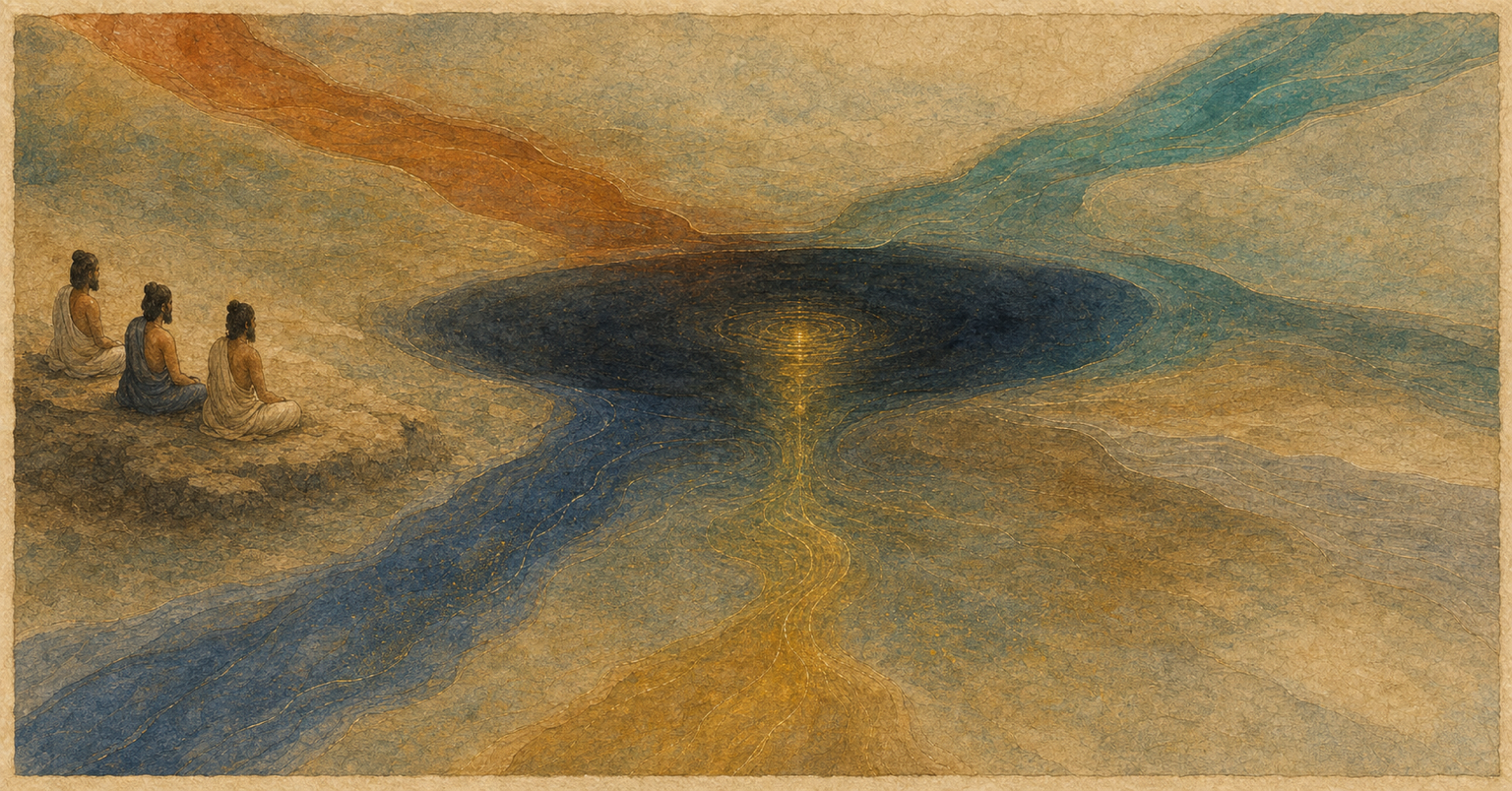


kālaḥ sva-bhāvo, niyatir yadṛcchā; bhūtāni yoniḥ, puruṣa iti cintyam | Analysis ▾ Analysis ▴
|
kālaḥ
|
time | |
|
sva
|
own, inherent | |
|
bhāvaḥ
|
nature, being, state | |
|
niyatiḥ
|
necessity, fixed order | |
|
yadṛcchā
|
chance | |
|
bhūtāni
|
elements, beings that have arisen | |
|
yoniḥ
|
source, origin | |
|
puruṣaḥ
|
Puruṣa, person, spirit | |
|
iti
|
thus, as | |
|
cintyam
|
to be considered, conceivable |
saṃyoga eṣāṃ, na tu* ātma-bhāvād; ātmā hy anīśaḥ, sukha-duḥkha-hetoḥ ||2|| Analysis ▾ Analysis ▴
|
saṃyogaḥ
|
conjunction, union | |
|
eṣām
|
of these | |
|
na
|
not | |
|
tu
|
but, however | |
|
ātma
|
of the Self | |
|
bhāvāt
|
because of existence, nature | |
|
ātmā
|
the Self | |
|
hi
|
for, indeed | |
|
anīśaḥ
|
powerless, not the lord | |
|
sukha
|
pleasure, happiness | |
|
duḥkha
|
pain, suffering | |
|
hetoḥ
|
because of the cause, for the reason |
The Bhāṣya attributed to Śaṅkara defines time, inherent nature and the other candidates for causation, but rejects both each one separately and their conjunction. What is composite serves another's purpose and is not sovereign. The Jīva, too, depends on merit, demerit, pleasure and pain and therefore cannot be the cause of the world.
Śaṅkarānanda treats the series as competing causal hypotheses. Their conjunction is partly impossible and, in any event, remains unconscious; the Jīva as experiencer of pleasure and pain is also not sovereign. The explanation therefore requires an independent, conscious ground.
Nārāyaṇa explains the terms from time through Puruṣa one by one. The material entities and their conjunction are insufficient because they are unconscious and dependent upon the experiencing self. That self is in turn excluded because it does not control pleasure and pain.
Vijñānabhagavat assigns the positions to historical schools of thought: proponents of time, Lokāyatas, Mīmāṃsakas, atheists, eternalists, doctrines of Prakṛti and Śakti, and Yoga. They all remain dependent upon the self as objects; the Jīva, dependent on karma and suffering, is likewise not sovereign.
cintyam LV1958 ] cintyā ASS1927; cintyāḥ LV1958-app
ātmā hy anīśaḥ LV1958 ] ātmāpy anīśaḥ ASS1927
tu* ātmabhāvād conj. ed. ] tv ātmabhāvād LV1958
<1: Alle aufgezählten Prinzipien können nicht für sich allein, sondern nur als Bestimmungen an einem Selbste (ātman) gedacht werden, welches daher unter allen Umständen der Urgrund ist. Aber das empirische Selbst kann dieser Urgrund nicht sein, da es nicht Herr ist, Lust und Schmerz zu schaffen, sondern ihnen unterworfen ist.>
<1: Alle aufgezählten Principien können nicht für sich allein, sondern nur als Bestimmungen an einem Selbste (ātman) gedacht werden, welches daher unter allen Umständen der Urgrund ist. Aber das empirische Selbst kann dieser Urgrund nicht sein, da es nicht Herr ist, Lust und Schmerz zu schaffen, sondern ihnen unterworfen ist.>
<1: Svabhāva, their own nature or independent character.>
<2: Union presupposes a uniter.>
<3: Ātmā is explained by Saṅkara as the gīvaḥ, the living self, and as that living self is in his present state determined by karman, work belonging to a former existence, it cannot be thought of as an independent cause.>
<1: Śankara, who is well aware of the above explanation, yet in preference to it, adopts another, which tallies better with Vedāntic doctrines, viz. he connects Yoni (which means either origin,—or cause) with all the members of the above series, so that the sense would be:—Is time the cause, or the own nature of the things, or the necessary consequences from work, or accident, or the elements, or the soul? If his view were correct, Yoni would probably not have been placed between two of the members of the series, and the explanation followed in our translation agrees also better with the doctrine of the Sānkhya which, within the limits set forth in the introduction, prevails throughout this Upanishad.>
<2: Here is, according to Śankara, an omission in the argument which he thus supplies:—If the mentioned things are the cause, they are so either individually or collectively, but not individually, because this would be at variance with our perception.>
<3: Hereby, then, all the above suppositions are denied. Bramha is neither cause, nor non-cause, nor both, that is to say, not by his own nature. How then can he be a cause? The answer is given in the next verse.—Ś.>
te dhyāna-yogā,nugatā apaśyan; devātma-śaktiṃ, sva-guṇair nigūḍhām | Analysis ▾ Analysis ▴
yaḥ kāraṇāni, nikhilāni tāni; kālātma-yuktāny, adhitiṣṭhaty ekaḥ ||3|| Analysis ▾ Analysis ▴
The Bhāṣya attributed to Śaṅkara understands the divine power of the Self as the dependent Māyā of the one Paramātman. Not Brahman in itself but this power mediates material and efficient causality. Alternatively, the commentary connects it with the guṇas and with Brahmā's, Viṣṇu's and Śiva's functions of creation, preservation and dissolution.
Śaṅkarānanda has meditation lead beyond the limits of mere debate. Avidyā or Māyā is the divine power of the Self, hidden by Sattva, Rajas and Tamas. Only through this power does the one ground appear in manifold forms and control every cause.
Nārāyaṇa equates the power of the Self with the power of the Paramātman. Avidyā and the three guṇas hide it from the Jīva without making it independent. The one Lord remains the guide of all the causes previously considered.
Vijñānabhagavat defines Māyā as the cause of the world's transformation, dependent upon unchanging consciousness. The guṇas and the functions of creation, preservation and dissolution conceal it. The one Paramātman sustains Māyā and every cause as being, consciousness and joy.
<2: Die individuelle Seele besteht nicht aus dem Purusha und der von ihm unabhängigen Prakriti (Çakti) nebst deren Guna’s (Sattvam, Rajas, Tamas), sondern es ist Gottes eigene Kraft (ātma-çakti), welche, in ihre eigenen Qualitäten (sva-guṇaiḥ) verhüllt, als Seele erscheint. — Schärfer kann der Gegensatz gegen die Sāṅkhyalehre wohl nicht ausgesprochen werden.>
<2: Die individuelle Seele besteht nicht aus dem Purusha und der von ihm unabhängigen Prakriti (Çakti) nebst deren Guna’s (Sattvam, Rajas, Tamas), sondern es ist Gottes eigene Kraft (ātma-çakti), welche, in ihre eigenen Qualitäten (sva-guṇaiḥ) verhüllt, als Seele erscheint. — Schärfer kann der Gegensatz gegen die Sāṅkhyalehre wohl nicht ausgesprochen werden.>
<1: Devātmaśakti is a very important term, differently explained by the commentators, but meaning a power belonging to the Deva, the Īśvara, the Lord, not independent of him, as the Sāṅkhyas represent Prakriti or nature. Herein lies the important distinction between Vedānta and Sāṅkhya.>
<2: Kālātmyābhyāṁ yuktāni, kālapuruṣasaṁyuktāni svabhāvādīni. Ātman is here taken as synonymous with puruṣa in verse 2.>
<1: For devātmaśaktiṁ svaguṇairnigūḍhāṁ Śankara offers several explanations.—1. Devātmaśakti (deva-ātmaśakti) is either the own power of god, that is to say, a power which is dependent upon god. Here is the power (Śakti) the Māyā, delusion, or nature as the root of all things (Prakriti, natura naturans), and its qualities are goodness (Sattva), activity (rajas), and darkness (tamas);—or 2. Devātmaśakti (devātmani avasthitāṁ śaktim) is the power, which is constituted in the likeness with god. Here are the “own qualities” (svaguṇāḥ) to be referred to god (Deva), as his omnipotence, omniscience, &c.; or 3. the power is of the same nature with god (deva), and his likeness with Bramha, Vishnu, and Śiva, is the cause of the creation, preservation, and destruction of the world. The “own qualities” (svaguṇāḥ) denote, according to this view, the three supreme deities, viz. goodness represents Bramha, activity Vishnu, and darkness Śiva, by which, however, the supreme god is concealed, not adequately expressed; or 4. devātmaśakti (deva, ātma, śakti) means the supreme ruler, the individual soul, and nature, which represent the power of god, and the “own qualities” (svaguṇāḥ), are the different allegations of a nature, &c., by which Bramha is concealed; or 5. devātmaśakti (devātma śakti) is the power, the omnipotence of god, his overruling of the creation, preservation, and destruction of the world, which is concealed by his special qualities.>
<2: Viz. the causes, named in verse 2.>
Continue with AYI Free
Illustrations: AI-generated.


Please log in to write a message. Go to login