



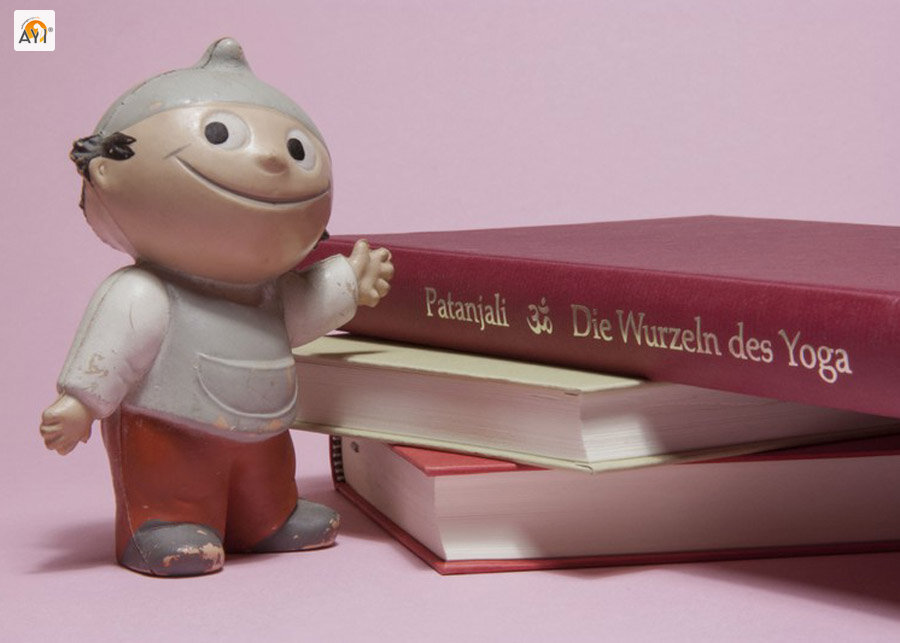
Later on, during my first teacher training, a good portion of the Yoga Sūtra were discussed more intensely, and I realized that they have much more to do with individual experience. While each of us could identify with the text, it was always on a very personal level. Each of us understood the words and their meanings in a very unique and highly individual way.
No maps and no shortcuts
Because the eight-fold path is so individual, it is obvious that the mind alone cannot fully explain or comprehend it. There is neither a map with detailed directions or a shortcut to understanding it. It unfolds through experiences in our personal practice and spreads out before us once we have found ourselves in the right direction. And the more committed our steps, the clearer the entire path becomes.
Along the way we may experience bold shifts in our perception - the way we see the world around us as much as the way we see ourselves. On my personal journey inward all of my self-created roadblocks, bad habits and old beliefs started to fall away. And then in the space left I was able to see how these were all obstructions, creating a blind spot in my ability to see things for what they were.

This process is often guided by a sort of internal dialogue. For example, when my mind is occupied with the experience of daily life and clearly follows into its very comfortable habits, my inner voice speaks up unexpectedly. You know, that same voice that accompanies you on the mat in asana practice that urges you to respect your breath, to recognize your boundaries and to observe before you act? Well, it starts showing up off the mat as well, asking you to do the same in your daily interactions. Sometimes for me this voice is so strong that it derails my mind mid-thought or action and stops me in my tracks.
Case in Point:
I'm working in my office, a small shop on a street corner. I'm sitting at the computer with my dog Basti sleeping in his basket next to me. On a pretty regular basis, a woman passes by with her little daughter, who is obviously in love with Basti and will press her nose against the window pane looking at him.
On a normal day the following occurs: the dog barks, I scold him, mother tugs her child away, and everyone is irritated by the interaction. On a day when I get the inner impulse to put things into perspective: the dog barks, I look up and I feel like scolding the dog but then I don't. Instead, I am astonished as I feel I am almost being guided to get up, go to the door and ask the girl if she wants to pet my dog. This of course actually does happen, everyone is content and grateful at the pleasant interaction, above all myself for having not reacted in haste.
The Transformation
After this moment occurred, I was left speechless. Looking back, I would say, "That was yoga". As if I were being controlled remotely, I had decided not to let the fact that I was disrupted further annoy me and instead looked at this situation as an opportunity to acknowledge and fulfill the little girl's wish. The rest of the day I couldn't help but smile. Experiences like these are for me the best affirmation that all of those hours on the mat or in the yoga studio weren't only for the physical benefits of the practice.
When I observe such a change in myself, I am not at all surprised that Aṣṭāṅga Yoga is often referred to as a transformative yoga practice. The most exciting thing about it is that it helps people to find their own clarity, open-mindedness and authenticity. This process takes place on a very personal level, within the individual and in secret, until the transformation becomes outwardly visible and starts to positively impact the people around us. And I believe that happens for each of us - even those who haven't gotten to work with the Yoga Sūtra yet.
Another Pattabhi Jois quote comes to mind which after this realization has a much deeper meaning: "Yoga is 99% practice and 1% theory". Once again, it is not just about the asana practice, but about the "big picture". Experiences like the one with the little girl happen to me time and time again, in situations big and small since I started to work through the sutras. With each chance to stop and think my actions through, everything becomes clearer.
Patañjali's Yoga Sūtra is an interesting guide. It neither shows you the way nor provides you an objective; however, it offers you orientation and grounding in every step of the path.
Similar to my first teacher's approach, I now lead my Mysore classes with a short meditation or chanting sequence. I offer nothing more than a short sit with a tiny taste of philosophy each day with the hopes of awakening a bit of curiosity and to observe the subtle shift from transformation on the mat to transformation in daily life.

Please log in to write a message. Go to login
No messages yet.