


Kṣemarāja expresses this in the following words:
upāyāntaram api tūcyate prāṇāyāma-mudrā-bandhādi-samasta-yantraṇā-tantra-troṭanena sukhopāyam eva.
But here an alternative path is taught – a thoroughly pleasant approach that makes all methods of control, such as Prāṇāyāma, Mudrā, Bandha and the other elaborate techniques, entirely unnecessary.
These statements emphasise that Kṣemarāja's teaching offers an alternative, readily accessible path. In place of elaborate techniques, the Sukhopāyas offer simple yet effective methods. Their primary purpose is the expansion of the centre: madhya-vikāse yuktim āha. When the centre expands, the joy of consciousness, cidānanda, is experienced, giving rise to liberation while living (jīivan-mukti).
Another characteristic of these teachings is flexibility in practice: Kṣemarāja emphasises that further methods can be inferred and that more methods exist:
evam anyad api ānanda-pūrṇa-svātma-bhāvanādikaṃ anumantavyam |
ity evam ādayaḥ atra madhya-vikāse upāyāḥ || 18 ||
Other practices, such as meditation on the self in joyful fullness, are likewise recommended. These and other methods, not described in detail here, are the means for expanding the centre in our system.
The Sukhopāyas thus form a link between the demanding philosophy of Kashmir Śaivism and a wider community of seekers who aspire to a direct experience of the divine in everyday life.
The Sukhopāyas in the Pratyabhijñā-hṛdayam
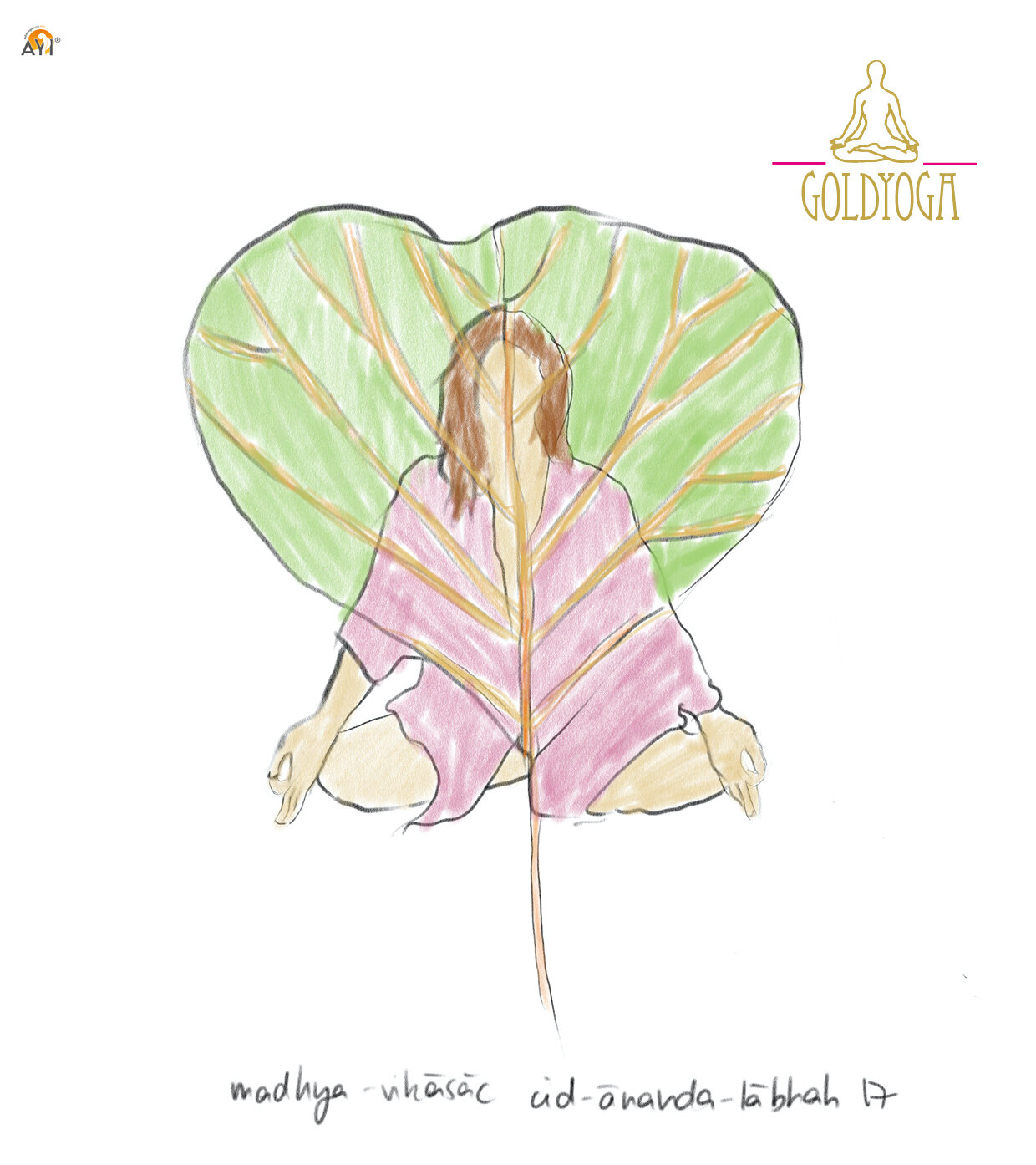
Having introduced the Sukhopāyas as “easy means” for expanding the centre, Kṣemarāja describes them in greater detail in his Pratyabhijñā-hṛdayam (The Heart of the Doctrine of Recognition). This work presents the central teachings of the Pratyabhijñā tradition in a concise, accessible form. It explains how practitioners can experience the expansion of the centre (madhya-vikāsa) without complex rituals or demanding exercises. When cosmic consciousness (citi) manifests, it is first transformed into vital energy (prāṇa), which is present primarily in the central energy channel (madhya / madhyanāḍī / suṣumnā). All processes arise from Madhya and come to rest in Madhya. Kṣemarāja compares the central energy channel to the midrib of a Palāśa leaf (see the image for Sūtra 17).
The Sukhopāyas are described in the commentary on Sūtra 18 of the Pratyabhijñā-hṛdayam. First, however, Kṣemarāja refers to five methods already described in Sūtras 13, 15 and 16:
- Sūtra 13 – Recognising that the self performs the five acts (pañca-kṛtyāni).
- Sūtra 15 – Focusing on creation and withdrawal while simultaneously expanding and contracting the senses.
- Sūtra 16 – Stabilising the consciousness of unity.
Kṣemarāja then supplements these methods with a total of nine Sukhopāyas. He describes them in detail (Sūtra 18 and its commentary), supporting them with quotations from various tantric texts. Only one of these Sukhopāyas – vikalpa-kṣaya (dissolving mental constructions) – also appears in the principal work of the Pratyabhijñā tradition. The other techniques likewise come from the tantric tradition, but had not previously been explicitly brought together in this form.
The following section introduces the nine Sukhopāyas in detail:
(1) vikalpa-kṣaya – Dissolving mental constructions
This very subtle method aims to bring to rest the mental constructions (vikalpas) that our mind creates about reality. Experience gives rise to impressions (saṃskāras), which lead us to perceive reality through the colouring of our individual conditioning rather than as it is. In this way, vikalpas prevent us from resting in ourselves (sva-sthiti-pratibandhaka). Reality as it truly is is perceived through the self, before the mind formulates a thought about it.
The following five steps for dissolving vikalpas can be drawn from Kṣemarāja's commentary:
- Rest the mind in the heart (hṛdaye nihita-citta)
Here, “heart” means consciousness itself. The aim is to focus not on individual objects, but on the fact of being conscious. For example, you might simultaneously perceive all the phenomena currently appearing, as well as what could appear. - Think of nothing in particular (akiṃcic-cintakatva)
For example, you could regard the content of thoughts as unimportant and instead focus on the field of consciousness in which thoughts arise and pass away. - Come into contact with reality free from mental constructions (avikalpa-parāmarśa)
This means becoming absorbed in what appears before a thought about it arises. Directly perceiving present phenomena without naming them could bring you into contact with avikalpa. - Focus on your own consciousness alone as the knower (sva-cit-pramātṛtā)
Everything you experience arises from the consciousness that you yourself are. - Recognise that this consciousness is unaffected by identification with the body and so on (dehādi-akaluṣa)
The body, mind and all other phenomena arise within consciousness. Even when they are affected by pain or something else, this does not change the nature of consciousness.
Kṣemarāja promises that this practice leads in a very short time (acira) to the states known as turya and turyātīta. These lie beyond the three everyday states of consciousness – waking, dreaming and deep sleep – and are filled with the joy of consciousness (cid-ānanda-ghana).
A simple way to practise:
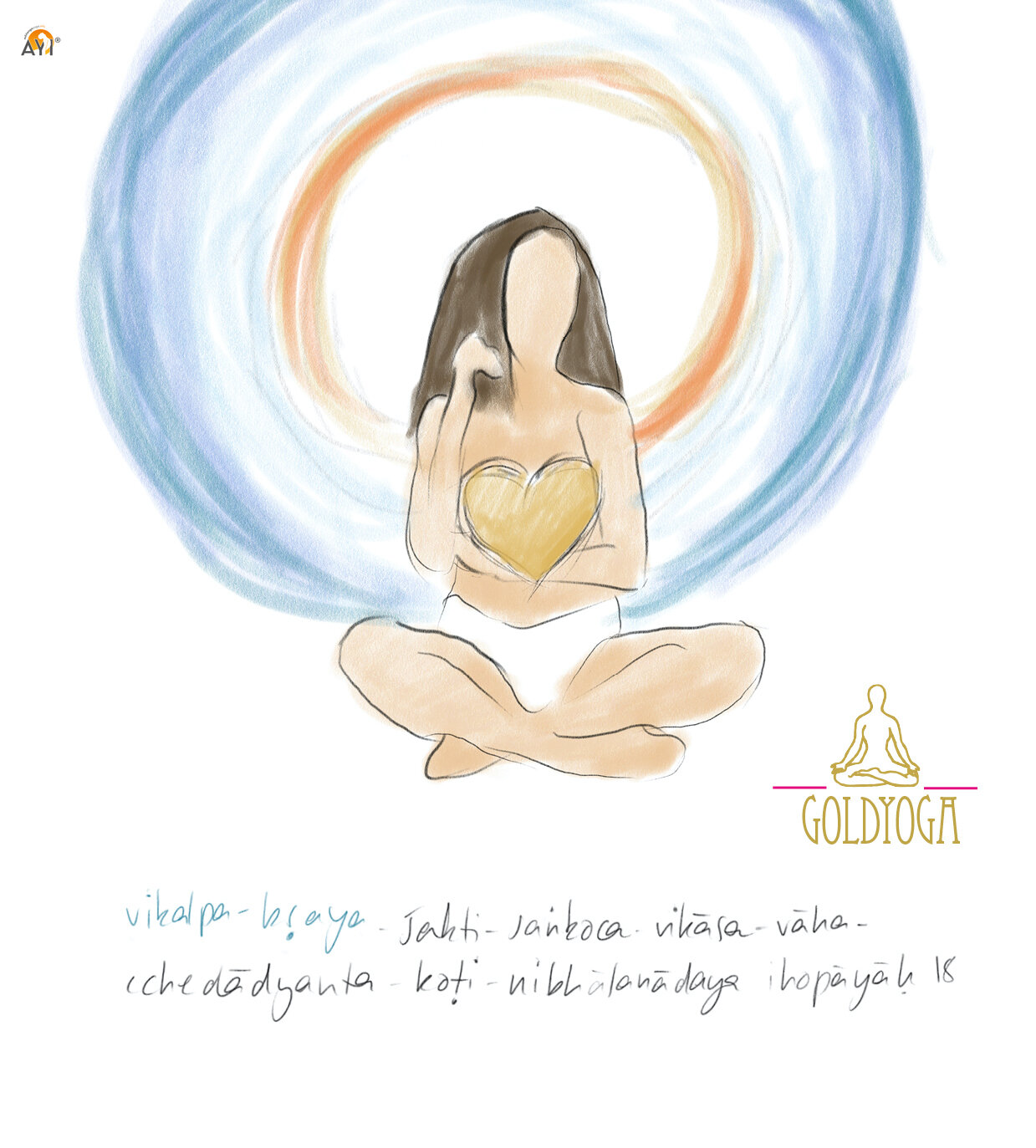
- Sit upright
- Adopt a gentle, open, centred and relaxed inner attitude
- Focus on your centre / your heart / Madhya-madyha (the centre of your centre)
- Rather than thinking about anything specific, attend to where thoughts come from and where they go, as though they were waves rising from the sea and sinking back into it
- Attend only to their form – their energy and vibration – as you might attend to the energy of an unfamiliar language that you do not understand
- Do not focus on the content
- Do not name or judge your thoughts, or identify with them
- Become absorbed in what is present before a thought arises
- Notice what exists underneath, deep in the sea
- Become aware of the peaceful mind present there
(2) śakti-saṅkoca – Contraction of energy
Kṣemarāja gives two variations for contracting energy:
- Bending back (ākuñcana) the energy as it flows out through the gateways of the senses (indriya-dvāra).
While seeing, hearing and so on, I become aware of the energy through which my senses meet the world and draw part of it back without changing it. In everyday life, this could mean becoming aware of how every action is connected to the heart centre (hṛdaya), without naming or judging anything.
A simple way to practise:
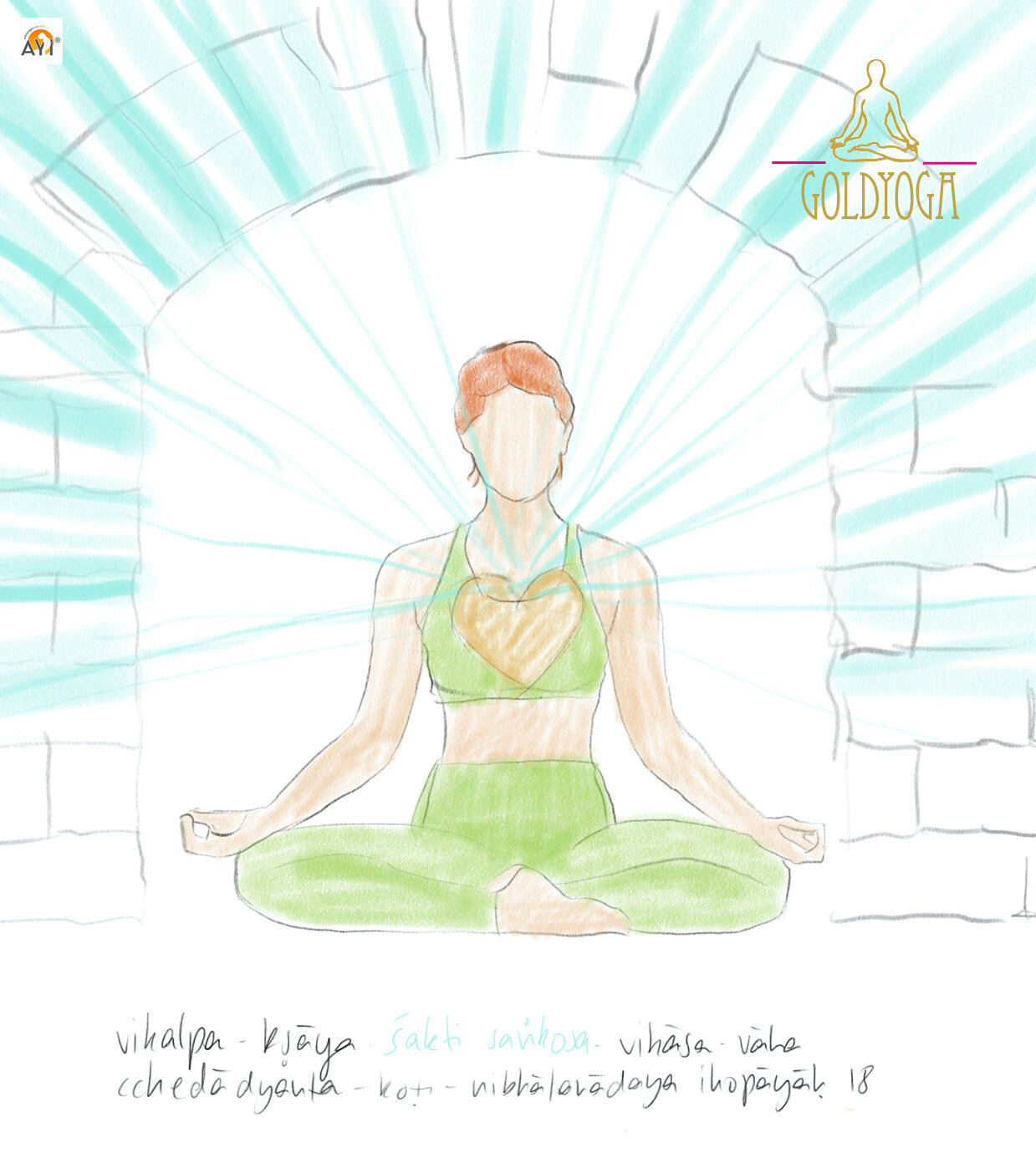
- Use your senses to perceive your surroundings / the entire field
- Keep a second thread of attention anchored within your heart
- Perceive your surroundings non-verbally from within, without asking why
- Focus on how perception takes place within the space of your heart
- Become familiar with your own energies: “What does this feel like?”
- Completely reversing (sarvato nivartana) the energy as it flows out.
Like a tortoise drawing in its limbs (kūrmāṅga-saṅkocavat) when startled (trāsa-samaye), this second variation draws back all the outward-flowing energy. For example, in a moment of intense emotion, you could close the gateways of the senses as far as possible, draw the energy into the centre, feel it fully and release it again after a while.
A simple way to practise:
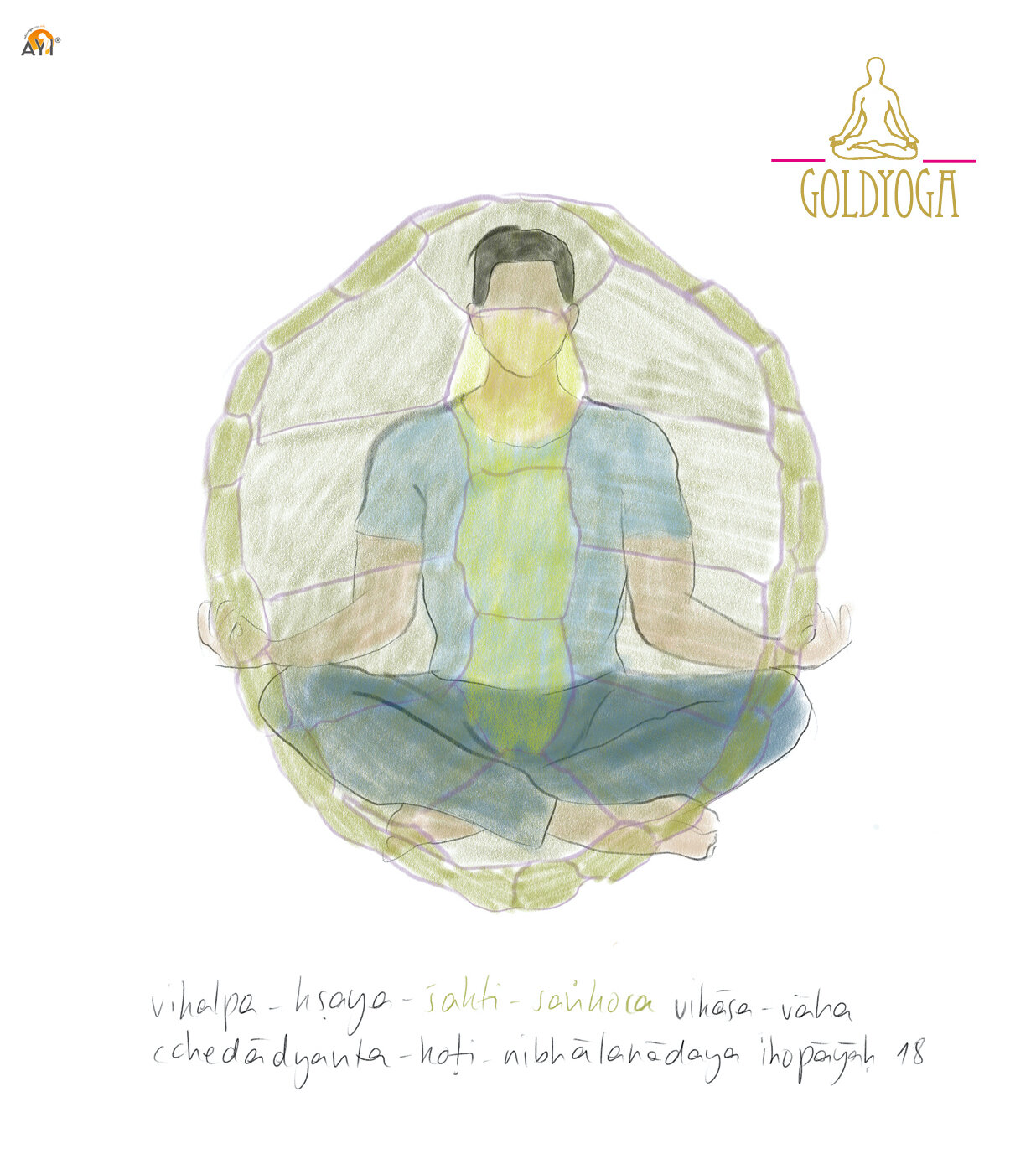
- Notice the energy flowing out from the inner space of your heart
- Draw it back and guide it into the central channel
- Feel the form of this energy fully as pure energy
- Allow it to dissolve in the centre and let it go
(3) śakti-vikāsa – Expansion of energy
This method requires the energy to have first been drawn inwards. It involves the sudden expansion (visphāra) of energy from the centre (madhya) into the entire field of perception, while keeping the centre continuously in awareness. The energies of the senses, together with thoughts and feelings, are simultaneously “thrown” (kṣip) into their respective sensory fields. This makes it possible to perceive directly that everything is a vibration of consciousness emanating from the centre (madhya), the “golden pillar” (hāṭaka-stambha).
A simple way to practise:
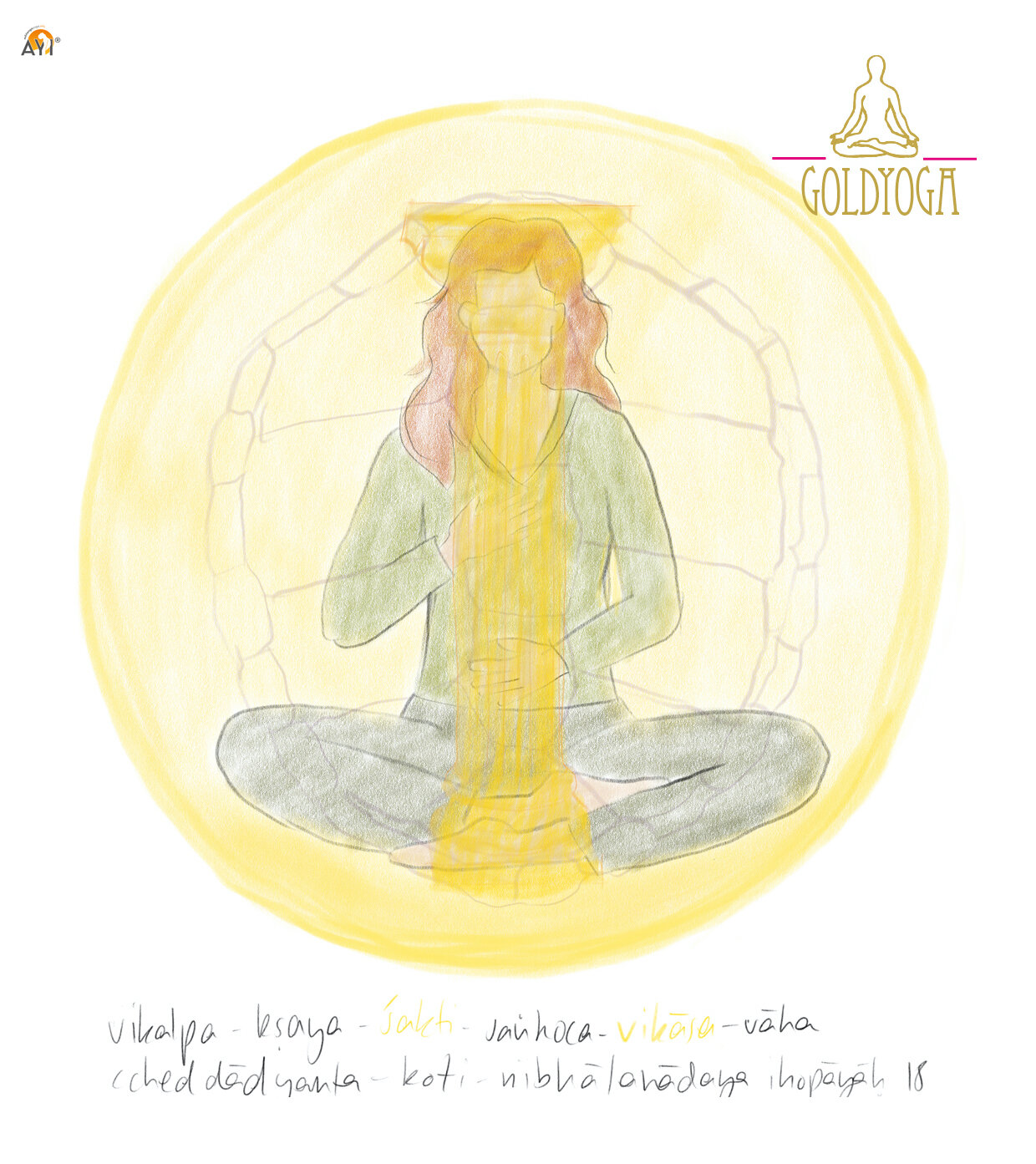
- First draw all your energy inwards (Śakti-sankoca, 2nd variation)
- Expand the energy from within into the entire field
- Perceive through all your senses simultaneously, treating all energies equally
- At the same time, keep consciousness in the centre within the golden pillar
- Move back and forth between the central channel and the outside
- Keep your eyes wide open while maintaining the connection with the inner channel
(4) śakti-saṅkoca-vikāsa – Expansion and contraction of energy
Here it becomes clear that this teaching recognises two kuṇḍalinīs: an upper (ūrdhva) and a lower (adhas). Both must be activated simultaneously so that they meet and merge in the centre. This gives rise to liberation while living (jīvan-mukti). Kṣemarāja describes two techniques:
- Activating the upper Kuṇḍalinī energy (ūrdhva-kuṇḍalinī)
through vibration in the nasal cavity (nāsāpuṭa-spandana). This vibration moves downwards on the inhalation with the Bīja Mantra “hrīṃ” and upwards on the exhalation with the Bīja Mantra “hrauṃ”. This is known as Uccãra practice and should not be undertaken without precise instruction. - Activating the lower Kuṇḍalinī energy (adhas-kuṇḍalinī)
through the transformation or integration of sexual energy.
Here Kṣemarāja uses three very specific terms to describe the activation of this Kuṇḍalinī, quoting Vijñāna Bhairava 68:
vahner viṣasya madhye tu; cittaṃ sukha-mayaṃ kṣipet |
kevalaṃ vāyu-pūrṇaṃ vā; smarānandena yujyate || 68 ||
(During lovemaking), one should cast (kṣipet | 3p sg) one's mind (cittaṃ | acc sg), which consists of bliss (sukha-mayaṃ | acc sg), into the middle (madhye | loc sg) between the ‘fire’ (vahner | gen sg) [symbolising the kindling of desire at the beginning] and the ‘poison’ (viṣasy | gen sg) [representing the all-encompassing awareness of calm at the end]. One who holds the breath released (kevalaṃ | nom sg) or (vā) filled (vāyu-pūrṇaṃ | nom sg) becomes united (yujyate | 3p sg pass) with the bliss of passion (smarānandena | ins sg) [arising from the union of Śiva and Śakti] (verse 68).
Kṣemarāja describes the techniques only in broad terms and uses specific tantric terminology, so a deeper understanding requires further explanations, for example from additional texts.
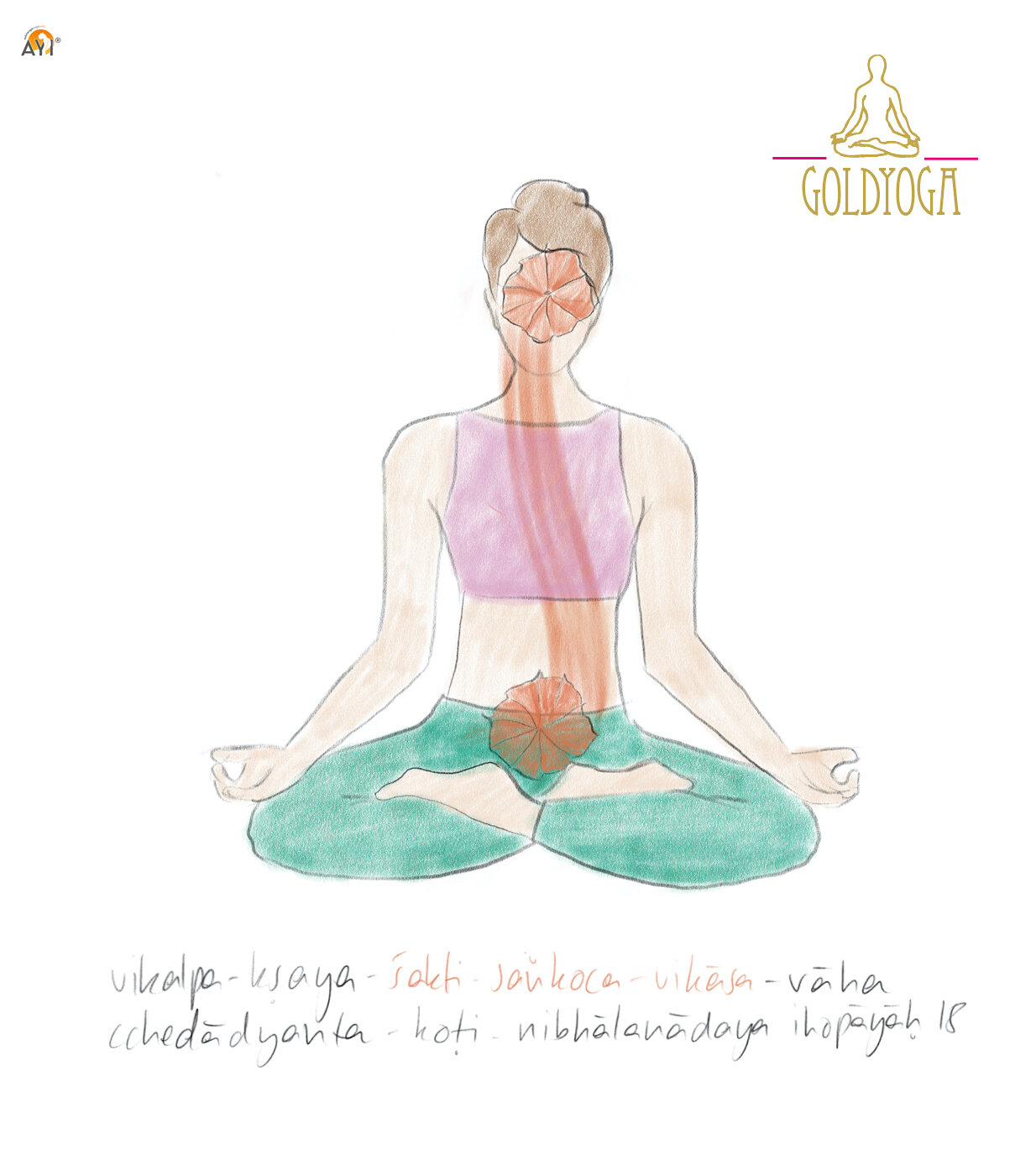
(5) vāha-cheda – Interrupting the currents
This practice activates energy (prāṇa and apāna) in the heart centre by interrupting its flow. Once the energy has come to rest in the heart centre (hṛdaya-viśrānti-puraḥsara), the interruption is brought about by inwardly uttering a consonant without a vowel, such as “k” or “h” (antaḥ kakāra-hakārādi-varṇoccāra). Concentration remains in the heart centre.
One possible approach
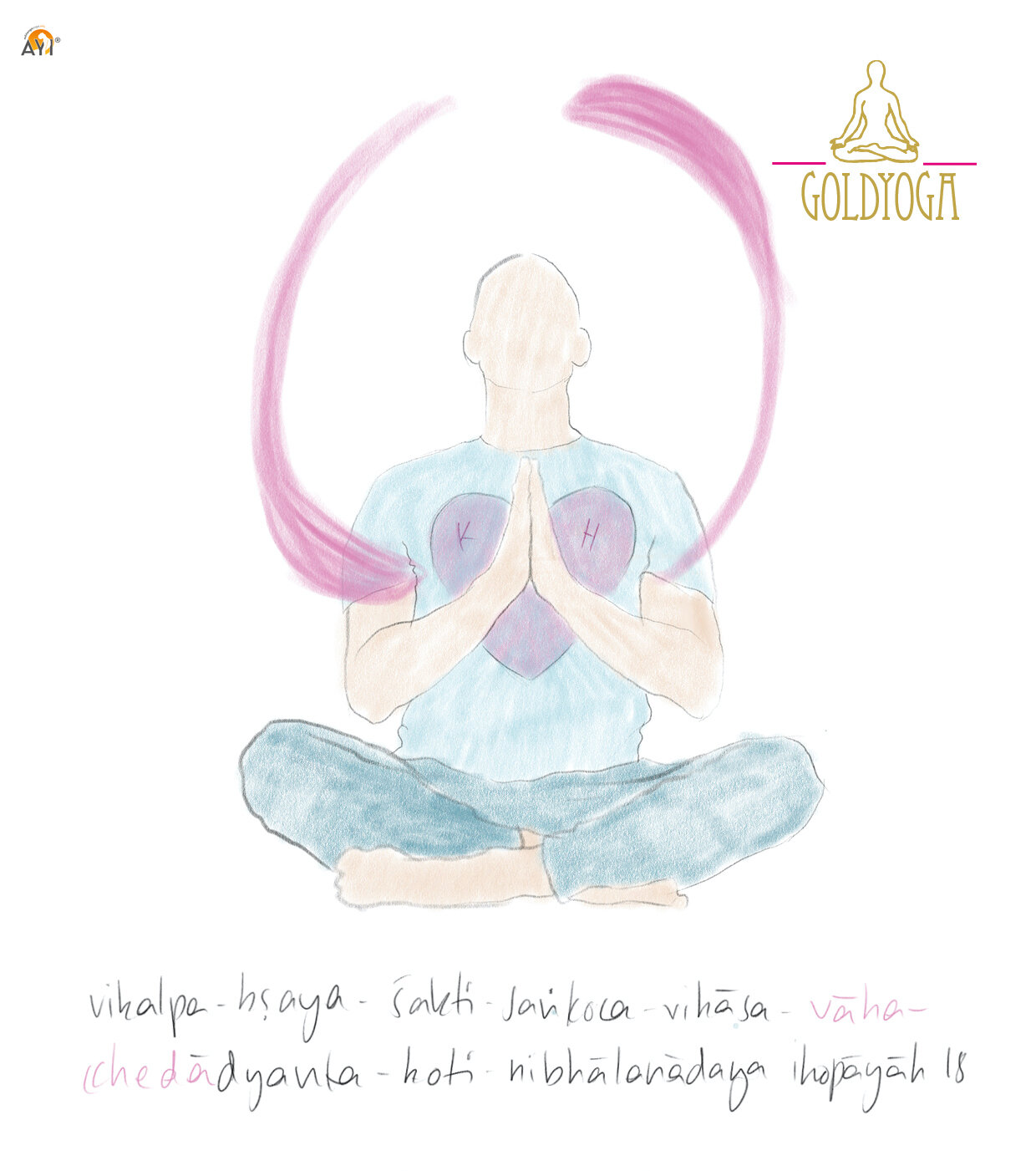
Breathe in towards the heart, hold the breath there and “prepare inwardly” to pronounce the letter “k” (or a word beginning with it) until the urge to exhale arises. As you breathe out, however, do not actually pronounce the letter or word, and keep your attention in the heart centre.
A simple way to practise:
- Take a meditation posture
- Take a few deep breaths
- Exhale slowly and fully
- Breathe deeply into the heart
- Hold prana energy in the heart so that you feel “full”, and hold your breath
- Inwardly utter a “K” or an “H”
- Connect with the heart centre and feel this state of potential and stillness
- Exhale without a consonant
- Repeat the cycle several times if you wish
(6) ādyanta-koṭi-nibhālana – Focusing on the beginning and end points
The “beginning point” is the heart (hṛdaya); the “end point” is the dvādaśānta, the “end” (anta) twelve (dvādaśa) finger-widths above the head. This point marks the upper boundary of the energy body. When prāṇa arises (ullāsa) or comes to rest (viśrānti), attention should rest on these two points. According to Kṣemarāja, this cultivates (pariśīlana) the practice of settling the mind (citta-niveśana).
One possible approach
Imagine the exhalation flowing vertically upwards from the heart centre through the central channel, out through the crown of the head and “coming to rest” at the dvādaśānta. Then visualise the inhalation flowing down from there into the central channel and coming to rest again in the heart centre. Focused attention allows prāṇa to be visualised in this way, even though the physical breath actually flows through the nose or mouth.
Kṣemarāja quotes verses 49 and 51 of the Vijñāna Bhairava Tantra to explain the significance of both points. Verse 51 promises a transformation within days when this practice is regularly integrated into everyday life:
yathā tathā yatra tatra dvādaśānte manaḥ kṣipet |
pratikṣaṇaṃ kṣīṇa-vṛtter vailakṣaṇyaṃ dinair bhavet || 51 ||
“Wherever you are, whatever you are doing, direct your mind towards the dvādaśānta.
Within days, as mental restlessness continually subsides, a transformed state will arise.” (verse 51)
A simple way to practise:
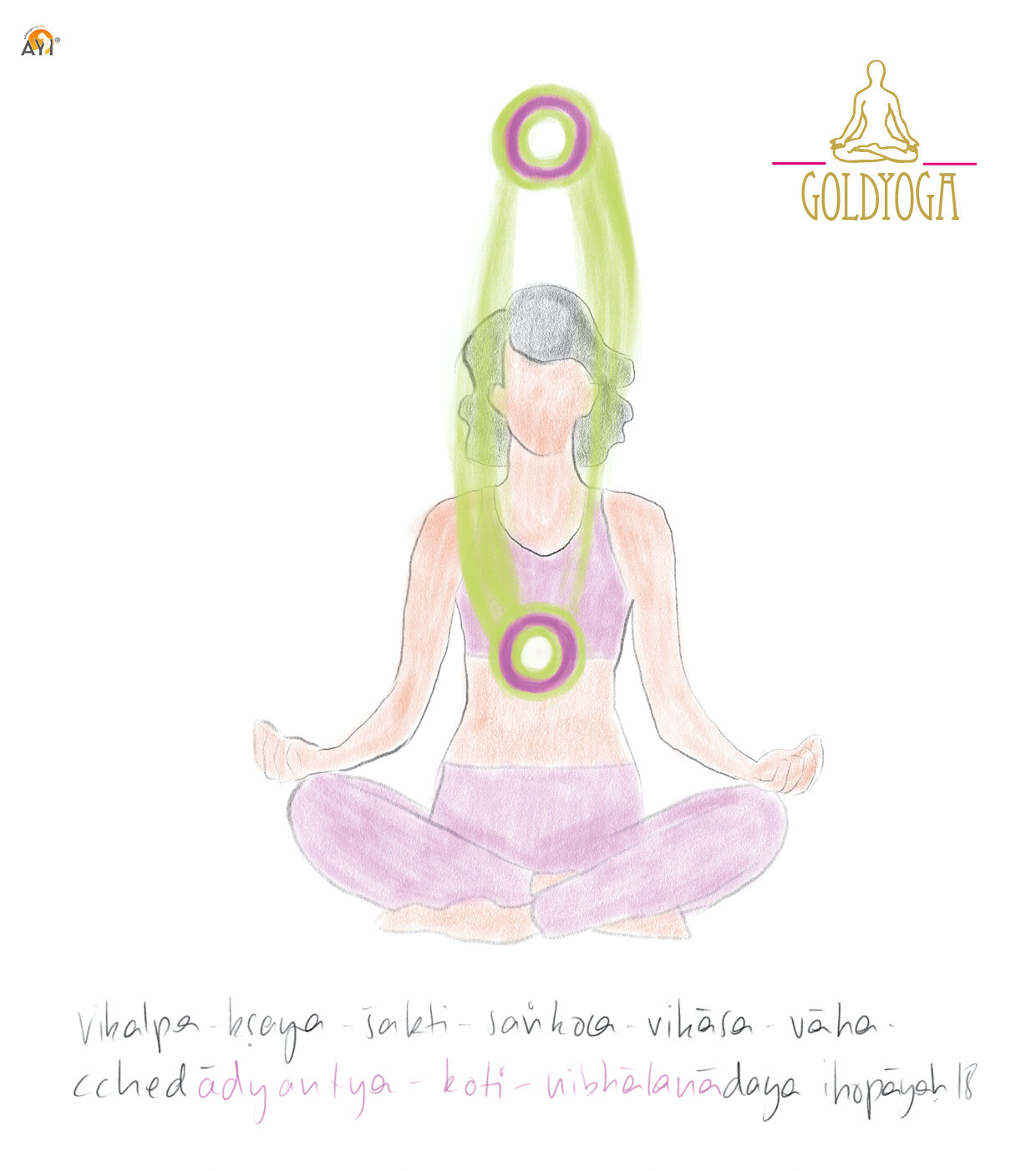
- Exhale vertically upwards through the channel from the heart point (hrdayam)
- At the end of the exhalation, rest 12 finger-widths above the crown (dvadasanta)
- Come to rest there
- Inhale down from there into the deepest point of your heart centre
- Rest here too, and settle
- Notice the energy of the breath after each pause
(7) unmeṣa-daśā-niṣevaṇa – Attending to the phase of unfolding
Here Kṣemarāja describes the first practice implied by “etc.” in the Sūtra. It concerns the phase (daśā) in which you are already occupied with a thought or process and a new thought, impulse or shift occurs. The practice is to consciously notice this phase in which something new unfolds (unmeṣa).
This rests on the understanding that consciousness alone is the source of every change and unfolding. The focus is not on the content, which is coloured by our conditioning, but on the pure energy of unfolding that springs from consciousness itself.
A first approach to this subtle practice would be to notice, in everyday life, when a different mood or stream of thought begins to emerge. Perceive this very delicate moment of change for as long as possible, without naming or analysing it.
A simple way to practise:
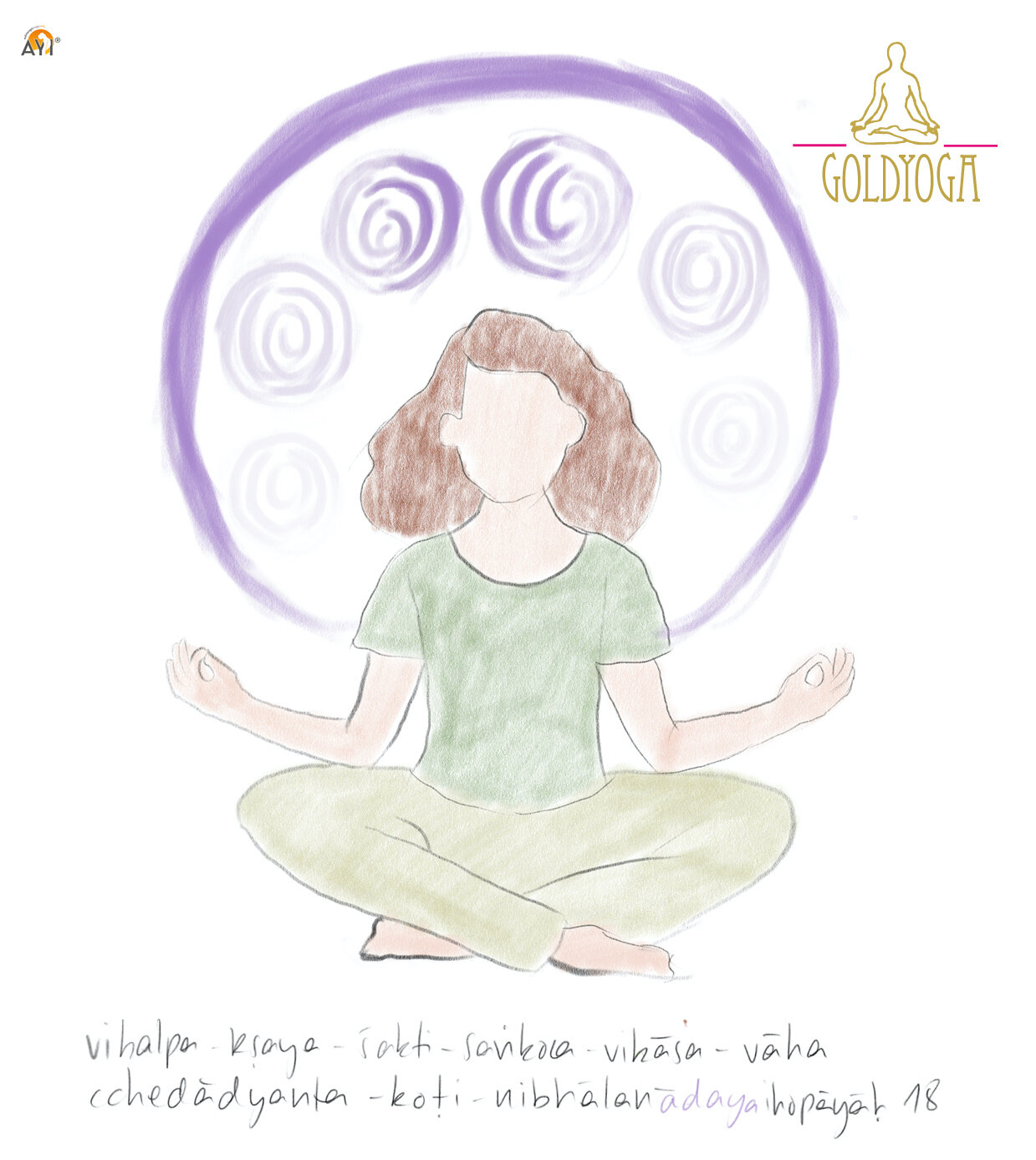
- Take a meditation posture
- Let the breath flow freely
- Focus on the shift in energy from one thought to the next, from one emotion to the next
- Slow down your observation
- Observe the changes in your inner perception with curiosity and fascination
- Focus on perceiving and feeling; do not name or analyse
- Open yourself to the stillness, the space between shifts in energy
- Open yourself to the true nature that can emerge in this space
- Let waves of inspiration arise in this space
- “I am the source of all inspiration”
- Ask yourself, “What does it feel like to be me right now?” and feel the answer
(8) ramaṇīya-viṣaya-carvaṇa – Savouring a beautiful sensory object
Kṣemarāja offers no description of his own, instead quoting three verses from the Vijñāna Bhairava Tantra. These give examples such as good food (jagdhi), drink (pāna) or song (gīta), to be enjoyed in a way that allows the state of fullness arising through that enjoyment to be perceived. When the mind (manas) is allowed to dwell where it finds delight (tuṣṭi), supreme bliss (parānanda) arises.
The aim is not just to enjoy the experience, but also to sustain attention long enough to notice how it gradually fades and where it dissolves, so that no impression (saṃskāra) remains (see Sūtra 11).
A simple way to practise:
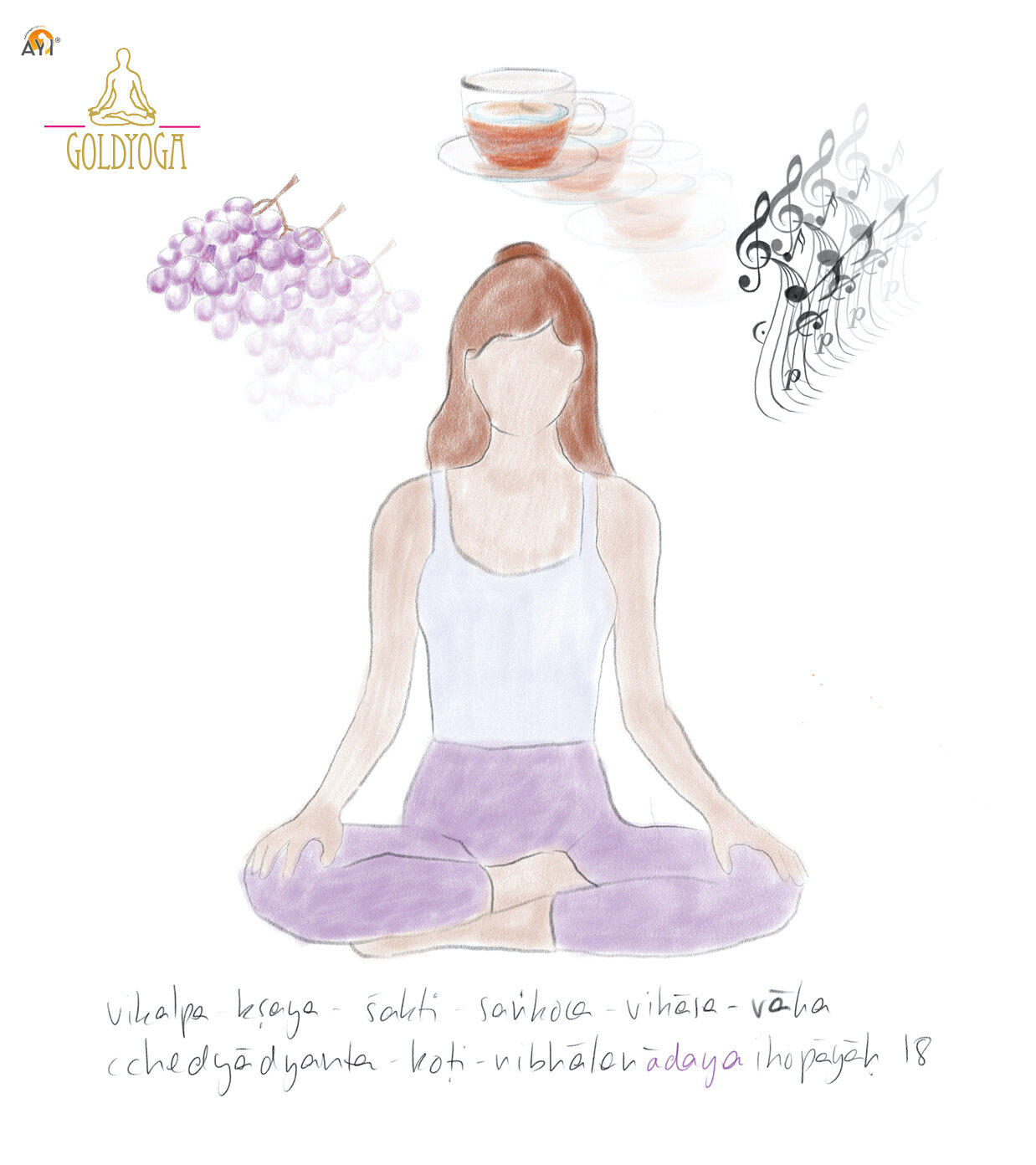
- Give your full attention to enjoying a sensory object
- Take the object in completely
- Perceive it in all its fullness and beauty
- Savour it fully by bringing your aesthetic awareness to it
- After enjoying it, let it fade without attachment
(9) ānanda-pūrṇa-svātma-bhāvanā – Meditating on your own self when it is full of joy
Finally, Kṣemarāja explains that further practices can be inferred, such as meditation (bhāvanā) on one's own self (svātma) when it is full (pūrṇa) of joy (ānanda).
Verses 65 and 71 of the Vijñāna Bhairava Tantra provide examples of this practice:
sarvaṃ jagat svadehaṃ vā svānandabharitaṃ smaret |
yugapat svāmṛtenaiva parānandamayo bhavet || 65 ||
“Meditate on your own body (svadeha) or the whole world (sarva-jagat) as filled with your own joy (svānanda-bharita). Then, through your own ‘nectar’ (svāmṛta), you will suddenly experience supreme bliss (parānanda).” (verse 65)
ānande mahati prāpte dṛṣṭe vā bāndhave cirāt
ānandam udgataṃ dhyātvā tallayas tanmanā bhavet || 71 ||
“When you feel great joy (mahānanda) – for example, on seeing someone you love again after a long time – meditate on it. Let your mind dissolve into it (laya); become one with this joy.” (freely rendered from verse 71)
This concludes the description of the Sukhopāyas in the Pratyabhijñā-hṛdayam.
A simple way to practise:
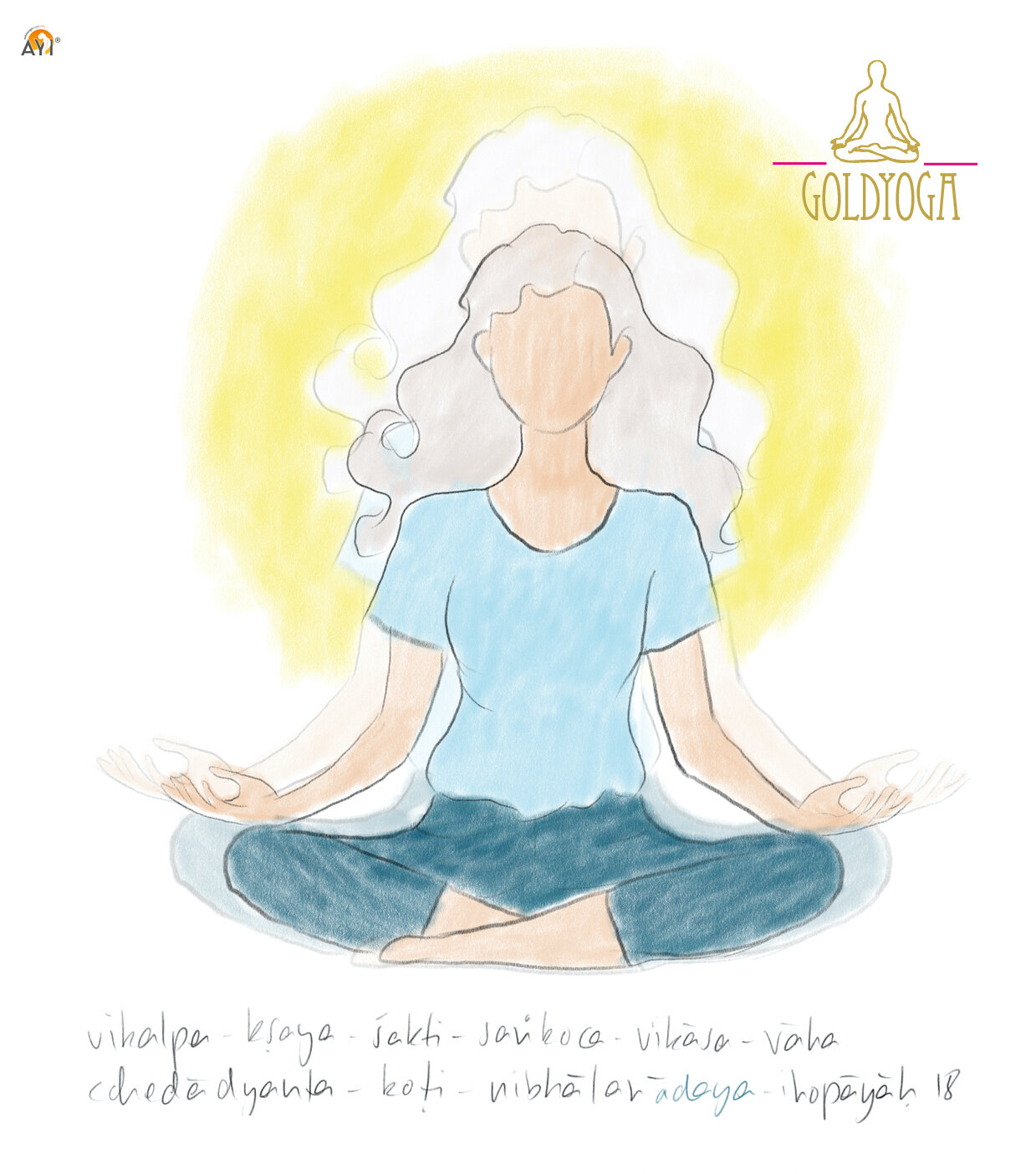
- Choose a posture that feels comfortable for you
- Connect with your heart
- Recall a state of joy and bring it into your awareness
- Remain in this joy, allowing it to spread through your centre
- Anchor the joy within you
From text to practice – The path of the Sukhopāyas
In conclusion, the Sukhopāyas of the Pratyabhijñā-hṛdayam offer a direct, practical approach to the highest spiritual recognition, even without personal instruction or formal initiation by a guru. As Bettina Bäumer emphasises, the tantric texts (Āgamas) themselves leave this possibility open, since the highest experience can also be attained through the revealed texts. What matters is continuous practice with focused attention, leading to internalisation, which in turn deepens practice. The methods in this text are open to people outside the tradition and to those of different religious affiliations. They thus continue to make profound spiritual experience possible today. This affirms the final verse of the Pratyabhijñā-hṛdayam, which proclaims that the state of universal consciousness can be attained through this text's instruction – a recognition extending far beyond historical or cultural boundaries.
Sources
Wallis, Christopher D. The Recognition Sūtras: Illuminating a 1,000-Year-Old Spiritual Masterpiece (English Edition) (p.482). Mattamayura Press. Kindle edition.
Bäumer, Bettina Vijñāna Bhairava Tantra Das göttliche Bewusstsein, Verlag der Weltreligionen, 6th edition 2021
Images
Katrin Goldman



Please log in to write a message. Go to login
No messages yet.