
Who is who
Who is who

The roots of the living tradition of Aṣṭāṅga Yoga

Looking back at the legendary lineage of the Aṣṭāṅga tradition: From Patañjali to Vāmana Ṛṣi, and Kṛṣṇamācārya to BNS Iyengar and Pattabhi Jois - an ancient yoga tradition with refreshing vitality in the present.

Dr. Ronald Steiner Dr. Ronald Steiner

Sri K. Pattabhi Jois and the Yoga Mala

As Kṛṣṇamācārya then left Mysore, he handed the transmission of traditional yoga over to his oldest student, Sri K. Pattabhi Jois.

A little later Pattabhi Jois began to write a book about the practice system. The „Yoga Mala“ was written between 1958 and 1960. "Mala" means garland, and refers to Aṣṭāṅga Yoga as the identical pearls of breath and movement, lined up along a garland. In 1962, the book was published by one of his pupils, a coffee planter from Coorg. Eddie Stern, a longtime student of Pattabhi Jois, from the U.S, published the first English translation in 1999. To date, the book is a reference for the practice. It is a testament to how the tradition continues unchanged through the years. It was already there before the first Westerners (the Belgian Andre van Lysbeth), in 1964, found Pattabhi Jois and began to learn yoga from him. It was there before Aṣṭāṅga Yoga came to be celebrated in thousands of yoga schools in the West.

Sri K. Pattabhi Jois taught up until he passed away on May 18, 2009, and he consistently emphasized exactly what he learned from his guru Sri T. Kṛṣṇamācārya. In 1927 he met his teacher and studied Aṣṭāṅga yoga with him for more than 25 years.

BNS Iyengar

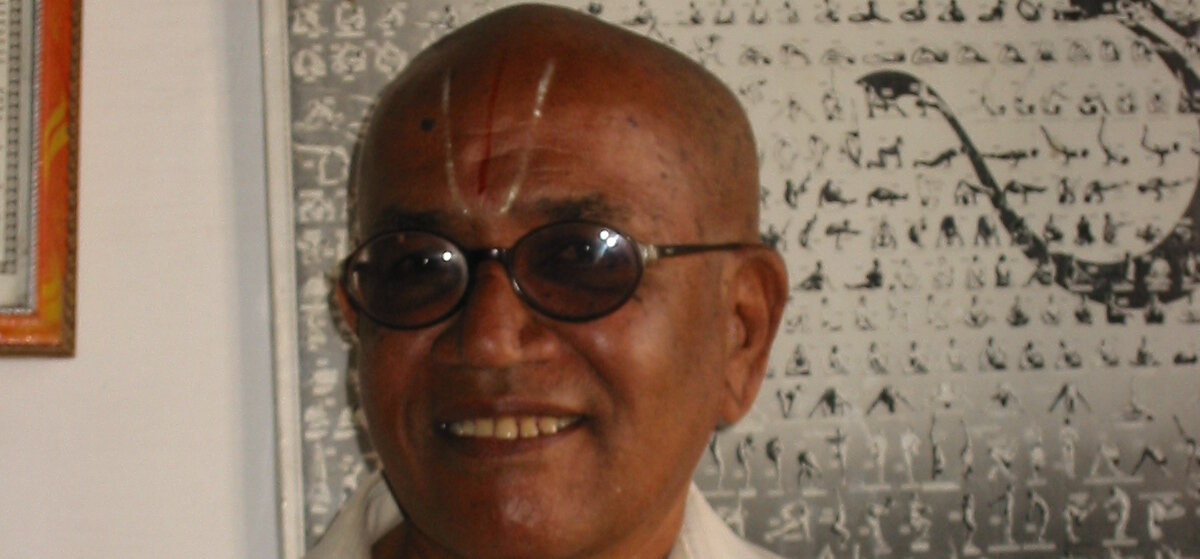
While Sri K. Pattabhi Jois focused on the propagation of the Aṣṭāṅga Vinyasa system, BNS Iyengar, also a direct disciple of Kṛṣṇamācārya, continued the Aṣṭāṅga tradition through the teachings of pranayama, mudra and meditation. Jois and Iyengar were students of Kṛṣṇamācārya’s in Mysore at the same time. When Kṛṣṇamācārya left the city, he left the teachings of Aṣṭāṅga in the hands of his oldest and most experienced student, Sri K. Pattabhi Jois. Who started teachings at the University of Mysore. At the Jagamohan temple, a Vaishnava temple, in which Kṛṣṇamācārya also taught, BNS Iyengar, a Vaishnava like Kṛṣṇamācārya, continued the tradition of teaching – up until today!

Kṛṣṇamācārya

If one traced back the tradition of Aṣṭāṅga Yoga from Pattabhi Jois and BNS Iyengar a step further, one comes to Sri Tirumalai Kṛṣṇamācārya. This great sage and yogi traveled to the Himalayas in the year 1916 to learn yoga. There he met his guru Sri Ramamohan Brahmāchari and spent seven and a half years with him. In this time he studied the Aṣṭāṅga yoga system. In 1933 he first taught in Mysore, and later on in Madras for many Indian and Western students. In addition to Sri K. Pattabhi Jois and BNS Iyengar, among his best known students are Indra Devi, BKS Iyengar and his son TKV Desikachar. Influenced by these masters, yoga styles have stemmed from one family. Their representatives were students of the great master Kṛṣṇamācārya, just at different times. Krishnamarchaya taught the most traditional and original form of yoga , Aṣṭāṅga yoga, in Mysore. In Madras he changed his style, which ultimately became Vini-Yoga. However, the origin connects Aṣṭāṅga- with Vini- and Iyengar-Yoga.

Yoga Korunta and Vāmana Ṛṣi

One of the most important books during Kṛṣṇamācārya’s studies with Ramamohan was the „Yoga Korunta“. This he did in the old tradition, whereby important philosophical texts are transmitted orally from master to student, so he learned it by heart. When he parted with his guru in 1924, he received from him the task of looking for the book. After great effort he finally found a copy in the University Library of Calcutta. Unfortunately, a little later the book was severely damaged by ants and it was not possible for Kṛṣṇamācārya to preserve it. So it may now be impossible to prove its authenticity.

„Korunta“ means „group“ and it is said that its text contained the exact grouping of the asanas. Everything about vinyasa, bandha, dristhi, asana and all 6 series, as they should be taught to this day, are included in it. The "Yoga Korunta" thus forms the basis of the Asana Vinyasa Systems of Aṣṭāṅga Yoga.

The "Yoga Korunta" is attributed to the sage Vāmana Ṛṣi. It is said that he was born when Aṣṭāṅga yoga was almost forgotten, and a wise man was needed to bring it back to mankind. Vāmana Ṛṣi incarnated himself specifically for this task. Since he was already in the womb, he himself had no idea of Aṣṭāṅga Yoga. Thus he meditated on Viṣṇu, so that he could help him. So it happened that Viṣṇu taught the Aṣṭāṅga Yoga system to him in the womb. After nine months had passed, Vamana had not yet been through the entire curriculum. According to legend, he refused to be born until he had finished his studies of Aṣṭāṅga yoga.

Yoga Sūtra and Patañjali

The philosophical basis of Aṣṭāṅga yoga can be found in another book, the "Yoga Sūtra". This book is not hard to find. It is available in many translations with commentaries. According to western Indian the "Yoga Sūtra" was written between 400 BC and 200 AD. Hindu mythology dates back much earlier, to 10,000 BC. The "Yoga Sūtra" is the most important text of classical yoga. The author, Patañjali, collected and systematized the existing techniques and knowledge of his time in this work. The Yoga Sūtra defines yoga as "the quieting of the mind" (yogas chitta-vritti-nirodha). Only with a calm mind can the true nature of existence be realized. To achieve this goal Patañjali describes a way of eight stages:

  1. Yama (dealing with others)
  2. Niyama (dealing with oneself)
  3. Asana (position)
  4. Prāṇayama (breath control)
  5. Pratyahara (fasting with the senses)
  6. Dharana (concentration)
  7. Dhyana (meditation)
  8. Samadhi (self-awareness)

This eightfold path, seeking the calming of thoughts in the mind, is the namesake of Aṣṭāṅga Yoga: Ashta = eight, anga = limbs, yoga = peace of mind

Patañjali, the author of the "Yoga Sūtra", is recognized as an incarnation of Adisesa, the mythological serpent protector of Lord Viṣṇu. Lord Viṣṇu sleeps on Adisesa in the ocean of existence. Patañjali was born to a woman named Gonica. She was a very serious yogini. When she offered a prayer to the sun god Surya, a small snake appeared in her hands and took human form. Gonica was asked to adopt the boy as her son. She followed this request and named him Patañjali, which is a description of the circumstances of his birth: "fallen Prayer" (pata = to fall; anjali = prayer).

[VG-Wort Code 1 - empty]

Continue with AYI Free

Author

Dr. Ronald Steiner

From Ulm

The "Yoga Doc" - Dr. Ronald Steiner is the founder of the AYI method. This method links traditional Ashtanga Yoga with innovative Yogatherapy and living Philosophy. This forms a practice that is personal for each and... more ›

Messages and ratings
0 messages

Please log in to write a message. Go to login

No messages yet.