

Ronald: That may be what some traditionalists tell their students, but the truth is that yoga is a living tradition, and everything that is alive changes. Around 1916, Sri Kṛṣṇamācārya decided to search out the fabled yogi, Yogeshwara Rama Mohan Brahmāchari. Legend has it that after two and a half months of walking through the Himalayas he finally found him in a cave at the foot of Mount Kailash. He spent seven and a half years there, studying and being led into the depths of yoga. His studies included the practical aspects, like asana, pranayama and vinyasa, as well as philosophy. All of this was supposedly based on an ancient book, the Yoga Korunta by Vāmana Ṛṣi. When Kṛṣṇamācārya began teaching in Mysore in 1924, he rooted himself in this line of tradition. In this respect, it is possible to imagine that today we practice a system that has been preserved for thousands of years and has never been changed. Actually, the fact is that the Yoga Korunta has to date not been found and might never have existed as such. Moreover, Kṛṣṇamācārya was very open to the influences of the West. At the beginning of the 20th century, gymnastic and physical education systems were flourishing in Europe. These were brought to India by the English colonial troops. At that time, gymnastics was taught in every school. This much is clear: drawing upon the Hatha Yoga of the Middle Ages, we can see a lot of parallels between the teachings of Kṛṣṇamācārya and this European physical education system. It was in the context of this progression of events that the Aṣṭāṅga yoga system of Kṛṣṇamācārya continued to change and develop.
Although Pattabhi Jois said, “Never change anything.” How is that to be understood?
Ronald: This statement has to be seen in the context of the typical Indian worldview. In contrast to the Western theory of evolution, in which advances and developments are seen as improvements for the better, in India the ideal lies at the origin. The older the source is, the more important and correct it is. Iyengar and Jois both invoke Kṛṣṇamācārya, he in turn Ramamohan Brahmāchari, and he in turn certainly invokes his teacher as well. “I have not changed anything” therefore means more than anything: I am drawing upon an old tradition with the utmost respect. It does not mean, however, that changes within the practice are not actually possible or desired. It is possible to identify multiple things that have changed within the course of Pattabhi Jois' time teaching: from the number of breaths, to the entry into and exit from asanas, to newly introduced or removed positions, all the way to the establishment of the different series. And naturally the same yoga practice changes with each practitioner's own personality. In its essence yoga is always the same, it revolves around the knowledge of our true Self, or the divine within us. The techniques and methods, however, have changed over time: they have developed by means of transference into new contexts and have continued to branch out into different lines of tradition.
You found a way to preserve the Aṣṭāṅga tradition while simultaneously developing it further?
Ronald: Yes. The AY Innovation method that I've developed combines the classic traditional series of Aṣṭāṅga yoga with the modern insights of science, medicine and Sports Biomechanics. The goal is to provide each student with a very personal yoga practice - ranging from therapeutic-preventative to athletic-acrobatic. In order to be fair to everyone, the focus varies depending upon age and constitution. One person may enjoy a very athletic practice, while another might want to place an emphasis on therapy and illness or injury prevention. All of this is possible within the traditional series of postures - with variations and adjustments. I do not believe that I distance myself too far from the Aṣṭāṅga tradition by doing so. On the contrary: I believe that the tradition must remain alive.
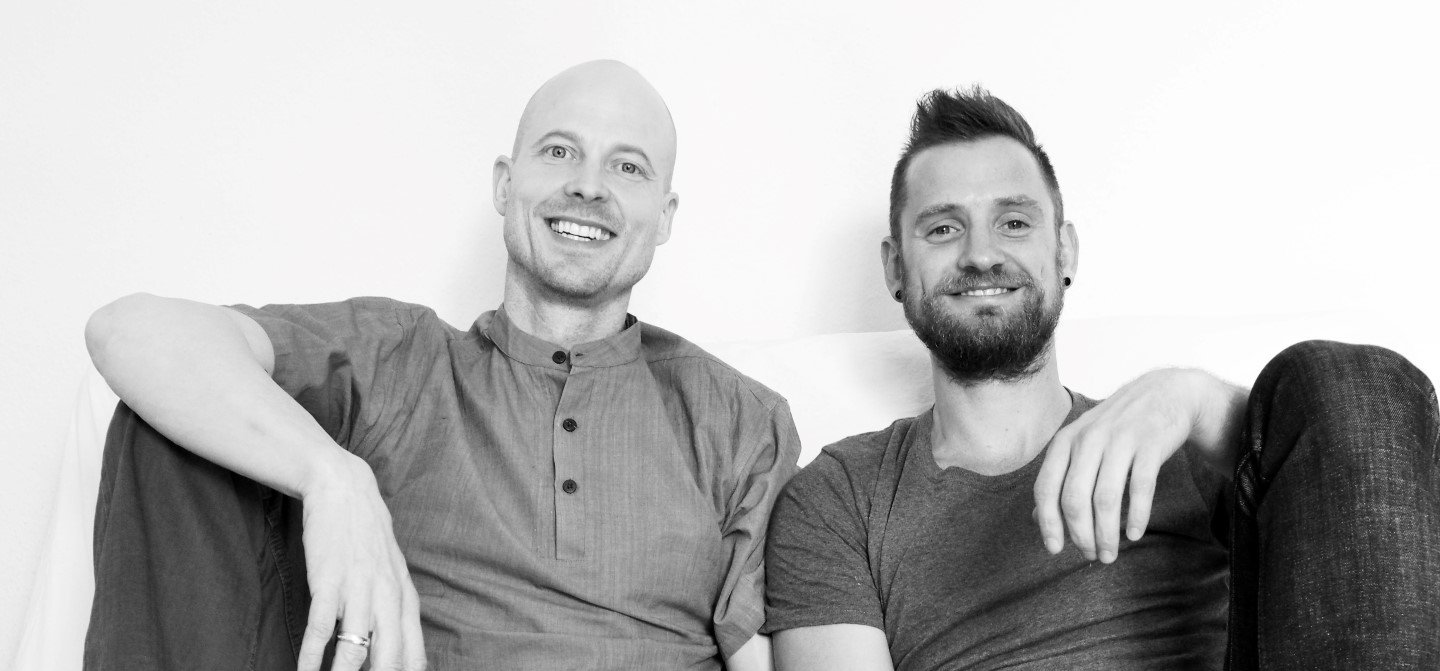
Janosh, it appears that Ronald gives his students a lot of freedom in terms of their personal development
Janosh: Indeed, I feel that he does. He places great value on the foundation, the tradition, the basis. But where one goes from there is up to each individual. Whether it's martial arts, meditation or a long walk, yoga provides the freedom to become engaged with oneself. And in this respect there can be no rules, other than those which we give to ourselves.

Please log in to write a message. Go to login
No messages yet.