

He was succeeded by the legendary Matsyendra Nāṭh. The tradition was then continued by Gorakṣa Nāṭh (11th/12th century). In the 15th/16th century the widely konwn author of the Haṭha Yoga Pradīpikā, Svâtmârâma, followed. Only shortly after, though, the tradition of the Nâţh yogis is discontinued in Southern India and the physically orientated way of Hatha-Yoga falls into oblivion. As son of a family of scholars, Kṛṣṇamācārya, who, in addition to that worked himself a lot and with great attention on the ancient source texts, knew precisely where to look: already at the beginning of the 20th century, scholars knew that the Nāṭh tradition or, Hatha Yoga, had been passed on in the remote mountains of the Himalaya.
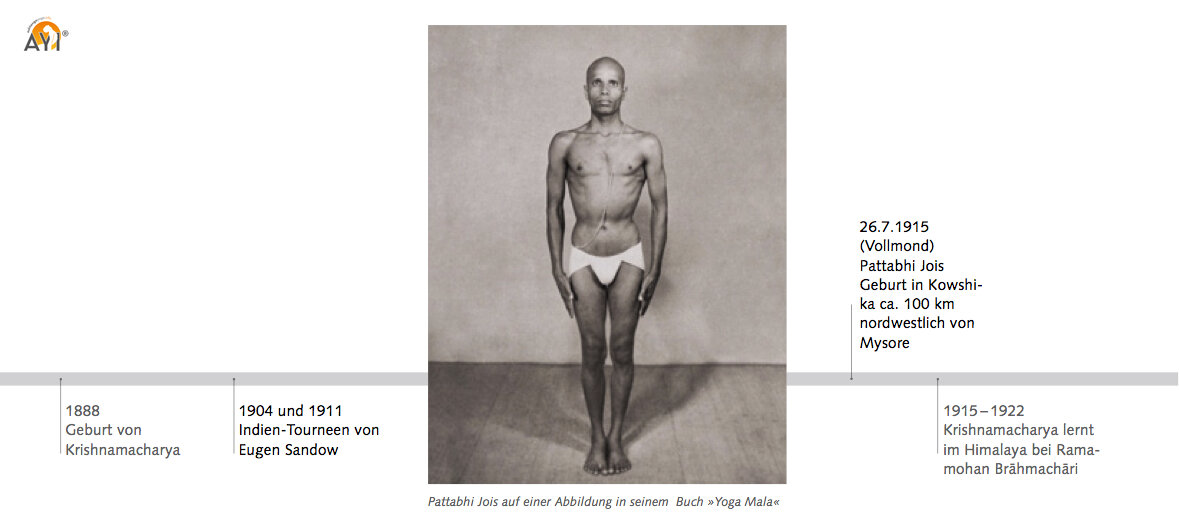
So, at the age of 27, Kṛṣṇamācārya started his journey into the Himalaya in 1915. It is said that he spent three and a half months wandering through the mountains before he finally found his teacher, Ramamohan Brāhmachāri, in a cave not far from the holy mountain Kailash. It was with him that Kṛṣṇamācārya studied philosophy, learned ancient source texts as well as the physical yoga practice. According to Desikachar, Kṛṣṇamācārya learned about 3000 different positions from Ramamohan Brāhmachāri, who himself mastered about 7000.
After seven and a half years of studying, Ramamohan Brāhmachāri send his pupil Kṛṣṇamācārya away to bring yoga back to where it had originally come from – Southern India or India as such. So, in 1922, Kṛṣṇamācārya left the Himalayan mountains and, after he had spent some time studying in Northern India, returned to Mysore in 1924.
The Yoga Korunta by Vāmana Ṛṣi
By now, it will probably not come as a suprise: yes, also Ramamohan Brāhmachāri seems to have referred to a teacher before him with the words »Never changed anything«. In any case, when sending Kṛṣṇamācārya out to spread what he's learned, he tells him that all techniques and exercises came from an ancient book, the »Yoga Korunta«. The Yoga Korunta is assumed to have been written by the sage Vâmana Ṛşi. The legend tells us how Vāmana Ṛṣi observed people on a subtle level. At that point, yoga had fallen into oblivion. People lived in misery, hurry and fear.Vāmana Ṛṣi felt sorry for these people and decided to come to earth to bring yoga back to them.
Therefore, he manifested himself in a mother's womb in order to be born as a human. However, the story shows us that even sages sometimes overlook minor details: since it was only already in the womb that he realised that he didn't know anything about yoga. For this reason, he prayed to the God Viṣnu to help him. His prayer was so intense that Viṣnu took pity on him and taught Vāmana Ṛṣi yoga. It is said that it was here that he learned all the physical exercises and movements which he later on laid down in the Yoga Korunta and which were passed as Asthanga Yoga on in an unchanged form by Ramamohan Brāhmachāri, Kṛṣṇamācārya and finally Pattabhi Jois. It is also that that the pregnancy was an unusually restless one. But after nine months' time of studying in the womb, Viṣnu thought it was time to say goodbuy; Vāmana Ṛṣi, though, had not even come close to teaching him everything at that point. According to the legend, he refused to be born before finishing his yoga studies. The legend also tells us about a very long pregnancy before Vāmana Ṛṣi was finally born and wrote down the entire Aṣṭāṅga Yoga practice system in his Yoga Korunta.
Retrieval and loss of the Yoga Korunta
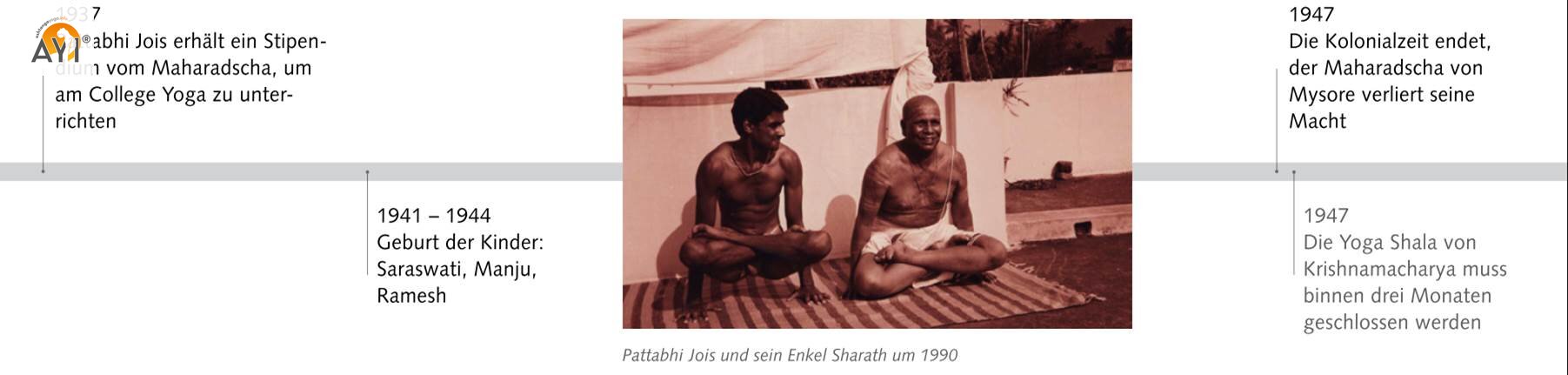
Rumour has it that Kṛṣṇamācārya found the Yoga Korunta in the Library of Calcutta in the years 1922 to 1924. It is said that it contained the entire practice system that he had learned from Ramamohan Brâhmachâri. The Yoga Korunta thus served him as the main work of reference for his yoga classes in Mysore. In 1940, Kṛṣṇamācārya's powerful patron, the Maharaja of Mysore, died. His nephew, Jacha Maraja Wadiyar V., succeeded him on the throne but with the end of Colonialism in 1947, he also lost his power. The new mayor of Mysore, K. C. Reddy, finally decreed that the yoga school had to be closed within three months and thus sealed the end of an era.
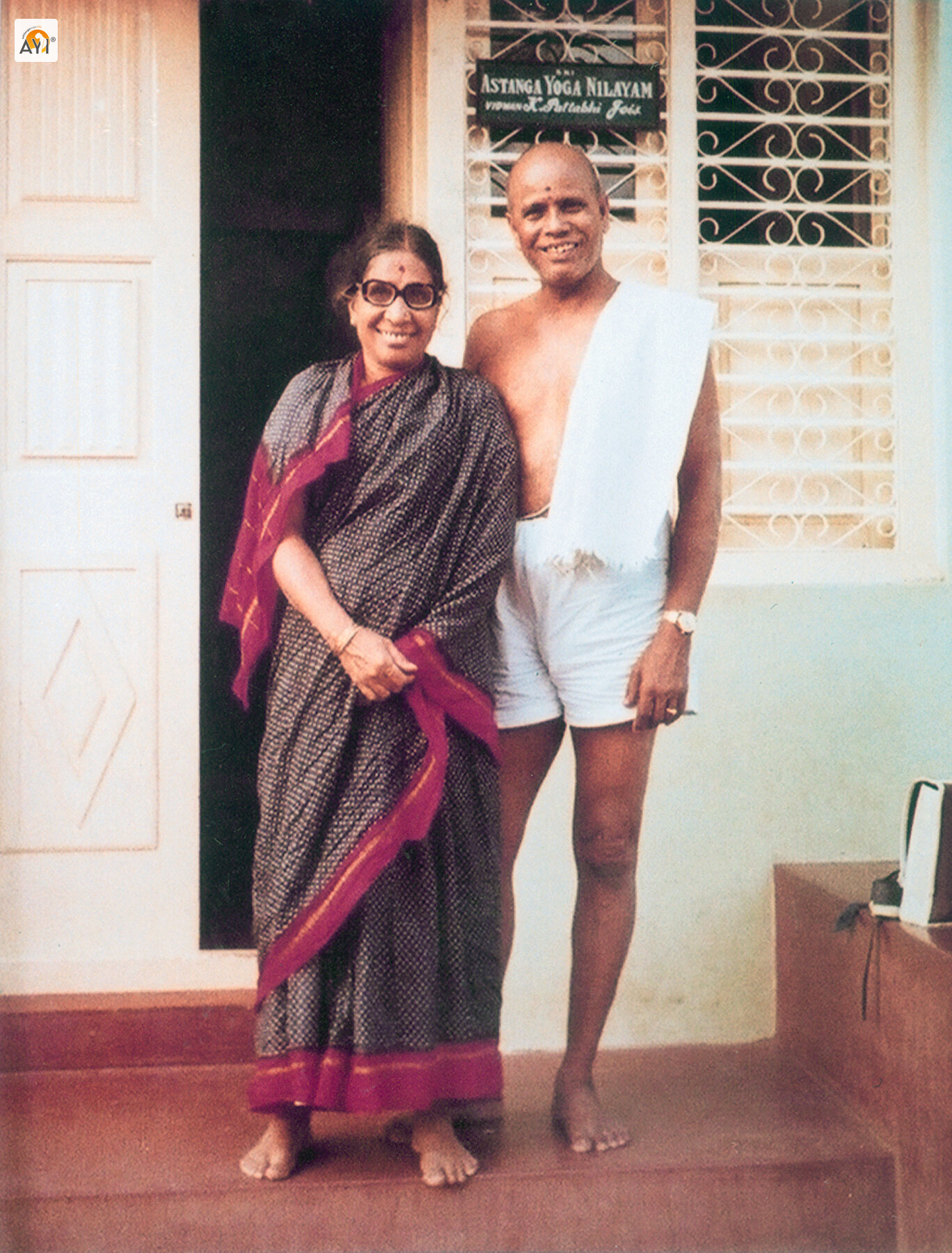
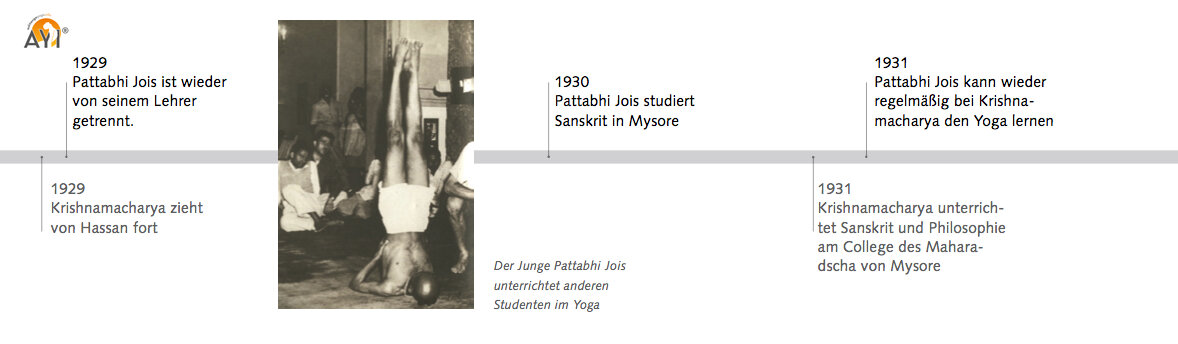
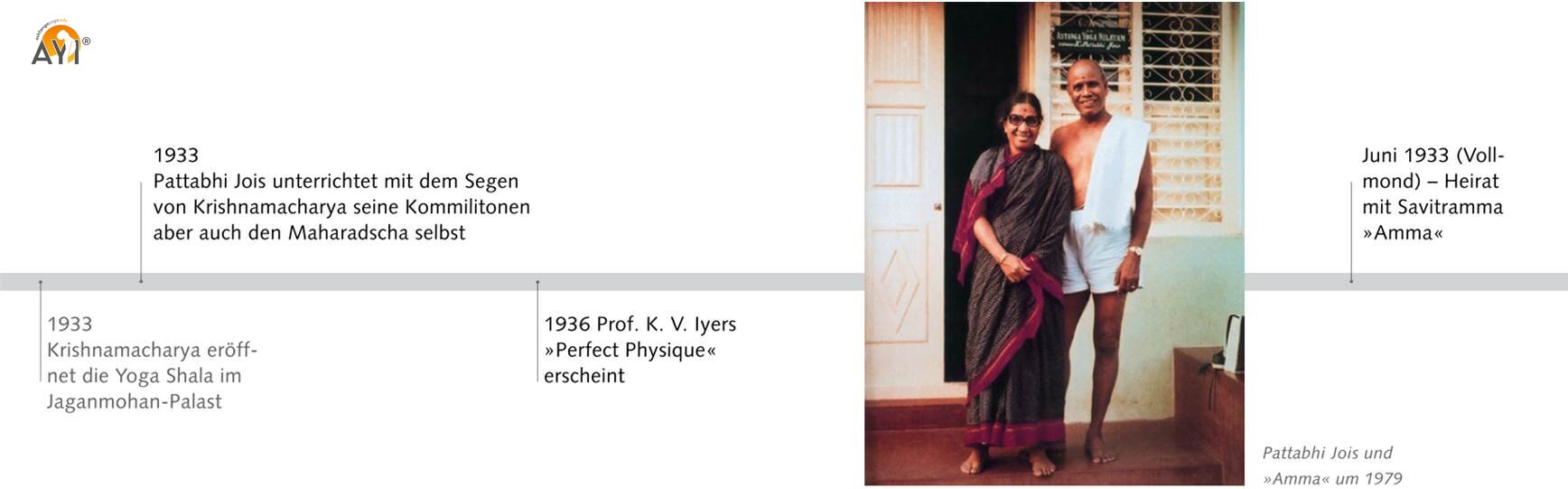
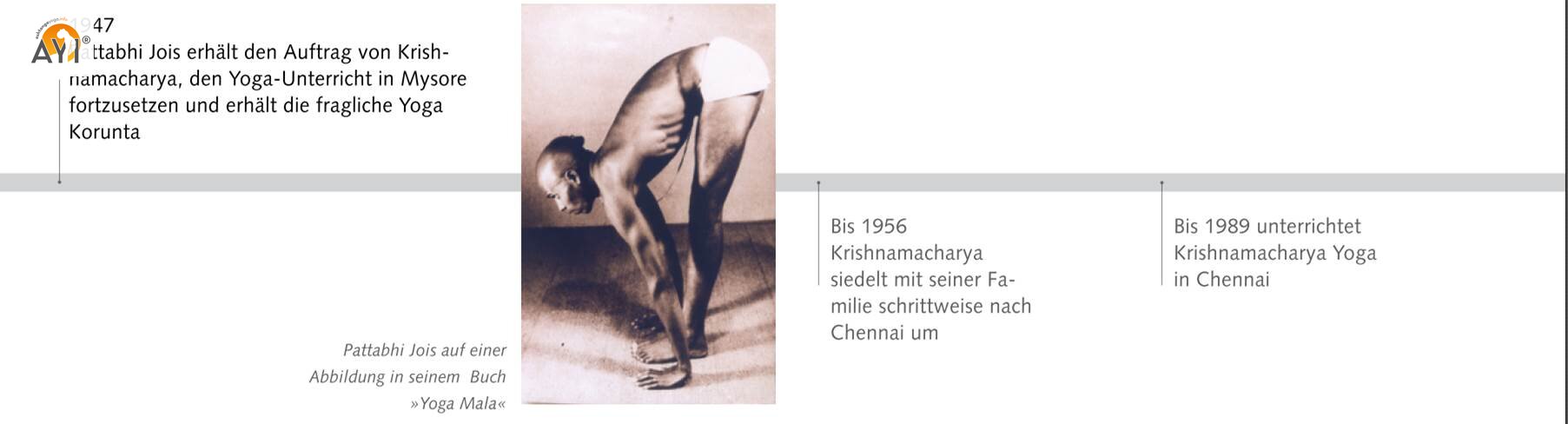
Step by step, Kṛṣṇamācārya settled over from Mysore to Chennai together with his family until 1956. He assigned the task of carrying on the yoga tradition at Mysore to his oldest and most experienced pupil, Sri. K. Pattabhi Jois.
»But he messed it up!«
B. N. S. Iyengar on Patthabi Jois
B. N. S. Iyengar, a fellows student of Pattabhi Jois, remembers the festive ceremony in the temple at the Jaganmohan Palace. It is said that Kṛṣṇamācārya handed over the Yoga Korunta to Pattabhi Jois there. But at this point, Iyengar's report always stops on an angry note: »But he messed it up!« Pattabhi Jois also told us that the book had been eaten by ants and did therefore no longer exist.
A Western perspective on the tradition
We thus apparently practice a system that has been passed on over several thousand years without any changes. It was laid down in the ancient book of the Yoga Korunta. But then this book gets lost. This raises the question of whether the Yoga Korunta might never have existed at all and that Aṣṭāṅga Yoga is a comparately new invention. It is true that a lot on the tradition of Aṣṭāṅga Yoga can be proved only with great difficulty or not at all. But do we always need proofs?
From this point of view, life is like looking through a kaleidoscope. You see beautiful colours and geometrical patterns. If you're only interested in physical reality, you will put the kaleidoscope apart and draw the conclusion that all the beauty you have seen was only the result of a few shards of old, coloured glass and get disillusioned. The dream created by the kaleidoscope is wasted. But at the same time, a new fascination might arise - the fascination how, from just a few simple shards something so wonderful and whole can form. For this reason, we take a closer look on the Aṣṭāṅga Yoga tradition here.
Eastern involution vs. Western evolution
I continued and extended my Aṣṭāṅga Yoga studies with B. N. S. Iyengar. In contrast to the usually very quiet Pattabhi, B. N. S. Iyengar liked to talk about yoga philosophy. However, I often felt frustrated since the dates and years mentioned by him did in no way correspond to those to be found in Western Indology. I experienced a key moment which helped me to a better understanding when Iyengar explained to me: »I know nothing. Everything I teach comes from my teacher, Kṛṣṇamācārya«.
Further developments in the years 1975 to 2009
It is a fact that, even if Pattabhi Jois himself always stressed that he hadn't changed anything, there are a couple of noticeable changes in his teaching with some positions being added and others being left out. Likewise, the number of breaths or the way in which we enter or leave a position changed. In fact, even the segmentation of the practice series changed.
While, from 1975 onwards, his first Western pupils David Williams and Nancy Gilgoff were still confronted with three practice series which became progressively more difficult, he, in his last years before his death in 2009, taught six progressively more difficult practice series. Apparently, each series was split in half with positions changing their order in the process. The resulting gaps were filled by new positions and the transitions between positions became longer, more dynamic and more elaborate. Such changes which came about during Pattabh Jois's long years of teaching are often confusing to us Western students – and there are thousands of examples of this greater and minor changes. However, it would go by far beyond the scope of this article to list them all. These changes seem to contradict the statement »Never changed anything«.
This is exactly what Kṛṣṇamācārya als said with respect to his teacher Ramamohan Brâhmachâri; and the latter in turn about his teacher. Being passed on from teacher to pupil, the tradition seems to have lost a bit of its sagacity in each step. The more wisdom and sagacity within a piece of work, the further back its origins have to be in the past. Therefore, when Iyengar mentioned years and dates to me, he referred less to a chronological time frame but rather to the hierarchy of their significance within the tradition as a whole.
By way of example, B. N. S. Iyengar gave the date of Patañjali's Yoga Sūtra as »very very important – ten thousand years before christ!« And the Yoga Korunta? »well important – five thousand years before christ!« According to this worldview which is quite widespread in India, everything developed in an involution from one origin, i.e. from God. The further back in time it happened, the closer it is to the absolute divine truth. This worldview seems to be in stark contrast to the evolution theory common in the West according to which everything develops into something better. For me, it is important to understand both perspectives and to recognise their value.
Yoga from the roof of the world
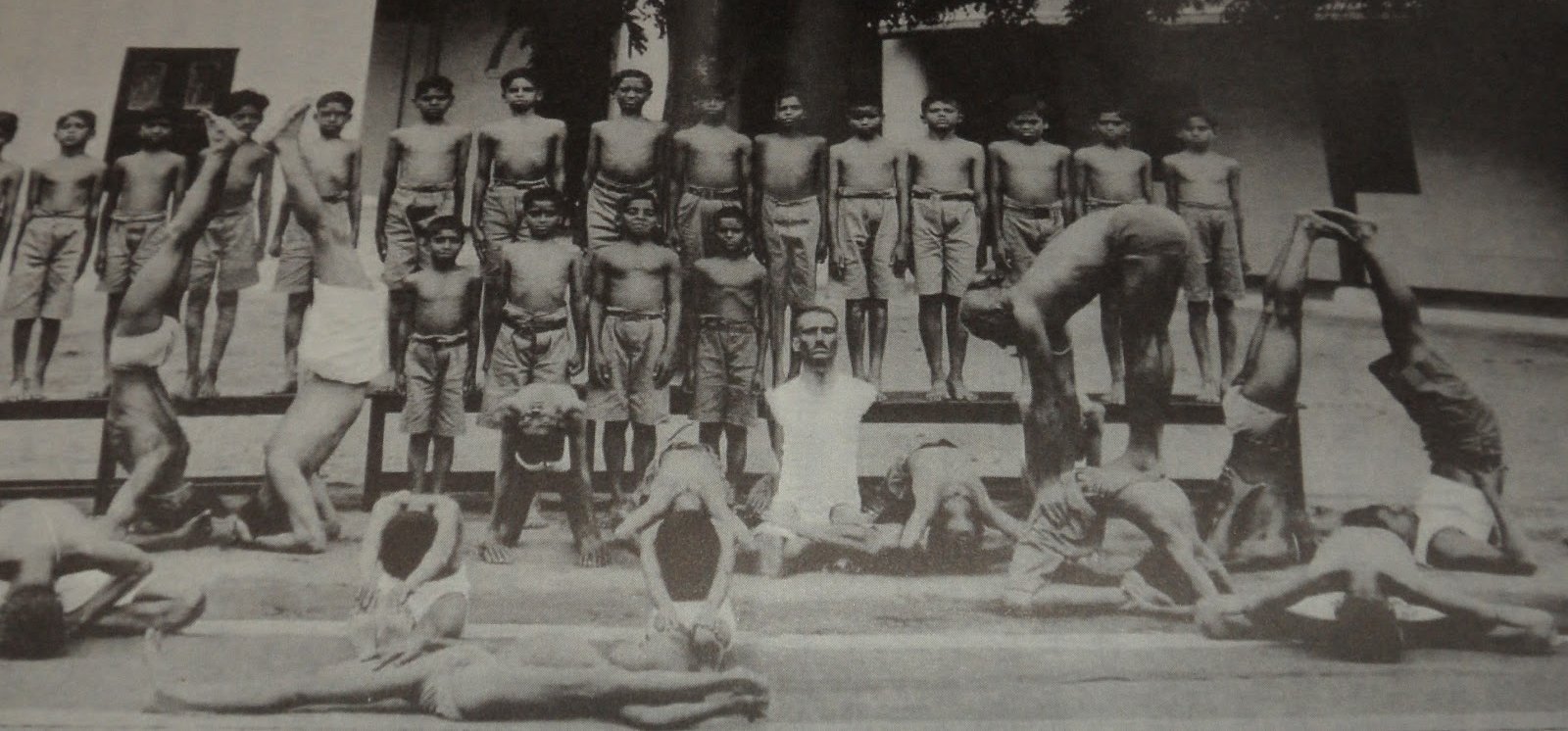
In the early Indian source texts of the Nâţh yogis and of Hatha Yoga, we find a physical practice mainly relying on static exercise with a comparatively small number of exercises. Even up to the 15th/16th centure, the distance to the currently widely practiced dynamic Aṣṭāṅga Yoga seems almost insurmountable. However, a different picture forms when we look at the source texts of the branch of the tradition which soon began to develop in the Himalaya region. Already before the 10th century, a large number of physical exercises were described which were often performed also dynamically. The movements are in tune with the breath. An elaborate system including ways to channel the energy and concentration points complements the physical practice. In recent years, such practice systems have again come from the Himalaya to Europa where they are known as Lu Jong or Yantra Yoga. On first sight, the similarities to modern Aṣṭāṅga Yoga become obvious. This proximity is hardly surprising since it was Kṛṣṇamācārya himself who brought the tradition with him from the Tibetan or, respectively, Nepalese mountains.
How the "Turnerbewegung" (turner movement) inspired yoga
When Kṛṣṇamācārya returned to the South of India from the mountains in 1924, the whole country was in an atmosphere of departure. On the one hand, India turned admiringly towards the West, but on the other hand it was ready to shake off Western colonial rule. At precisely this time, a new physical culture had developed in the West alongside the so-called Turnerbewegung (turner/gymnastics movement). In Europa, the aim was now not only to strengthen the body but, in tune with the Greek ideal, to likewise strengthen the mind. Therefore, in the West disciplines such as gymnastics, early forms of body building and Strongman as well as various types of fitness gymnastics developed.
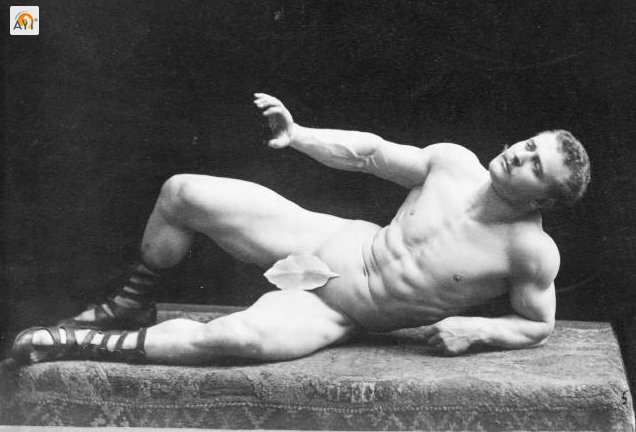
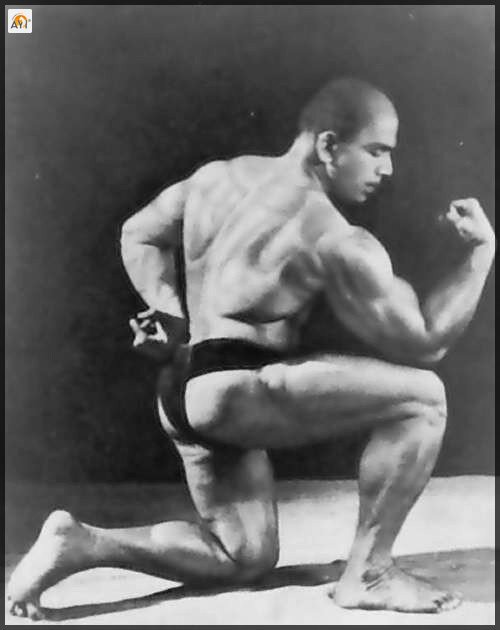
The India tours of the legendary bodybuilding pioneer Eugen Sandow (1867 – 1925), in the years 1904 and 1911 attracted thousands of Indians. Sandows visits had a far-reaching impact on the entire Indian society. They created the interest to train the physical body in broad strata of the population.
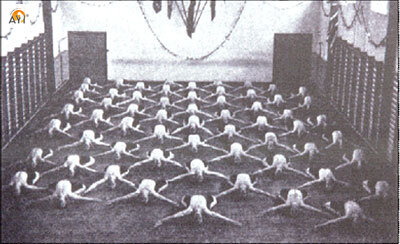
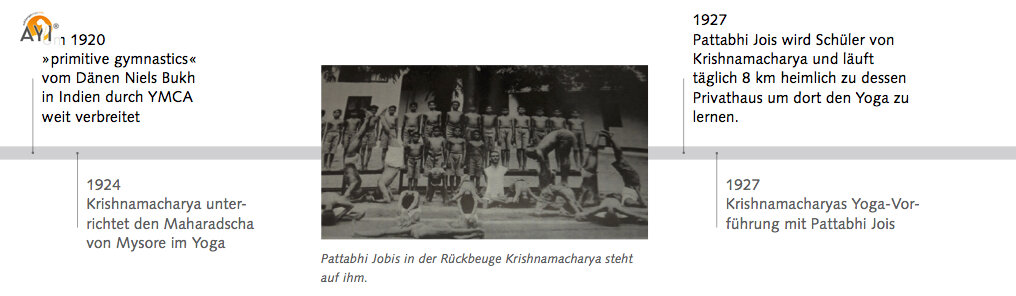
In Europa, training was peformed with weights, using machines or one's own body for many exercises. What's particularly worthy of mention is »primitive gymnastiks«, developed around 1900 by the Dane Niels Bukh (1880 – 1950), because the choice of exercises and their execution is surprisingly similar to today's Aṣṭāṅga Yoga. This type of gymnastics was in particular brought to India by the YMCA and the army during English colonial rule and was widespread there around 1920/1930. Movement series similar to the sun salutation were then performed in the whole country to strengthen the body with even competitions taking place.
So what was closer than countering the European fitness and turner movement with an authentic Indian physical practice? The preconditions to do so were good since the basic ideas of the European turner movement and the Indian Hatha Yoga seem surprisingly similar with both aiming to transform the mind by way of physical practice.
Krishnaraja Wodeyar IV, the Maharaja of Mysore, was also open towards the European fitness and turner movement. Thus, there were soon training sessions at the Jaganmohan Palace lead by Prof. M. V. Krishna Rao using weights and machines for individual exercises. Likewise, the type of gymnastics developed by the Dane Niels Bukh which is so similar to Aṣṭāṅga Yoga was practiced here. Only a few rooms further down, Kṛṣṇamācārya opened his yoga school a little later.
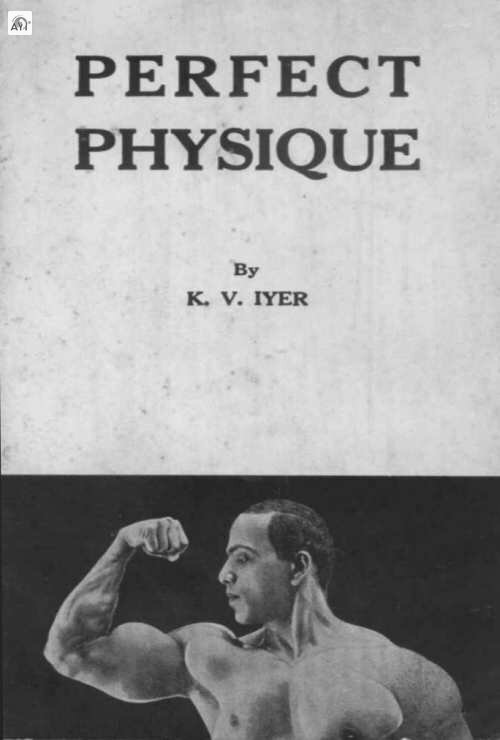
Pattabhi Jois and Prof. K. V. Iyer
It is said that it didn't take long for Iyer to notice Pattabhi's high level of body control and that he asked him how he had achieved such a high degree of physical perfection. When Pattabhi told him about Kṛṣṇamācārya's yoga classes, Iyer is said to have sent him back with the following words: »Go back to Kṛṣṇamācārya, there is nothing more you can learn here.«
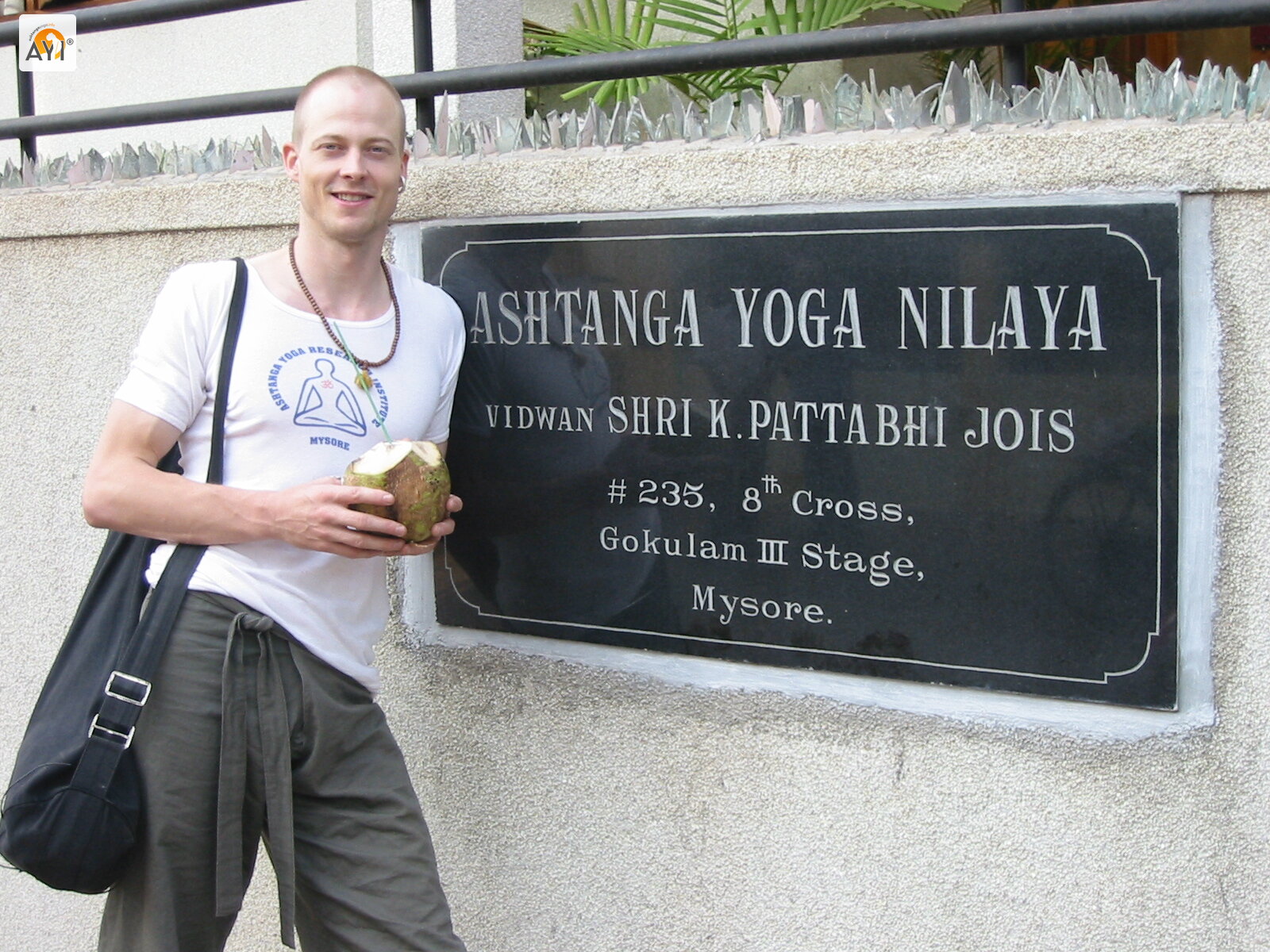
Prof. K. V. Iyer (1900 – 1980), the famous pioneer of the Indian fitness movement, was one of the close confidants and advisors of the Maharaja. Iyer lived in Bangalore, but he still was a regular guest for training sessions at the Jaganmohan Palace. Pattabhi Jois used to tell how he himself, presumably in the 1930s, skipped one of his yoga classes with Kṛṣṇamācārya during one of these visits to meet the famous Iyer and take a lesson with him.
»Never changed anything«
Even today, many European yoga teachers stress that they have never changed anything. Thus, on first sight, the impression arises that they are passing on yoga in precisely the form they have learned in India. But, when we take a closer look, we realise that yoga has undergone a certain development also over the last few years. The tradition lives on but gets new inspiration from all available sources with old and new elements fertilising each other. Yoga is and continues to be a transglobal phenomenon.
What still remains the same, though, is the basic idea or the main aim. As we can see in the Upanishades, the first origins of yoga dating back to approximately 800 B.C., it is here that a systematic search for a true core or self started and that the main aim of yoga practice was thus defined. Since then, yoga practitioners have tried to reach this aim – even though it was only in the 6th century A.D. that, with Hatha Yoga and its focus on the physical body, new, essential tools were added. However, even these tools were and still are subject to continuous change and further development. In this context, Pattabhi Jois's way of teaching represents a milestone. He decisively shaped the type of practice as we know it today and brought it to the Western world.
Almost 3,000 years of experience – and definitely worthy of recommendation
Let's compare Aṣṭāṅga to a medical drug. If I were to describe a patient a medicine that was developed 800 B.C., most would probably laughingly refuse it. The same reaction would most likely occur if I were to miraculously produce the latest invention from my lab coat pocket. In contrast, my patient would be convinced by a medicine that was passed on over generations and constantly improved in the process. In our comparison, Aṣṭāṅga Yoga would be such a medical drug. And definitely worthy of recommendation.
Further reading
Singleton: Yoga Body: The Origins of Modern Posture Practice
Desikachar, Kaustrub: The yoga of the yogi. The legacy of T. Kṛṣṇamācārya
Continue with AYI Free
Quiz: Ursprünge des Aṣṭāṅga Yoga
4 questions to deepen this article.

Please log in to write a message. Go to login
No messages yet.