

At the foot of Mt. Kailash
For Kṛṣṇamācārya, it was therefore a matter of course to go to the Himalaya to search for the vivid tradition of a practice system which also integrated the physical body. It is said that, in 1916, he spent three months erring through the mountains until, at the foot of Mt. Kailash in Tibet, he found his teacher Ramamohan Brahmāchari and spent the following seven and a half years with him in order to learn more and to thus become part of an ancient but still vivid tradition. During these years, Kṛṣṇamācārya learned the dynamic practice series, strictly guarded techniques and profound philosophy from his teacher.
Mysore from 1924 onwards
Having returned from the solitude of the mountains, Kṛṣṇamācārya lived in Mysore from 1924 onwards. It is there that the began to pass on the dynamic practice system we today know under the name Aṣṭāṅga Yoga. Pattabhi Jois and B. N. S. Iyengar are among the students who spent years with him. When Kṛṣṇamācārya left Mysore in 1955 Mysore, both stayed in the city and continued both his teaching and the tradition. Ultimately, their students in turn brought Aṣṭāṅga Yoga to the West.
Aṣṭāṅga Yoga goes West
In 1964, the Belgian André van Lysebeth was the first Westerner to find his way to Pattabhi Jois’ small yoga school in Mysore. It took only ten more years for further students from Europe and America to follow to learn Aṣṭāṅga Yoga from Pattabhi Jois and B. N. S. Iyengar. This was the starting point for the era of dynamic yoga in the West. Aṣṭāṅga Yoga was passed on, practiced, experienced. The raw form from India was complemented by details and became more sophisticated. Techniques for adjustments and anatomical alignment were perfected. Different teacher set different foci within the practice system. Multi-layered and opalescent, like a multi-dimensional web, Aṣṭāṅga Yoga today spans the entire globe and connects yogis from all over the world with each other.
Maybe, Aṣṭāṅga Yoga is like yoghurt ferment. If a little ferment is added to the milk, the bacteria in the milk will turn it into yoghurt. No matter in which country the ferment is added to the milk, the outcome will always be the same. Still, the yoghurt will always taste a little different. The ferment stays the same, but the milk changes. Likewise, Aṣṭāṅga Yoga also always has a slightly different flavor, but in the end, it stays Aṣṭāṅga Yoga. Anybody who has once mastered the dynamic practice system can practice in Aṣṭāṅga Yoga schools all over the world. This is a beautiful experience and almost feels a bit like being at home all over the world. At the same time, you will always notice slight differences which might provide valuable clues for your own practice. This universality of Aṣṭāṅga Yoga, combined with individual characteristics of teachers and students, is part of its magic charm.
Today, Aṣṭāṅga Yoga is one of the most widely known and most widely practiced yoga traditions in the world. Next to the traditional practice form, a large number of variations and new lines developed in the West. These spin-offs of Aṣṭāṅga Yoga are known under names such as Vinyasa Yoga, Power Yoga, Jivamukti Yoga or Dynamic Yoga.
Patañjali Yoga
If we search for the philosophical foundations of Aṣṭāṅga Yoga, there is now we around Patañjali's Yoga Sūtra: "This is Patañjali Yoga“, my teacher Pattabhi Jois used to say. Just as Pattabhi Jois, experienced teachers of the tradition again and again refer to Patañjali's Yoga Sūtra. The physical practice of Aṣṭāṅga Yoga is here understood as a commentary on the philosophy laid out in the text. Only in combination with it is a direct access, based on individual experience, to this seemingly abstract philosophical concepts possible. For each single line in the Sūtra, there is an equivalent in practice.
The name Aṣṭāṅga Yoga refers to the eight-fold path described by Patañjali. Its first two limbs require practical realization in our daily life, whereas the last two develop spontaneously on the basis of the preceding ones. For this, however, we need practice on the yoga mat first - the four limbs in the middle. Aṣṭāṅga Yoga links those four limbs to a single practice. The aim is to create harmony in the physical (Asana), energetic (Prāṇayama), emotional (Pratyahara) and mental (Dharana) aspects of our being as a human.
The central techniques of Aṣṭāṅga Yoga
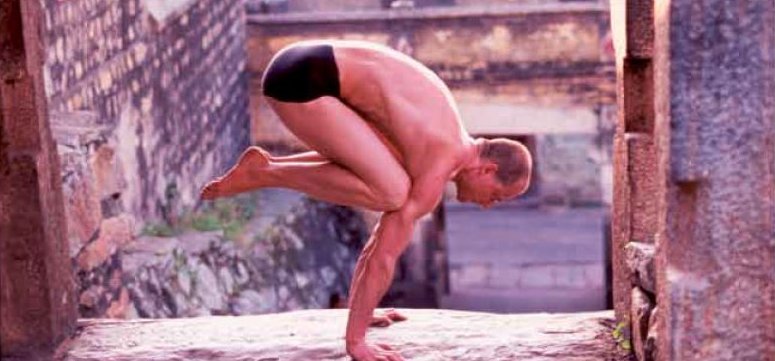
In the West, the possibly most well-known aspect of yoga practice are the physical exercises and position which create harmony in the physical body. In the Aṣṭāṅga Yoga practice system, a large number of positions (asanas) are grouped into six practice series which progressively become more difficult.
Ujjayi:
The audible, rustling breath is surely one of the most striking aspects of Aṣṭāṅga Yoga. The breath defines the rhythm for the movements and also serves as a help to stay focused. Breath and thoughts are linked. When the breath is brought into a calm, steady rhythm, our thoughts likewise become calmer.
Kumbhaka:
Once the steady flow of breath has been established, advanced practitioners deliberately interrupt this rhythm in some positions and seating exercises.They hold their breath to guide the subtle energy (prana) through the body.
Vinyasa:
In Aṣṭāṅga Yoga, the characteristic dynamics develop when breath and movement come together. This is the basis for a meditation in motion because it helps us to keep our focus in the moment. Even though each movement follows other paths and rules, the steady breath always forms the underlying basis, which strives towards balance both as far as speed and intensity are concerned.
Bandha:
Etymologically speaking, the German word "Band" (ribbon, tie), is connected with the term bandha. Just like a ribbon, the techniques of bandha guide the energy through the energetic body. This mainly happens by way of concentration and power of imagination. Subtle muscle contractions, the physical effect of bandha, facilitate concentration and form the basis for the correct alignment of the body in different positions.
Dṛṣṭi:
Focus and concentration points complete the techniques of Aṣṭāṅga Yoga. All sensory organs are closed off from the external world – far away from all distractions, one starts to move in a state of focus and unity.
From the mat into life
Trained bodies, exhausting positions and acrobatic movement sequences – with this description, Aṣṭāṅga Yoga is often reduced to the merely physical. This is only the surface, though; what is often overlooked is the fact that the physical practice only serves as a practice field to experience a kind of wisdom that will ultimately permeate our entire life. Life permanently confronts us with new tasks and challenges. For us, this means constantly having to find the right measure and to retain our inner harmony. If our practice on the mat is too easy, this will, in everyday life, have the result that we're not prepared for certain tasks. It is only the intensive, challenging practice which can serve as a practice field for those demands. At the same time, however, there's no need to worry: Aṣṭāṅga Yoga always offers new positions and movements in which it becomes difficult to find inner balance. The practice series are designed in a way to lead as to the point of the seemingly impossible where we experience our physical limits – it is here that work on our yoga path begins. The possibilities of finding new challenges are virtually unlimited: "Everybody can practice yoga – as long as they can breath“, as Kṛṣṇamācārya put it. An experienced teacher will put together the perfect, tailor-made practice for each student from the six traditional practice series, irrespective of whether they are old, young, athletic, less athletic, healthy or suffering from physical restrictions.
Dr. Ronald Steiner is a sports physician and teaches yoga nationwide in Germany. He teaches in the tradition of Aṣṭāṅga Yoga and is among the few yoga teachers authorized by both Pattabhi Jois and B. N. S..

Please log in to write a message. Go to login
No messages yet.