


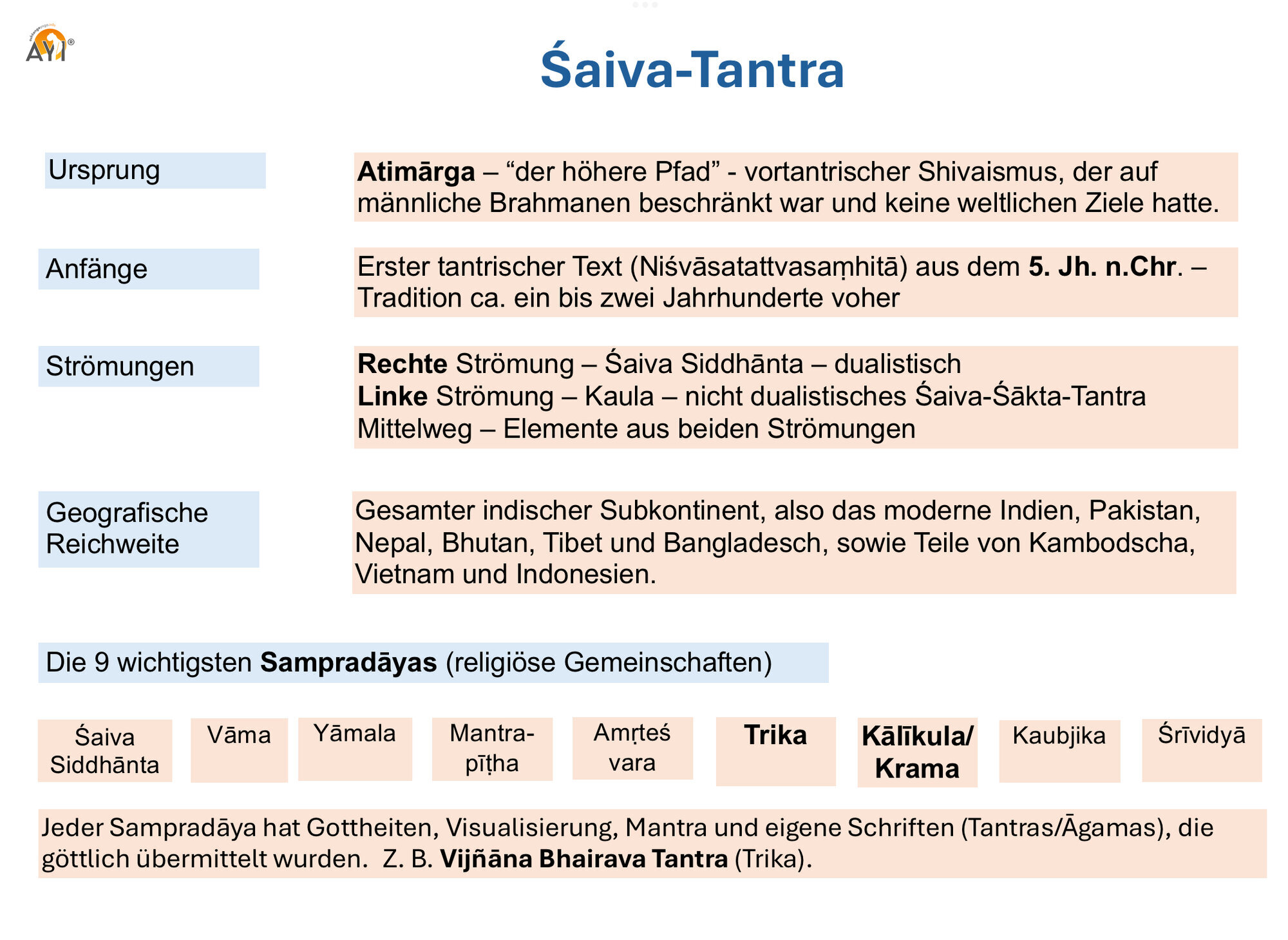
During this period, Śaiva Tantra developed in different directions, based on distinct philosophical and practical approaches:
The Right-Hand Current, Known as Śaiva Siddhānta
This rests on a dualist approach that distinguishes three eternally separate principles: God, the manifested universe and the individual soul. The universe is seen as a source of attachment and entanglement, while God liberates the soul — whose divine nature is concealed by embodiment — through grace. This grace leads a person to seek initiation from a guru. The mantras used in the ritual, revealed by God for this purpose, destroy most karma and guarantee liberation after death from the cycle of suffering and repeated death, Saṃsāra. The soul's innate divinity is thereby fully revealed, making it entirely equal to God while remaining separate from him.
Characteristic Features of Śaiva Siddhānta:
- Worship of Śiva without Śakti.
- The importance of ritual initiation for liberation.
- Acceptance of Vedic social norms.
Śaiva Siddhānta was the first tantric tradition to establish a clearly structured canon of scriptures and commentaries. It dominated the religious institutions of the Śiva tradition, such as temples and monasteries. From the 12th century onwards, under the influence of Advaita Vedānta, it turned towards a non-dualist approach.
The Left-Hand Current, Also Known as Kaula (from Kula, “Family”)
This has roots in an equally ancient but more popular layer of Indian religion: a shamanic and visionary world concerned with appeasing nature goddesses and animal-headed yoginīs. The highly educated followers of the 9th century did not reject shamanic practices, but reinterpreted them as expressions of inner processes of consciousness.
The left-hand current is also known as Kaula, “of the family”, from kula. This refers to the host of goddesses whose worship is its focus. Unlike the right-hand current, Kaulas sought liberation within the present lifetime, or jīvanmukti, cultivating insight and yoga through powerful spiritual experiences. As a practice-based lineage, it taught the use of sensory experience as a springboard into divine presence.
Essential Features of Kaula:
- Worship of female and “wild” deities.
- The goal of liberation during life, jīvanmukti.
- Rejection of strict ritual obligations, despite performing certain ceremonies.
- Challenging social norms, for example through the empowerment of women and transgressive rituals.
Kaula is primarily a non-dualist Śiva-Śakti tradition, less institutionalised than the right-hand current.
The Middle Way of Tantrism
Between these two main currents were several schools representing a kind of middle way that combined elements of both. This tradition's central text, the Svacchandatantra, is impressive for its comprehensive accounts of cosmology and yogic practices. It contains many valuable teachings that were later incorporated into the Trika tradition, discussed below.
6th–11th Centuries: The Nine Most Important Sampradāyas
Over roughly 500 years, from about 600 to 1100 CE, different religious groups, or sampradāyas, emerged within Śaiva Tantra. Their main differences lay in the deities they worshipped, their practices and their symbolism. They also included both dualist and non-dualist approaches. The nine most important sampradāyas are presented below in the order in which they emerged:
- Śaiva Siddhānta (right-hand current)
- Emphasis on dualist theology, ritual initiation and Vedic norms.
- A clearly defined canon of text collections and commentaries.
- Strong institutional presence in temples and monasteries.
- Vāma
- Part of the left-hand currents.
- Goddess worship and the use of transgressive rituals.
- Had already died out before tantric culture reached its height.
- Yāmala
- An early tradition dating from the 6th century.
- Intense death symbolism and transgressive practices at cremation grounds.
- Strong shamanic roots.
- Mantrapīṭha
- Takes a middle path between the left- and right-hand currents.
- Principal text: the Svacchandatantra, without a clearly defined philosophy.
- Focuses on tantric practice and cosmology.
- Amṛteśvara
- Worships Amṛteśvara, a form of Śiva as conqueror of death, also called Mṛtyuñjaya-Śiva.
- Followers did not have to commit themselves to a single deity.
- The Amṛteśvara mantra plays a central role.
- Trika
- Often called Kashmir Śaivism, although it was pan-Indian.
- Worships three goddesses — parā, aparā and parāparā — and places great emphasis on comprehensive philosophy.
- An important text is the Vijñāna Bhairava Tantra.
- The basis for Abhinavagupta's later Śaiva works.
- Kālīkula, Especially Krama
- Worship of the goddess Kālī, whose ultimate nature is formless, not to be confused with the Bengali goddess of destruction.
- The most radical, feminine, transgressive and non-dualist Śaiva tantric group.
- Later merged with the Trika school through Abhinavagupta's teachings.
- Kaubjika
- Worship of the complex goddess Kubjikā.
- Connections with Trika and Śrīvidyā.
- An important text, the Kubjikā-mata-tantra, is a source for the cakra system and Kuṇḍalinī techniques that continue into the present day.
- Śrīvidyā / Traipura
- Worship of the goddess Tripurasundarī, also known as Lalitā.
- Focus on practices that enhance the joys of life.
- The only sampradāya to have survived to the present day; it later entered the non-tantric Vedānta tradition.
- Its practices were adopted by the Nātha-Sampradāya, the guru lineages of Matsyendra and Gorakṣanātha, and thus entered Haṭha Yoga.
Considering the sampradāyas in relation to the right- and left-hand currents mentioned above gives the following picture. The further to the left a sampradāya stood, the more it emphasised these features:
- Non-dualism.
- Goddess worship.
- The inclusion of women.
- Transgression of social norms.
- Symbolism associated with death and dying.
- Charismatic gurus.
At the far right of the spectrum, almost none of these features appear. In the middle are groups that display some but not others.
Accordingly, the principal sampradāyas can be arranged from right (1) to left (5) as follows:
- Siddhānta: Conservative, dualist and ritualistic.
- Mantrapīṭha: A middle way, with minimally transgressive practice and no clearly defined philosophy.
- Śrīvidyā / Traipura: Goddess worship, transgressive elements and practices that enhance enjoyment of life.
- Trika: Primarily non-dualist, worshipping three goddesses, with women as fully recognised practitioners.
- Krama: Transgressive, feminine and radically non-dualist.
All the sampradāyas draw on the scriptures mentioned above, Tantras or Āgamas, and on their own deities, practices and mantras. The anonymously authored scriptures are regarded as transmitted by Śiva himself, or, in the case of Krama, by Śakti herself. These texts were often mysterious and elliptical in their wording, focusing more on practice than philosophy. One prominent example among many is the Vijñāna Bhairava Tantra of the Trika tradition, which describes 112 practices leading to direct experience of divine or universal consciousness, Vijñāna Bhairava.
The nine sampradāyas of Śaiva Tantra should be understood as parts of a whole rather than in isolation. This is already apparent in their followers' view of all tantric scriptures as expressions of a unified consciousness arising from the five faces of the one Śiva.
Over time, Śaiva tantric literature became increasingly complex, giving rise to what is called a second phase of tantric writing.
9th–11th Centuries: The Second Phase of Tantric Writing
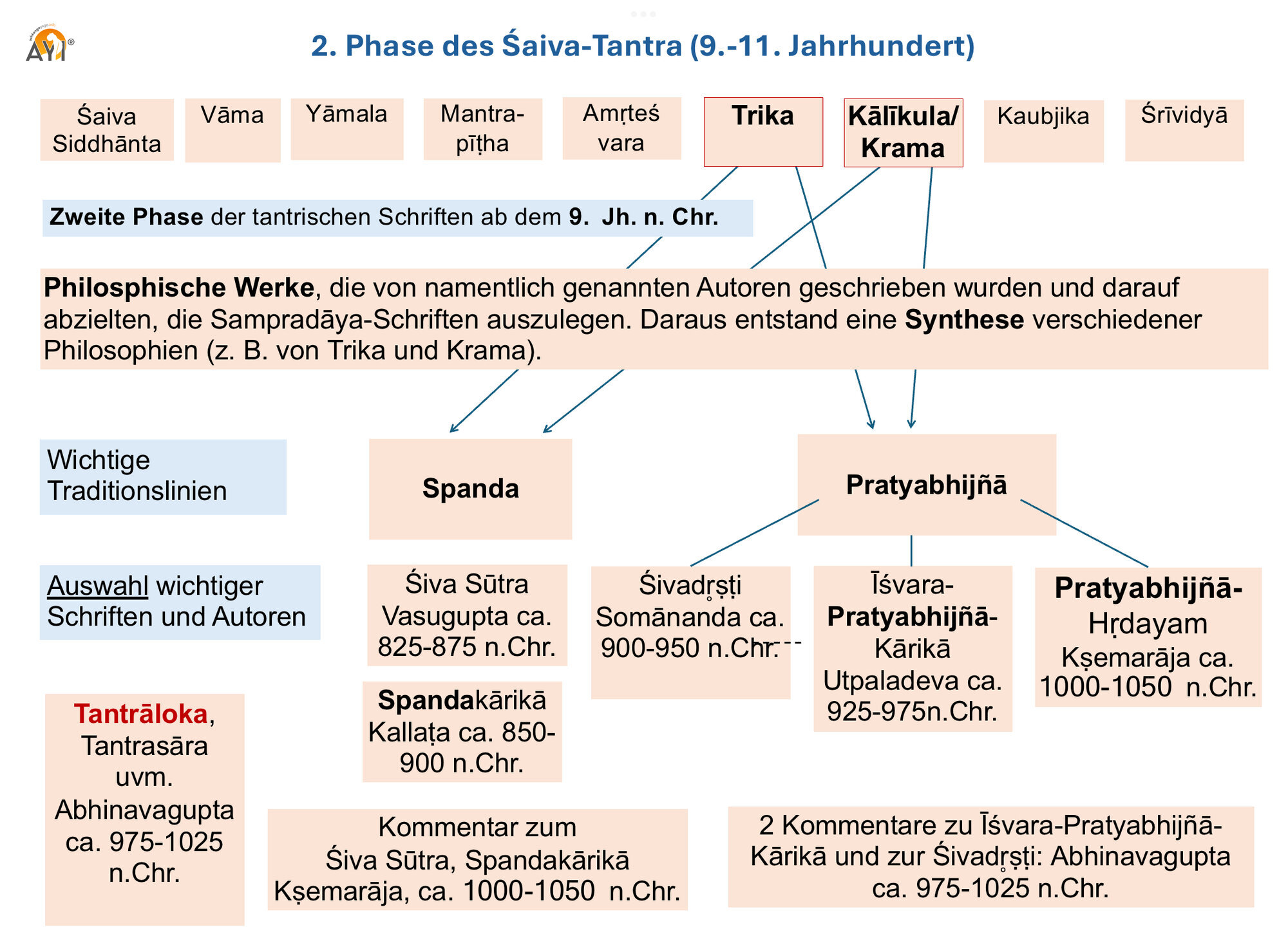
While the sampradāya texts of the first phase were anonymous and regarded as divinely revealed, the second phase consists of works by named authors. These writers were often highly educated and used a notably sophisticated and artful Saṃskṛt style. Their works sought to explain and interpret the original texts while also displaying a strongly philosophical orientation or an elaborate theology.
These authors incorporated the prevailing theories of knowledge and logic of their time, developing coherent systems that combined reason, scriptural authority and personal experience. Their works addressed not only other Śaivas but also followers of other traditions and students, making them influential both intellectually and spiritually.
The Importance of Trika and Krama in Kashmir
During this phase, the Trika and Krama schools gained importance in Kashmir. Their initiates included learned masters and people associated with the royal court. Through their works, these highly educated scholars brought the two schools great prestige and philosophical depth. Some were regarded as fully liberated and awakened spiritual masters. Their words were considered especially powerful and illuminating, offering a unique insight into the nature of reality. Over time, their explanations and commentaries came to be valued as highly as the original scriptures on which they drew.
The Trika school, often known as Kashmir Śaivism, focuses on the worship of three goddesses. Its most important representative, the polymath Abhinavagupta, came from the Kashmir Valley, and his work made the school widely known. Like most Śaiva traditions, however, Trika was widespread across India and was not restricted to Kashmir.
The Krama tradition, a group within the Kālīkula sampradāya, was known for its radical and progressive approaches. The name Krama means “process” or “sequence”, reflecting its veneration of the different stages of thought as manifestations of the goddess Kālī. Krama combined profound philosophical ideas with transgressive methods, challenging the social norms of its time. Despite its unconventional practices, the school gained considerable recognition in Kashmir and attracted influential followers, including royal ministers.
The close interaction between the two currents led to a gradual merging that reached its height in this second phase of tantric texts. In the works of Abhinavagupta in particular, the profound ideas and practices of both schools came together in an integrated teaching that decisively shaped the later direction of Śaiva Tantra.
Spanda and Pratyabhijñā: Two New Schools
Two important transmission lineages emerged during this second phase of Tantrism: the Spanda and Pratyabhijñā traditions.
The Spanda Lineage
In composing their works, the spiritual masters of the Spanda lineage, meaning vibration or pulsation, drew on both Trika and Krama. They thereby advanced a synthesis that had already begun within the scriptures themselves. The earliest and most original of these master-philosophers was Vasugupta (c. 825–875 CE). He revealed the text known as the Aphorisms of Śiva, the Śiva Sūtras. His student was Kallaṭa (c. 850–900 CE), whose major work is the Verses on Pulsation, the Spandakārikās. Several commentaries on both works were written much later by other authors. The central concept is that God is none other than the vibrating pulsation of consciousness, moving through successive phases of expansion and contraction.
The Pratyabhijñā Tradition
The Pratyabhijñā tradition was founded by Somānanda (c. 900–950), who wrote the Śiva-Dṛṣṭi, the Vision of Śiva. Its followers emphasise the liberating power of recognising, or pratyabhijñā, one's own true nature as Śiva. Somānanda's student, the great siddha master Utpaladeva (c. 925–975), is best known for his principal philosophical work, the Īśvara-pratyabhijñā-kārikā, Verses on Recognising the Divine. This work, which gave the tradition its name, is demanding and rich in both philosophical and mystical passages.
Abhinavagupta (c. 975–1025) wrote a commentary on the Śiva-Dṛṣṭi and two extensive commentaries on the Īśvara-pratyabhijñā-kārikā, which are fundamental to the transmission of the Pratyabhijñā tradition. He is one of India's greatest philosophers, mystics and aestheticians, and the foremost representative of non-dual Śaivism. He brought together earlier traditions, especially Trika and Krama, and profoundly influenced later developments. Alongside his formative contributions to the interpretation of Śaiva philosophy, he wrote important works on aesthetics, including the Abhinavabhāratī commentary on the Nāṭyaśāstra.
His principal work, the Tantrāloka, Light on Tantra, is a comprehensive account of tantric philosophy and practice in more than 5,800 verses. It is not merely a reference work, but a synthesis that integrates the diversity of tantric scriptures into a coherent, holistic system. Abhinavagupta bridges contradictions between texts composed for different contexts, creating an understanding of Śaiva Tantra that is both clearly structured and complex.
Abhinavagupta's student and successor, Kṣemarāja (c. 1000–1050), was almost as prolific as his teacher. He wrote influential commentaries from a non-dual perspective on the major Śaiva scriptures of the period, including the Svacchandatantra, the Śiva Sūtras and the Spandakārikās, as well as several independent works. He also composed the Pratyabhijñā-Hṛdayam, consisting of just 20 concise sūtras with his own commentary. This valuable work clearly and accessibly summarises the teachings of Utpaladeva's Īśvara-pratyabhijñā-kārikās for readers who are spiritually inclined but not trained in the rigorous discipline of logical philosophy. Śaiva masters in Kashmir continue to teach the Pratyabhijñā-Hṛdayam today.
From the 12th Century: Śaiva Tantra after Its Height
After Śaiva Tantra's flourishing period, roughly 800–1200 CE, known as classical Tantra, conditions changed substantially. The rise of Islam led to the dissolution of its institutional base and thus the end of financial support for Śaiva tantric traditions. Important developments included:
- A “Shift to the Left”
As central temple and monastic structures lost importance, decentralised, “left-hand” Kaula lineages moved to the forefront of the tradition. - Transgressive Practices
Over time, Kaula groups became increasingly associated with body-oriented and transgressive practices. - Wandering Sādhus
Wandering, renunciant, ascetic tantric yogīs became the principal bearers of the tradition. - Tantra's Reputation
Public demonstrations of “magical” rituals aimed at worldly goals, alongside opaque practices that were rarely systematically documented, damaged Tantra's public standing. - Declining Numbers of Women Practitioners
The tradition lost an important balance as the proportion of women, once an essential part of tantric traditions, steadily declined.
From the 12th Century: The Emergence of Haṭha Yoga
Among wandering ascetic yogīs, the Nātha-Sampradāya, a Śaiva monastic order with Kaula tantric roots, was particularly important. Its legendary gurus Matsyendra and Gorakṣanātha are associated with many teachings and texts of Haṭha Yoga.
Among other things, they practised tantric rituals and yogic methods for awakening Kuṇḍalinī energy, which originally emerged from two sampradāyas: Śrīvidyā and Kaubjika. Many other elements of tantric texts, such as cakras, nāḍīs and prāṇas/vāyus, also appear in Haṭha Yoga texts. Non-dualist Śaiva Tantra thus became one of the many sources of Haṭha Yoga.
From the 14th Century: Late Tantra
Between 1400 and 1800 CE, late Tantra entered a syncretic phase largely without philosophy. Texts from southern and eastern India document this orientation, which focused almost exclusively on practice, or sādhanā. Mantra, yantra and visualisation were central, used to embody the powers of a particular deity. Unlike the classical tantric tradition, in which the deity is understood as an overarching divine unity, the deity here serves only the attainment of specific worldly goals.
The Diverse Legacy of Modern Tantra
During the colonial period, tantric scriptures and rituals remained highly valued among Śākta Brahmins in Bengal. The many books of Sir John Woodroffe, writing as Arthur Avalon, made them known worldwide and profoundly shaped modern understanding of Hindu Tantra.
In the postcolonial era, transnational movements such as Siddha Yoga, Ānanda Mārga and Sahaja Yoga emerged, explicitly emphasising Tantra, while philosophers such as Śrī Aurobindo interpreted it in philosophically profound ways. Osho's lucrative global Neo-Tantra movement gives the impression of continuing the left-hand tantric current, but is only a kind of modern imitation. The association between Tantra and New Age thought dates back to the 19th century and was initiated by the Theosophical Society.
Hinduism today has distanced itself from its tantric roots because Tantra often carries negative associations. While almost all tantric traditions lost influence or fell into disrepute during the 20th century, traditional tantric systems such as Śrīvidyā and so-called Kashmir Śaivism experienced a form of revival.
Despite the distance modern yoga shows from its original tantric roots, the connection remains, for example through the legends of Gorakṣa and Matsyendra. Today's yoga practice still contains elements that derive from tantric sources, such as the cakra system and certain meditation techniques. For yoga practitioners interested in spirituality, classical Śaiva Tantra continues to offer deep insight into the philosophical and ritual roots of their own practice.
Sources
Goodall, Dominic & Isaacson, Harunaga: “Tantric Traditions.” In: Jessica Frazier (ed.), The Continuum Companion to Hindu Studies, London: Continuum, 2011.
Hatley, Shaman: “Tantra (Overview).” In: Brill’s Encyclopedia of Hinduism, Volume 6, Leiden: Brill, 2015.
Sanderson, Alexis: “Śaivism and the Tantric Traditions.” In: S. Sutherland, L. Houlden, P. Clarke & F. Hardy (eds.), The World’s Religions, London: Routledge, 1988.
Wallis, Christopher: Tantra Illuminated: The Philosophy, History, and Practice of a Timeless Tradition. San Rafael, CA: Mattamayūra Press, 2013.
Header image: Open AI


Please log in to write a message. Go to login
No messages yet.