


The oldest known composition of this kind is the Ṛgveda, “The Knowledge of the Verses”. Indologists date its composition to around 1500 BCE. Individual hymns may be several centuries older [WITZEL 2007]. The Ṛgveda was transmitted entirely orally for thousands of years.
In the 5th century BCE, the linguist and grammarian Pāṇini examined the grammar and phonology used in Saṃskṛt up to that point. His observations formed the basis of his rules for grammar and pronunciation, regarded as the oldest grammar of all. These, too, were initially passed on entirely orally.
The linguist Stahl considers Pāṇini's theory of “morphological analysis” substantially more advanced than any comparable Western linguistic theory before the 20th century CE [STAHL 1988:47].
From Language to Writing
Saṃskṛt acquired a written form much later. The development of its scripts is complex and branching, with more than a dozen intermediate stages.
This article focuses on the main stages in the development of Indian writing:
- Brāhmī, the oldest script: 3rd century BCE
- Kuṣāṇa-Brāhmī: 2nd–3rd centuries CE
- Gupta script: 3rd century CE
- Nāgarī: 7th century CE
- Devanāgarī, which remains in use today.
Our aim is to make the key developments of today's most widely used script for Saṃskṛt both visible and understandable.
An Imperial Commission: Brāhmī Script
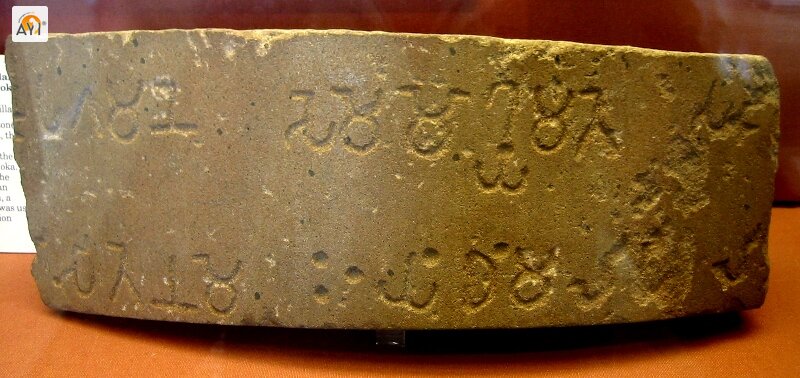
In the 3rd century BCE, Emperor Aśoka systematically conquered ever larger territories until his empire covered almost all of India. A writing system was needed to spread news of his conquests, as well as the Buddhist faith, throughout the empire.
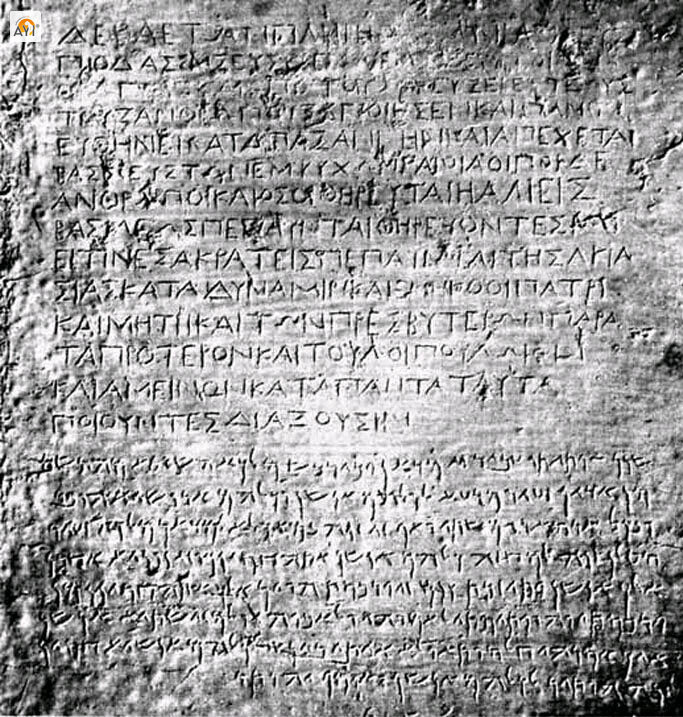
It is thought that Brāhmī, which emerged at that time, was deliberately commissioned by the emperor. Indian scholars appear to have developed a new script systematically at his request, drawing on models from other countries. The resulting Brāhmī script was inspired by Aramaic, Phoenician and Greek writing.
Aśoka had pillars with lion capitals erected throughout India to proclaim his edicts across the empire. Many of these texts have survived to the present day (Figure 1).
Although the script is consistently Brāhmī, several languages often appear together on a single pillar. Pali, Aramaic, Greek and Magadhi were widely used in the empire and are represented in these inscriptions (Figure 2).
An Unexpected Discovery in the Turfan Collection: Kuṣāṇa-Brāhmī Script
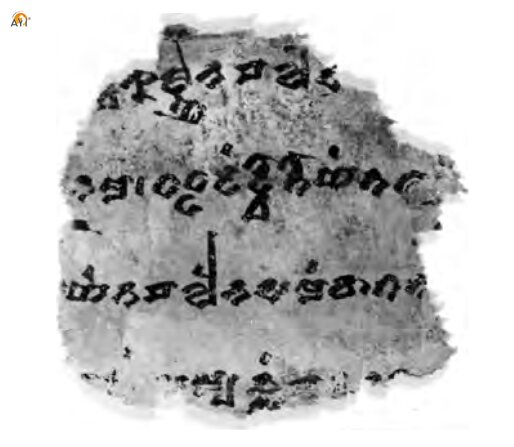
In 1906, the German Indologist Professor Moritz Spitzer made a remarkable discovery: the oldest written document in the Saṃskṛt language. It dates from the 2nd–3rd centuries CE and is written in Kuṣāṇa-Brāhmī, a development of Brāhmī script.
The manuscript discovered by Professor Spitzer consists of 1,000 fragments, most of them very small. They deal mainly with philosophical topics such as the Buddha's omniscience. They also include extracts from the Upaniṣads, Vaiśeṣika theory concerning the basic constituents of matter (guṇa), and a refutation of a personified God [FRANCO 2004: 21-29].
Many Buddhist texts are written in Kuṣāṇa-Brāhmī. Some of the oldest texts about the life, activities and teachings of the Tathāgata—the “Thus-Gone One”, or Buddha—have survived in this script. One example is the Daśabalasūtra, the “Discourse Listing the Ten Powers of the Tathāgata” (Figure 3).
All these manuscripts belong to the Turfan Collection, discovered during the German Turfan expeditions of 1902–1914. The collection comprises more than 40,000 manuscripts and manuscript fragments and is now held at the Berlin State Library.
The discovery of the Turfan manuscripts was a pivotal moment for Indology. Most of the texts reflect a Buddhist perspective, but they also address Christian Nestorian, Manichaean and secular subjects. Written in 16 languages and 26 scripts, they are valuable sources for researching the development of language and writing in India [ZATURPASKIJ 1912: 116-127].
A New Dynasty's Variant: Gupta Script
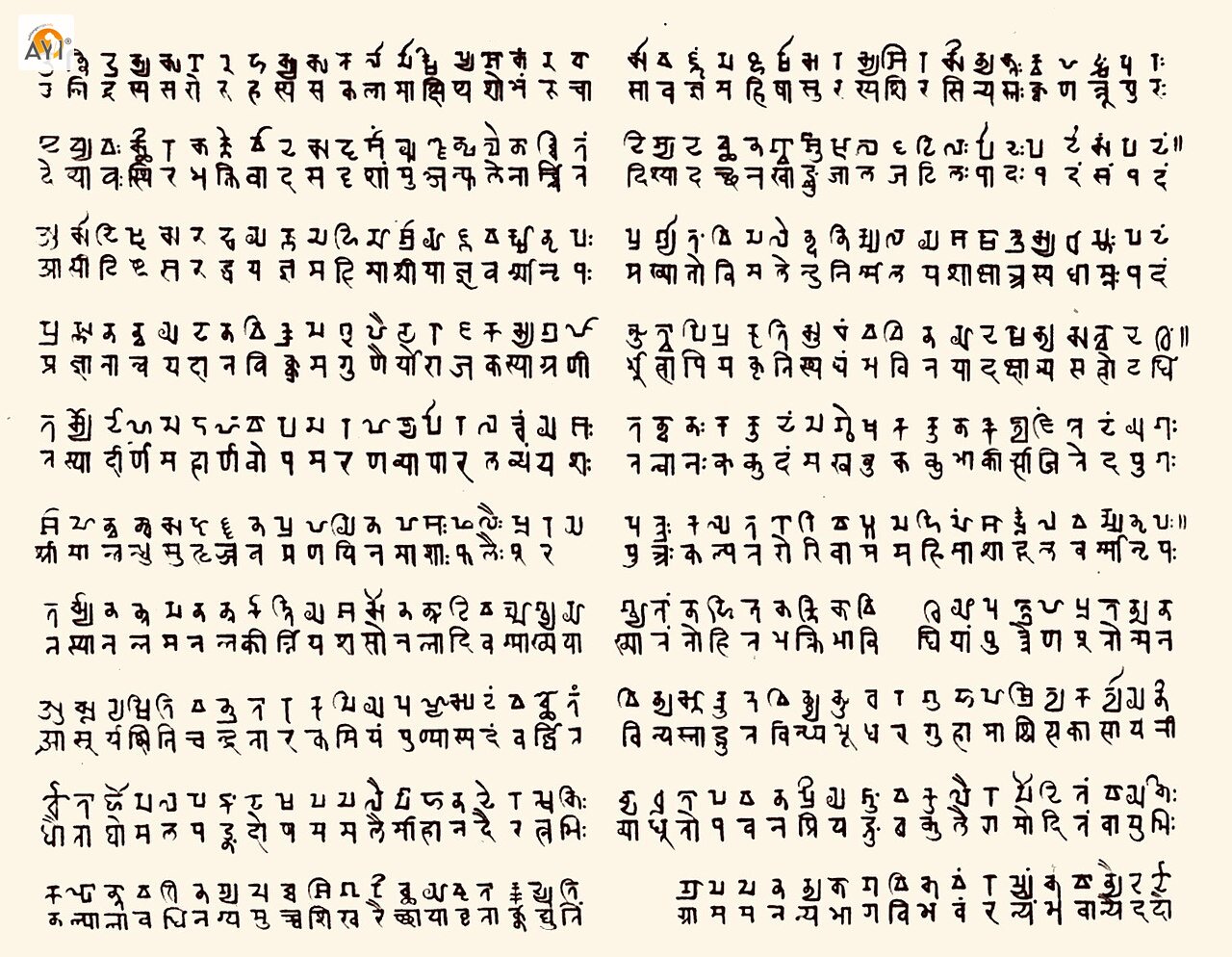
Two hundred years later, the Gupta dynasty spread across northern and central India. A new variant, Gupta script, developed from Brāhmī. Buddhism, which had dominated Aśoka's empire, was increasingly replaced by Hinduism.
This renewed interest in the old Vedic texts written in Saṃskṛt. Accordingly, from the 3rd century CE onwards, we find increasing numbers of written Saṃskṛt compositions in Gupta script. Its resemblance to the later Devanāgarī is already clear (Figure 4).
According to Srivastava, up to five variants of Gupta script were used in the Gupta Empire [SRIVASTAVA 1998]. Gupta script represents a transitional stage between Brāhmī and Nāgarī. Comparing the earlier and later scripts reveals a development that is easy to trace.
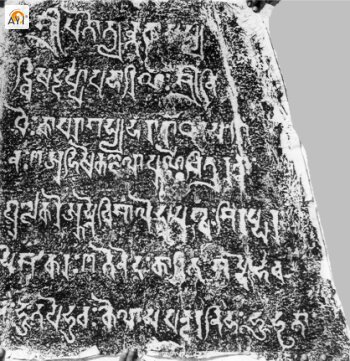
A New Development from the East: Nāgarī
Nāgarī developed from an eastern variant of Gupta script. Unlike Gupta script, scholars of the period used this new script almost exclusively for religious or philosophical texts in Saṃskṛt.
As Nāgarī developed, writing tools and materials became finer and more delicate. The characters consequently acquired more flowing lines. In form, Nāgarī was already close to the Devanāgarī script that developed from it.
The name “Nāgarī” probably derives from “Nāgara”, a title given to the city of Pāṭaliputra. Today, the city is called Pranta and is the capital of the Indian state of Bihar.
The oldest stone inscription in Nāgarī is in Gujarat. Indologists date it to between the 1st and 4th centuries CE. From the 7th century CE onwards, Nāgarī was widely used throughout India (Figure 5).
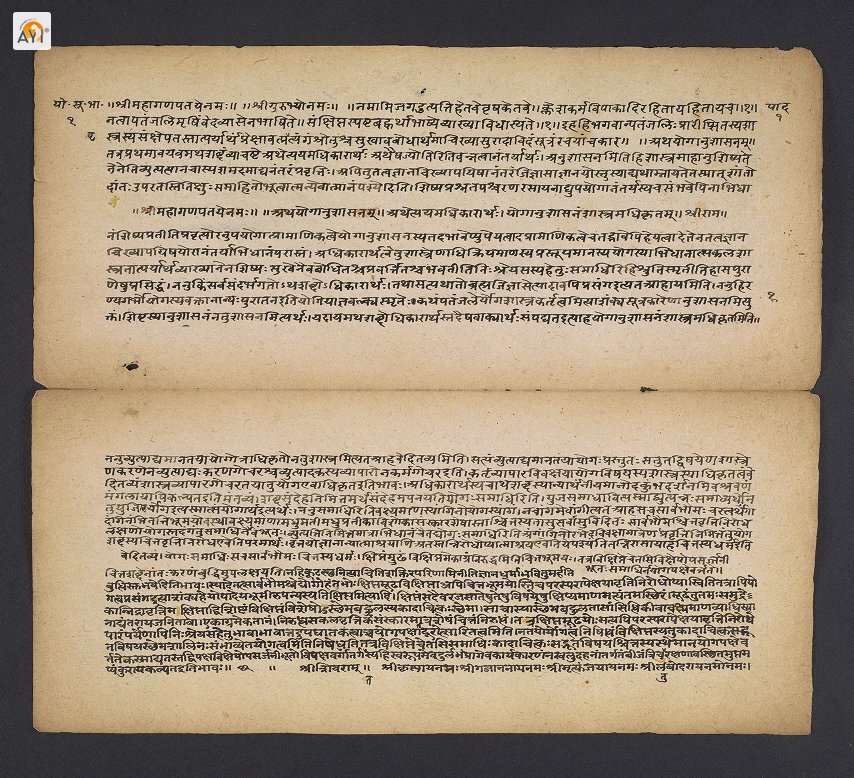
The Script Used Today: Devanāgarī
From the 11th century CE onwards, Devanāgarī developed from Nāgarī [MYLIUS 1988: 14]. It is particularly well suited to representing subtle differences in pronunciation precisely. Once familiar with Devanāgarī, readers find it relatively easy to read many of Saṃskṛt's distinctive sounds fluently.
The script is also compact, which is useful when writing on fragile palm leaves. Although beauty is subjective, many people find its curved arches and straight connecting lines beautiful. Writing itself was used as a meditative practice then, as it still is today. Devanāgarī had emerged as the script that remains widely used for Saṃskṛt (Figure 6).
One Script for Many Languages
Devanāgarī remains in use today and is India's most widespread script. As a precise phonetic script, it is suitable for more than Saṃskṛt alone. Today, it is commonly used for Hindi, Marathi, Nepali and many other regional languages of India.
A document written in Devanāgarī is therefore not necessarily in Saṃskṛt. If we can read the script, however, we can pronounce the text correctly. Understanding its meaning is the next step.
The Sounds of Saṃskṛt in Many Scripts
Conversely, several scripts have always been used alongside one another to represent the sounds of Saṃskṛt. Different regions of India developed their own scripts, which local people also used to write Saṃskṛt.
We do much the same in the West today, often writing Saṃskṛt in Roman letters. Our Roman alphabet has only 26 letters, while Saṃskṛt has more than 50 sounds. To record its pronunciation without losing distinctions, we therefore add special signs known as diacritics.
Devanāgarī is, in any case, the traditional means of representing the sounds of Saṃskṛt precisely. It is therefore well worth spending some time becoming familiar with the script.
Enjoy the meditative practice of writing and reading!
References
- Briggs, Rick: Knowledge Representation in Saṃskṛt and Artificial Intelligence. In: AI Magazine, Vol. 6. California: Moffet Field, 1985.
- Franco, Eli (Ed.): The Spitzer Manuscript. Verlag der österreichischen Akademie der Wissenschaften, 2004.
- Hartmann, Jens-Uwe; Wille, Klaus: Apotropäisches von der Seidenstraße: eine zweite 'Löwenhandschrift'. In: Franco, Eli (ed.): From Turfan to Ajanta : Festschrift for Dieter Schlingloff on the Occasion of his Eightieth Birthday. Vol. 1. Bhairahawa, Rupandehi: Lumbini International Research Institute. pp. 365–388, 2010.
- Mylius, Klaus: Geschichte der altindischen Literatur. Bern: Fischer Scherz, 1988.
- Schneller, Julius: Kenntnis und Wissenschaft im Ursprung: Sprache - Saṃskṛt. In: Conversationsblatt. Zeitschrift für wissenschaftliche Unterhaltung, Vol. 6, pp. 1057–68, 1821.
- Staal, Frits: Universals: studies in Indian logic and linguistics. University of Chicago Press, 1988.
- Srivastava, Anupama: The Development of Imperial Gupta Brahmi Script. New Delhi: Ramanand, 1998.
- Witzel, Michael & Goto, Toshifumi: Rig-Veda: Das heilige Wissen, Erster und zweiter Liederkreis. Verlag der Weltreligionen, 2007.
- Zaturpanskij, Choros (i. e. A. v. Le Coq): Reisewege und Ergebnisse der deutschen Turfanexpeditionen, Orientalisches Archiv 3, pp. 116–127, 1912.
Image Credits
- Cover image: Folio 1a of Yogasārasaṅgraha by Vijñānabhikṣu, Ms. M-5553, Lalchand Research Library, www.dav.splrarebooks.com/collection/view/Yogasarasamgrahah (accessed: 11 September 2019)
- Figure 1: de.wikipedia.org/wiki/Edikte_des_Ashoka (accessed: 1 July 2018)
- Figure 2: de.wikipedia.org/wiki/Edikte_des_Ashoka (accessed: 1 July 2018)
- Figure 3: Hartmann, Jens-Uwe; Wille, Klaus: Apotropäisches von der Seidenstraße: eine zweite 'Löwenhandschrift'. In: Franco, Eli (ed.): From Turfan to Ajanta : Festschrift for Dieter Schlingloff on the Occasion of his Eightieth Birthday. Vol. 1. Bhairahawa, Rupandehi: Lumbini International Research Institute. p. 370, 2010.
- Figure 4: en.wikipedia.org/wiki/Gupta_script (accessed: 1 July 2018)
- Figure 5: www.tnarch.gov.in/epi/ins5.htm (accessed: 1 July 2018)
- Figure 6: dla.library.upenn.edu/dla/medren/detail.html (accessed: 20 June 2018)


Please log in to write a message. Go to login