
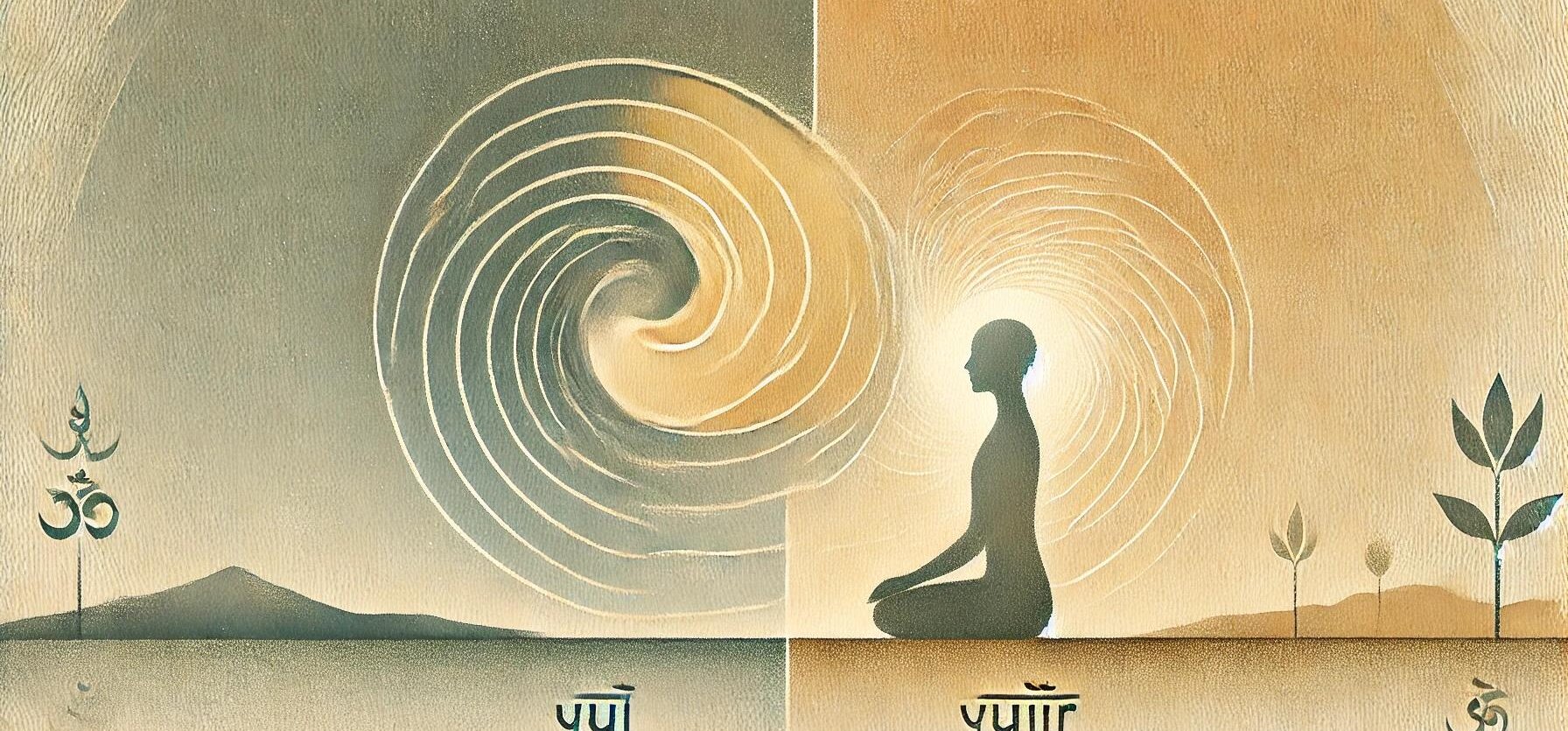

This perspective aligns well with the Sāṃkhya philosophy, a dualistic system that views puruṣa (pure consciousness) and prakṛti (matter/nature) as fundamentally distinct. Sāṃkhya also serves as the philosophical foundation for the Yoga Sūtra and the more elaborate Yoga Śāstra of the sage Patañjali.
These texts emphasize the “separation” of puruṣa and prakṛti. Puruṣa represents pure, unchanging awareness, while prakṛti encompasses all external and internal phenomena (nature, thoughts, emotions). The terms draṣṭā (the Seer) and dṛśya (the Seen) further illustrate this distinction: Only when one realizes oneself as the draṣṭā does one cease to identify with the dṛśya.
Liberation (kaivalya) is achieved precisely through this detachment from all objects and experiences. True freedom is realized when the Seer understands that they are not what they perceive.
Practical Application:
Those who approach yoga from a Sāṃkhya perspective focus on letting go of everything that does not belong to the true self. In practice, this means observing distracting thoughts or attachments without identifying with them. Concentration (dhyāna) is used to gain clarity about one's essence and to detach from both external and internal distractions. This “separation from the non-essential” ultimately serves to recognize pure consciousness as the unchanging core of one’s being.
Which Interpretation is Correct?
A Linguistic Analysis
The Saṃskṛt root yuj has several variations. In addition to yuj, we find forms such as yujir and yunch, each carrying slightly different nuances (e.g., "to control," "to concentrate," "to detach"). Notably, the verbal root yujir does exist with the meaning "to separate" or "to disengage."
Despite these variations, Saṃskṛt philology largely agrees that yoga is primarily derived from yuj, meaning "to connect," "to yoke," or "to harness." This widely accepted scholarly interpretation is supported by extensive philological evidence, suggesting that "union" is the original meaning of yoga.
A Philosophical Analysis from the Sāṃkhya Perspective
At first glance, the meaning of "union" seems to contradict Sāṃkhya philosophy, which is fundamentally based on separation. However, within sāṃkhya–yoga, the process of attaining clarity about pure consciousness (the Seer) involves separating everything that does not belong to the true self. In this sense, puruṣa is ultimately "separated" from everything that is non-self—but this very separation is understood as the highest form of union with the true self.
References
Böhtlingk, O., & Roth, R. (1855–1875). Saṃskṛt-Wörterbuch (Vols. 1–7). St. Petersburg: Kaiserliche Akademie der Wissenschaften.
Williams, M. (1899). A Saṃskṛt-English dictionary: Etymologically and philologically arranged with special reference to cognate Indo-European languages (New ed., greatly enlarged and improved). Clarendon Press.
Whitney, W. D. (1885). The roots, verb-forms, and primary derivatives of the Saṃskṛt language: A supplement to his Saṃskṛt grammar. Leipzig: Breitkopf & Härtel

Please log in to write a message. Go to login
No messages yet.