
Guruji, red
Guruji, red

Pioneers of Aṣṭāṅga Yoga (Part 2/3)

Today, almost every German city has at least one school connected with the Aṣṭāṅga Yoga tradition. The yoga shaped and taught so influentially by Pattabhi Jois has also found a home in other Western countries.

Dr. Ronald Steiner Dr. Ronald Steiner
1948-1964
The beginnings of the Aṣṭāṅga Yoga Research Institute in Mysore

Continue reading

Pattabhi Jois only spoke broken English. He spent four years writing his only book - with the English translation following as long as 37 years later. As a student at the Saṃskṛt College at Mysore, he earned a meagre living by teaching yoga classes for his fellow students. Nevertheless, yoga always played the most important role in Pattabhi Jois's life. Whenever he entered the room, I immediately felt his enthusiasm for yoga practice and the motivation with which he wanted to share yoga with us pupils. A look at the life of Guruji, as his students affectionately called him, can help us understand this.

The development of a practice system

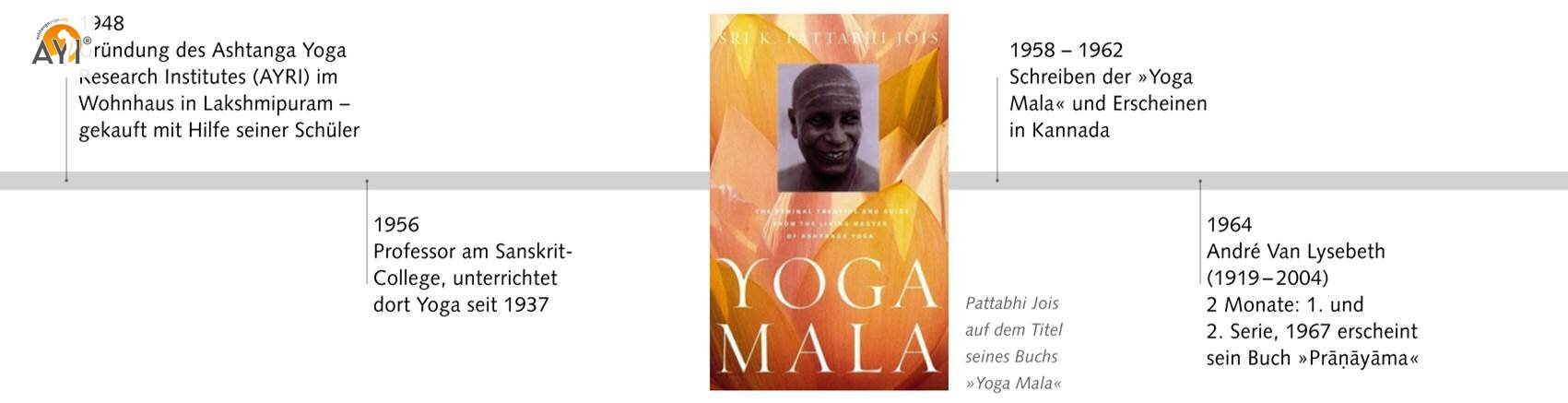
With his students' financial help, Pattabhi Jois was able to purchase a small house with only two rooms in Mysore’s Lakshmipuram district in 1948. It was there that he founded the Aṣṭāṅga Yoga Research Institute, in short AYRI. Classes were taught in the living room. Pattabhi lived a simple, disciplined life, taught with great enthusiasm and worked long hours: classes started at 04.30 in the morning and, with the exception of days of the full moon and the new moon, he also taught classes in the evening. In his teaching, he focused on the therapeutic benefit of the exercises. Therefore, he paid great attention to the individual needs and conditions of his students and helped each person develop an individual practice. Many renowned personalities from Mysore learned from Pattabhi and even doctors referred patients to him for yoga therapy.

In 1956, the financial situation of the Jois family finally improved. Pattabhi was given the rank of a professor at the Mysore Saṃskṛt College and also received better pay for his yoga classes there. Two years later, in 1958, he started writing a book with the title »Yoga Mala«, with mala translating into garland or prayer beads.

The positions of the practice system taught by Pattabhi Jois are structured like the beads of a mala. In this context, breath-linked postures connect the individual positions in what is known as the Vinyāsa system. The Yoga Mala was published in 1962 and, with only minimal deviations, describes the first practice series as it is still practised in Aṣṭāṅga Yoga today. It is called Yoga Cikitsa, which translates into yoga therapy.

1971-1975
The first Americans come to Mysore to learn Aṣṭāṅga Yoga with Sri K. Pattabhi Jois.

How attention in the West turned to Pattabhi Jois

It was a small picture in one of many yoga books that was to start a revolution bringing Americans and Europeans to India to Pattabhi Jois and Aṣṭāṅga Yoga to the West. It was triggered by a visit by the Belgian André van Lysebeth to Pattabhi Jois’s small yoga school in Mysore in 1964. Drawing upon extensive previous knowledge in yoga and Sanskrit, he was highly interested in the practice system and spent two months with Pattabhi Jois. It is said that André learned the first and second series of Aṣṭāṅga Yoga during this time. The Second Series is called »Nāḍī Śodhana«, cleansing of the energy channels. Unfortunately, we don't know to what extent the practice system learned by André corresponded to the second series established in Aṣṭāṅga Yoga today.

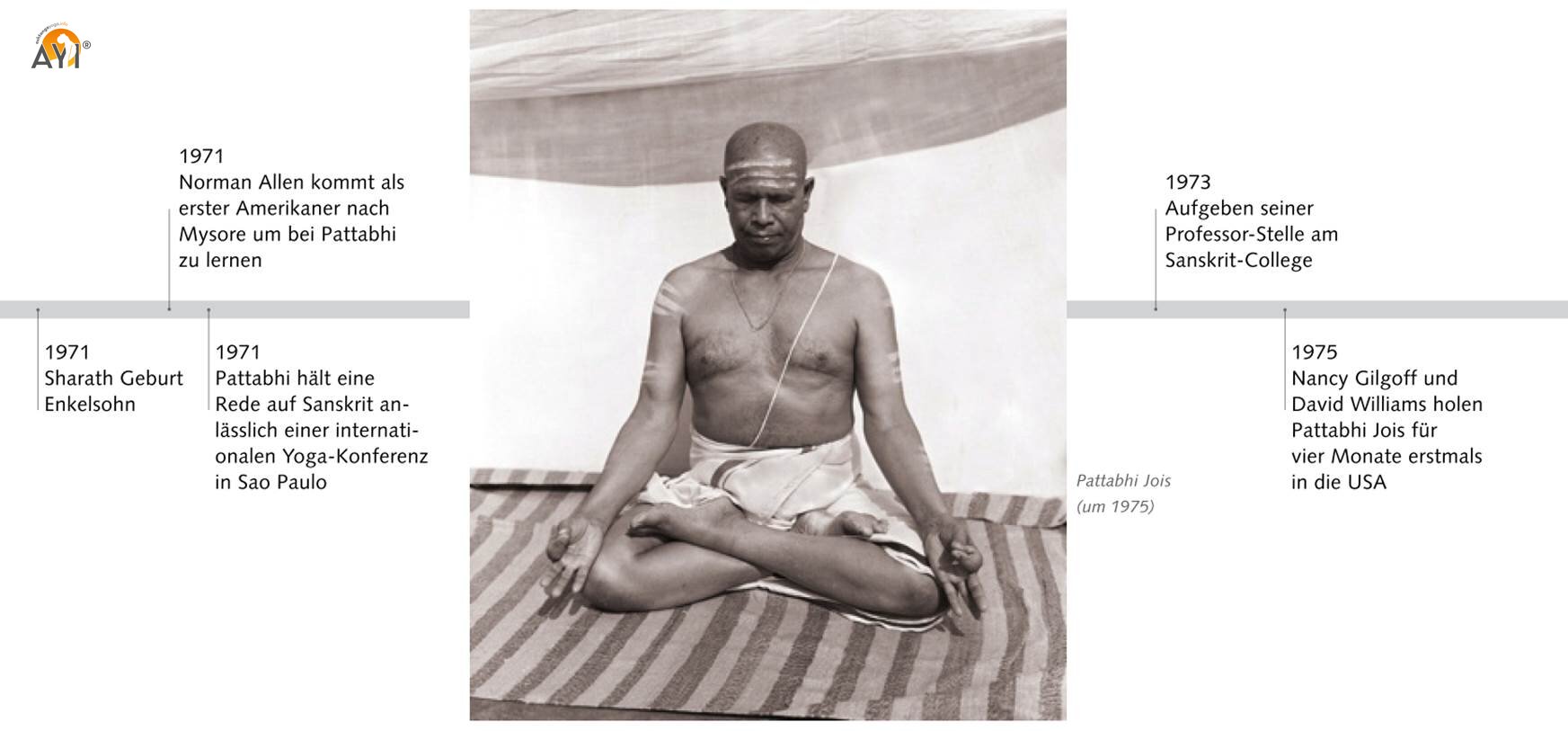
It was approximately at the same time that Pattabhi Jois expanded his small house to create a separate yoga room, where at least twelve students could practice and which freed him from having to use his living room for classes. Among the many books written by André van Lysebeth in the following years, one bears the title »Prāṇāyāma«; it was written directly after his time with Jois. The book also contains a picture of the guru, together with his name and his address. In this way, the name Pattabhi Jois slowly spread throughout the Western world but mainly in Europe. Among the first Westerners to travel to India to meet Pattabhi, many were Europeans. In 1971, Pattabhi Jois left India for the first time. Following an invitation, he gave a talk in Saṃskṛt at an international yoga conference at Sao Paulo. Only two years later, in 1973, Pattabhi abandoned his professorship at the Mysore Saṃskṛt College to focus exclusively on teaching yoga.

Aṣṭāṅga Yoga's growing popularity

The first American to take yoga classes with Pattabhi Jois was Norman Allen in 1971. He attended a yoga demonstration at the Svāmī Gitananda Ashram in Pondicherry given by Manju Jois, Pattabhi's son. Impressed by what he had seen, he set out to learn this specific yoga system.
1978-2009
Personal losses in Pattabhi Jois’s life. Aṣṭāṅga Yoga continues to grow in popularity.

A little later, David Williams and Nancy Gilgoff arrived at the small Yoga Shala in Mysore. By his own account, David Williams was, after a little more than a year practising with Pattabhi Jois the first Westerner to master all practice series of Aṣṭāṅga Yoga in 1974. He was also the first teacher certified by Pattabhi Jois. The further series bear the name »Sthira Bhaga«, sublime serenity. They include progressive, physically challenging and athletic positions. These series underwent considerable further development in the later years of Pattabhi Jois's teaching. In contrast, there are only very few changes as far as the first two series are concerned.

It was also David and Nancy who invited Pattabhi Jois to come to California in 1975. Pattabhi Jois taught there for four months. This first workshop included only ten or 15 participants. A small start indeed, especially when you know how many people attended Pattabhi's later workshops. Pattabhi was accompanied on this journey by his son Manju Jois, who decided to stay in America to spread the traditional technique of Aṣṭāṅga Yoga there.

Time went by and Aṣṭāṅga Yoga gradually became more well-known in the Western world. Pattabhi Jois was invited to many workshops, not only in the US, but also in Brazil, England and many other countries. The numbers of his pupils started to increase and the early morning queue in front of the Yoga Shala in Lakshmipuram became longer and longer. The finishing sequence including the deep final relaxation was moved to a smaller room one floor higher. In doing so, room was made for the next practitioners. Rumour has it that Amma, the name lovingly given by Pattabhi's pupils to his wife, eventually secured Saturdays off from teaching, so that Pattabhi, in addition to the free days of the full and the new moon, had an additional day per week to spend with his family and to relax.

Deutsches Yoga-Forum | Issue 3 | 06/2013
The yoga of Pattabhi Jois, part 2 of 3

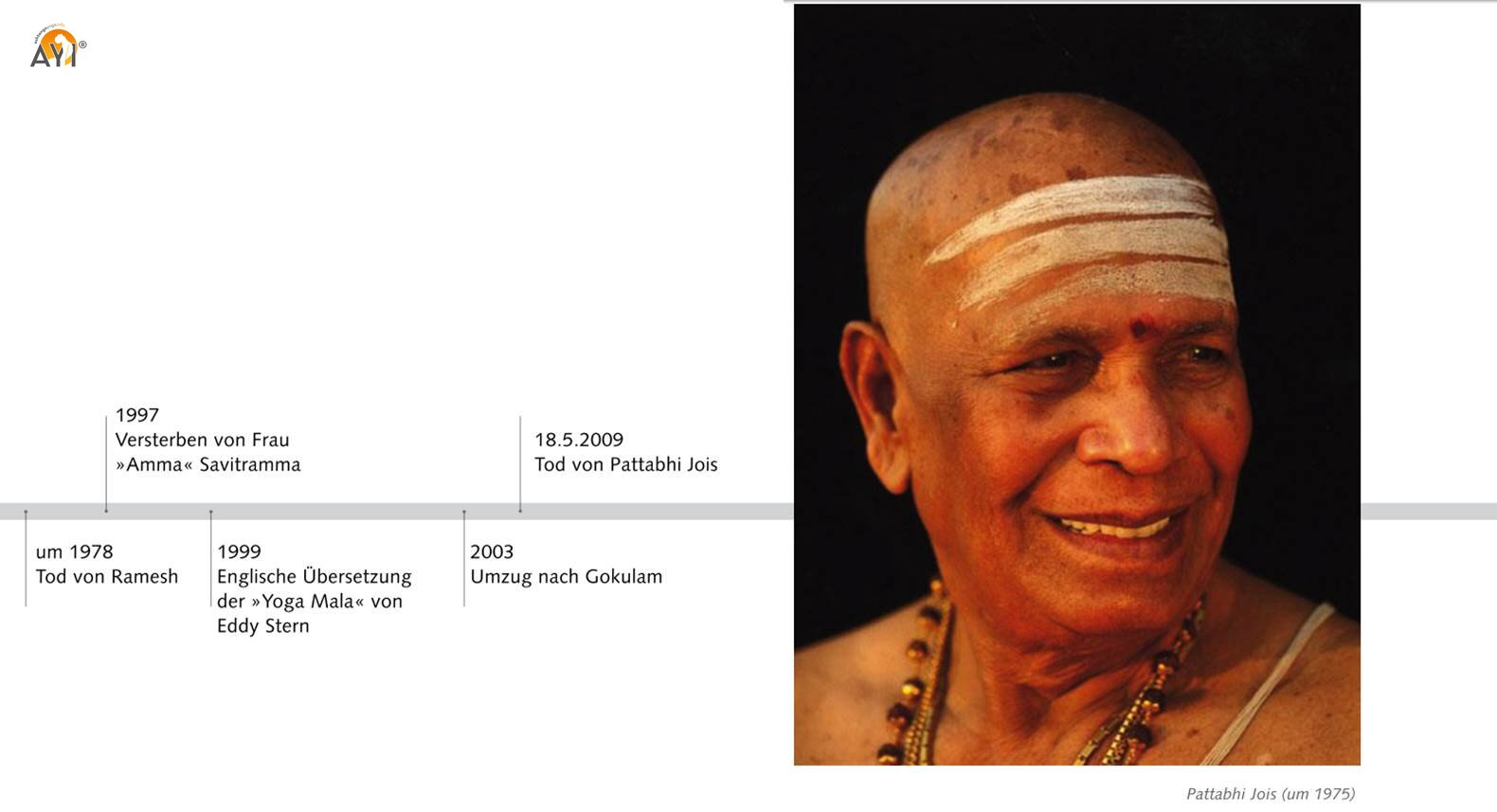
Around 1978, Ramesh, Pattabhi’s youngest son, died. His death came as a shock to the family. Little is said about the exact circumstances, although there are rumours of suicide. As a devout Hindu, Pattabhi gave up what mattered most to him on that day: his own yoga practice. In 1997, with Amma's death, the family suffered another severe loss.

As late as 1999, Eddy Stern finally translated Pattabhi Jois's only book, the Yoga Mala, into English. The number of Western students in Mysore continued to rise. Morning practice often lasted from 04.30 in the morning long into the afternoon. Teaching in the old Shala was virtually no longer possible. For this reason, the Jois family moved to Gokulam, a suburb of Mysore, in 2003 and opened a new, considerably larger Shala there. On some days, more than 200 yoga students from around the world practise here.

Pattabhi's teaching and the Aṣṭāṅga Yoga practice system continued to develop. While adjustments in the early years sometimes bordered on bodily harm, Pattabhi now guided students into postures more gently and attentively. In addition to that, many Western students could at this point already look back on decades of practical experience. They also contributed insights from anatomy and movement studies and integrated them into the practice. Even though Pattabhi himself never spoke directly about a healthy alignment in the exercises and movements, the topic »Alignment« gained increasing importance among practitioners. At this point, there were also led classes two times a week, in which the combined precision of breath and movement, the Vinyāsa system, becomes clear. On the remaining days of the week, classes are taught in the proven Mysore Style, where each pupil practises in tune with their own breathing rhythm and Pattabhi assisted only in case of difficulties or uncertainty. His daughter Saraswati (born in 1941) and her son, i.e. Pattabhi's grandson, Sharath (born in 1971) now also act as assistants in Pattabhi's classes.

The tradition lives on

Guruji, as Pattabhi is still lovingly called by his pupils, died on 18 May 2009 at the age of 93. His family has continued the tradition at Mysore. Up to the present day, Jois's daughter Saraswati and his grandson Sharath Rangaswamy each year teach Aṣṭāṅga Yoga to hundreds of pupils from all over the world at the renowned Shala in Mysore.

Further Reading

  • Donahay, Stern: Guruji – A Portrait of Sri K. Pattabhi Jois Through the Eyes of His Students

Continue with AYI Free

Quiz: Pioneers of Aṣṭāṅga Yoga

5 questions to deepen this article.

Author

Dr. Ronald Steiner

AYI Expert teacher

From 89075 Ulm

The "Yoga Doc" - Dr. Ronald Steiner is the founder of the AYI method. This method links traditional Ashtanga Yoga with innovative Yogatherapy and living Philosophy. This forms a practice that is personal for each and... more ›

Messages (0)

Please log in to write a message. Go to login

No messages yet.