

Kṛṣṇamācārya’s Saṃskṛt studies
These studies were severely disrupted when he was ten, since Kṛṣṇamācārya's father died and the family had to move to Mysore. There, Kṛṣṇamācārya’s great-grandfather, H.H. Sri Srinivasa Brahmātantra Parakala Swami, was the head of the traditional Bramhatantra Parakala Mutt, a Hindu monastic university. Kṛṣṇamācārya then continued his religious studies there.
During the whole time he remained faithful to the practice of yoga and took advantage of free time to travel extensively through India and the Himalayas.
Kṛṣṇamācārya’s studies in the Himalayas (1916-1924)
Around the year 1916 he decided to seek out the legendary yogi Yogeshwara Rama Mohan Brahmāchari. After two and a half months on foot, he found him in a cave at the foot of Mount Kailash. He spent seven and a half years there and learned the depths of yoga from Brahmāchari. Besides the practical aspects, consisting of asana, pranayama and vinyasa, he also learned several traditional yoga books by heart. Besides the Yoga Sūtras of Patañjali, he especially studied the texts of the Yoga-Kuruntha/Korunta by Vāmana Ṛṣi in this period.
Kṛṣṇamācārya’s time in Mysore (1924-1955)
After his return from the Himalayas, Kṛṣṇamācārya spent some time in Varanasi. His mastery of yoga soon attracted attention and Kṛṣṇamācārya came into contact with many powerful men of his time.
The 60th birthday of the Maharaja of Mysores mother brought the Maharaja, Krishna Raja Wadiyar IV, to Varanasi. There he also met Kṛṣṇamācārya. A friendship developed between the two men. Wadiyar became an important disciple and patron of Kṛṣṇamācārya. So Kṛṣṇamācārya soon taught in Mysore in the Viṣṇu temple next to the Jaganmohan Palace, in the center of Mysore. At the request of the Maharaja he wrote several books, including Yoga Makaranda, Yoganjali, and Yogasanalu. Kṛṣṇamācārya was not only a yoga teacher for the Maharaja, but also a friend and advisor on political issues.
In 1925 Kṛṣṇamācārya married his wife, Namagiriammal.
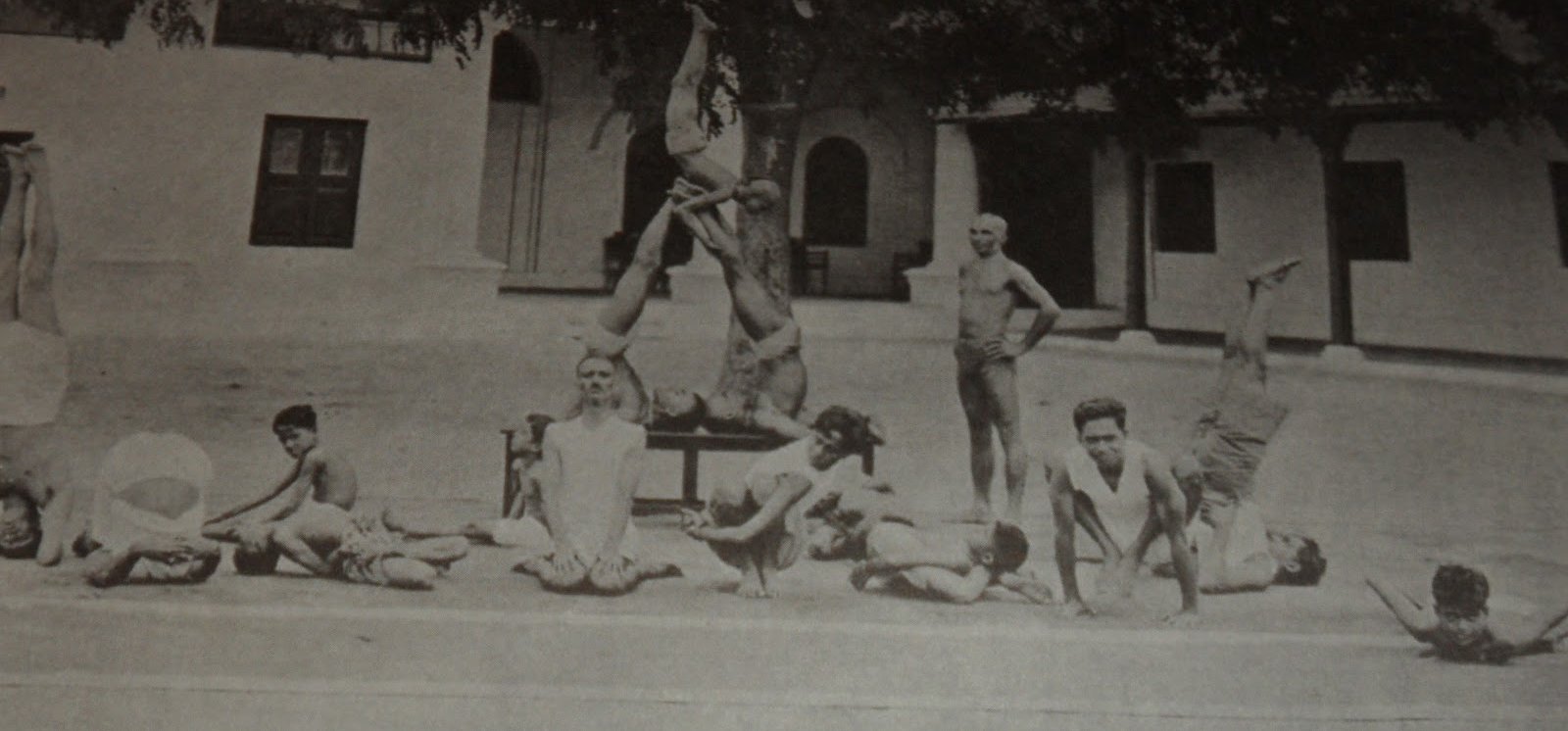
Kṛṣṇamācārya brought numerous yoga demonstrations to the people. Among other things, he is said to have voluntarily stopped his heartbeat, stopped cars with his bare hands, and lifted heavy weights with his teeth. Still impressive to this day are the videos of his Asana-Vinyasa practice.
In addition to the Maharaja, Kṛṣṇamācārya’s students from this period that are still famous today included Sri K. Pattabhi Jois, BNS Iyengar, BKS Iyengar and Indra Devi.
With the end of the colonial period, the Maharajas lost their power. Krishna Raja Wadiyar IV died and was succeeded by his nephew, Jacha Maraja Wadiyar V. The mayor of Mysore K.C. Reddy ordered that the yoga school be closed within three months. Thus came the end of an era.
Kṛṣṇamācārya’s time in Chennai (1957-1989)
After Kṛṣṇamācārya had left Mysore, he first spent about two years in Bangalore. Eventually he became a noted lawyer, whose help was sought after by those who had had a stroke, and was invited to Chennai.
In Chennai, Kṛṣṇamācārya taught yoga to his sons TK Srinivasan, TKV Desikachar and TK Sribhashyam. Srivatsa Ramaswami and AG Mohan were also his students at this time.
In 1985, at the age of 96, Kṛṣṇamācārya collapsed on his way to the mailbox. He refused an operation, but treated himself through the practice of yoga.
He practiced and taught yoga until his death on 3.11.1989. He was 100 years old and his mind remained clear until the end.
Kṛṣṇamācārya as the origin of modern Hatha Yoga
Kṛṣṇamācārya built the bridge, over which yoga was taken on its way out of the past and into our present. Despite the resistances of his time, he saved yoga as a valuable treasure for humankind.
Traditional and yet innovative, could one thus describe Kṛṣṇamācārya. Conserving old traditions, yet boldly crossing boundaries, was his motto. He was the first to teach a man and woman from West, and so he aroused the opposition of the traditionalists of his time. Although the science of Yoga had been practiced in secret since ancient times, worldwide interest for this ancient experience blossomed due to his many demonstrations. His demonstrations of asanas and pranayama are legendary.
The yoga that Kṛṣṇamācārya taught always recognized the individual person with their specific characteristics. Systematically and progressively a practice developed that was customized to the individual student. The yoga of Pattabhi Jois, Indra Devi, BNS Iyengar or BKS Iyengar, as learned from Kṛṣṇamācārya in Mysore, differs only superficially from the yoga that TK Srinivasan, TKV Desikachar, TK Sribhashyam, Srivatsa Ramaswami and AG Mohan, learned several years later in Chennai. One a dynamic and powerful version, called Aṣṭāṅga Yoga, the other calm and deliberate, called Vini yoga, they are still equal at the core. The students were distinct from each other, therefore Kṛṣṇamācārya took a different approach to the same yoga. However, considering the two contrary-appearing approaches to yoga, we see that each is contained within the other - Vini Yoga can be found within Aṣṭāṅga, and Aṣṭāṅga Yoga within Vini.
Kṛṣṇamācārya’s yoga was, from then on, designed to recognize the person as a whole and to assist in their individual development. Physical health and spiritual growth were equally part of the objective. Through the individually tailored practice, Kṛṣṇamācārya could achieve successful results for many diseases.
Sources:
- Desikachar K. The Yoga of the Yogi. 2005
- Desikachar TKV. The Heart of Yoga. 1995
- Desikachar TKV. Yoga and the living Tradition of Kṛṣṇamācārya. 1998

Please log in to write a message. Go to login
No messages yet.