


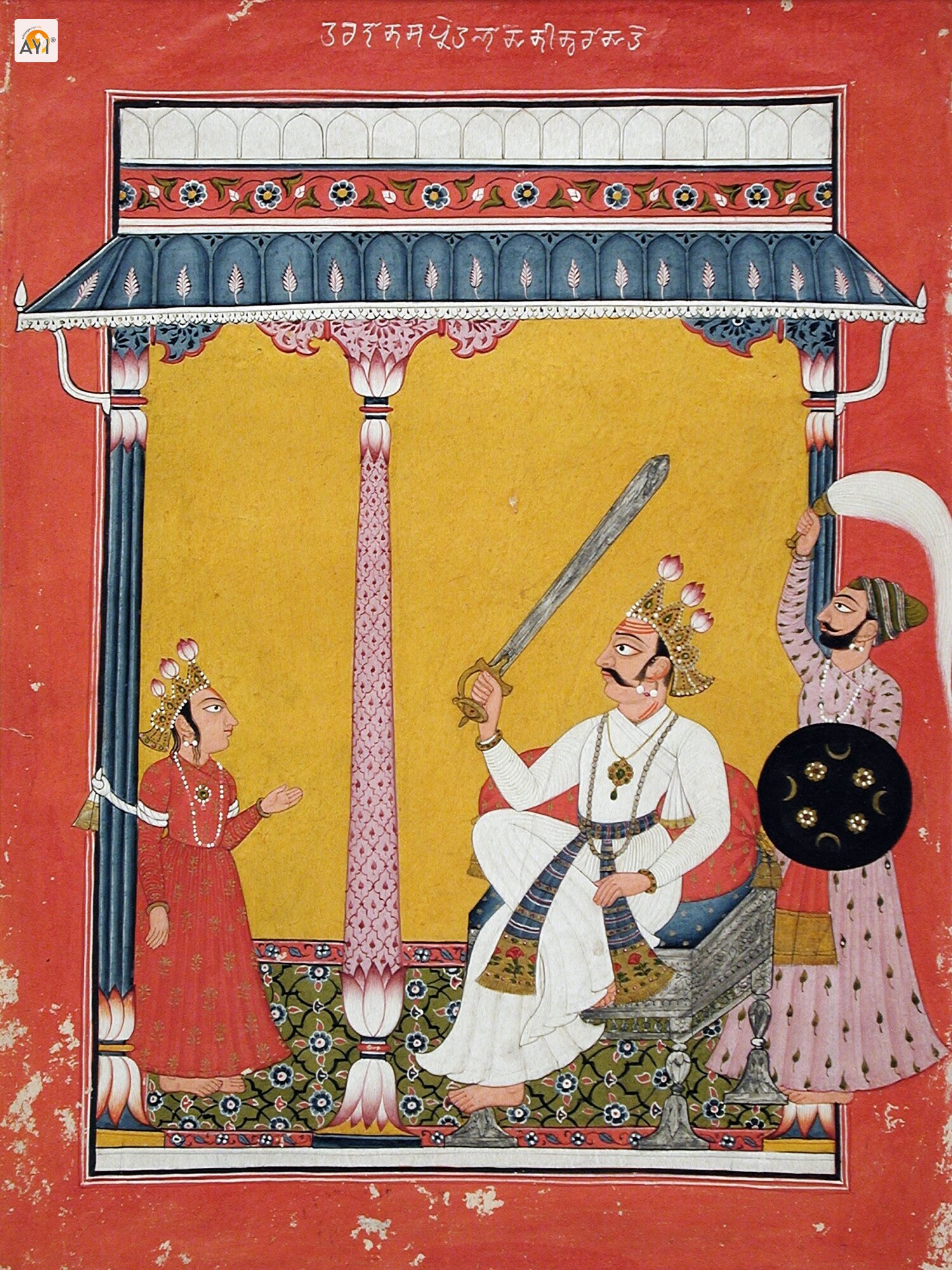
“You villain! When I become angry, all the worlds and their leaders tremble. What power has made you so bold that you fearlessly defy my authority?”
Prahlāda replies: “My dear king, my strength comes from the same source as yours. All powers arise from the same primal ground. Without it, no one can gain strength. Whether Brahmā or an insignificant being, all are subject to its power.”
“O unfortunate one,” said Hiraṇyakaśipu, “you have always spoken of a supreme being who pervades everything and rules over all. Where is he now? Is he perhaps in this pillar? You speak much nonsense, so I shall now sever your head from your body. Let me see how this Hari (Viṣṇu) protects you.”
German translation: Anneliese and Peter Keilhauer: Die Bildsprache des Hinduismus. Die indische Götterwelt und ihre Symbolik. DuMont, Cologne 1983, ISBN 3-7701-1347-0, pp. 84 ff.
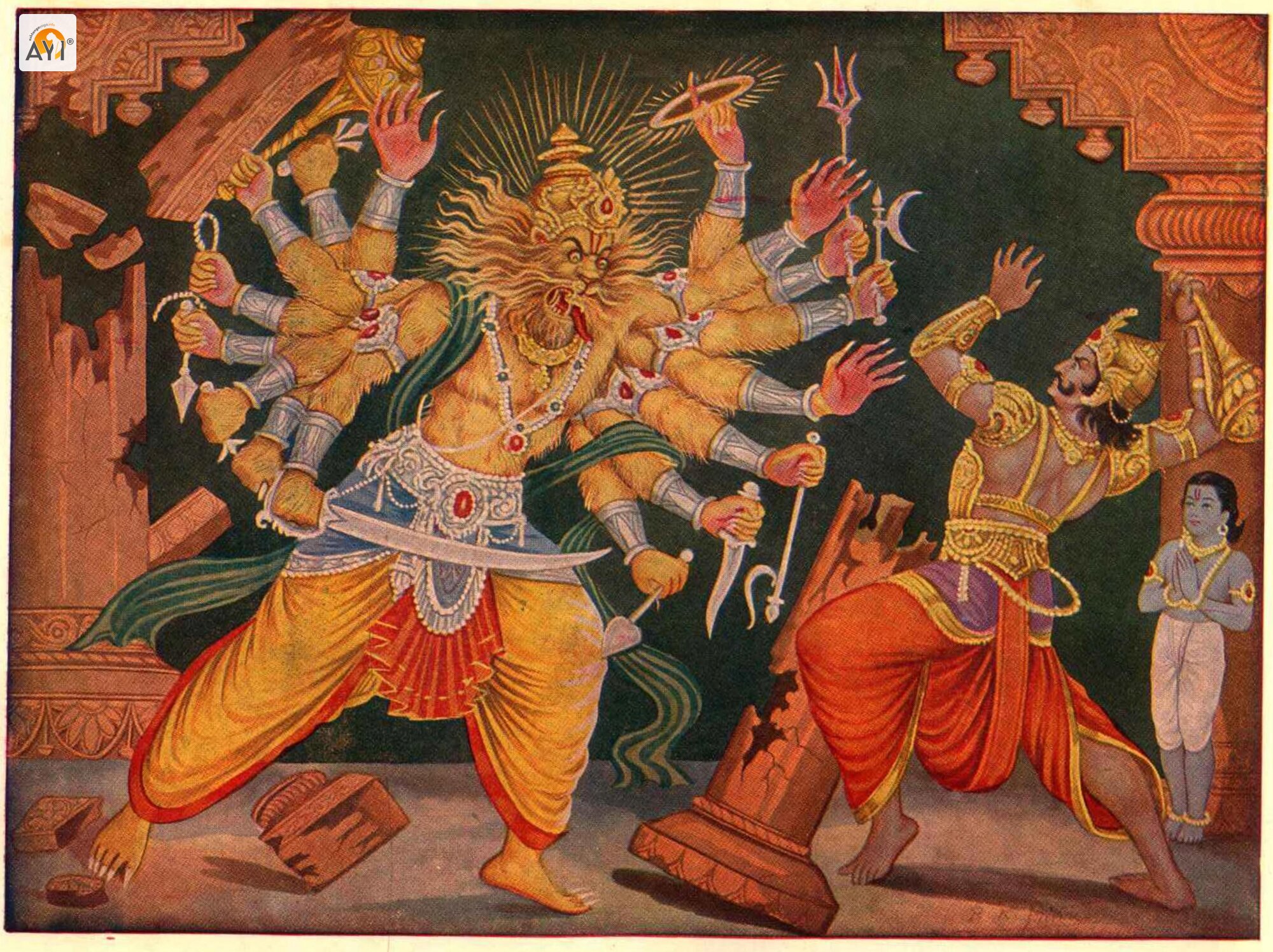
At that moment, Viṣṇu emerged from a palace pillar in the form of Narasiṃha. A terrible battle broke out between Narasiṃha and Hiraṇyakaśipu (Image 2).
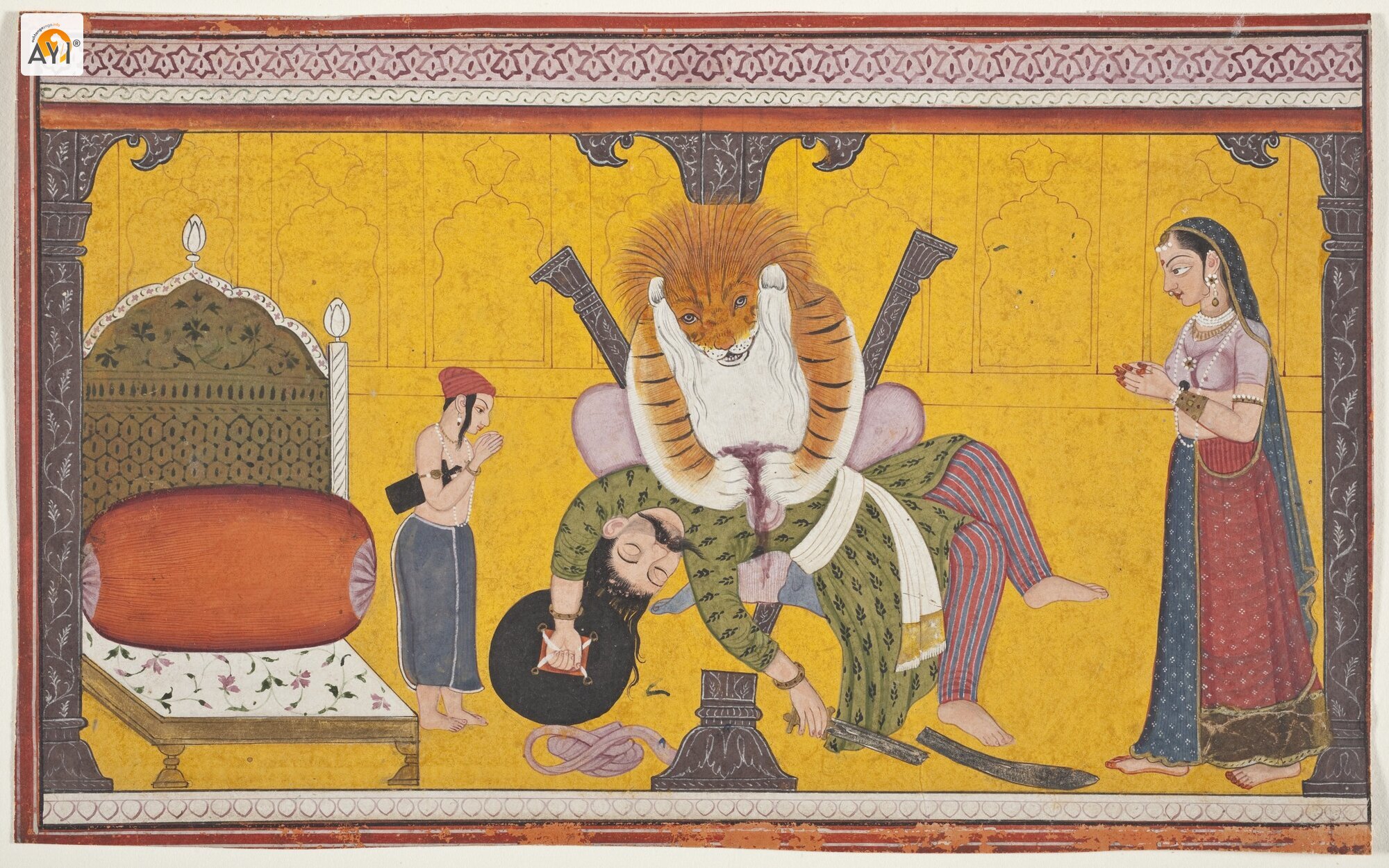
Only at dusk did Narasiṃha drag the king to the threshold of his palace. There, he laid the tyrant across his lap and tore him apart with his claws. In this way, the conditions surrounding Hiraṇyakaśipu's death were fulfilled: he was killed neither on earth nor in the sky, neither by day nor by night, neither inside a house nor outdoors, neither by a human nor an animal, neither by a weapon nor a hand, and neither by a deity (deva) nor a demon (asura) (Image 3).
Note: As part of the trinity of Brahmā, Viṣṇu and Śiva, Viṣṇu is not counted among the deities (deva).
Tradition and meaning
A vision gives life meaning
Those who sell their ideals sell themselves. Without ideals, neither effort nor action has meaning. Those who stand by their ideals, even when it is uncomfortable, become invincible. Even if this seems to bring external disadvantages, they always know what they live and act for. In the mythological story, Prahlāda stands by his ideals and does not abandon his faith in God, although his own father tries to kill him. Ultimately, his steadfast belief in his ideals is rewarded.
We are part of nature
Are we like Hiraṇyakaśipu in modern society? We use ever more technology to separate ourselves from nature. We exploit animals, reshape the landscape and try to remain young forever. Yet the further we move away from nature, the more difficulties we become entangled in. Nature always catches up with us in the end, because the eternal youth we seek is an illusion. We are part of nature. Everything around us, and we ourselves, is subject to change. Surrendering to this change leads us towards deep contentment. The key to true happiness therefore lies in being content with what is here and now, rather than chasing new things outside ourselves.
In the Indian tradition
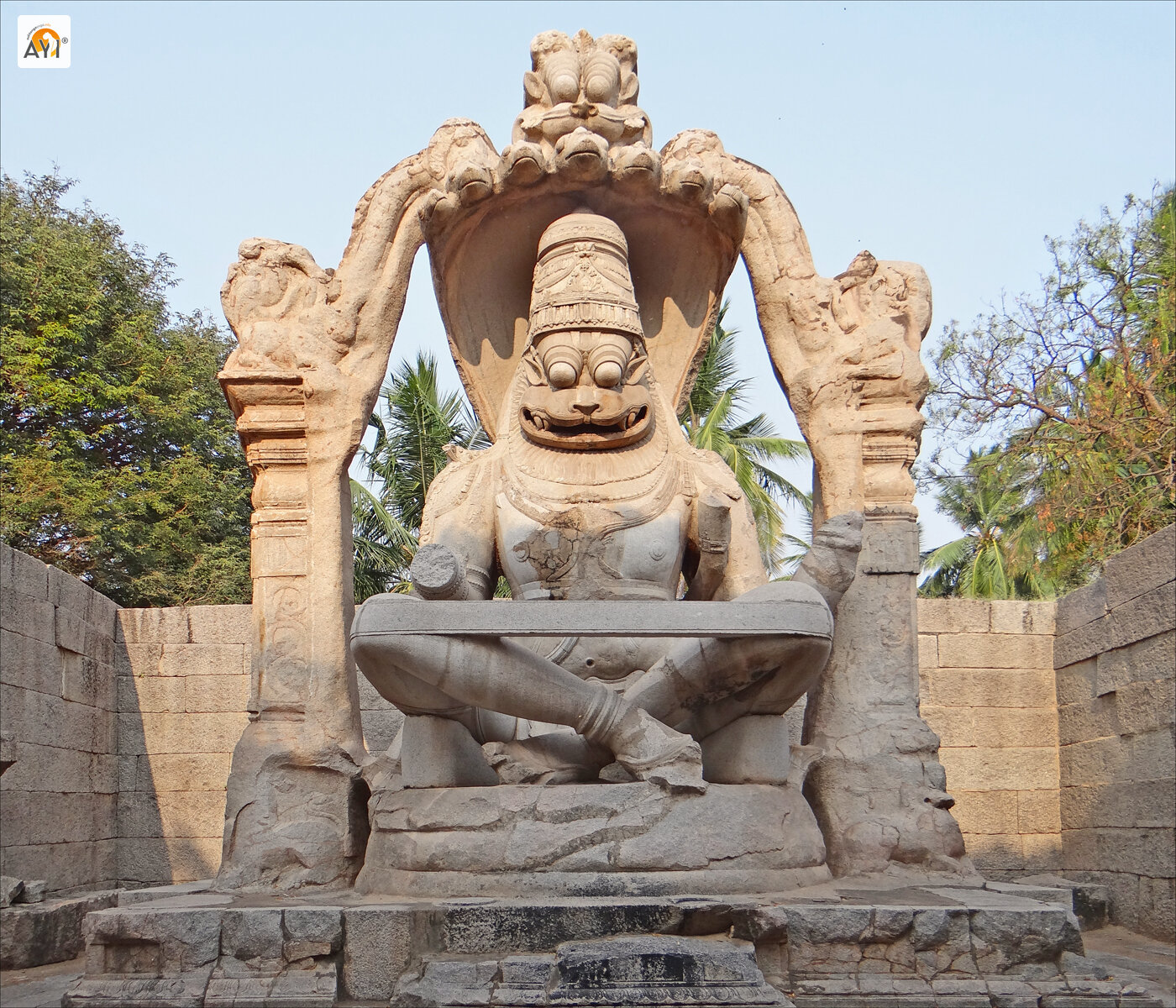
Narasiṃha is the fourth of ten embodiments (avatāra) of the god Viṣṇu. Literally, Nṛsiṃha—or, as he is often called, Narasiṃha—means “man-lion”. Depictions of Narasiṃha as half human and half lion are common throughout India. He has a human body with the head and claws of a lion (Image 4).
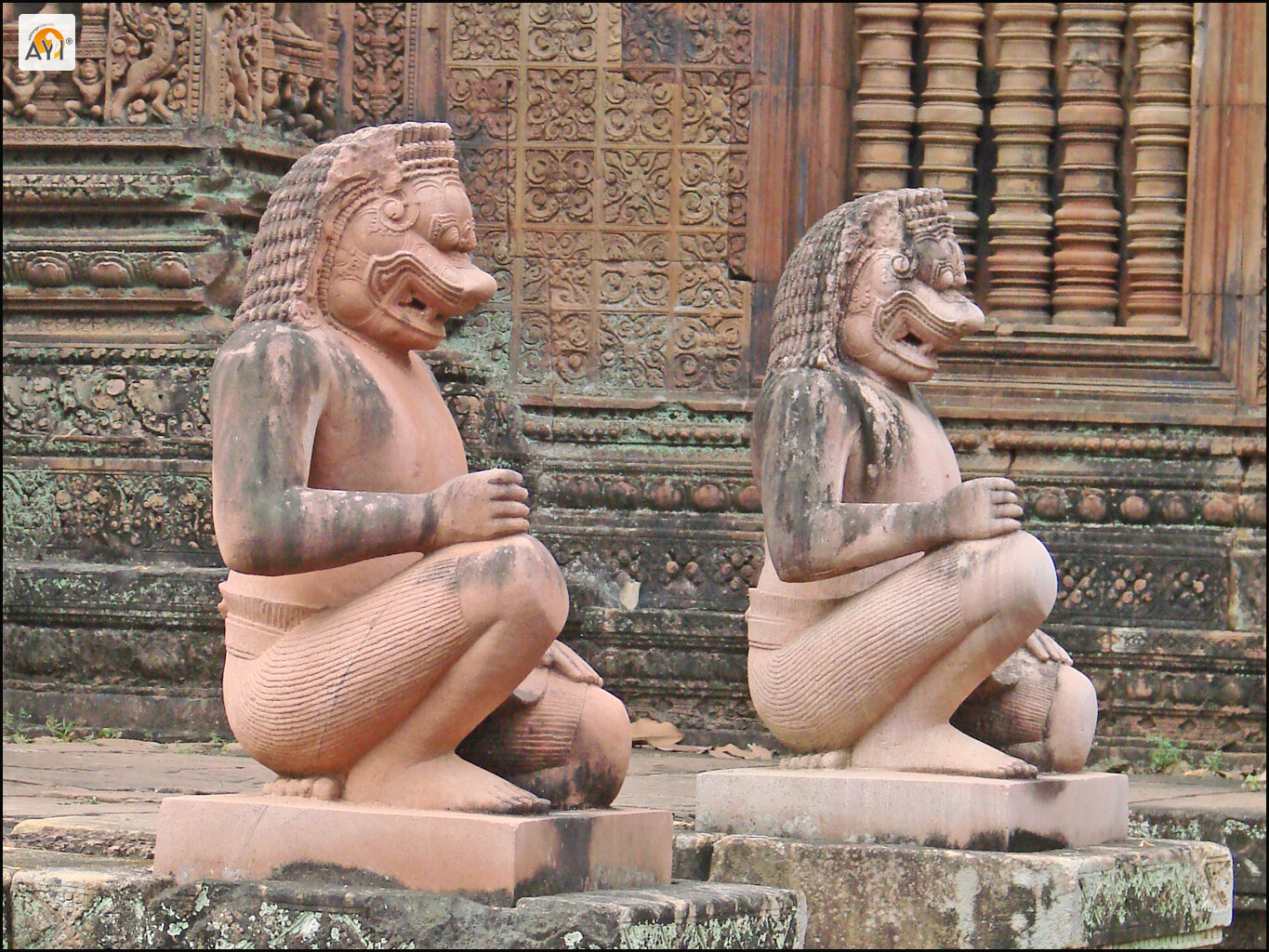
In India, Narasiṃha is still worshipped particularly by the warrior caste. Unlike a mercenary whose services can be bought, a warrior lives by and nurtures ideals. A warrior protects what is precious to them and is prepared to face danger, even to risk their own life for it. Narasiṃha's epithet, “Great Protector”, therefore refers not only to physical abilities but also to the protection of ideals (Image 5).
A guiding figure in tantric texts
It is unsurprising that Narasiṃha often appears as a guiding figure in tantric and Haṭha Yoga texts. We find the following particularly relevant:
- The Mokṣopaya from the 10th century.
- The Nṛsiṃhottaratāpinyupaniṣat, a Yoga Upaniṣad centred on him, from the 17th century.
And, of course, the powerful invocation to Nṛsiṃha in the opening mantra of the Dattātreyayogaśāstra:
nṛsiṃha-rūpiṇe cid-ātmane sukha-sva-rūpiṇe |
padais tribhis tad ādibhir nirūpitāya vai namaḥ |1|To him who has the form of Narasiṃha, whose self (ātman) is consciousness (cit), whose true form (svarūpa) is bliss (sukha), [and]
who is defined by the three words beginning with “that” (tat)1. Reverence (namas) be to him.
A legend with deep mythological roots
Stories about Narasiṃha appear in the Purāṇas and the Mahābhārata in a total of 17 slightly different versions. This shows how deeply rooted the legend is in Indian mythology. If you would like to compare them yourself, we have listed where the versions can be found. The legend recounted above follows the Bhagavata Purāṇa version (Canto 7).
- Nr̥śiṁhapurāṇa, a Purāṇa devoted specifically to him, from the 5th century.
- Valmiki Ramayana (7.24)
- Harivaṃśa (41 & 3.41-47)
- Viṣṇu Purāṇa (1.16-20)
- Bhagavata Purāṇa (Canto 7) – The legend recounted above follows this account.
- Agni Purāṇa (4.2-3)
- Brahmāṇḍa Purāṇa (2.5.3-29)
- Vayu Purāṇa (67.61-66)
- Brahmā-Purāṇa (213.44-79)
- Viṣṇudharmottara Purāṇa (1.54)
- Kūrma Purāṇa (1.15.18-72)
- Matsya Purāṇa (161-163)
- Padma Purāṇa (Uttara-khaṇḍa 5.42)
- Śiva Purāṇa (2.5.43 & 3.10-12)
- Liṅga Purāṇa (1.95-96)
- Skanda Purāṇa 7 (2.18.60-130)
- Mahābhārata (3.272.56-60)
Image credits
- Image 1:
https://de.wikipedia.org/wiki/Prahlada#/media/Datei:Hiranyakasipu_About_to_Decapitate_Prahlada,_
Folio_from_a_Bhagavata_Purana_(Ancient_Stories_of_the_Lord)_LACMA_M.88.227.jpg - Image 2:
https://en.wikipedia.org/wiki/Hiranyakashipu#/media/File:God_Narasiṃha.jpg - Image 3 and header image:
https://en.wikipedia.org/wiki/Narasiṃha#/media/File:Narasiṃha_Disemboweling_Hiranyakashipu,_Folio_from_a_Bhagavata_Purana_
(Ancient_Stories_of_the_Lord)_LACMA_M.82.42.8_(1_of_5).jpg - Image 4:
https://en.wikipedia.org/wiki/Narasiṃha#/media/File:7_La_statue_de_Narasiṃha_Hampi_Vijayanagar_Karnataka_India_April_2014.jpg - Image 5:
https://en.wikipedia.org/wiki/Narasiṃha#/media/File:Gardiens_du_temple_(Banteay_Srei,_Angkor)_(6883239929).jpg




Please log in to write a message. Go to login