





























Yoga Sūtra 1: On the experience of absolute unity (samādhi)

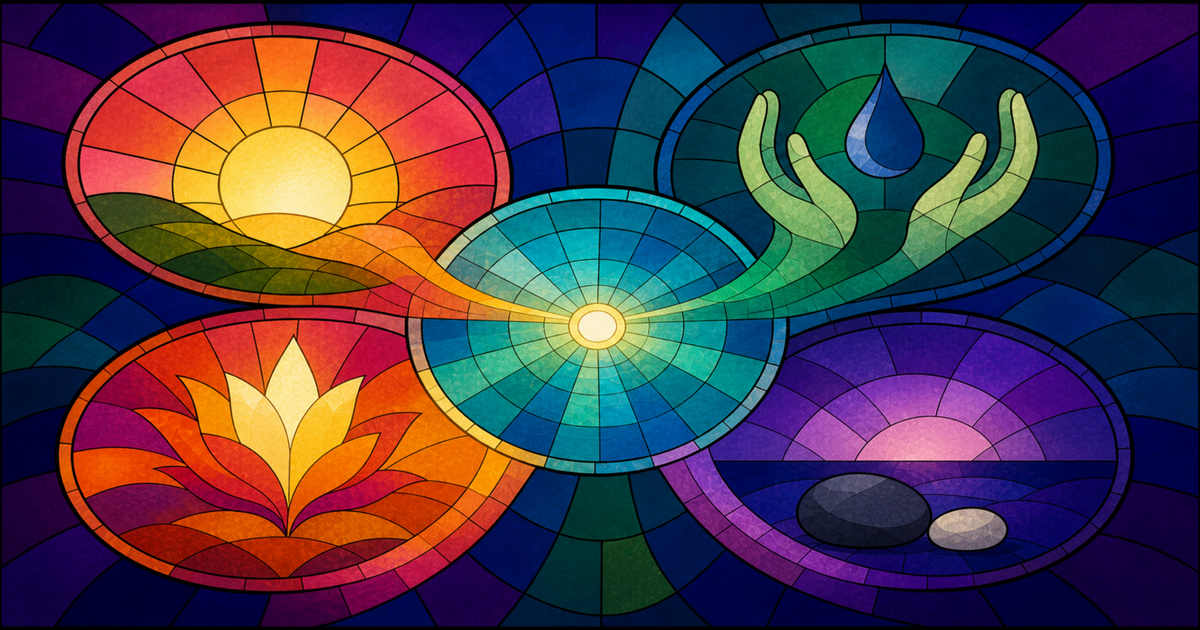
Patañjali begins his Yoga Sūtra with the basics: learning to distinguish your perception from your essence. This will allow you to immerse yourself in an experience of absolute unity (samādhi).

Dr. Ronald Steiner Dr. Ronald Steiner Laura von Ostrowski Laura von Ostrowski
PYS 1.1: Beginn der Yogalehre

Yogaśāstra 1.1: Now the Teaching of Yoga Begins

`Atha` opens the teaching; the Bhāṣya defines yoga as samādhi and distinguishes absorption with cognition from the complete cessation of all vṛtti.

PYS 1.2–4: Anhalten der Vṛtti

Yogaśāstra 1.2–4: Citta-Nirodha and Puruṣa

Yoga is the cessation of citta-vṛtti. Then the seer abides in its own form; otherwise the seer's activity appears identical with the vṛtti.

PYS 1.5–11: Die fünf Vṛtti

Yogaśāstra 1.5–11: Activities of Citta

Valid cognition, error, conceptual construction, sleep, and memory are the five afflicted or unafflicted citta-vṛtti.

Patañjali Yoga Sūtra 1.5
The fluctuations (vṛttayaḥ | nom pl) are fivefold (pañcatayyaḥ | nom pl f) [and each is] afflictive or non-afflictive (kliṣṭākliṣṭāḥ | nom pl f).
Dr. Ronald Steiner - 2026 - historically literal
Patañjali Yoga Sūtra 1.6
Valid cognition, error, conceptual construction, sleep and memory (pramāṇa-viparyaya-vikalpa-nidrā-smṛtayaḥ | nom pl) [are these five fluctuations of Citta].
Dr. Ronald Steiner - 2026 - historically literal
Patañjali Yoga Sūtra 1.7
Direct perception, inference and reliable tradition (pratyakṣānumānāgamāḥ | nom pl) [are] means of valid cognition (pramāṇāni | nom pl).
Dr. Ronald Steiner - 2026 - historically literal
Patañjali Yoga Sūtra 1.8
Error (viparyayaḥ | nom sg) [is] false cognition (mithyā-jñānam | nom sg) based on a form that is not that [of the object] (atad-rūpa-pratiṣṭham | nom sg n).
Dr. Ronald Steiner - 2026 - historically literal
Patañjali Yoga Sūtra 1.9
Conceptual construction (vikalpaḥ | nom sg) follows cognition from words (śabda-jñānānupātī | nom sg m) and is devoid of a [corresponding] real object (vastu-śūnyaḥ | nom sg m).
Dr. Ronald Steiner - 2026 - historically literal
Patañjali Yoga Sūtra 1.10
Sleep (nidrā | nom sg) [is] a fluctuation of Citta (vṛttiḥ | nom sg) supported by the cognition of absence [of waking and dream contents] (abhāva-pratyayālambanā | nom sg f).
Dr. Ronald Steiner - 2026 - historically literal
Patañjali Yoga Sūtra 1.11
The non-loss of an experienced object (anubhūta-viṣayāsaṃpramoṣaḥ | nom sg) [is] memory (smṛtiḥ | nom sg).
Dr. Ronald Steiner - 2026 - historically literal
PYS 1.12–16: Abhyāsa und Vairāgya

Yogaśāstra 1.12–16: Paths to Nirodha

Practice steadies the quiet flow of citta; dispassion ends thirst for sense objects, heavenly realms, and finally the guṇas themselves.

Patañjali Yoga Sūtra 1.12
Through practice and dispassion (abhyāsa-vairāgyābhyām | ins du) [comes] the suppression of those [fluctuations] (tan-nirodhaḥ | nom sg).
Dr. Ronald Steiner - 2026 - historically literal
Patañjali Yoga Sūtra 1.13
Here (tatra), practice (abhyāsaḥ | nom sg) [is] effort (yatnaḥ | nom sg) towards stability [in the stillness of Citta] (sthitau | loc sg).
Dr. Ronald Steiner - 2026 - historically literal
Patañjali Yoga Sūtra 1.14
This [practice] (saḥ | nom sg m), however (tu), when cultivated for a long time, without interruption and with respect (dīrgha-kāla-nairantarya-satkārāsevitaḥ | nom sg m), is firmly grounded (dṛḍha-bhūmiḥ | nom sg m).
Dr. Ronald Steiner - 2026 - historically literal
Patañjali Yoga Sūtra 1.15
The state of awareness designated as mastery (vaśīkāra-saṃjñā | nom sg) of one who no longer thirsts for objects seen or known from tradition (dṛṣṭānuśravika-viṣaya-vitṛṣṇasya | gen sg m) [is] dispassion (vairāgyam | nom sg).
Dr. Ronald Steiner - 2026 - historically literal
Patañjali Yoga Sūtra 1.16
This [dispassion] (tat | nom sg n) [is] higher (param | nom sg n): due to discernment of Puruṣa (puruṣa-khyāteḥ | abl sg), [there is] thirstlessness towards the Guṇas (guṇa-vaitṛṣṇyam | nom sg).
Dr. Ronald Steiner - 2026 - historically literal
PYS 1.17–18: Zwei Arten des Samādhi

Yogaśāstra 1.17–18: Samādhi with and without Support

Supported saṃprajñāta-samādhi is differentiated by vitarka, vicāra, ānanda, and asmitā. In asaṃprajñāta all vṛtti cease and only saṃskāras remain.

PYS 1.19–22: Zwei Zugänge

Yogaśāstra 1.19–22: Mode of Existence and Method

For bodiless beings and those dissolved in prakṛti, the state is conditioned by their mode of existence; other yogins approach it through faith, energy...

PYS 1.23–26: Īśvara
PYS 1.23–26: Īśvara

Yogaśāstra 1.23–26: The Special Puruṣa

Devotion to Īśvara brings samādhi near. Īśvara is an ever-free puruṣa untouched by kleśas and karma, omniscient and a teacher beyond time.

PYS 1.27–29: Praṇava

Yogaśāstra 1.27–29: Īśvara's Designation

Praṇava designates Īśvara. Reciting it and contemplating Īśvara make citta one-pointed, remove obstacles, and reveal one's own puruṣa.

PYS 1.30: Neun Hindernisse

Yogaśāstra 1.30: Distractions of Citta

Illness, languor, doubt, and six further disturbances distract citta; they prevent the attainment and stabilization of the stages of samādhi.

PYS 1.31–32: Zerstreuung und Mittel

Yogaśāstra 1.31–32: Signs and Remedy

Suffering, dejection, bodily tremor, and disturbed breathing accompany distraction; practice focused on a single reality counteracts it.

PYS 1.33: Klärung des Citta

Yogaśāstra 1.33: Four Attitudes toward Living Beings

Friendliness toward the happy, compassion for those who suffer, joy in the virtuous, and equanimity toward the nonvirtuous clarify citta.

PYS 1.34–39: Sechs Stützen

Yogaśāstra 1.34–39: Ways to Stabilize Citta

Expelling and retaining the breath, extraordinary sense experience, inner light, a dispassionate citta, dream or sleep knowledge, and a chosen object provide...

Patañjali Yoga Sūtra 1.34
Or (vā), through expulsion and retention (pracchardana-vidhāraṇābhyām | ins du) of the breath (prāṇasya | gen sg), [there arises clarification of Citta].
Dr. Ronald Steiner - 2026 - historically literal
Patañjali Yoga Sūtra 1.35
Or (vā), when arisen (utpannā | nom sg f), sense activity (pravṛttiḥ | nom sg) related to a [sense] object (viṣayavatī | nom sg f) [becomes] stability-securing (sthiti-nibandhanī | nom sg f) for the mind (manasaḥ | gen sg).
Dr. Ronald Steiner - 2026 - historically literal
Patañjali Yoga Sūtra 1.36
Or (vā), [sense activity that is] sorrowless (viśokā | nom sg f) and luminous (jyotiṣmatī | nom sg f) [stabilises the mind].
Dr. Ronald Steiner - 2026 - historically literal
Patañjali Yoga Sūtra 1.37
Or (vā), a Citta (cittam | nom sg) that has as its object [the Citta] of one free from passion (vīta-rāga-viṣayam | nom sg n) [attains stability].
Dr. Ronald Steiner - 2026 - historically literal
Patañjali Yoga Sūtra 1.38
Or (vā), [a Citta] that takes cognition from dream or sleep as its support (svapna-nidrā-jñānālambanam | nom sg) [attains stability].
Dr. Ronald Steiner - 2026 - historically literal
Patañjali Yoga Sūtra 1.39
Or (vā), through meditation according to one's preference (yathābhimata-dhyānāt | abl sg), [Citta attains stability].
Dr. Ronald Steiner - 2026 - historically literal
PYS 1.40–41: Meisterschaft

Yogaśāstra 1.40–41: Mastery and Samāpatti

Citta gains mastery over objects from the atom to the greatest magnitude. Cleared of its activities, it takes the form of its support like a crystal.

PYS 1.42–43: Grobe Samāpatti

Yogaśāstra 1.42–43: Savitarkā and Nirvitarkā

In savitarkā, word, object, and cognition are mixed. When the corresponding memories are purified, only the gross object appears in nirvitarkā.

PYS 1.44–45: Subtile Samāpatti

Yogaśāstra 1.44–45: Savicārā and Nirvicārā

Samāpatti with and without subtle reflection takes the subtle causal series of the elements as its object, ending in featureless, unmanifest prakṛti.

PYS 1.46–49: Samādhi mit Keim

Yogaśāstra 1.46–49: Truth-Bearing Insight

The four object-based samāpattis constitute samādhi with seed. In mature nirvicārā an insight arises that directly apprehends the particular.

PYS 1.50–51: Samādhi ohne Keim

Yogaśāstra 1.50–51: The End of Citta's Task

Samādhi-saṃskāras inhibit the other saṃskāras. When they too cease, citta returns to prakṛti; puruṣa remains alone in kaivalya.

Continue with AYI Free

Illustrations: AI-generated.

Editor

Dr. Ronald Steiner

From Ulm

The "Yoga Doc" - Dr. Ronald Steiner is the founder of the AYI method. This method links traditional Ashtanga Yoga with innovative Yogatherapy and living Philosophy. This forms a practice that is personal for each and... more ›

Laura von Ostrowski

Ich bin 2004 das erste Mal mit Yoga in Berührung gekommen und habe seitdem unendlich viele Facetten kennengelernt. Einerseits die vielfältigen praktischen Seiten von Yoga - in Form verschiedener Ausbildungen (500 h... more ›