































Yoga Sūtra 3: Über Ergebnisse (vibhūti) der Yogapraxis

Das dritte Kapitel des Yoga Sūtra schildert, wie Du schrittweise tiefer in saṃyama eintauchst und welche Ergebnisse, vibhūti oder siddhi, daraus entstehen.

Dr. Ronald Steiner Dr. Ronald Steiner Laura von Ostrowski Laura von Ostrowski
PYS 3.1–4: Saṃyama
PYS 3.1–4: Saṃyama

Yogaśāstra 3.1–4: Dhāraṇā, Dhyāna, and Samādhi

Dhāraṇā binds citta to a place, dhyāna maintains the same cognition uninterruptedly, and samādhi displays only the object; their unity is saṃyama.

PYS 3.5–8: Stufen des Saṃyama

Yogaśāstra 3.5–8: Inner Limb, Outer Means

Mastery of saṃyama brings the light of insight and is applied in stages. Its three limbs are more internal than the first five, but external to nirbīja.

PYS 3.9–12: Drei Wandlungen des Citta

Yogaśāstra 3.9–12: Nirodha, Samādhi, Ekāgratā

Imprints of cessation overcome activity, distraction gives way to one-pointedness, and homogeneous cognitions form an uninterrupted peaceful flow.

Patañjali Yoga Sūtra 3.9
When, among the imprints of activity and inhibition (vyutthāna-nirodha-saṃskārayoḥ | gen du), the [former] is overcome and the [latter] arises (abhibhava-prādurbhāvau | nom du), the conjunction of Citta with the moment of inhibition (nirodha-kṣaṇa-cittānvayaḥ | nom sg) [is] the transformation into inhibition (nirodha-pariṇāmaḥ | nom sg).
Dr. Ronald Steiner - 2026 - historically literal
Patañjali Yoga Sūtra 3.10
The tranquil flow (praśānta-vāhitā | nom sg) of that [Citta] (tasya | gen sg) [arises] from the imprint [of inhibition] (saṃskārāt | abl sg).
Dr. Ronald Steiner - 2026 - historically literal
Patañjali Yoga Sūtra 3.11
The Samādhi-transformation (samādhi-pariṇāmaḥ | nom sg) of Citta (cittasya | gen sg) [is] the respective waning and arising (kṣayodayau | nom du) of many-directedness and one-pointedness (sarvārthataikāgratayoḥ | gen du).
Dr. Ronald Steiner - 2026 - historically literal
Patañjali Yoga Sūtra 3.12
Then (tataḥ) again (punaḥ), the one-pointedness-transformation (ekāgratā-pariṇāmaḥ | nom sg) of Citta (cittasya | gen sg) [occurs] when the subsided [preceding cognition] and the arisen [following cognition] (śāntoditau | nom du m) are of the same kind (tulya-pratyayau | nom du).
Dr. Ronald Steiner - 2026 - historically literal
PYS 3.13–14: Drei Arten der Wandlung

Yogaśāstra 3.13–14: Property, Time, and State

The model of citta also applies to elements and senses: a persisting dharmin bears past, present, and still indeterminate properties.

PYS 3.15–16: Abfolge der Wandlung

Yogaśāstra 3.15–16: Past and Future

Different sequences produce different transformations. Saṃyama on changes of property, temporal mark, and state reveals past and future.

PYS 3.17–20: Außergewöhnliches Wissen

Yogaśāstra 3.17–20: Speech, Births, Another Citta

Saṃyama reveals the speech of all beings, past births, and another's citta; the object of another's cognition remains unknown without separate saṃyama.

PYS 3.21–22: Unsichtbarkeit und Todeszeit

Yogaśāstra 3.21–22: Bodily Form and Ripening Karma

Saṃyama interrupts the perceptibility of bodily form and makes the yogin invisible; directed at ripening karma, it reveals the time of death, as do omens.

PYS 3.23–25: Kräfte und Fernwissen

Yogaśāstra 3.23–25: Strength and Hidden Things

Saṃyama on friendliness, compassion, or joy produces powers; saṃyama on strength grants an elephant's power, and inner cognitive light reveals subtle, hidden...

PYS 3.26–28: Wissen über den Kosmos

Yogaśāstra 3.26–28: Sun, Moon, and Pole Star

Saṃyama on the sun reveals the seven worlds, on the moon the arrangement of the stars, and on the pole star their motion in the traditional cosmos.

PYS 3.29–34: Körperorte und Erkenntnisse

Yogaśāstra 3.29–34: Navel, Throat, Crown, and Heart

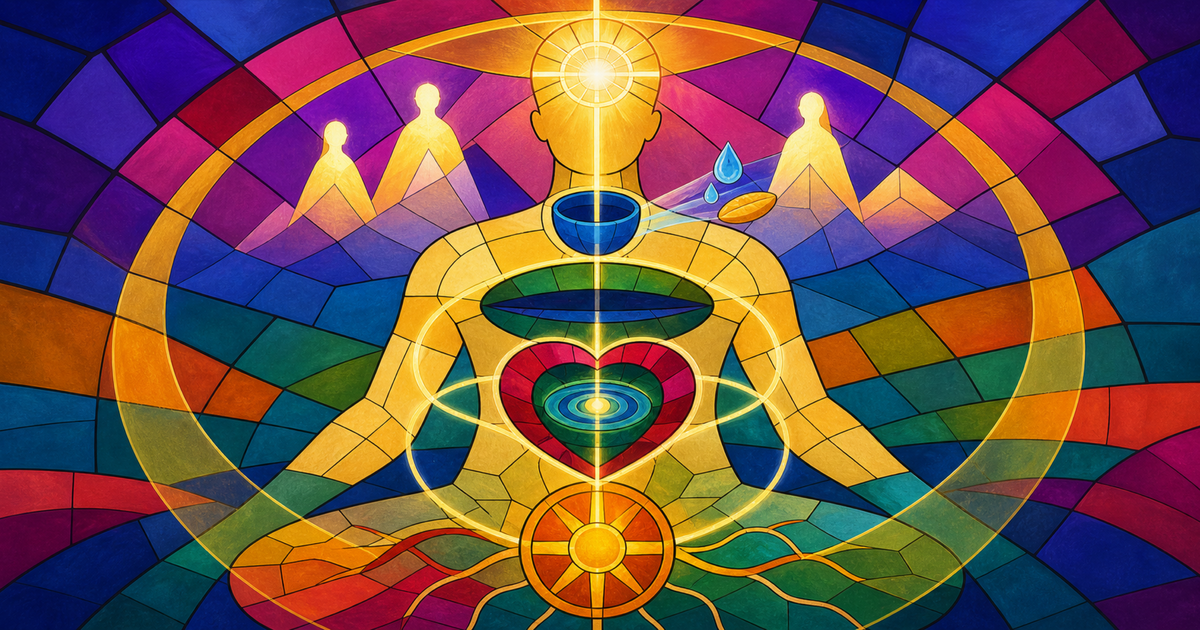
Saṃyama at the navel, throat, kūrma-nāḍī, crown light, and heart yields knowledge of body and citta, ends hunger and thirst, gives stability, and reveals...

Patañjali Yoga Sūtra 3.29
Through [Saṃyama] on the navel centre (nābhi-cakre | loc sg), knowledge of the structure of the body [in terms of doṣa, dhātu, and bodily parts] (kāya-vyūha-jñānam | nom sg) [arises].
Dr. Ronald Steiner - 2026 - historically literal
Patañjali Yoga Sūtra 3.30
Through [Saṃyama] on the hollow of the throat (kaṇṭha-kūpe | loc sg), the cessation of hunger and thirst (kṣut-pipāsā-nivṛttiḥ | nom sg) [arises].
Dr. Ronald Steiner - 2026 - historically literal
Patañjali Yoga Sūtra 3.31
Through [Saṃyama] on the tortoise-shaped inner channel [below the hollow of the throat in the chest] (kūrma-nāḍyām | loc sg), steadiness (sthairyam | nom sg) [arises].
Dr. Ronald Steiner - 2026 - historically literal
Patañjali Yoga Sūtra 3.32
Through [Saṃyama] on the light at the crown (mūrdha-jyotiṣi | loc sg), vision of the Siddhas [perfected beings] (siddha-darśanam | nom sg) [arises].
Dr. Ronald Steiner - 2026 - historically literal
Patañjali Yoga Sūtra 3.33
Or (vā), through intuitive insight [as the precursor of discriminative knowledge] (prātibhāt | abl sg), [the yogin knows] everything (sarvam | acc sg n).
Dr. Ronald Steiner - 2026 - historically literal
Patañjali Yoga Sūtra 3.34
Through [Saṃyama] in the heart [as the locus of Citta] (hṛdaye | loc sg), knowledge of Citta (citta-saṃvit | nom sg) [arises].
Dr. Ronald Steiner - 2026 - historically literal
PYS 3.35–37: Puruṣa-Erkenntnis und Siddhis

Yogaśāstra 3.35–37: Extraordinary Senses

Saṃyama on the difference between sattva and puruṣa produces knowledge of puruṣa and supernatural hearing, touch, sight, taste, and smell; in samādhi they are...

PYS 3.38: Eintritt in einen fremden Körper

Yogaśāstra 3.38: Citta Leaves Its Bond

Loosening the karmic bond to the body and knowing the paths of citta's movement enable its actual entry into another body.

PYS 3.39–40: Udāna und Samāna

Yogaśāstra 3.39–40: Nonadhesion, Death, and Blazing

Mastered udāna prevents the body from adhering to water, mud, or thorns and enables departure at death; samāna makes the body blaze.

PYS 3.41–42: Göttliches Hören und Raumgang

Yogaśāstra 3.41–42: Hearing, Body, and Space

Saṃyama on the relation of the hearing faculty and space produces divine hearing; directed at body and space together with lightness, it enables bodily travel...

PYS 3.43: Mahāvidehā

Yogaśāstra 3.43: Great Bodilessness

In mahāvidehā, an unconstructed vṛtti exists outside the body; this causes the covering of the light of citta-sattva to disappear.

PYS 3.44–46: Meisterschaft über Elemente

Yogaśāstra 3.44–46: Aṇiman and Bodily Perfection

Saṃyama on the elements produces mastery, atomic smallness and other siddhis, immunity to their properties, and bodily beauty, strength, and diamond hardness.

PYS 3.47–48: Meisterschaft über Sinne

Yogaśāstra 3.47–48: Sense Faculties and Pradhāna

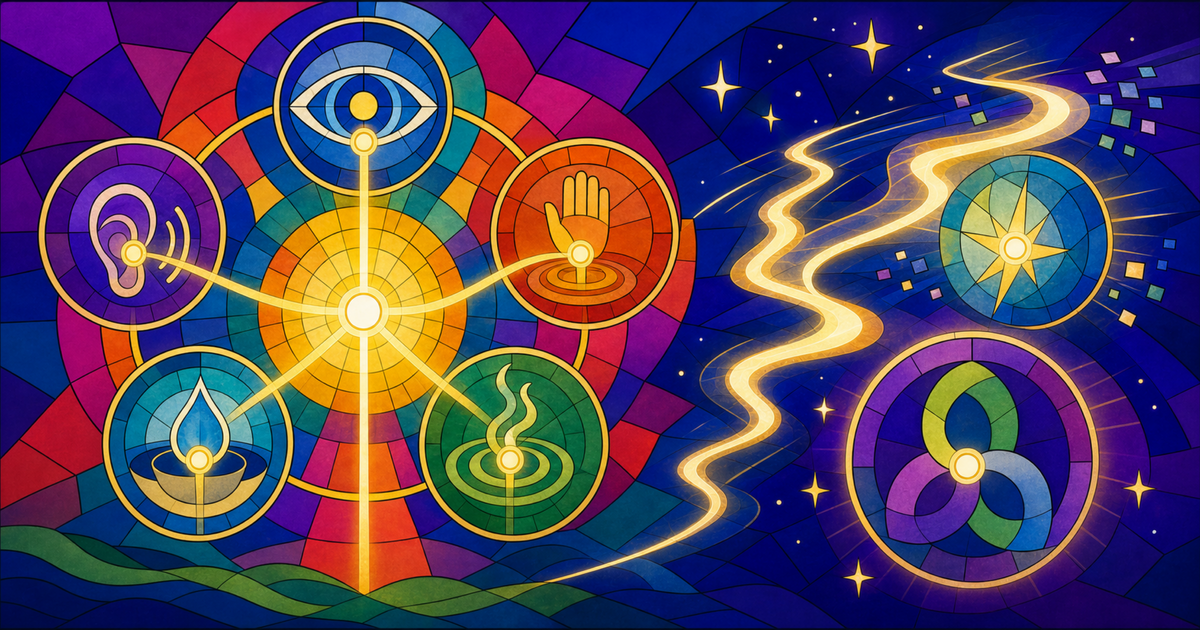
Saṃyama on the five aspects of the sense faculties grants movement swift as thought, cognition without bodily sense instruments, and mastery over pradhāna.

PYS 3.49–51: Allwissen oder Kaivalya

Yogaśāstra 3.49–51: Relinquishing the Highest Siddhis

Distinguishing sattva from puruṣa grants omniscience and dominion. Dispassion toward these destroys the seed of defect and leads to kaivalya; divine...

PYS 3.52–55: Viveka und Kaivalya

Yogaśāstra 3.52–55: Knowledge without Sequence

Saṃyama on moment and sequence produces all-encompassing, nonsequential discriminative knowledge. When sattva and puruṣa are equally pure, there is kaivalya.

Patañjali Yoga Sūtra 3.52
Through Saṃyama (saṃyamāt | abl sg) on the [smallest] moment and its sequence (kṣaṇa-tat-kramayoḥ | loc du) [arises] knowledge born of discrimination (vivekajaṃ jñānam | nom sg).
Dr. Ronald Steiner - 2026 - historically literal
Patañjali Yoga Sūtra 3.53
From this (tataḥ) [arises] discernment [of the difference] (pratipattiḥ | nom sg) between two alike [things] (tulyayoḥ | gen du), because their difference cannot be delimited (anyatānavacchedāt | abl sg) by class, characteristic, and place (jāti-lakṣaṇa-deśaiḥ | ins pl).
Dr. Ronald Steiner - 2026 - historically literal
Patañjali Yoga Sūtra 3.54
Knowledge born of discrimination (vivekajaṃ jñānam | nom sg) [is] born of one’s own intuition [rather than imparted through instruction] (tārakam | nom sg n); it encompasses every object (sarva-viṣayam | nom sg n), encompasses [each] in every way (sarvathā-viṣayam | nom sg n), and is nonsequential (akramam | nom sg n)—thus (ceti) [it is defined].
Dr. Ronald Steiner - 2026 - historically literal
Patañjali Yoga Sūtra 3.55
When there is equality of purity (śuddhi-sāmye | loc sg) between Sattva [of Citta] and Puruṣa (sattva-puruṣayoḥ | gen du), [there is] isolation [of Puruṣa] (kaivalyam | nom sg)—thus (iti).
Dr. Ronald Steiner - 2026 - historically literal

Continue with AYI Free

Illustrations: AI-generated.

Editor

Dr. Ronald Steiner

From Ulm

The "Yoga Doc" - Dr. Ronald Steiner is the founder of the AYI method. This method links traditional Ashtanga Yoga with innovative Yogatherapy and living Philosophy. This forms a practice that is personal for each and... more ›

Laura von Ostrowski

Ich bin 2004 das erste Mal mit Yoga in Berührung gekommen und habe seitdem unendlich viele Facetten kennengelernt. Einerseits die vielfältigen praktischen Seiten von Yoga - in Form verschiedener Ausbildungen (500 h... more ›