


jāti-lakṣaṇa-deśair anyatānavacchedāt tulyayos tataḥ pratipattiḥ ||53|| Analysis ▾ Analysis ▴
|
jāti
|
Genus, species, birth | |
|
lakṣaṇa
|
characteristic, characteristic | |
|
deśaiḥ
|
place, place | |
|
anyatā
|
Difference, otherness | |
|
anavacchedāt
|
Non-demarcation, non-determination | |
|
tulyayoḥ
|
of two equals | |
|
tatas
|
from this, through this | |
|
pratipattiḥ
|
perception, apprehension |
The Vyāsa-Bhāṣya here explains the power of knowledge born of discrimination (vivekaja-jñāna).
Ordinarily, we distinguish things by:
- Jāti: genus or species,
- Lakṣaṇa: characteristic or mark,
- Deśa: place or location.
When two things appear alike in all three respects, ordinary perception remains uncertain. Knowledge born of discrimination nevertheless knows their difference because it apprehends the moment (kṣaṇa) and sequence (krama) of each. Difference thus becomes perceptible even where external characteristics no longer allow the two to be distinguished.
tārakaṃ sarva-viṣayaṃ sarvathā-viṣayam akramaṃ ceti vivekajaṃ jñānam ||54|| Analysis ▾ Analysis ▴
|
tārakam
|
saving, leading over | |
|
sarva
|
everything | |
|
viṣayam
|
Subject area, area | |
|
sarvathā
|
in every way | |
|
viṣayam
|
Subject area, area | |
|
akramam
|
without sequence, not successively | |
|
ca
|
and | |
|
iti
|
thus, namely | |
|
vivekajam
|
born of distinction | |
|
jñānam
|
Knowledge, understanding |
The Vyāsa-Bhāṣya explains tāraka here as knowledge that arises from one’s own intuition (svapratibhottha) and is not conveyed through instruction (anaupadeśika). It encompasses all objects, knows them in every respect, and—unlike ordinary thought—does not proceed step by step. It is therefore the mature form of knowledge born of discrimination.
When Buddhi-Sattva, cleansed of Rajas and Tamas, has no task left except revealing its difference from Puruṣa, and the seeds of the Kleśas have been burned, its purity becomes, as it were, equal to Puruṣa’s. The Vyāsa-Bhāṣya explicitly makes this outcome independent of whether the yogin has attained extraordinary mastery or complete discriminative knowledge: once the seeds of the Kleśas have been burned, no further knowledge is needed. The Kleśas and karmic fruition cease, the Guṇas no longer present themselves to this Puruṣa as objects of sight, and Puruṣa remains alone as the stainless light of its own nature; this is kaivalya.
In PE1904, iti marks the end of the statement. PM2026 and TKVD2019 omit the particle. The critical apparatus of PM2026 reports no support for it in the manuscripts used there; TKVD2019 additionally attests the same omission in the printed Desikachar lineage but is not itself a manuscript witness. The doctrinal meaning is unchanged, but the sentence and textual boundary is marked less explicitly. The working translation retains the base reading.
Continue with AYI Free
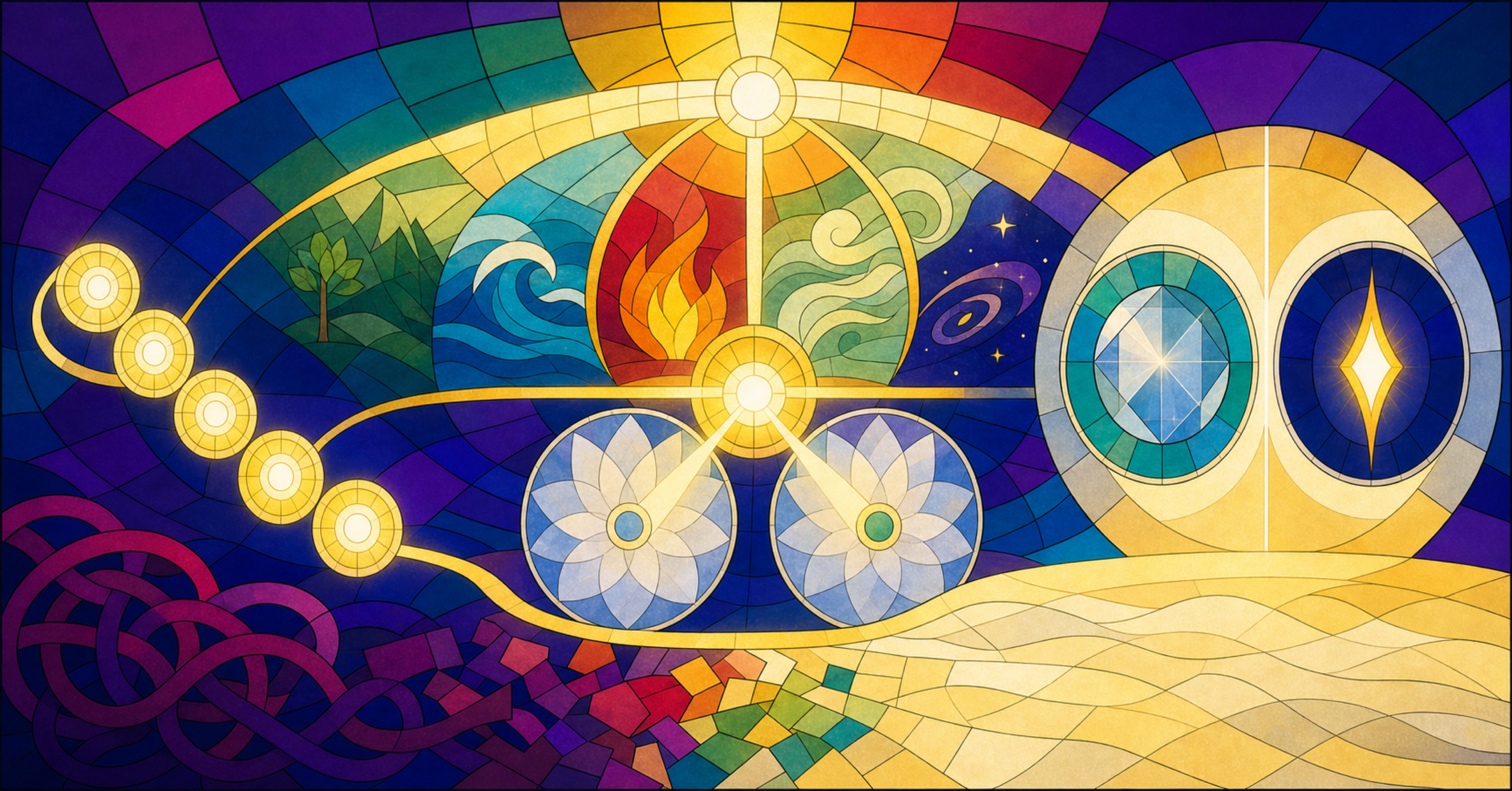
Illustrations: AI-generated.


Please log in to write a message. Go to login
No messages yet.