

marut मरुत् – Wind; Atem
Partikel · Substantiv Feminin · Substantiv Maskulin · Substantiv Neutrum · Worttyp nicht bestimmt
Wörterbuchquellen
AYI Wörterbuch Substantiv Maskulin · Substantiv Neutrum
Cappeller 1891 Substantiv Maskulin
Originaltext · Englisch · Substantiv Maskulin
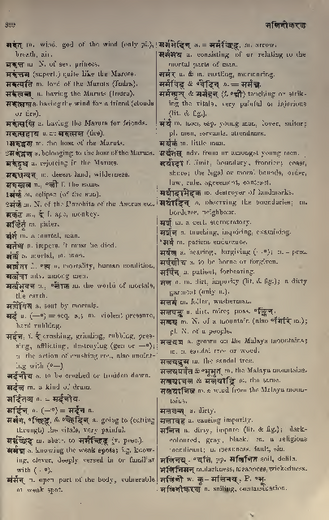
marút ·m. wind, god of the wind (only pl.), breath, air.
Monier-Williams 1872 Substantiv Maskulin
Originaltext · Englisch · Substantiv Maskulin
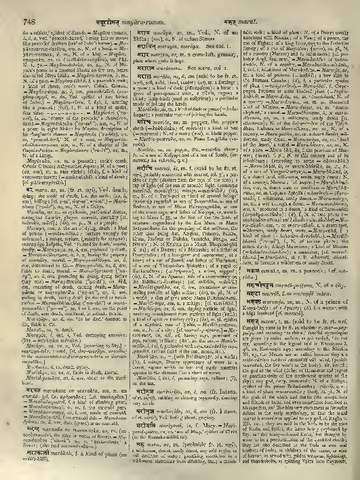
marut marut, t, m. (said to be fr. rt. mṛ, thought by some to be fr. an obsolete rt. mar = μαρ- μαίρω and meaning ‘to shine;’ fanciful etymologies are given by native authors, as mā rudaḥ, ‘do not cry,’ according to the legend told in Rāmāyaṇa 1. 46, 20, Hari-vaṃśa 249; according to the Nirukta XI. 13, the Maruts are so called because they are mita-rāviṇo mahad ravantīti vā), wind, (pañca marutaḥ, the five winds in the body), air, breath; the god of the wind (father of Hanu-mat and regent or guardian-deity of the north-west quarter of the sky); any god, deity, immortal; N. of a Sādhya; epithet of the prince Bṛhad-ratha; = ṛtv-ij, q. v.; a kind of plant, = maruvaka; (tas), m. pl., N. of the gods of the winds and storms (the companions and friends of Indra, and even sometimes described as his superiors, and like him very prominent as favourite deities in the early mythology, so that the word marut is sometimes applied to any god, cf. Raghu-v. XII. 101; they are said in the Veda to be the sons of Rudra and Pṛśni, the latter being explained by Sāy. as ‘the many-coloured Earth,’ but thought by some to be a personification of the speckled clouds; they are also described in the Veda as sons and brothers of Indra, as children of the ocean, as sons of heaven, as armed with golden weapons, lightnings, and thunderbolts, as splitting Vṛtra into fragments, as clothed with rain, as shaking the mountains and overturning trees, as having iron teeth and roaring like lions, as residing in the north, as riding with whips in their hands in golden cars drawn by ruddy horses, with which the chariots are said to be winged, and which are sometimes called Pṛṣatīḥ, q. v.; they are reckoned in the Nighaṇṭus among the gods of the middle sphere, and in Ṛg-veda VIII. 96, 8, are held to be sixty-three in number, forming nine Gaṇas or troops of seven each; in the Post-vedic literature they are described as the children of Diti, either seven or seven times seven in number, and are sometimes said to be led by Mātari-śvan; the legend in the Rāmāyaṇa and Hari-vaṃśa, referred to above, relates that the Asuras or sons of Diti having been subdued by Indra and the Suras, their mother im- plored her husband Kaśyapa, son of Marīci, to bestow on her an ‘Indra-destroying’ son; her request was granted, but Indra, with his weapon Vajra, divided the child with which she was pregnant into forty-nine pieces, which commenced uttering grievous cries till Indra in compassion afterwards transformed them into the Maruts or Winds); (t), f. Trigonella Corniculata, = pṛkkā; (t), n. an ill-scented kind of plant (= granthi-parṇa); in Naigh. 1. 2. marut is said to be a synonym of hiraṇya, ‘gold,’ and in III. 7. of rūpa, ‘form, beauty;’ [cf. māruta.]
Petersburger 1855 Partikel · Substantiv Feminin · Substantiv Maskulin · Substantiv Neutrum · Worttyp nicht bestimmt
Originaltext · Deutsch · Partikel · Substantiv Feminin · Substantiv Maskulin · Substantiv Neutrum
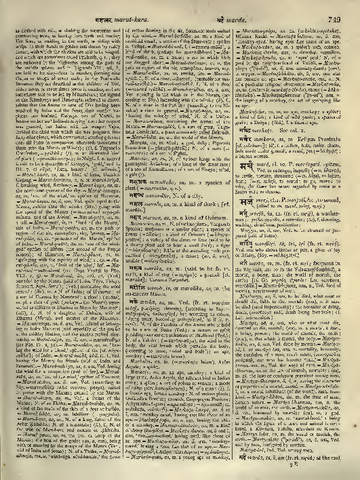
marút UṆĀDIS. 1,96. 1〉 m. a〉 pl. gaṇa parśvādi zu P. 5,3,117. N. der Götter der Winde, meist Indraʼs Gefährten; vgl. die Lieder ṚV. 1,85. fgg. ṚV. 1,165. ṚV. 2,34. fgg. ṚV. 5,52. ṚV. 7,58. fgg. ṚV. 7,59. fgg. ṚV. 8,20. AV. 4,27. VS. 7,36. VS. 12,70. Ihr Gespann sind die Pṛṣatī (s. d. und pṛṣadaśva); sie heissen pṛśnimātaraḥ ṚV. 1,23,10 u. sonst. ṚV. 5,52,16. auch Söhne Rudraʼs ṚV. 2,34,2. ṚV. 5,3,3. ṚV. 6,50,4. sie nennen sich Indraʼs Brüder ṚV. 1,170,2. indrāmarutaḥ ṚV. 2,29,3. drei mal sechzig Marut ṚV. 8,85,8. ma̱rutò de̱vānā̱ṃ viśàḥ TS. 2,2,5,7. sieben Schaaren (gaṇa) ebend. und TS. 11,1. TBR. 2,7,2,2. ŚAT. BR. 4,3,3,6. ŚAT. BR. 4,5,2,17. ŚAT. BR. 2,5,1,12. ŚAT. BR. 2,5,2,10. ŚAT. BR. 2,5,3,3. ŚAT. BR. 2,5,1,20. ŚAT. BR. 13,4,2,16. devānāṃ bhūyiṣṭhāḥ PAÑCAV. BR. 21,14,3. ĀŚV. GṚHY. 2,4,14. KAUŚ. 97. KAUŚ. 128. haben ihren Sitz im Norden VS. 9,35. Soma an ihrer Spitze CHĀND. UP. 3,9,1. zu den Götterschaaren des mittleren Gebiets gezählt NAIGH. 5,5. NIR. 11,13. vasavaḥ, rudrāḥ, ādityāḥ, marutaḥ, sādhyāḥ CHĀND. BR._in_Ind. St. 1,258. M. 3,88. M. 11,221. MBH. 3,1768. BHAG. 11,6. BHAG. 11,22. HARIV. 441. HARIV. 11050. HARIV. 12112. HARIV. 13162. HARIV. 14077. HARIV. 14171. marudutpatti Verz. d. Oxf. H. 12,b,48. Verz. d. Oxf. H. 46,b,31. Verz. d. Oxf. H. 83,a,12. Kinder der Diti und sieben oder sieben mal sieben an der Zahl R. 1,47,3. HARIV. 249. fgg. VP. 152. BHĀG. P. 6,18,18. Verz. d. Oxf. H. 39,a,16. Kinder der Marutvatī (vgl. marutvant) VP. 120. HARIV. 11548 (die Lesart der neueren Ausg. s. u. marutvant 2,b.). saptānāṃ marutāṃ lokān MBH. 13,5315. śakro 'si marutām MBH. 13,916. MBH. 14,1176. bhartā marutām = indraḥ VIKR. 36. marīcirmarutāmasmi (sagt Kṛṣṇa) BHAG. 10,21. marutāṃ chandāṃsi Ind. St. 8,76. die Gottheiten des Nakṣatra Mārgaśīrṣa WEBER, Nax. II, 370. WEBER, Nax. II,379. marutāmarkaḥ, kālakākrandaḥ, jyāhraudau, dhenu, prakrīḍaḥ oder saṃkrīḍaḥ oder ni krīḍaḥ, preṅkhaḥ, saṃstobhaḥ und saveśīyam Namen von Sāman Ind. St. 3,228. Wie Indra als Lieblingsgott des arischen Volkes allmählich in den Vordergrund tritt, so auch seine Gefährten, die Marut, und zwar in dem Grade, dass schliesslich marutaḥ gleichbedeutend mit devāḥ wird. AK. 3,4,14,61. H. 89. MED. t. 142. HALĀY. 1,4. marutāṃ paśyatāṃ tasya śirāṃsi patitānyapi RAGH. 12,101. Lot. de la b. l. 8. LALIT. ed. Calc. 111,17. vāyumarullipi die Schrift der Windgötter LALIT. ed. Calc. 144,4. — b〉 sg. der Gott des Windes: Vater Hanumantʼs RĀJA-TAR. 8,3260. Regent des Nordostens AK. 1,1,2,4. HALĀY. 1,100. — c〉 Wind AK. 1,1,1,58. AK. 3,4,14,61. H. 1106. MED. HALĀY. 1,75. SŪRYAS. 2,3. ŚĀK. 58. MEGH. 34. RAGH. 2,10. maruto vavuḥ RAGH. 3,14. surabhirmarut KATHĀS. 45,3. prāleya˚ Spr. 1914. MĀRK. P. 128,33. fgg. PRAB. 79,17. katarasminmarutāṃ pathi vartāmahe ŚĀK. 98,15. RAGH. 10,47. marutaḥ pañca śarīragocarān Winde im Körper RAGH. 8,19. marutpittajvaracikitsā Verz. d. B. H. No. 949. Luft: dhūmajyotiḥsalilamarutāṃ saṃnipātaḥ (meghaḥ) MEGH. 5. BHĀṢĀP. 2. Verz. d. Oxf. H. 226,a, No. 554, Śl. 4. Athem: yogino jitamarunmanasaḥ BHĀG. P. 3,32,10. — d〉 N. pr. eines Sādhya HARIV. 11536; die neuere Ausg. hat eine andere Lesart. — e〉 Bein. des Fürsten Brhadratha MAITRYUP. 2,1. MAITRYUP. 6,30. — f〉 = ṛtvij NAIGH. 3,18. — g〉 eine best. Pflanze, = maruvaka BHĀVAPR._im_ŚKDR. — h〉 fehlerhaft für maru MĀRK. P. 40,3. — 2〉 f. Trigonella corniculata Lin. (pṛkkā) ŚABDAR._im_ŚKDR. — 3〉 n. eine best. wohlriechende Pflanze, = granthiparṇa MED.; vgl. AK. 2,4,4,21. — 4〉 indecl. P. 1,4,57, Vārtt. 1 in der Calc. Ausg. — Etymologie der Grammatiker NIR. 11,13; vgl. HARIV. 249. fgg. R. 1,46,20. VP. 152. Zur Form des Wortes ist ausser garut und garmut auch parut (in parucchepa) zu vergleichen. Die Ableitung Neuerer von mar sterben ist unvereinbar mit dem Bilde, welches der Veda von den Marut giebt; auch ist das zu Hilfe genommene maru in der alten Sprache nicht nachweisbar. Dagegen würde eine im Sanskrit nicht mehr vorhandene Wurzel MAR schimmern, welche man zu μαρμαίρω u. s. w. annimmt, gut passen, und wären in diesem Falle die in NAIGH. 1,2. NAIGH. 3,7 für marut aufgestellten Bedeutungen Gold und Schönheit oder Schmuck bemerkenswerth. Indessen ist zu erinnern, dass auch garmut Gold be deuten soll, und leicht eine Verwechselung stattgefunden haben könnte. An dieselbe Wurzel schliesst sich auch marīci. — Vgl. māruta, māruti.
Originaltext · Deutsch · Worttyp nicht bestimmt
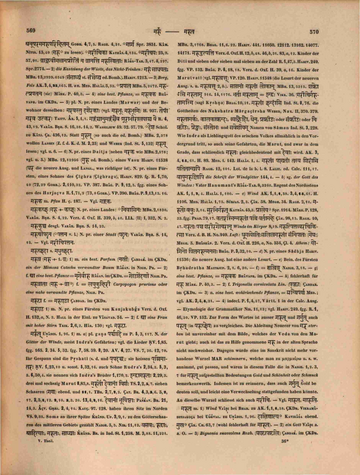
marut 1〉a〉 Sp. 570, Z. 10 lies ni- st. ni. — c〉 Athem auch BHĀG. P. 10,87,23.
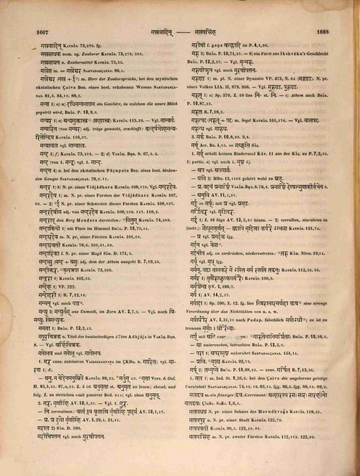
Böhtlingk 1879 Substantiv Feminin · Substantiv Maskulin · Substantiv Neutrum
Originaltext · Deutsch · Substantiv Feminin · Substantiv Maskulin · Substantiv Neutrum
marút — 1〉 m. — a〉 Pl. — α〉 Name der Götter des Windes (Gefährten Indraʼs). — β〉 die Götter überh. — b〉 der Gott des Windes. — c〉 Wind (auch des Körpers). — d〉 Luft. — e〉 Athem. — f〉 eine best. Pflanze BHĀVAPR. 1,229. — g〉 *= ṛtvij. — h〉 Bein. des Fürsten Bṛhadratha. — i〉 N. pr. eines Sādhya. — k〉 MĀRK. P. 40,3 fehlerhaft für marū. — 2〉 *f. Trigonella corniculata. — 3〉 *n. ein best. Parfum.
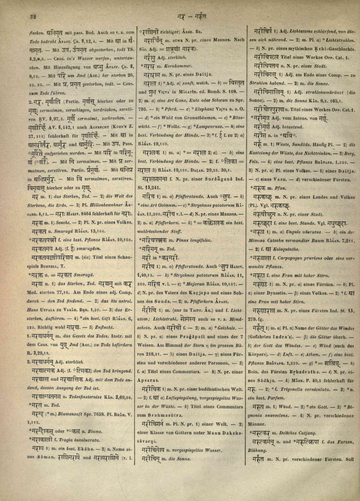
Apte 1890 Substantiv Maskulin · Substantiv Neutrum
Originaltext · Englisch · Substantiv Maskulin · Substantiv Neutrum
marut m. [mṛ-uti Uṇ. 1. 94] 1 Wind, air, breeze; diśaḥ prasedurmaruto vavuḥ sukhāḥ R. 3. 14. 2 Vital air or breath, life-wind; (ajayat) aparaḥ praṇidhānayogyayā marutaḥ paṃca śarīragocarān R. 8. 19; Ku. 3. 48. 3 The god of wind; Ki. 2. 25. 4 A god, deity; vaimānikānāṃ marutāmapaśyadākṛṣṭalīlānnaralokapālān R. 6. 1; R. 12. 101. 5 A kind of plant (maruvaka). — n. A kind of plant (graṃthiparṇa). Comp. — aṃdolaḥ a kind of fan (of a deer's or buffalo's skin). — iṣṭaṃ bdellium. — karaḥ a kind of bean. — karman n. — kriyā flatulency. — koṇaḥ the northwest quarter. — gaṇaḥ the host of the gods. — tanayaḥ, -putraḥ, -sutaḥ, -sūnuḥ 1 epithets of Hanumat. 2 of Bhīma. — dhvajaṃ the down of cotton floating in the air. — paṭaḥ a sail. — patiḥ, — pālaḥ an epithet of Indra. — pathaḥ sky, atmosphere. — plavaḥ a lion. — phalaṃ hail. — baddhaḥ 1 an epithet of Viṣṇu. 2 a kind of sacrificial vessel. — rathaḥ 1 a car in which idols of gods are moved about. 2 a horse. — lokaḥ the world of the Maruts. — vartman n. sky, atmosphere. — vāhaḥ 1 an epithet of fire. 2 of Indra.
Cappeller 1887 Substantiv Maskulin
Originaltext · Deutsch · Substantiv Maskulin
marut m. Wind, Gott des Windes, Luft, Atem; Pl. die Sturmgötter.
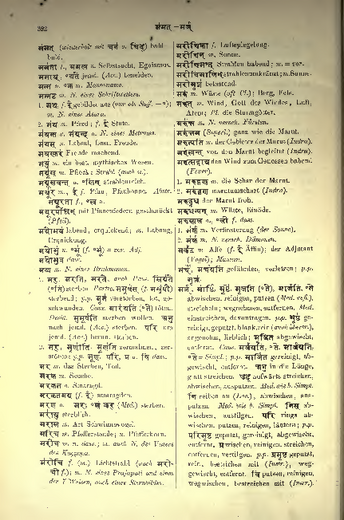
Burnouf 1866 Substantiv Maskulin
Originaltext · Französisch · Substantiv Maskulin
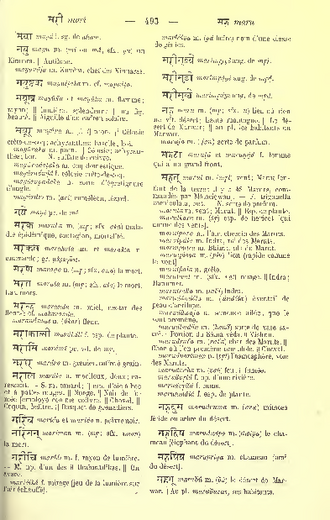
marut marut m. (mṛt) vent; Marut [enfant de la terre; il y a 48 Maruts, commandés par Mātariśvan]. — F. trigonella corniculata, bot. — N. sorte de parfum. maruta m. vent; Marut. Esp. de plante. marutkara m. (kṛ) esp. de haricot [qui donne des vents]. marutpatha m. l'air, chemin des Maruts. marutpāla m. Indra, roi des Maruts. marutputra m. Bhīma, fils du Marut. marutplava m. (plu) lion (rapide comme le vent). marutphala n. grêle. marutvat m. (sfx. vat) nuage. Indra; Hanumat. marutsakha m. (sakhi) Indra. marudāndola m. (āndola) éventail de peau d'antilope. maruddhvaja n. semence ailée, que le vent promène. marudbaddha m. (bandh) sorte de vase sacré. Portion du Sāma veda. Viṣṇu. marudratha m. (ratha) char des Maruts. Char où l'on promène une idole. Cheval. marudvartman n. (vṛt) l'asmosphère, voie des Maruts. marudvāha m. (vah) feu; fumée. marudhvṛtā f. np. d'une rivière. marudvṛdhā f. mms. marunmālā f. esp. de plante.
Quelltextfundstellen (16)
GoS 4 Fundstellen
HP 4 Fundstellen
HTK 4 Fundstellen
HTK 10.26–29*1: Cakra, Śaṅkha, Vāmāvartta, Vartmagati und Gadā 1 Fundstelle
Direkt belegt
-
HTK 10.26 Segment 11
SiSa 2 Fundstellen
Mit AYI Free weitermachen
Bildquelle: AYI Archiv.