

hṛ हृ – take; carry; remove
verbal root · Word type unspecified · verb
Dictionary sources
AYI dictionary verbal root
take; carry; remove
Cappeller 1891 verb
Original text · English · verb
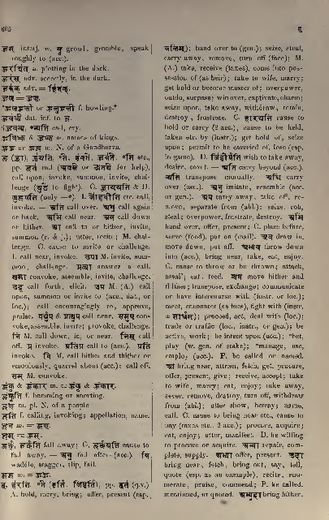
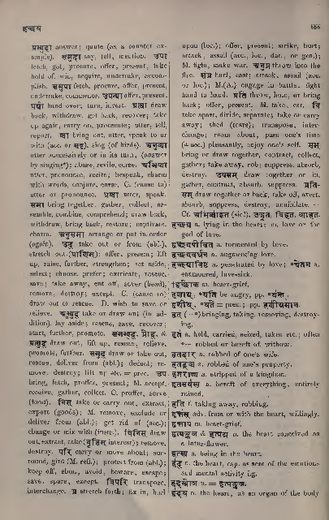
hṛ hárati hára°te ·v (harti, jiharti), pp. hṛtá (q.v.) A. hold, carry, bring; offer, present (esp. balim); hand over to (gen.); seize, steal, carry away, remove, turn off (face); M. (A.) take, receive (taxes), come into possession of (as heir); take to wife, marry; get hold or become master of; overpower, outdo, surpass; win over, captivate, charm; seize upon, take away, withdraw, retain, destroy, frustrate. C. hārayati cause to hold or carry (2 acc.), cause to be held, taken etc. by (instr.); get hold of, seize upon; permit to be carried of, lose (esp. in game). D. jíhīrṣati wish to take away, desire, covet. -- ati carry beyond (acc.). vyati transpose mutually. adhi carry over (acc.). anu imitate, resemble (acc. or gen.). apa carry away, take off, remove, separate from (abl.); seize, rob, steal; overpower, frustrate, destroy. abhi hand over, offer, present; C. place before, serve (food), put on (mail). ava draw in, move down, put off. abhyava throw down into (acc.), bring near, take, eat, enjoy. C. cause to throw or be thrown; attack, assail; eat, feed. vyava move hither and thither; transpose, exchange; communicate or have intercourse with (instr. or loc.); meet, encounter (as foes), fight with (instr. ±sārdham); proceed, act, deal with (loc.); trade or traffic (loc., instr., or gen.); be active, work; be intent upon (acc.); *bet, play (w. gen. of stake); *manage, use, employ (acc.). P. be called or named. ā bring near, attract, fetch, get, procure, offer, present, give; receive, accept; take to wife, marry; eat, enjoy; take away, sever, remove, destroy, turn off, withdraw from (abl.); utter show, betray; name, call. C. cause to bring near etc., cause to pay (taxes etc., 2 acc.); procure, acquire; eat, enjoy; utter, manifest. D. be willing to procure or acquire. anvā repair, complete, supply. abhyā offer, present. udā bring near, fetch, bring out, say, tell, quote (esp. as an example), recite, enumerate, praise, commend; P. be called, mentioned, or quoted. abhyudā bring hither. prabhyudā answer; quote (as a counter example). samudā say, tell, mention. upā fetch, get, procure, offer, present, take hold of, win, acquire, undertake, accomplish. samupā fetch, procure, offer, present, undertake, commence. upanyā offer, present. paryā hand over; turn, invert. pratyā draw back, withdraw, get back, recover; take up again, carry on, prosecute; utter, tell, report. vyā bring out, utter, speak to or with (acc. or saha), sing (of birds). anuvyā utter successively or in its turn, (answer by singing*); abuse, revile, curse. abhivyā utter, pronounce, recite; bespeak, charm with words, conjure, curse. C. (cause to) utter or pronounce. pravyā utter, speak. samā bring together, gather, collect, assemble, combine, comprehend; draw back, withdraw, bring back, restore; captivate, charm. anusamā arrange or put in order (again). ud take out or from (abl.), stretch out (pāṇim); offer, present; lift up, raise, further, strengthen; set aside, select; choose, prefer; extricate, rescue, save; take away, cut off, sever (head), remove, destroy; except. C. (cause to) draw out or rescue. D. wish to save or relieve. abhyud take or draw out (in addition), lay aside; rescue, save, recover; start, further, promote. samabhyud, prod & pratyud draw out, lift up, rescue, relieve, promote, further. samud draw or take out, rescue, deliver from (abl.); deduct; remove, destroy; lift up etc. = prec. upa bring, fetch, proffer, present; M. accept, receive, gather, collect. C. proffer, serve (food). nis take or carry out, extract, export (goods); M. remove, exclude or deliver from (abl.); get rid of (acc.); change or mix with (instr.). vinis draw out, extract, take (vṛddhim interest); remove, destroy. pari carry or move about; surround, gird (M. refl.); protect from (abl.); keep off, shun, avoid, beware, escape; save, spare, except. vipari transpose, interchange. pra stretch forth; fix in, hurl upon (loc.); offer, present; strike, hurt; attack, assail (acc., loc., dat., or gen.); M. fight, make war. anupra throw into the fire. saṃpra hurl, cast; attack, assail (acc. or loc.); M. (A.) engage in battle, fight hand to hand. prati throw, hold, or bring back; offer, present. M. take, eat. vi take apart, divide, separate; take or carry away; shed (tears); transpose, interchange; roam about, pass one's time (±acc.) pleasantly, enjoy one's self. sam bring or draw together, contract, collect, gather; take away, rob; suppress, absorb, destroy. upasam draw together or in, gather, contract, absorb, suppress. pratisam draw together or back, take off, avert, absorb, suppress, destroy, annihilate. -- Cf. abhivyā́hṛta (sic!), uddhṛta, vihṛta, vyāhṛta.
Monier-Williams 1872 Word type unspecified
Original text · English · Word type unspecified
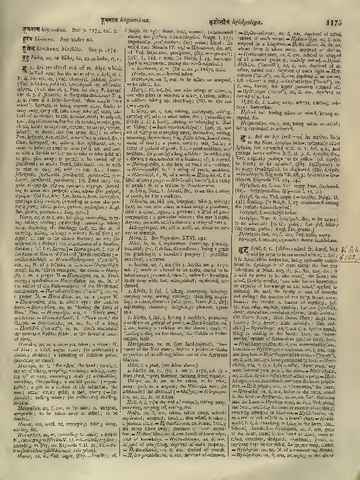
hṛ 1 . hṛ (evolved out of rt. bhṛ, which in Ved. often has the sense of rt. 1. hṛ), cl. 1. P. A. harati, -te, (Ved. bharati), jahāra, jahre, (Ved. jabhāra, jabhre), hariṣyati, -te, ahārṣīt, ahṛta, (Ved. also cl. 2. Pres. 1st sing. P. harmi, also cl. 3. P. jiharti; in Śatapatha-Brāhmaṇa X. 4, 3, 9. there is a form harāsai, ‘thou may'st have seized’), hartum, to bring, convey, carry, fetch; to carry away, carry off, take away, take off, seize, take hold of, extricate; to rob, plunder, steal; to strip off, spoil, despoil, remove, deprive of; to take, acquire, gain, obtain, hold; to captivate, charm; to accept, receive, inherit; to throw, cast (an arrow &c.); to offer: Pass. hriyate, Aor. ahāri, to be taken or seized, &c.: Caus. hārayati, -te, -yitum, Aor. ajīharat, -ta, to cause to bring or carry or seize (with acc. and inst. or with a double acc.), cause to take or take hold of; to give, give away; to permit to be carried off or plundered; to send: Desid. jihīrṣati, -te, to wish to take or carry off, wish to rob, &c.: Intens. jehrīyate, jarharīti, jariharīti, jarīharīti, jar- harti, jariharti, jarīharti; [cf. Zend zar; Gr. χείρ, εὐ-χερ-ής, χέρ-ης, χράομαι, κίχρημι, (accord- ing to some also perhaps) αἴρω, αἱρέω (for χαίρω), ἀγείρω; Old Lat. hir; Lat. heru-s, hera, her-e(d)-s, (perhaps also) co-hors, (according to some also per- haps) gero; Goth. geiro, gairon, gairnjan; Angl. Sax. georu, geornian; Eng. yare.]
Original text · English · Word type unspecified
hṛ 2 . hṛ or hṝ (referred in native lists to the Nom. hṛṇīya below, technically called hṛṇīṅ, but connected with rt. 1. hrī, q. v., and perhaps better written hṝ), cl. 9. A. hṛṇīte, &c., Ved. originally perhaps ‘to be yellow’ (cf. hari); to blush; to be ashamed, (Sāy. lajjāyām); to be angry (roṣāyām), be displeased, (Sāy. hṛṇīte = krudhyati, Ṛg-veda VII. 86, 3; hṛṇīṣe = kru- dhyasi, Ṛg-veda VII. 104, 14.)
Whitney Roots 1885 verbal root
Original text · English · verbal root
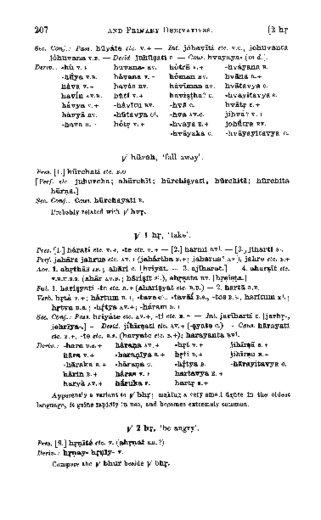
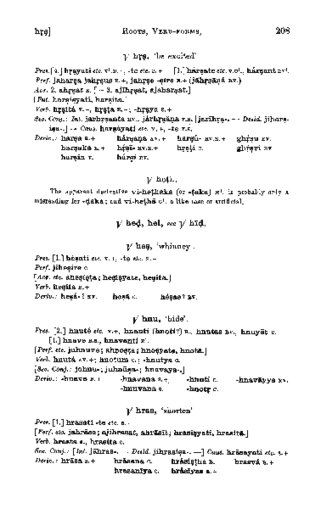
hṛ [1] — take
Original text · English · verbal root
hṛ [2] — be angry
Apte 1890 verbal root
Original text · English · verbal root
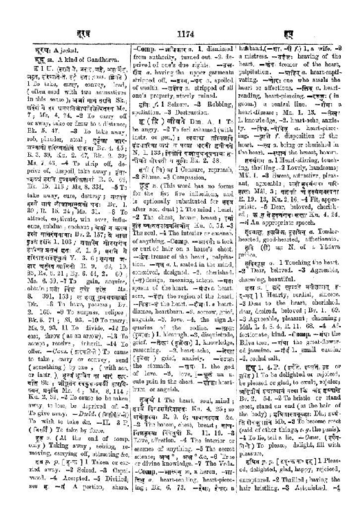
hṛ I. 1 U. (harati-te, jahāra, jahre, ahārṣīt, ahṛta, hariṣyati-te, hartuṃ hṛta; pass. hriyate) 1 To take, carry, convey, lead, (often used with two accusatives in this sense); ajāṃ grāmaṃ harati Sk.; saṃdeśaṃ me hara dhanapatikrodhaviśleṣitasya Me. 7; Ms. 4. 74. 2 To carry off or away, take or draw to a distance; Bk. 5. 47. 3 To take away, rob, plunder, steal; durvṛttā jārajanmāno hariṣyaṃtīti śaṃkayā Bv. 4. 45; R. 3. 39, Ku. 2. 47, Bk. 2. 39; Ms. 7. 43. 4 To strip off, deprive of, despoil, take away; vṛṃtācślathaṃ harati puṣpamanokahānāṃ R. 5. 69, Bk. 15. 116; Ms. 8. 334. 5 To take away, cure, destroy; tathāpi harate tāpaṃ lokānāmunnato ghanaḥ Bv. 1. 39; R. 15. 24; Me. 31. 6 To attract, captivate, win over, influence, subdue; enchant; ceto na kasya harate gatiraṃganāyāḥ Bv. 2. 157; ye bhāvā hṛdayaṃ haraṃti Bv. 1. 103; tavāsmi gītarāgeṇa hāriṇā prasabhaṃ hṛtaḥ Ś. 1. 5; harati me harivāhanadiṅmukhaṃ V. 3. 6; mṛgayā jahāra catureva kāminī R. 9. 69, R. 10. 83, Rs. 6. 21; Bg. 6. 44, Bg. 2. 60; Ms. 6. 59. 7 To gain, acquire, obtain; tato viṃśaṃ nṛpo haret Ms. 8. 391, Ms. 8. 153; sa haratu subhagapatākāṃ Dk. 8 To have, possess; Bv. 2. 163. 9 To surpass, eclipse; Bk. 5. 71; Śi. 93. 10 To marry; Ms. 9. 93. 11 To divide. 12 To cast, throw (as an arrow). 13 To accept, receive, inherit. 14 To offer. — Caus. (hārayati-te) 1 To cause to take, carry or convey, send (something) by one, (with acc. or instr.); bhṛtyaṃ bhṛtyena vā bhāraṃ hārayati Sk.; jīmūtena svakuśalamayīṃ hārayiṣyan pravṛttiṃ Me. 4; Ms. 8. 114; Ku. 2. 39. 2 To cause to be taken away, to lose, be deprived of. 3 To give away. — Desid. (jihīṣati-te) To wish to take &c. II. 3 P. (jiharti) To take by force.
Cappeller 1887 Word type unspecified
Original text · German · Word type unspecified
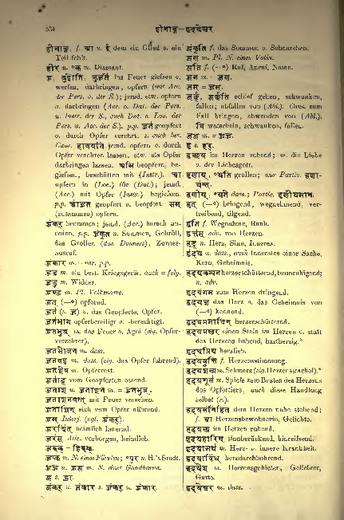
hṛ s. har.
Burnouf 1866 verbal root
Original text · French · verbal root
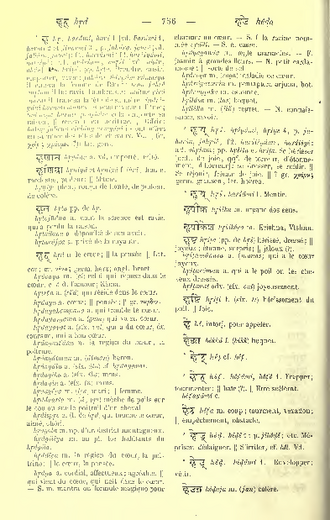
*hṛ hṛ. harāmi, hare 1 [vd. bharāmi 1, harmi 2 et jiharmi 3]; p. jahāra, jahre [vd. jabhāra, jabhre]; f1. hartāsmi; f2. hariṣyāmi, hariṣye; a1. ahārṣam, ahṛṣi [vd. ahār, ahāḥ]. Ps. hriye; pp. hṛta. Prendre, saisir, emporter, ravir: jahāra bhāryām rāmasya il enleva la femme de Rāma; tena jahre 'mṛtam il lui ravit l'ambroisie; mātus śiro 'harat il trancha la tête de sa mère; indriyāṇi haranti manas les sens ravissent l'âme; tad asya harati prajñām cela emporte sa raison; recevoir en héritage. Offrir: baliṃ jabhruḥ śīrṣāṇy aśvyāni ils ont offert en sacrifice des têtes de chevaux. Vd. Gr. χείρ; χράομαι (?); lat. gero.
Occurrences in source texts (21)
DYS 4 occurrences
GoS 2 occurrences
HP 7 occurrences
1 more source page
HTK 2 occurrences
PJH 1 occurrence
SiSa 3 occurrences
SiSa 5.191-5.207: Kailāsa und Mahāśūnya 2 occurrences
Direct occurrences
-
SiSa 5.193 Segment 19
-
SiSa 5.194 Segment 13
SVU 1 occurrence
VBT 1 occurrence
Continue with AYI Free
Image source: AYI archive.