
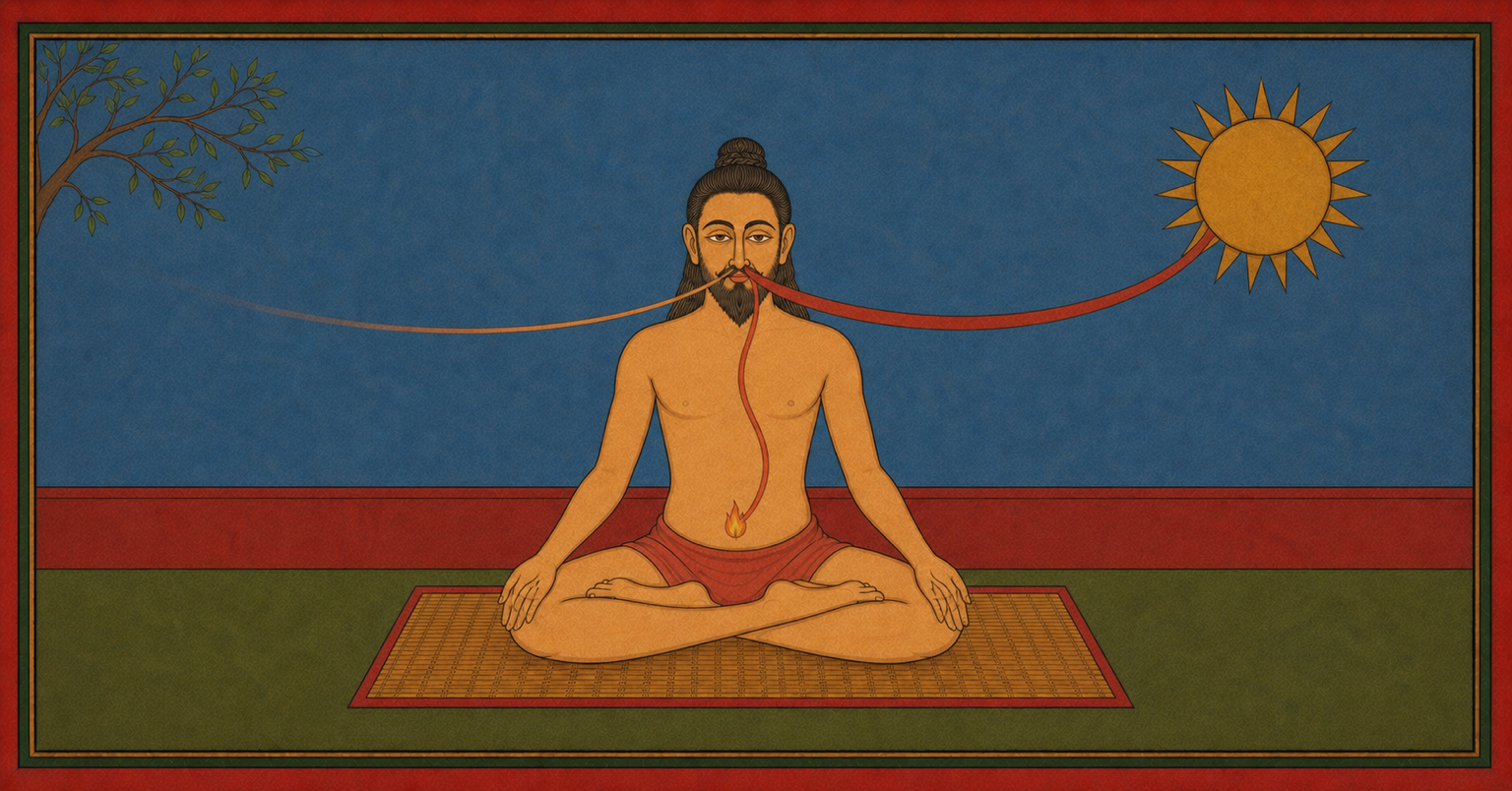
Illustration for the Haṭha Pradīpikā section “HP 2.48-2.50: Sūryabhedana”.

Haṭha Pradīpikā 2.48-2.50: Sūryabhedana

Sūryabhedana is described as inhaling through the right, retaining, and exhaling through the left; it cleanses, warms, and removes Doṣas.

Dr. Ronald Steiner Dr. Ronald Steiner
Haṭha Pradīpikā 2.48
आसने सुखदे योगी बद्ध्वा वज्रासनं ततः |
āsane sukha-de yogī; baddhvā vajrāsanaṃ tataḥ | Analysis ▾ Analysis ▴
āsane
lokative singular
substantive neuter
on the seat, in the posture
sukha
karmadhāraya-compound
adjective
pleasant, comfortable
de
lokative singular neuter
adjective
giving, making pleasant
yogī
nominative singular
substantive masculine
the yogin
baddhvā
absolutus
verbal root
having bound, adopted
vajrāsanam
accusative singular
substantive neuter
Vajrāsana
tataḥ
adverb
then
दक्षनाड्या समाकृष्य बहिःस्थं पवनं शनैः ||48||
dakṣa-nāḍyā samākṛṣya; bahiḥ-sthaṃ pavanaṃ śanaiḥ ||48|| Analysis ▾ Analysis ▴
dakṣa
tatpuruṣa-compound lokative
adjective
right
nāḍyā
instrumental case singular
substantive feminine
through the nāḍī, channel
sam
previx
together, completely
ākṛṣya
absolutus
previx
verbal root
having drawn in
bahiḥ
tatpuruṣa-compound lokative
adverb
outside
stham
accusative singular masculine
adjective
situated, remaining
pavanam
accusative singular
substantive masculine
the breath, wind
śanaiḥ
adverb
slowly, gradually
Metre: Anuṣṭubh
On a comfortable seat (āsane sukhade | loc sg), the yogi (yogī | nom sg), having adopted (baddhvā | abs) Vajrāsana (vajrāsanaṃ | acc sg), should then (tataḥ) slowly (śanaiḥ) draw in (samākṛṣya | abs) the external air (bahiḥsthaṃ pavanam | acc sg) through the right channel (dakṣa-nāḍyā | ins sg).
Dr. Ronald Steiner - 2026 - historically literal
For Sūryabhedana, the yogi sits comfortably in Vajrāsana and slowly draws the breath in through the right channel.
Dr. Ronald Steiner - 2026 - modern transfer

From the Yogacintāmaṇi, Brahmānanda inserts a complete daily framework:

  • In the morning, the guru and chosen deity are remembered, purification and resolve are performed, and Ananta is invoked for success in Āsana.
  • When fatigue arises during Āsanas, Śavāsana follows; Viparītakaraṇī precedes Kumbhaka.
  • Alternate-nostril breathing begins with ten rounds and increases by five each day to 80. This is followed by Sūryabhedana, Ujjāyī, Sītkārī, Śītalī, Bhastrikā, further Kumbhakas, Mudrās, and Nāda meditation.
  • The practice is offered to Īśvara. A warm bath, brief duties, and later suitable food, teachings on liberation, listening to the Purāṇas, or divine names follow.
  • A similar sequence is repeated at noon, in the evening, and at night. Viparītakaraṇī is omitted in the evening, at night, and after eating.

The insertion presents Prāṇāyāma as part of a religiously and temporally ordered life.

Brahmānanda's Jyotsnā - 19th c.
vajrāsanaṃ MBHDL2026 ] caivāsanaṃ NS1882
Critical Apparatus
Taking any comfortable posture and performing the âsana, the Yogî should draw in the air slowly, through the right nostril.
Pancham Sinh - 1915
Placing himself on a convenient seat and assuming an easy asana, the Yogi should slowly draw in the breath through the right Nadi, Pingala.
Srinivasa Iyangar - 1893
Auf einem angenehmen Sitz verweile der Yogin in einem Asana und ziehe langsam die äussere Luft durch die rechte Nâdî (Sûrya, Pingala) ein.
Hermann Walter - 1893
Haṭha Pradīpikā 2.49
आ केशाग्रान्नखाग्राच्च निरोधावधि कुम्भयेत् |
ā keśāgrān nakhāgrāc ca; nirodhāvadhi kumbhayet | Analysis ▾ Analysis ▴
ā
particle
up to
keśa
tatpuruṣa-compound genitive
substantive neuter
hair
agrān
accusative plural
substantive masculine
tips
nakha
tatpuruṣa-compound genitive
substantive neuter
nail
agrāt
ablative singular
substantive neuter
tip, extreme end
ca
particle
and
nirodha
tatpuruṣa-compound accusative
substantive neuter
restraint, retention
avadhi
accusative singular
substantive neuter
limit, up to the limit
kumbhayet
3rd person singular aktive optative
verbal root
he should retain in kumbhaka
ततः शनैः सव्यनाड्या रेचयेत्पवनं सुधीः ||49||
tataḥ śanaiḥ, savya-nāḍyā; recayet pavanaṃ sudhīḥ ||49|| Analysis ▾ Analysis ▴
tataḥ
adverb
afterward
śanaiḥ
adverb
slowly
savya
karmadhāraya-compound
adjective
left
nāḍyā
instrumental case singular
substantive feminine
through the nāḍī
recayet
3rd person singular aktive optative
verbal root
he should exhale
pavanam
accusative singular
substantive masculine
the breath, wind
sudhīḥ
nominative singular masculine
adjective
the wise, discerning one
Metre: Anuṣṭubh
He should hold the breath (kumbhayet | 3p sg act opt) from the tips of the nails (nakhāgrāt | abl sg) as far as the tips of the hair (ā keśāgrān | acc pl), up to the limit of cessation (nirodhāvadhi | acc sg); afterwards (tataḥ), the wise man (sudhīḥ | nom sg) should slowly (śanaiḥ) exhale (recayet | 3p sg act opt) the breath (pavanam | acc sg) through the left channel (savya-nāḍyā | ins sg).
Dr. Ronald Steiner - 2026 - historically literal
The breath is retained until its effect reaches the tips of the hair and nails. The yogi then exhales slowly through the left channel.
Dr. Ronald Steiner - 2026 - modern transfer

Brahmānanda connects strong breath retention with long-term habituation. The resolve to conquer Prāṇa immediately by force would be wrong, yet within gradual training Kumbhaka is to be deepened with great effort. Inhalation may be slow or rapid; exhalation always remains slow, because hasty emptying, in his explanation, causes loss of strength.

Brahmānanda's Jyotsnā - 19th c.
ā keśāgrān nakhāgrāc ca MBHDL2026 ] ākeśād ānakhāgrāc ca NS1882

sudhīḥ MBHDL2026 ] śanaiḥ NS1882
Critical Apparatus
Then it should be confined within, so that it fills from the nails to the tips of the hair, and then let out through the left nostril slowly.
Pancham Sinh - 1915
He should practise Kumbhaka until he feels that Prâna pervades the whole of his body from the head to the toe. Then he should slowly exhale it through the right nostril.
Srinivasa Iyangar - 1893
Man verrichte den Kumbhaka, bis der Athem gehemmt ist von den Haaren bis zu den Zehenspitzen, dann athme man langsam durch die linke Nâdî (Ida, Candra) die Luft wieder aus.
Hermann Walter - 1893
Haṭha Pradīpikā 2.50
कपालशोधनं वातदोषघ्नं कृमिदोषहम् |
kapāla-śodhanaṃ vāta;-doṣa-ghnaṃ kṛmi-doṣa-ham | Analysis ▾ Analysis ▴
kapāla
tatpuruṣa-compound genitive
substantive neuter
of the skull, head
śodhanam
nominative singular
substantive neuter
purification
vāta
tatpuruṣa-compound accusative
substantive masculine
vāta, wind
doṣa
tatpuruṣa-compound accusative
substantive masculine
disorder, doṣa
ghnam
nominative singular neuter
adjective
removing, destroying
kṛmi
tatpuruṣa-compound accusative
substantive masculine
worm, parasite
doṣa
tatpuruṣa-compound accusative
substantive masculine
disorder, disease
ham
nominative singular neuter
verbal root
removing, expelling
पुनः पुनरिदं कार्यं सूर्यभेदमुदाहृतम् ||50||
punaḥ punar idaṃ kāryaṃ; sūrya-bhedam udāhṛtam ||50|| Analysis ▾ Analysis ▴
punaḥ
adverb
again
punar
adverb
repeatedly
idam
nominative singular neuter
pronoun dem
this
kāryam
nominative singular neuter future participle passive
verbal root
to be performed
sūrya
tatpuruṣa-compound genitive
substantive masculine
of the sun, solar channel
bhedam
accusative singular
substantive neuter
piercing, breaking through
udāhṛtam
nominative singular neuter past participle passive
previx
previx
verbal root
called, designated
Metre: Anuṣṭubh
This (idam | nom sg n) purifies the skull (kapāla-śodhanam | nom sg), removes disorders of Vāta (vāta-doṣa-ghnam | nom sg n), and dispels diseases caused by worms (kṛmi-doṣa-ham | nom sg n). It is to be performed (kāryam | nom sg n pfp) again and again (punaḥ punar) and is called (udāhṛtam | nom sg n ppp) Sūryabheda (sūrya-bhedam | acc sg).
Dr. Ronald Steiner - 2026 - historically literal
Sūryabheda is said to cleanse the skull and remove Vāta disorders and illnesses caused by worms. For this reason, the practice is repeated.
Dr. Ronald Steiner - 2026 - modern transfer
kṛmidoṣaham MBHDL2026 ] kṛmidoṣahṛt NS1882

sūryabhedam udāhṛtam MBHDL2026 ] sūryabhedanam uttamam NS1882
Critical Apparatus
This excellent Sûrya Bhedana cleanses the forehead (frontal sinuses), destroys the disorders of Vâta, and removes the worms, and, therefore, it should be performed again and again.
Pancham Sinh - 1915
This Suryabhedi Kumbhaka should again and again be performed, as it purifies the brain and destroys the intestinal worms and the diseases arising from the excess of wind.
Srinivasa Iyangar - 1893
Dieses vortreffliche, immer und immer wieder zu übende Sûryabhedana reinigt den Kopf, vernichtet Athemkrankheiten und beseitigt die durch Würmer hervorgebrachten Störungen.
Hermann Walter - 1893

Continue with AYI Free

Illustrations: AI-generated.

Editor

Dr. Ronald Steiner

From Ulm

The "Yoga Doc" - Dr. Ronald Steiner is the founder of the AYI method. This method links traditional Ashtanga Yoga with innovative Yogatherapy and living Philosophy. This forms a practice that is personal for each and... more ›

Messages and ratings
0 messages

Please log in to write a message. Go to login

No messages yet.