
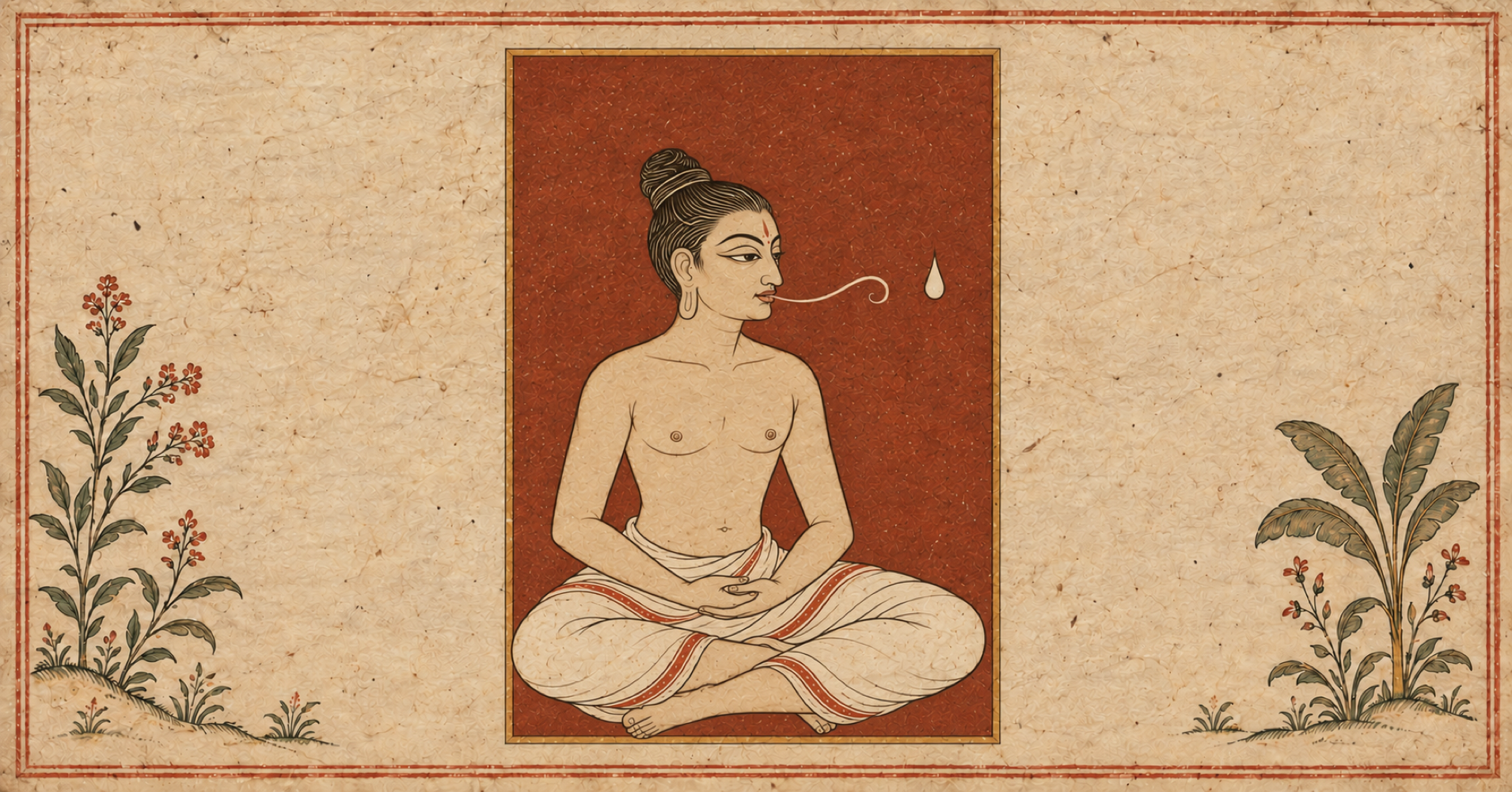

Haṭhatattvakaumudī 10.10
सीत्कां दद्यान् मुखेन प्रथमम् अनु विजृंभां च नासापुटाभ्यां नित्याभ्यासप्रयोगादिति भवति नरः कामदेवो द्वितीयः |
sītkāṃ dadyān mukhena, prathamam anu vijṛṃ,bhāṃ ca nāsā-puṭābhyāṃ; nityābhyāsa-prayogād, iti bhavati naraḥ, kāma-devo dvitīyaḥ | Analysis ▾ Analysis ▴
|
sītkām
|
hissing sound | |
|
dadyāt
|
one should give | |
|
mukhena
|
with the mouth | |
|
prathamam
|
first | |
|
anu
|
afterwards | |
|
vijṛmbhām
|
expansion, opening | |
|
ca
|
and | |
|
nāsā
|
of the nose | |
|
puṭābhyām
|
through the two openings | |
|
nitya
|
constant | |
|
abhyāsa
|
of practice | |
|
prayogāt
|
through application | |
|
iti
|
thus | |
|
bhavati
|
he becomes | |
|
naraḥ
|
the person | |
|
kāma
|
of love | |
|
devaḥ
|
god | |
|
dvitīyaḥ
|
second |
निद्रालस्यक्षुधातृट्रहित इह चरेद्योगिनीचक्रसेव्यः सृष्टेः संहारकारी विहरति स सदोपद्रवो न पृथिव्याम् ||10||
nidrālasya-kṣudhā-tṛṭ,-rahita iha cared, yoginī-cakra-sevyaḥ; sṛṣṭeḥ saṃhāra-kārī, viharati sa sado,padravo na pṛthivyām ||10|| Analysis ▾ Analysis ▴
|
nidrā
|
sleep | |
|
ālasya
|
sluggishness | |
|
kṣudhā
|
hunger | |
|
tṛṣ
|
thirst | |
|
rahitaḥ
|
freed | |
|
iha
|
here | |
|
caret
|
one should move | |
|
yoginī
|
of the Yoginīs, female divine beings | |
|
cakra
|
circle | |
|
sevyaḥ
|
to be revered | |
|
sṛṣṭeḥ
|
of creation | |
|
saṃhāra
|
dissolution | |
|
kārī
|
causing | |
|
viharati
|
he moves freely | |
|
saḥ
|
that | |
|
sadā
|
always | |
|
upadravaḥ
|
affliction | |
|
na
|
not | |
|
pṛthivyām
|
on the earth |
Metre: Sragdharā
First (prathamam), [one] should produce (dadyāt | 3p sg act opt) a hissing sound (sītkām | acc sg) with the mouth (mukhena | ins sg), and (ca) afterwards (anu) [bring about] an expansion [of breath] (vijṛmbhām | acc sg) through both nostrils (nāsā-puṭābhyām | ins du). Thus (iti), through the application of constant practice (nityābhyāsa-prayogāt | abl sg), a person (naraḥ | nom sg) becomes (bhavati | 3p sg act pres) a second (dvitīyaḥ | nom sg m) god of love (kāma-devaḥ | nom sg). Free from sleep, sluggishness, hunger and thirst (nidrālasya-kṣudhā-tṛṭ-rahitaḥ | nom sg m ppp), [he] may move (caret | 3p sg act opt) here (iha), worthy of reverence from the circle of Yoginīs (yoginī-cakra-sevyaḥ | nom sg m pfp). Bringing about dissolution (saṃhāra-kārī | nom sg m) of creation (sṛṣṭeḥ | gen sg), he (saḥ | nom sg m) always (sadā) moves (viharati | 3p sg act pres) upon the earth (pṛthivyām | loc sg), [with] no (na) affliction (upadravaḥ | nom sg).
The reference to the nostrils supports interpreting vijṛṃbhā as an outflow. I connect nominative upadravaḥ with a supplied verb: “no affliction [exists]”.
Return to the same sound as you practise. Notice whether you hear more detail over time or whether your attention wanders.
sītkāṃ dadyān mukhena GDJ2007 ] sītkādayānmukhe GDJ2007-b
vijṛṃbhāṃ ca GDJ2007 ] vijṛmbhāva GDJ2007-b
tṛṭrahita GDJ2007 ] tṛṭirahita GDJ2007-b
sevyaḥ GDJ2007 ] sodhu GDJ2007-b
vijṛṃbhāṃ ca GDJ2007 ] vijṛmbhāva GDJ2007-b
tṛṭrahita GDJ2007 ] tṛṭirahita GDJ2007-b
sevyaḥ GDJ2007 ] sodhu GDJ2007-b
Haṭhatattvakaumudī 10.11
सुधास्रावि शिरारन्ध्रतालु स्पृष्ट्वामृतं मरुत् |
हिमो जिह्वाग्रयुक्शीतल्येव सीत्कार्य् अतो ऽरुजा ||11||
Metre: Anuṣṭubh
Having touched (spṛṣṭvā | abs) the nectar-secreting (sudhā-srāvi | acc sg n) palate at the opening of the vessels (śirā-randhra-tālu | acc sg), the cool (himaḥ | nom sg m) breath (marut | nom sg), joined to the tip of the tongue (jihvāgra-yuk | nom sg m), [is] nectar (amṛtam | nom sg). Therefore (ataḥ), Sītkārī (sītkārī | nom sg) [is] precisely (eva) Śītalī (śītalī | nom sg), [and] free of disease (arujā | nom sg f).
I take amṛtam as a nominal predicate of marut.
Notice how air feels against your tongue and palate. For this observation, the simple distinctions between cool, warm and barely perceptible are enough.
spṛṣṭvāmṛtaṃ GDJ2007 ] spṛṣṭaścamṛta GDJ2007-b
sītkāryato'rujā em. ed. ] sītkārya'to'rujā GDJ2007
sītkāryato'rujā em. ed. ] sītkārya'to'rujā GDJ2007
Haṭhatattvakaumudī 10.11*1
इति पित्तज्वरदाहतृषादौ सीत्कारकुम्भकः |
Metre: none
Thus (iti) [is described] the hissing breath retention (sītkāra-kumbhakaḥ | nom sg) for Pitta, fever, burning, thirst and the like (pitta-jvara-dāha-tṛṣādau | loc sg).
The image of cooling can remind you to look for a comfortable measure in practice.
sītkāra GDJ2007 ] sītkā GDJ2007-b
Continue with AYI Free
Illustrations: AI-generated.

Please log in to write a message. Go to login
No messages yet.