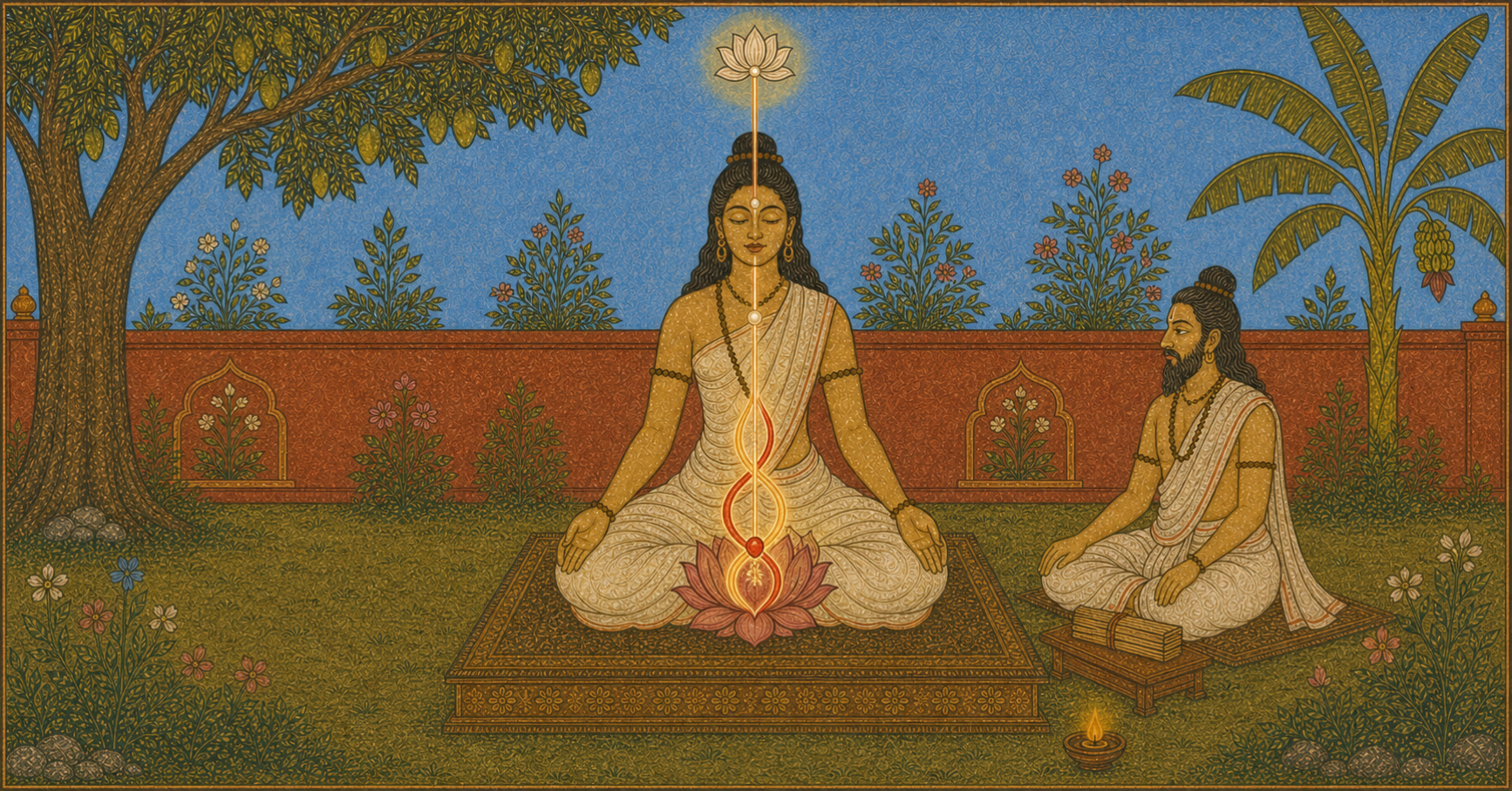
DYS 168–179*1: Vajrolī for the Yoginī

Dattātreyayogaśāstra 168–179*1: Preserving Rajas and Attaining Female Perfection

The yoginī is to retain rajas and practise with a knowledgeable partner; the DYŚ star verse preserves Avasthī’s brief transition to Amarolī and Sahajolī.

Dr. Ronald Steiner Dr. Ronald Steiner Nils Jacob Liersch Nils Jacob Liersch
Dattātreyayogaśāstra 168
सिन्दूरसदृशं योनौ स्त्रीणामस्ति नवं रजः |
sindūra-sadṛśaṃ yonau; strīṇām asti navaṃ rajaḥ | Analysis ▾ Analysis ▴
sindūra
tatpuruṣa-compound instrumental case
substantive neuter
red lead, vermilion
sadṛśam
nominative singular neuter
adjective
resembling
yonau
lokative singular
substantive feminine
in the vagina
strīṇām
genitive plural
substantive feminine
of women
asti
3rd person singular aktive present
verbal root
is found
navam
nominative singular neuter
adjective
fresh
rajas
nominative singular
substantive neuter
Rajas
तत्राव्रतो ऽप्ययं गच्छेत्तदाभ्यासेन रक्षयेत् ||168||
tatrāvrato 'py ayaṃ gacchet; tadābhyāsena rakṣayet ||168|| Analysis ▾ Analysis ▴
tatra
adverb
there
avrataḥ
nominative singular masculine
adjective
one who has taken no vows
api
particle
even
ayam
nominative singular masculine
pronoun dem
this one
gacchet
3rd person singular aktive optative
verbal root
may reach
tadā
adverb
then
abhyāsena
instrumental case singular
substantive masculine
through practice
rakṣayet
3rd person singular aktive optative
verbal root
should retain
Metre: Anuṣṭubh
Fresh Rajas (navaṃ rajaḥ | nom sg), resembling red lead (sindūra-sadṛśam | nom sg n), is found (asti | 3p sg act pres) in women’s vaginas (strīṇāṃ yonau | loc sg). Even (api) one who has taken no vows (avrataḥ | nom sg m) may reach it (gacchet | 3p sg act opt); then (tadā) he should retain it (rakṣayet | 3p sg act opt) through practice (abhyāsena | ins sg).
Dr. Ronald Steiner - 2026 - historically literal
Fresh Rajas, compared to red lead, is found in the vagina. Even someone who has taken no special vows may reach it and should learn to retain it.
Dr. Ronald Steiner - 2026 - modern transfer
sindūrasadṛśaṃ yonau strīṇām asti navaṃ rajaḥ JM2024 ] om. DYŚ

tatrāvrato ’py ayaṃ gacchet tadābhyāsena rakṣayet JM2024 ] om. DYŚ
Critical Apparatus
Dattātreyayogaśāstra 169
वज्रोलीमभ्यसेन्नारी रजोरक्षार्थमेव च |
vajrolīm abhyasen nārī; rajo-rakṣārtham eva ca | Analysis ▾ Analysis ▴
vajrolīm
accusative singular
substantive feminine
Vajrolī
abhyaset
3rd person singular aktive optative
previx
verbal root
should practise
nārī
nominative singular
substantive feminine
a woman
rajas
tatpuruṣa-compound genitive
substantive neuter
Rajas
rakṣā
tatpuruṣa-compound dative
substantive feminine
retention
artham
accusative singular
substantive masculine
for the purpose
eva
particle
only
ca
particle
and
यदि नारी रजो रक्षेद्वज्रोल्या सा हि योगिनी ||169||
yadi nārī rajo rakṣed; vajrolyā sā hi yoginī ||169|| Analysis ▾ Analysis ▴
yadi
particle
if
nārī
nominative singular
substantive feminine
a woman
rajas
accusative singular
substantive neuter
Rajas
rakṣet
3rd person singular aktive optative
verbal root
should retain
vajrolyā
instrumental case singular
substantive feminine
by means of Vajrolī
sā
nominative singular feminine
pronoun dem
she
hi
particle
indeed
yoginī
nominative singular
substantive feminine
a Yoginī
Metre: Anuṣṭubh
A woman (nārī | nom sg) too (ca) should practise (abhyaset | 3p sg act opt) Vajrolī (vajrolīm | acc sg), solely (eva) for the retention of Rajas (rajo-rakṣārtham | acc sg). If (yadi) a woman (nārī | nom sg) retains (rakṣet | 3p sg act opt) Rajas (rajaḥ | acc sg) by means of Vajrolī (vajrolyā | ins sg), she (sā | nom sg f) is truly (hi) a Yoginī (yoginī | nom sg).
Dr. Ronald Steiner - 2026 - historically literal
A woman too may practise Vajrolī in order to retain her Rajas. If she succeeds, the text calls her a true Yoginī.
Dr. Ronald Steiner - 2026 - modern transfer
vajrolīm abhyasen nārī rajorakṣārtham eva ca JM2024 ] om. DYŚ

yadi nārī rajo rakṣed vajrolyā sā hi yoginī JM2024 ] om. DYŚ
Critical Apparatus
Dattātreyayogaśāstra 170
अतीतानागतं वेत्ति खेचरी वा भवेद्ध्रुवम् |
atītānāgataṃ vetti; khecarī vā bhaved dhruvam | Analysis ▾ Analysis ▴
atīta
dvandva-compound past participle passive
previx
verbal root
past
anāgatam
accusative singular neuter past participle passive
previx
previx
verbal root
not yet arisen
vetti
3rd person singular aktive present
verbal root
knows
khecarī
nominative singular
substantive feminine
a Sky-Roving Yoginī
vā
particle
and
bhavet
3rd person singular aktive optative
verbal root
would become
dhruvam
adverb
certainly
देहसिद्धिं च लभते वज्रोल्यभ्यासयोगतः ||170||
deha-siddhiṃ ca labhate; vajroly-abhyāsa-yogataḥ ||170|| Analysis ▾ Analysis ▴
deha
tatpuruṣa-compound genitive
substantive masculine
body
siddhim
accusative singular
substantive feminine
perfection
ca
particle
and
labhate
3rd person singular medial present
verbal root
she attains
vajrolī
tatpuruṣa-compound genitive
substantive feminine
Vajrolī
abhyāsa
tatpuruṣa-compound genitive
substantive masculine
practice
yogatas
adverb
as a result of
Metre: Anuṣṭubh
She knows (vetti | 3p sg act pres) the past and the future (atītānāgatam | acc sg n) and (vā) is certain (dhruvam) to become (bhavet | 3p sg act opt) a Sky-Roving Yoginī (khecarī | nom sg f). As a result of practising Vajrolī (vajroly-abhyāsa-yogataḥ), she also (ca) obtains (labhate | 3p sg med pres) perfection of the body (deha-siddhim | acc sg).
Dr. Ronald Steiner - 2026 - historically literal
Such a Yoginī knows past and future, becomes a Sky-Rover, and attains perfection of the body through Vajrolī.
Dr. Ronald Steiner - 2026 - modern transfer
atītānāgataṃ vetti khecarī vā bhaved dhruvam JM2024 ] om. DYŚ

dehasiddhiṃ ca labhate vajrolyabhyāsayogataḥ JM2024 ] om. DYŚ
Critical Apparatus
Dattātreyayogaśāstra 171
अभ्यासस्य क्रमं वक्ष्ये नारीणां च शनैः शनैः |
abhyāsasya kramaṃ vakṣye; nārīṇāṃ ca śanaiḥ śanaiḥ | Analysis ▾ Analysis ▴
abhyāsasya
genitive singular
substantive masculine
of practice
kramam
accusative singular
substantive masculine
the sequence
vakṣye
1st person singular aktive future
verbal root
I shall teach
nārīṇām
genitive plural
substantive feminine
of women
ca
particle
also
śanaiḥ
adverb
gradually
śanaiḥ
adverb
gradually
यभयेन्निष्ठुरं पुंसां बहिः शिश्नेन यत्फलम् ||171||
yabhayen niṣṭhuraṃ puṃsāṃ; bahiḥ śiśnena yat phalam ||171|| Analysis ▾ Analysis ▴
yabhayet
3rd person singular aktive optative causative
verbal root
she should copulate
niṣṭhuram
adverb
forcefully
puṃsām
genitive plural
substantive masculine
of men
bahis
adverb
externally
śiśnena
instrumental case singular
substantive neuter
with the penis
yat
accusative singular neuter
pronoun rel
until
phalam
accusative singular
substantive neuter
a result, ejaculation
Metre: Anuṣṭubh
I shall teach (vakṣye | 1p sg act fut) the sequence (kramam | acc sg) of the practice (abhyāsasya | gen sg) for women (nārīṇām | gen pl) too (ca), gradually, step by step (śanaiḥ śanaiḥ). [A woman] should copulate (yabhayet | 3p sg act opt caus) forcefully (niṣṭhuram), with a man’s penis (puṃsāṃ śiśnena | ins sg) outside [her vagina] (bahiḥ), until (yat) there is a result, ejaculation (phalam | acc sg).
Dr. Ronald Steiner - 2026 - historically literal
The graduated training for women now begins. First, the practitioner vigorously stimulates a man’s penis outside her vagina until he ejaculates.
Dr. Ronald Steiner - 2026 - modern transfer
abhyāsasya kramaṃ vakṣye nārīṇāṃ ca śanaiḥ śanaiḥ JM2024 ] om. DYŚ

yabhayen niṣṭhuraṃ puṃsāṃ bahiḥ śiśnena yat phalam JM2024 ] om. DYŚ
Critical Apparatus
Dattātreyayogaśāstra 172
रजःपूरितवीर्यं तं शिश्नवीर्यं समाहरेत् |
rajaḥ-pūrita-vīryaṃ taṃ; śiśna-vīryaṃ samāharet | Analysis ▾ Analysis ▴
rajas
tatpuruṣa-compound instrumental case
substantive neuter
with Rajas
pūrita
karmadhāraya-compound past participle passive
verbal root
filled
vīryam
accusative singular
substantive neuter
semen
tam
accusative singular masculine
pronoun dem
that
śiśna
tatpuruṣa-compound genitive
substantive neuter
penile
vīryam
accusative singular
substantive neuter
semen
samāharet
3rd person singular aktive optative
previx
previx
verbal root
she should draw up
लिङ्गं कराभ्यामाकुञ्च्य मणिमात्रं प्रवेशयेत् ||172||
liṅgaṃ karābhyām ākuñcya; maṇi-mātraṃ praveśayet ||172|| Analysis ▾ Analysis ▴
liṅgam
accusative singular
substantive neuter
the penis
karābhyām
instrumental case dual
substantive masculine
with both hands
ākuñcya
absolutus
previx
verbal root
having pulled
maṇi
tatpuruṣa-compound accusative
substantive masculine
the glans
mātram
accusative singular neuter
adjective
only
praveśayet
3rd person singular aktive optative causative
previx
verbal root
she should insert
Metre: Anuṣṭubh
She should draw up (samāharet | 3p sg act opt) her semen filled with Rajas (rajaḥ-pūrita-vīryam | acc sg) and that semen from the penis (taṃ śiśna-vīryam | acc sg). Having pulled (ākuñcya | abs) the penis (liṅgam | acc sg) with both hands (karābhyām | ins du), she should insert (praveśayet | 3p sg act opt caus) only (mātram | acc sg n) the glans (maṇim | acc sg).
Dr. Ronald Steiner - 2026 - historically literal
She is to draw upward both her own fluid mixed with Rajas and the man’s semen. Holding the penis with both hands, she inserts only the glans.
Dr. Ronald Steiner - 2026 - modern transfer
rajaḥpūritavīryaṃ taṃ śiśnavīryaṃ samāharet JM2024 ] om. DYŚ

liṅgaṃ karābhyām ākuñcya maṇimātraṃ praveśayet JM2024 ] om. DYŚ
Critical Apparatus
Dattātreyayogaśāstra 173
यावन्मणिप्रवेशः स्यात्तावदभ्यासमाचरेत् |
yāvan maṇi-praveśaḥ syāt; tāvad abhyāsam ācaret | Analysis ▾ Analysis ▴
yāvat
adverb
as long as
maṇi
tatpuruṣa-compound genitive
substantive masculine
the glans
praveśaḥ
nominative singular
substantive masculine
insertion
syāt
3rd person singular aktive optative
verbal root
lasts
tāvat
adverb
so long
abhyāsam
accusative singular
substantive masculine
the practice
ācaret
3rd person singular aktive optative
previx
verbal root
should perform
ततः परं समर्था चेदूर्ध्वमाकुञ्चयेद्रजः ||173||
tataḥ paraṃ samarthā ced; ūrdhvam ākuñcayed rajaḥ ||173|| Analysis ▾ Analysis ▴
tatas
adverb
after that
param
adverb
further
samarthā
nominative singular feminine
adjective
capable
cet
particle
if
ūrdhvam
adverb
upward
ākuñcayet
3rd person singular aktive optative causative
previx
verbal root
she should draw
rajas
accusative singular
substantive neuter
Rajas
Metre: Anuṣṭubh
For as long as (yāvat) the glans is inserted (maṇi-praveśaḥ | nom sg), she should continue (ācaret | 3p sg act opt) the practice (abhyāsam | acc sg) for that long (tāvat). After that (tataḥ param), if (cet) she is capable (samarthā | nom sg f), she should draw (ākuñcayet | 3p sg act opt caus) Rajas (rajaḥ | acc sg) upward (ūrdhvam).
Dr. Ronald Steiner - 2026 - historically literal
She continues the exercise for as long as the glans remains inserted. Once able, she then attempts to draw Rajas upward as well.
Dr. Ronald Steiner - 2026 - modern transfer
yāvan maṇipraveśaḥ syāt tāvad abhyāsam ācaret JM2024 ] om. DYŚ

tataḥ paraṃ samarthā ced ūrdhvam ākuñcayed rajaḥ JM2024 ] om. DYŚ
Critical Apparatus
Dattātreyayogaśāstra 174
तस्यास्तदा रजो नाशं न गच्छति न संशयः |
tasyās tadā rajo nāśaṃ; na gacchati na saṃśayaḥ | Analysis ▾ Analysis ▴
tasyāḥ
genitive singular feminine
pronoun dem
her
tadā
adverb
then
rajas
nominative singular
substantive neuter
Rajas
nāśam
accusative singular
substantive masculine
loss
na
particle
not
gacchati
3rd person singular aktive present
verbal root
undergoes
na
particle
no
saṃśayaḥ
nominative singular
substantive masculine
doubt
तस्याः शरीरे नादस्तु बिन्दुतामेव गच्छति ||174||
tasyāḥ śarīre nādas tu; bindutām eva gacchati ||174|| Analysis ▾ Analysis ▴
tasyāḥ
genitive singular feminine
pronoun dem
her
śarīre
lokative singular
substantive neuter
in the body
nādaḥ
nominative singular
substantive masculine
Nāda
tu
particle
but
bindutām
accusative singular
substantive feminine
the state of Bindu
eva
particle
completely
gacchati
3rd person singular aktive present
verbal root
attains
Metre: Anuṣṭubh
Then (tadā) her (tasyāḥ | gen sg f) Rajas (rajaḥ | nom sg) is not (na) lost (nāśaṃ gacchati | 3p sg act pres), without doubt (na saṃśayaḥ | nom sg). The Nāda (nādaḥ | nom sg) in her body (tasyāḥ śarīre | loc sg) instead (tu) becomes (gacchati | 3p sg act pres) entirely (eva) Bindu (bindutām | acc sg).
Dr. Ronald Steiner - 2026 - historically literal
Her Rajas is thereby preserved. The text also describes this as the complete transformation of Nāda within her body into Bindu.
Dr. Ronald Steiner - 2026 - modern transfer
tasyās tadā rajo nāśaṃ na gacchati na saṃśayaḥ JM2024 ] om. DYŚ

tasyāḥ śarīre nādas tu bindutām eva gacchati JM2024 ] om. DYŚ
Critical Apparatus
Dattātreyayogaśāstra 175
स बिन्दुस्तद्रजश्चैव एकीभूय स्वदेहगौ |
sa bindus tad rajaś caiva; ekībhūya sva-deha-gau | Analysis ▾ Analysis ▴
saḥ
nominative singular masculine
pronoun dem
that
binduḥ
nominative singular
substantive masculine
semen
tat
nominative singular neuter
pronoun dem
that
rajas
nominative singular
substantive neuter
Rajas
ca
particle
and
eva
particle
indeed
ekībhūya
absolutus
ekī
previx
verbal root
having become one
sva
karmadhāraya-compound
adjective
their own
deha
tatpuruṣa-compound lokative
substantive masculine
in the body
gau
nominative dual masculine
adjective
both situated
वज्रोल्याभ्यासयोगेन सर्वसिद्धिः प्रजायते ||175||
vajrolyābhyāsa-yogena; sarva-siddhiḥ prajāyate ||175|| Analysis ▾ Analysis ▴
vajrolyāḥ
tatpuruṣa-compound genitive
substantive feminine
of Vajrolī
abhyāsa
tatpuruṣa-compound genitive
substantive masculine
practice
yogena
instrumental case singular
substantive masculine
through application
sarva
karmadhāraya-compound
adjective
all
siddhiḥ
nominative singular
substantive feminine
supernatural powers
prajāyate
3rd person singular medial present
previx
verbal root
arise
Metre: Anuṣṭubh
When that semen (sa binduḥ | nom sg) and that Rajas (tad rajaḥ | nom sg), having become one (ekī-bhūya | abs), are situated together in their own body (sva-deha-gau | nom du m), all supernatural powers (sarva-siddhiḥ | nom sg) arise (prajāyate | 3p sg med pres) through applying the practice of Vajrolī (vajrolyābhyāsa-yogena | ins sg).
Dr. Ronald Steiner - 2026 - historically literal
When semen and Rajas become one within the body, Vajrolī is said to produce every supernatural power.
Dr. Ronald Steiner - 2026 - modern transfer
sa bindus tad rajaś caiva ekībhūya svadehagau JM2024 ] om. DYŚ

vajrolyābhyāsayogena sarvasiddhiḥ prajāyate JM2024 ] om. DYŚ
Critical Apparatus
Dattātreyayogaśāstra 176
अयं योगः पुण्यवतां धन्यानां तत्त्वशलिनाम् |
ayaṃ yogaḥ puṇyavatāṃ; dhanyānāṃ tattva-śalinām | Analysis ▾ Analysis ▴
ayam
nominative singular masculine
pronoun dem
this
yogaḥ
nominative singular
substantive masculine
yoga
puṇyavatām
genitive plural masculine
adjective
for the meritorious
dhanyānām
genitive plural masculine
adjective
for the fortunate
tattva
tatpuruṣa-compound lokative
substantive neuter
in truth
śālinām
genitive plural masculine
adjective
those abiding
निर्मत्सराणां सिध्येत न तु मात्सर्यशालिनाम् ||176||
nirmatsarāṇāṃ sidhyeta; na tu mātsarya-śālinām ||176|| Analysis ▾ Analysis ▴
nirmatsarāṇām
genitive plural masculine
adjective
for those without malice
sidhyeta
3rd person singular medial optative
verbal root
succeeds
na
particle
not
tu
particle
but
mātsarya
tatpuruṣa-compound lokative
substantive neuter
in malice
śālinām
genitive plural masculine
adjective
for those abiding
Metre: Anuṣṭubh
This yoga (ayaṃ yogaḥ | nom sg) succeeds (sidhyeta | 3p sg med opt) for the meritorious (puṇyavatām | gen pl m), the fortunate (dhanyānām | gen pl m), those established in truth (tattva-śālinām | gen pl m), and those free from malice (nirmatsarāṇām | gen pl m), but not (na tu) for those established in malice (mātsarya-śālinām | gen pl m).
Dr. Ronald Steiner - 2026 - historically literal
This practice succeeds for people endowed with merit, good fortune, truthfulness, and freedom from malice. Those ruled by envy do not attain its goal.
Dr. Ronald Steiner - 2026 - modern transfer
ayaṃ yogaḥ puṇyavatāṃ dhanyānāṃ tattvaśalinām JM2024 ] om. DYŚ

nirmatsarāṇāṃ sidhyeta na tu mātsaryaśālinām JM2024 ] om. DYŚ
Critical Apparatus
Dattātreyayogaśāstra 177
लज्जां विहाय कर्तव्यो योगाभ्यासस्तु ईदृशः |
lajjāṃ vihāya kartavyo; yogābhyāsas tu īdṛśaḥ | Analysis ▾ Analysis ▴
lajjām
accusative singular
substantive feminine
shame
vihāya
absolutus
previx
verbal root
having abandoned
kartavyaḥ
nominative singular masculine future participle passive
verbal root
to be performed
yoga
tatpuruṣa-compound genitive
substantive masculine
yoga
abhyāsaḥ
nominative singular
substantive masculine
practice
tu
particle
but
īdṛśaḥ
nominative singular masculine
adjective
of this kind
इष्टैश्च पुरुषैः सार्धमथवा योगवेदिभिः ||177||
iṣṭaiś ca puruṣaiḥ sārdham; athavā yoga-vedibhiḥ ||177|| Analysis ▾ Analysis ▴
iṣṭaiḥ
instrumental case plural masculine past participle passive
verbal root
chosen
ca
particle
and
puruṣaiḥ
instrumental case plural
substantive masculine
with men
sārdham
particle
together
athavā
particle
or
yoga
tatpuruṣa-compound accusative
substantive masculine
yoga
vedibhiḥ
instrumental case plural masculine
adjective
with those who know
Metre: Anuṣṭubh
[A woman], having abandoned (vihāya | abs) shame (lajjām | acc sg), should perform (kartavyaḥ | nom sg m) this kind of yoga practice (yogābhyāsas tu īdṛśaḥ | nom sg), together (sārdham) with men of her choosing (iṣṭaiḥ puruṣaiḥ | ins pl) or (athavā) with those who know yoga (yoga-vedibhiḥ | ins pl m).
Dr. Ronald Steiner - 2026 - historically literal
A female practitioner is told to set aside shame and perform this yoga with partners of her choice or with men who understand yoga.
Dr. Ronald Steiner - 2026 - modern transfer
lajjāṃ vihāya kartavyo yogābhyāsas tu īdṛśaḥ JM2024 ] om. DYŚ

iṣṭaiś ca puruṣaiḥ sārdham athavā yogavedibhiḥ JM2024 ] om. DYŚ
Critical Apparatus
Dattātreyayogaśāstra 178
यो वेत्तीमं योगशास्त्रं सन्धिं तेन सहाचरेत् |
yo vettīmaṃ yoga-śāstraṃ; sandhiṃ tena sahācaret | Analysis ▾ Analysis ▴
yaḥ
nominative singular masculine
pronoun rel
who
vetti
3rd person singular aktive present
verbal root
knows
imam
accusative singular neuter
pronoun dem
this
yoga
tatpuruṣa-compound genitive
substantive masculine
yoga
śāstram
accusative singular
substantive neuter
treatise
sandhim
accusative singular
substantive masculine
sexual union
tena
instrumental case singular masculine
pronoun dem
with him
saha
particle
together
ācaret
3rd person singular aktive optative
previx
verbal root
she should engage in
अज्ञातयोगशास्त्रेण वज्रोलीं स्त्री तु नाभ्यसेत् ||178||
ajñāta-yoga-śāstreṇa; vajrolīṃ strī tu nābhyaset ||178|| Analysis ▾ Analysis ▴
ajñāta
karmadhāraya-compound past participle passive
previx
verbal root
not known
yoga
tatpuruṣa-compound genitive
substantive masculine
yoga
śāstreṇa
instrumental case singular
substantive neuter
treatise
vajrolīm
accusative singular
substantive feminine
Vajrolī
strī
nominative singular
substantive feminine
a woman
tu
particle
but
na
particle
not
abhyaset
3rd person singular aktive optative
previx
verbal root
should practise
Metre: Anuṣṭubh
She should enter into union (sandhim ācaret | 3p sg act opt) with a [man] who knows this yoga treatise (yo vettīmaṃ yoga-śāstram | nom sg m). A woman (strī | nom sg), however (tu), should not (na) practise (abhyaset | 3p sg act opt) Vajrolī (vajrolīm | acc sg) with a [man] who does not know the yoga treatise (ajñāta-yoga-śāstreṇa | ins sg).
Dr. Ronald Steiner - 2026 - historically literal
She should join only with a partner who knows this yoga teaching. A woman should not practise Vajrolī with someone who does not understand it.
Dr. Ronald Steiner - 2026 - modern transfer
yo vettīmaṃ yogaśāstraṃ sandhiṃ tena sahācaret JM2024 ] om. DYŚ

ajñātayogaśāstreṇa vajrolīṃ strī tu nābhyaset JM2024 ] om. DYŚ
Critical Apparatus
Dattātreyayogaśāstra 179
सर्वेषामपि योगानामयं योगः सुखंकरः |
sarveṣām api yogānām; ayaṃ yogaḥ sukhaṃ-karaḥ | Analysis ▾ Analysis ▴
sarveṣām
genitive plural masculine
pronoun quant
of all
api
particle
even
yogānām
genitive plural
substantive masculine
yogas
ayam
nominative singular masculine
pronoun dem
this
yogaḥ
nominative singular
substantive masculine
yoga
sukham
tatpuruṣa-compound accusative
substantive neuter
pleasure
karaḥ
nominative singular masculine
adjective
bringing
तस्मादयं वक्ष्यमाणो भोगो योगश्च मुक्तिदः ||179||
tasmād ayaṃ vakṣyamāṇo; bhogo yogaś ca mukti-daḥ ||179|| Analysis ▾ Analysis ▴
tasmāt
ablative singular masculine
pronoun dem
therefore
ayam
nominative singular masculine
pronoun dem
this
vakṣyamāṇaḥ
nominative singular masculine future participle passive
verbal root
being taught
bhogaḥ
nominative singular
substantive masculine
enjoyment
yogaḥ
nominative singular
substantive masculine
yoga
ca
particle
and
mukti
tatpuruṣa-compound genitive
substantive feminine
liberation
daḥ
nominative singular masculine
adjective
giving
Metre: Anuṣṭubh
Of all yogas (sarveṣām api yogānām | gen pl), this is the yoga (ayaṃ yogaḥ | nom sg) that brings pleasure (sukhaṃ-karaḥ | nom sg m). Therefore (tasmāt), this [way] now being taught (ayaṃ vakṣyamāṇaḥ | nom sg m) is enjoyment (bhogaḥ | nom sg) and (ca) yoga (yogaḥ | nom sg) and bestows liberation (muktidaḥ | nom sg m).
Dr. Ronald Steiner - 2026 - historically literal
Of all yogas, the text claims, this one uniquely combines pleasure with practice. It unites enjoyment and yoga while also promising liberation.
Dr. Ronald Steiner - 2026 - modern transfer
sarveṣām api yogānām ayaṃ yogaḥ sukhaṃkaraḥ JM2024 ] om. DYŚ

tasmād ayaṃ vakṣyamāṇo bhogo yogaś ca muktidaḥ JM2024 ] om. DYŚ
Critical Apparatus
Dattātreyayogaśāstra 179*1
बिन्दुरक्षाप्रसादेन सर्वं सिध्यति योगिनः |
bindu-rakṣā-prasādena; sarvaṃ sidhyati yoginaḥ | Analysis ▾ Analysis ▴
bindu
tatpuruṣa-compound genitive
substantive masculine
of Bindu
rakṣā
tatpuruṣa-compound genitive
substantive feminine
retention
prasādena
instrumental case singular
substantive masculine
through the efficacy
sarvam
nominative singular neuter
pronoun quant
everything
sidhyati
3rd person singular aktive present
verbal root
succeeds
yoginaḥ
genitive singular
substantive masculine
of the yogin
अमरोलिस्तद्यथा स्यात्सहजोलिस्ततो यथा ||179*1||
amarolis tad yathā syāt; sahajolis tato yathā ||179*1|| Analysis ▾ Analysis ▴
amaroliḥ
nominative singular
substantive feminine
Amarolī
tat
nominative singular neuter
pronoun
that
yathā
adverb
how
syāt
3rd person singular aktive optative
verbal root
may be
sahajoliḥ
nominative singular
substantive feminine
Sahajolī
tataḥ
adverb
thereafter
yathā
adverb
how
Metre: Anuṣṭubh
Through the efficacy of preserving Bindu (bindu-rakṣā-prasādena | ins sg), everything (sarvam | nom sg n) succeeds (sidhyati | 3p sg act pres) for the yogin (yoginaḥ | gen sg). How (yathā) Amarolī (amaroliḥ | nom sg) might be (tat syāt | 3p sg act opt), and how (yathā) Sahajolī (sahajoliḥ | nom sg) [is] thereafter (tataḥ), [will now be explained].
Dr. Ronald Steiner - 2026 - historically literal
Through preserving Bindu, the yogin is said to succeed in everything. The practices of Amarolī and Sahajolī follow.
Dr. Ronald Steiner - 2026 - modern transfer
bindurakṣāprasādena sarvaṃ sidhyati yoginaḥ DYŚ ] om. JM2024

amarolis tad yathā syāt sahajolis tato yathā DYŚ ] om. JM2024
Critical Apparatus

Continue with AYI Free

Illustrations: AI-generated.

Editor

Dr. Ronald Steiner

From Ulm

The "Yoga Doc" - Dr. Ronald Steiner is the founder of the AYI method. This method links traditional Ashtanga Yoga with innovative Yogatherapy and living Philosophy. This forms a practice that is personal for each and... more ›

Nils Jacob Liersch

Meine Begeisterung für Yoga, indische Philosophie und Sanskrit führte mich zum Studium der Indologie und Religionswissenschaft an der Universität Heidelberg. Seit 2004 befinde ich mich auf meinem persönlichen Yogaweg... more ›

Messages and ratings
0 messages

Please log in to write a message. Go to login

No messages yet.