

niyama नियम – observance; discipline
substantive masculine · substantive neuter · Word type unspecified
Dictionary sources
AYI dictionary substantive masculine · substantive neuter
substantive masculine
observance; discipline
Derived from
substantive neuter
rule; prescription; observance
Cappeller 1891 substantive masculine
Original text · English · substantive masculine
niyama ·m. = prec. + limitation, restriction to (loc. or prati); definition, statement; fixed rule or law, strict necessity; promise, vow; voluntary restraint, minor duty (r.); common-place (rh.). Instr. & abl. necessarily, absolutely, by all means.
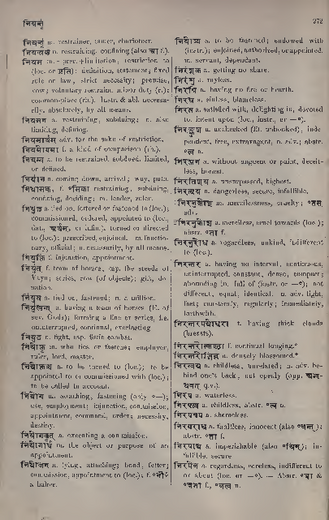
Monier-Williams 1872 substantive masculine
Original text · English · substantive masculine
Ni-yama, as, m. restraining, holding back, check- ing, keeping back; taming, subduing, preventing, confining; restraint, restriction, restriction to (with loc.); limitation; fixing, defining, definition; keeping down, lowering (as the tone of the voice); fixed rule or law, necessity, obligation; rule, precept (e. g. strīṇām Prākṛta-bhāṣaṇam eva niyamaḥ, the usage of women is to speak only Prākṛt); certainty, ascertainment; agreement, contract, engagement, assent, promise, vow; any self-imposed restraint or religious observance voluntarily practised, as fast- ing, watching, pilgrimage, praying, &c.; voluntary penance, meritorious or supererogatory piety; a lesser vow, minor observance (as opposed to yama, a greater vow which must always be observed); (in rhetoric) a common-place in poetry, any conventional expres- sion or usual comparison (as notice of the birch in describing the Himālaya, of the sandal tree in de- scribing the Malaya mountains, of the peacock's cry in the rains, of the koïl in spring, &c.); Necessity or Fixed Law personified as a son of Dharma by Dhṛti; (ena or āt), ind. by a fixed rule, necessarily, surely, certainly.
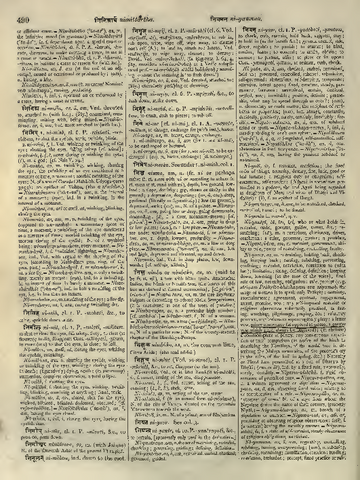
Petersburger 1855 substantive masculine · Word type unspecified
Original text · German · substantive masculine
niyamá (von yam mit ni) m. = niyāma P. 3,3,63. P. 6,2,144. 1〉 Bändigung, Zurückhaltung, Beschränkung: bhūtānāmatha pañcānāṃ yathaiṣāmīśvaraḥ manaḥ . niyame ca visarge ca bhūtātmā mana eva ca .. MBH. 14,1424. adharmaniyamāya M. 8,122. viṣayāsakti˚ ŚUK. in LA. 40,1. prabhāva˚ RĀJA-TAR. 4,331. niyama = bandha TRIK. 3,3,298. fg. = yantraṇā, yantraṇa TRIK. H. an. 3,467. MED. m. 46, wo yantraṇāyāṃ für mantraṇāyāṃ zu lesen ist. — 2〉 das Niederhalten, Senken (des Tones) ṚV. PRĀT. 3,13. — 3〉 Beschränkung auf (loc., prati mit acc.), Beschränkung, Feststellung, genauere Bestimmung KAP. 1,41. saṃkhyā˚ ṚV. PRĀT. 11,11. svarasaṃskārayośchandasi niyamaḥ VS. PRĀT. 1,1. VS. PRĀT. 1,4. ŚIKṢĀ. 11. daivasyāmbumucaśca nāsti niyamaḥ ko 'pyānukūlyaṃ prati RĀJA-TAR. 4,544. bhūteśavardhamāneśavijayeśānapaśyataḥ . niyamo rājakāryeṣu tasyābhūtprativāsaram .. wenn er nicht die Heiligthü -mer Bhūteśa u. s. w. besuchte, beschränkte er sich auf die königlichen Angelegenheiten RĀJA-TAR. 2,123. āraṇyakasya ŚĀṄKH. GṚHY. 6,1. ŚĀṄKH. GṚHY. 6,2. KĀTY. ŚR. 1,4,8. ānupūrvya˚ KĀTY. ŚR. 5,3. a˚ KĀTY. ŚR. 1,3,6. KĀTY. ŚR. 1,5,16. kāla˚ ŚĀṄKH. GṚHY. 2,11. MBH. 1,6452. — Ind. St. 3,395 (23). SĀṂKHYAK. 12. ŚRUT. 10. Schol. zu P. 1,1,62. P. 1,2,46. P. 2,2,20. P. 2,2,32. P. 6,1,80. P. 7,1,67. P. 7,2,19. SIDDH. K._zu_P. 1,1,34. P. 7,2,63. — 4〉 feste Regel, Nothwendigkeit KAP. 1,71. KAP. 1,116. KAP. 3,76. ˚laṅghana KAP. 4,15. sāhacarya˚ TARKASAM̃GR. 29. strīṇāṃ prākṛtabhāṣaṇameva niyamaḥ Schol. zu ŚĀK. 9,6. ŚAṂK._zu_BṚH. ĀR. UP. S. 35. tithiniyamāt nach der festen Norm der Tithi (nimmt der Mond zu und ab) VARĀH. BṚH. S. 4,31. niyamena mit Nothwendigkeit, mit Bestimmtheit, gewiss: yaṃ pālayasi dharmaṃ tvaṃ dhṛtyā ca niyamena ca R. 2,25,3. SUŚR. 2,450,9. PAÑCAT. II, 53. Schol. zu JAIM. 1,16. niyamāt dass. VARĀH. BṚH. S. 45,20. mṛtyuṃ dadāti niyamātkhalu saihikeyaḥ VARĀH. BṚH. S. 103,3. BṚH. 11,6. niyama = niścaya TRIK. H. an. MED. — 5〉 Versprechen, Gelübde AK. 1,1,4,14. TRIK. H. an. MED. īdṛktu vācā niyamo grāhyaḥ saṃbandhinā tvayā KATHĀS. 17,83. ayametasyā (in Betreff ihrer) niyamaścāstu vaḥ sadā KATHĀS. 15,142. VID. 76. VID. 77. — 6〉 eine Beschränkung die man sich auflegt, eine übernommene besondere Observanz, ein kleines Gelübde im Gegens. zu yama (ein grosses Gelübde, welches stets zu beobachten ist) AK. 2,7,37. AK. 2,7,48. TRIK. H. 843. H. an. MED. śaucasaṃtoṣatapaḥsvādhyāyeśvarapraṇidhānāni niyamaḥ YOGAS. 2,32. YOGAS. 2,29. TATTVAS. 19. VEDĀNTAS. (Allah.) No. 129. VEDĀNTAS. (Allah.) No. 127. H. 82. snānamaunopavāsejyāsvādhyāyopasthanigrahāḥ . niyamā guruśuśrūṣāśaucākrodhāpramādatāḥ .. YĀJÑ. 3,314. yamānseveta nityaṃ na nityaṃ niyamānbudhaḥ M. 4,204. VP. 288. VP. 653. BHĀG. P. 2,9,39. BHĀG. P. 5,8,5. tasminvrate niyamaviśeṣāḥ TAITT. ĀR. 1,32,1. vratā niyamadharmāśca M. 2,3. niyamāḥ M. 97. M. 175. M. 3,193. niyamamāsthitā M. 9,75. niyamasya (= vedasya KULL.) dhāraṇāt M. 10,3. vṛthāniyamadhārin MBH. 13,1585. MBH. 13,2736 (wo wie MBH. 13,2880 kaṃcidā˚ zu lesen ist). BRĀHMAṆ. 2,54. SUND. 2,16. sāvitre niyame pūrṇe HARIV. 5658. R. 1,8,14. samāptadīkṣā˚ R. 1,17,10. niyamamātiṣṭhe R. 21,4. R. 25,11. utsṛjya niyamāṃstīvrān R. 2,22,23. yathaite niyamaṃ paurāḥ kurvantyasmannivartane R. 1,46,20. gṛhītvā niyamam R. 1,52,62. satāṃ pathi svairniyamaiḥ paraiḥ sthitaḥ R. 1,94,26. SUŚR. 1,21,19. RAGH. 1,94. RAGH. 5,8. ŚĀK. 180. VARĀH. BṚH. S. 104,49. BHĀG. P. 3,14,36. BRAHMA-P. in LA. 50,6. BRAHMA-P. in LA. 55,10. Schol. zu P. 4,2,15. pravaktāraḥ suniyamā netāro nayadarśinām HARIV. 4139. saniyamā VIKR. 37,7. — 7〉 bei den Rhetorikern feststehender Vergleich, Gemeinplatz KAVIKALPALATĀ_im_ŚKDR. — 8〉 personif. (wohl der Begriff u. 4) ein Sohn Dharmaʼs von der Dhṛti VP. 55. MĀRK. P. 50,25. — niyamāt AK. 2,9,4 falsche Lesart für nimayāt. — Vgl. a˚.
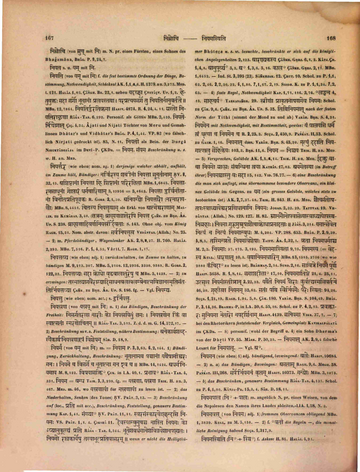
Original text · German · Word type unspecified
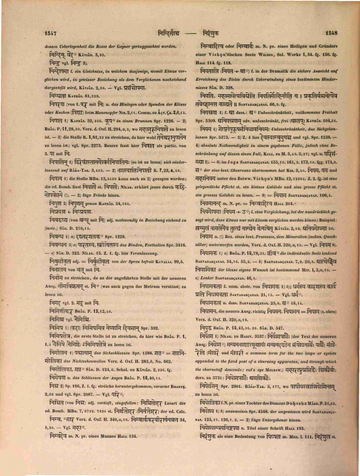
niyamá [vgl. [4:167]] Z. 3 v. u. Lies: devasyāmbumucaśca und vgl. Spr. 1238. (revision)
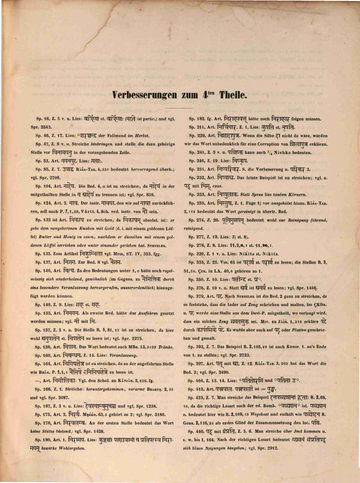
Original text · German · Word type unspecified
niyama 1〉 goṣṭhīpūruṣasaṃnidhāvaniyamaḥ Unbeschränktheit, das Sichgehenlassen Spr. 5373. — 3〉 Z. 4 lies devasyāmbumucaśca und vgl. Spr. 1238. — 4〉 absolute Nothwendigkeit in einem gegebenen Falle, jedoch ohne Beschränkung auf diesen einen Fall, KULL._zu_M. 3,45. M. 5,27; vgl. u. parisaṃkhyā 2〉. — 6〉 im Yoga SARVADARŚANAS. 155,10. fgg. SARVADARŚANAS. 161,3. SARVADARŚANAS. 173,18. fgg. SARVADARŚANAS. 174,3. sa˚ der eine best. Observanz übernommen hat KIR. 5,40. niyama, yama und mahāniyama unter den Beiww. Viṣṇuʼs MBH. 12,12864. Z. 2. fg. ist eine gelegentliche Pflicht st. ein kleines Gelübde und eine grosse Pflicht st. ein grosses Gelübde zu lesen. — 9〉 = niyāma SARVADARŚANAS. 100,4.
Original text · German · Word type unspecified
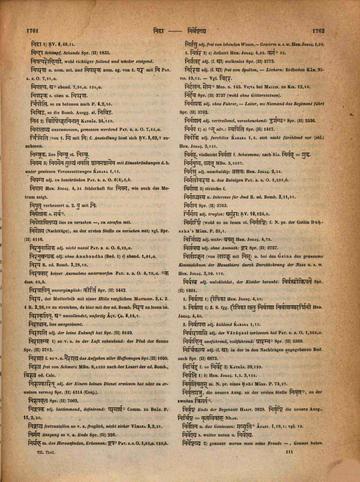
niyama 3〉 niyamena tulyaṃ bhavati jñānamajñānena mit Einschränkungen d. h. unter gewissen Voraussetzungen CARAKA 1,15.
Böhtlingk 1879 substantive masculine
Original text · German · substantive masculine
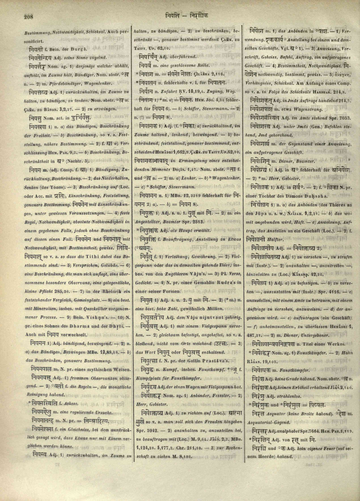
niyama m. (adj. Comp. f. ā) — 1〉 Bändigung, Zurückhaltung, Beschränkung. — 2〉 das Niederhalten, Senken (des Tones). — 3〉 Beschränkung auf (Loc. oder Acc. mit prati), Einschränkung, Beschränkung, genaue Bestimmung. niyamena mit Einschränkungen, unter Voraussetzungen. — 4〉 feste Regel, Nothwendigkeit, absolute Nothwendigkeit in einem gegebenen Falle, jedoch ohne Beschränkung auf diesen einen Fall. niyamena und niyamāt mit Nothwendigkeit, mit Bestimmtheit, gewiss tithiniyamāt so v. a. so dass die Tithi dabei das Bestimmende sind. — 5〉 Versprechen, Gelübde. — 6〉 eine Beschränkung, die man sich auflegt, eine übernommene besondere Observanz, eine gelegentliche, kleine Pflicht Chr. 285,30. — 7〉 in der Rhetorik ein feststehender Vergleich, Gemeinplatz. — 8〉 in best. mit Mineralien insbes. mit Quecksilber vorgenommener Process. — 9〉 Bein. Viṣṇuʼs. — 10〉 N. pr. eines Sohnes des Dharma und der Dhṛti. — Auch mit nimaya verwechselt.
Apte 1890 substantive masculine
Original text · English · substantive masculine
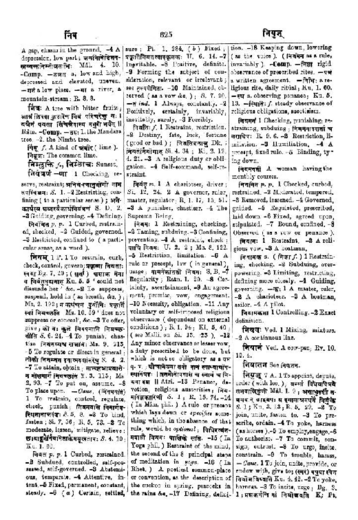
niyamaḥ 1 Restraining, checking. 2 Taming, subduing. 3 Confining, preventing. 4 A restraint, check; vāci niyamaḥ U. 2. 2; Ms. 8. 122. 5 Restriction, limitation. 6 A rule or precept, law (in general), usage; nāyamekāṃtato niyamaḥ Ś. B. 7 Regularity; Ratn. 1. 20. 8 Certainty, ascertainment. 9 An agreement, promise, vow, engagement. 10 Necessity, obligation. 11 Any voluntary or self-imposed religious observance (dependent on external conditions); R. 1. 94; Ki. 5. 40; (see Malli. on Śi. 13. 23). 12 Any minor observance or lesser vow, a duty prescribed to be done, but which is not so obligatory as a yama q. v.; śaucamijyā tapo dānaṃ svādhyāyopasthanigrahaḥ . vratamaunopavāsaṃ ca snānaṃ ca niyamā daśa .. Atri. 13 Penance, devotion, religious austerities; niyamavighnakāriṇī Ś. 1; R. 15. 74. 14 (In Mīm. phil.) A rule or precept which lays down or specifies some thing which, in the absence of that rule, would be optional; vidhiratyaṃtamaprāptau niyamaḥ pākṣike sati. 15 (In Yoga phil.) Restraint of the mind, the second of the 8 principal steps of meditation in yoga. 16 (In Rhet.) A poetical common-place or convention, as the description of the cuckoo in spring, peacocks in the rains &c. 17 Defining, ([Page 0625-c]) definition. 18 Keeping down, lowering (as the voice). (niyamena as a rule, invariably). Comp. — niṣṭhā rigid observance of prescribed rites. — patraṃ a written agreement. — vidhiḥ a religious rite, daily ritual; Ku. 1. 60. — stha a. observing penance; Ku. 5. 13. — sthitiḥ f. steady observance of religious obligations, asceticism.
Cappeller 1887 substantive masculine
Original text · German · substantive masculine
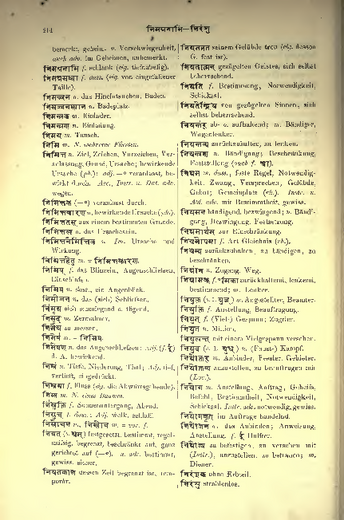
niyama m. dass., feste Regel, Notwendigkeit, Zwang, Versprechen, Gelübde, Gebot; Gemeinplatz (rh.). Instr. u. Abl. adv. mit Bestimmtheit, gewiss.
Burnouf 1866 substantive masculine
Original text · French · substantive masculine
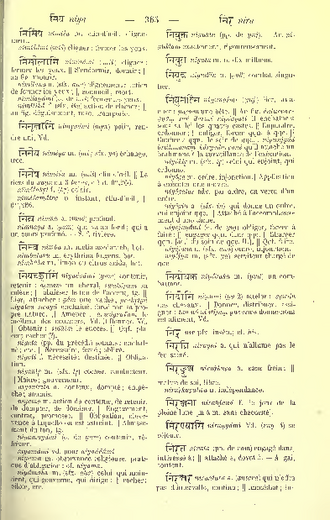
niyama m. action de contenir, de retenir, de dompter, de dominer. Engagement, contrat, promesse. Obligation, observance à laquelle on est astreint. Abaissement du ton, tg.
Occurrences in source texts (13)
DYS 3 occurrences
HP 3 occurrences
PYS 2 occurrences
SiSa 5 occurrences
SiSa 3.34-3.38: Förderliche Mittel 2 occurrences
Direct occurrences
Continue with AYI Free
Image source: AYI archive.