

nityam abhyāsayuktasya jaṭharāgnivivardhanī MBHDL2026 ] transp. NS1882 ante HP 3.75a
alpāhāro yadi bhaved agnir dehaṃ dahet kṣaṇāt MBHDL2026 ] transp. NS1882 ante HP 3.76a
saṃpādyaḥ sādhakasya tu MBHDL2026 ] sampādyaḥ sādhakasya ca NS1882
agnir dehaṃ dahet kṣaṇāt MBHDL2026 ] agnir dahati tatkṣaṇāt NS1882
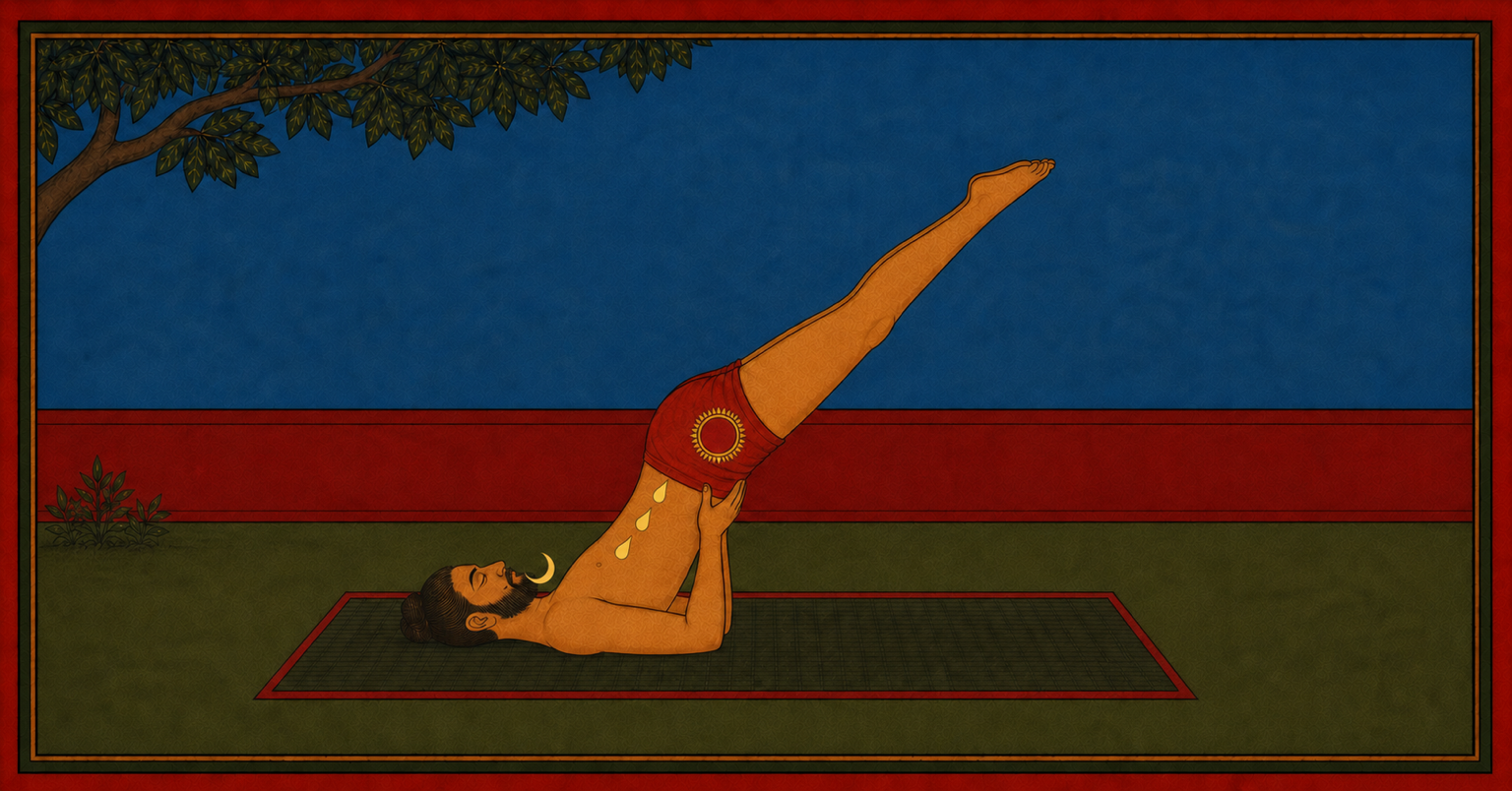
Brahmānanda specifies the bodily position as follows: the hands support the hips, while the upper arms, shoulders, neck, and back of the head rest on the floor; the feet point upward. One begins for a moment and then lengthens the duration in small daily increments. The description indicates a supported inversion, not necessarily an unsupported headstand.
kṣaṇāc ca kiṃcid adhikam abhyasec ca dine dine MBHDL2026 ] transp. NS1882 ante HP 3.77a
Brahmānanda connects the promise of overcoming time with a far-reaching claim about karma: yogic practice could even inhibit Prārabdha Karman, the karma that has already ripened into the present birth. He thereby explains traditions according to which perfected yogis leave their bodies in Samādhi by their own decision.
According to Brahmānanda, the inner moon lies at the root of the palate and lets nectar flow downward. The sun is the fire at the navel that devours this nectar and thereby causes aging. This bodily model provides the rationale for Viparītakaraṇī: the inversion is intended to prevent the ordinary loss of nectar.
piṇḍaṃ jarāyutam MBHDL2026 ] piṇḍo jarāyutaḥ NS1882
According to Brahmānanda, the decisive technique of inversion cannot be obtained from any number of theoretical scriptural interpretations. It must be learned through instruction from a guru. The commentary thereby explicitly marks a boundary between written description and practically transmitted knowledge.
mukhabandhanam MBHDL2026 ] mukhavañcanam NS1882
Continue with AYI Free
Illustrations: AI-generated.

Please log in to write a message. Go to login
No messages yet.