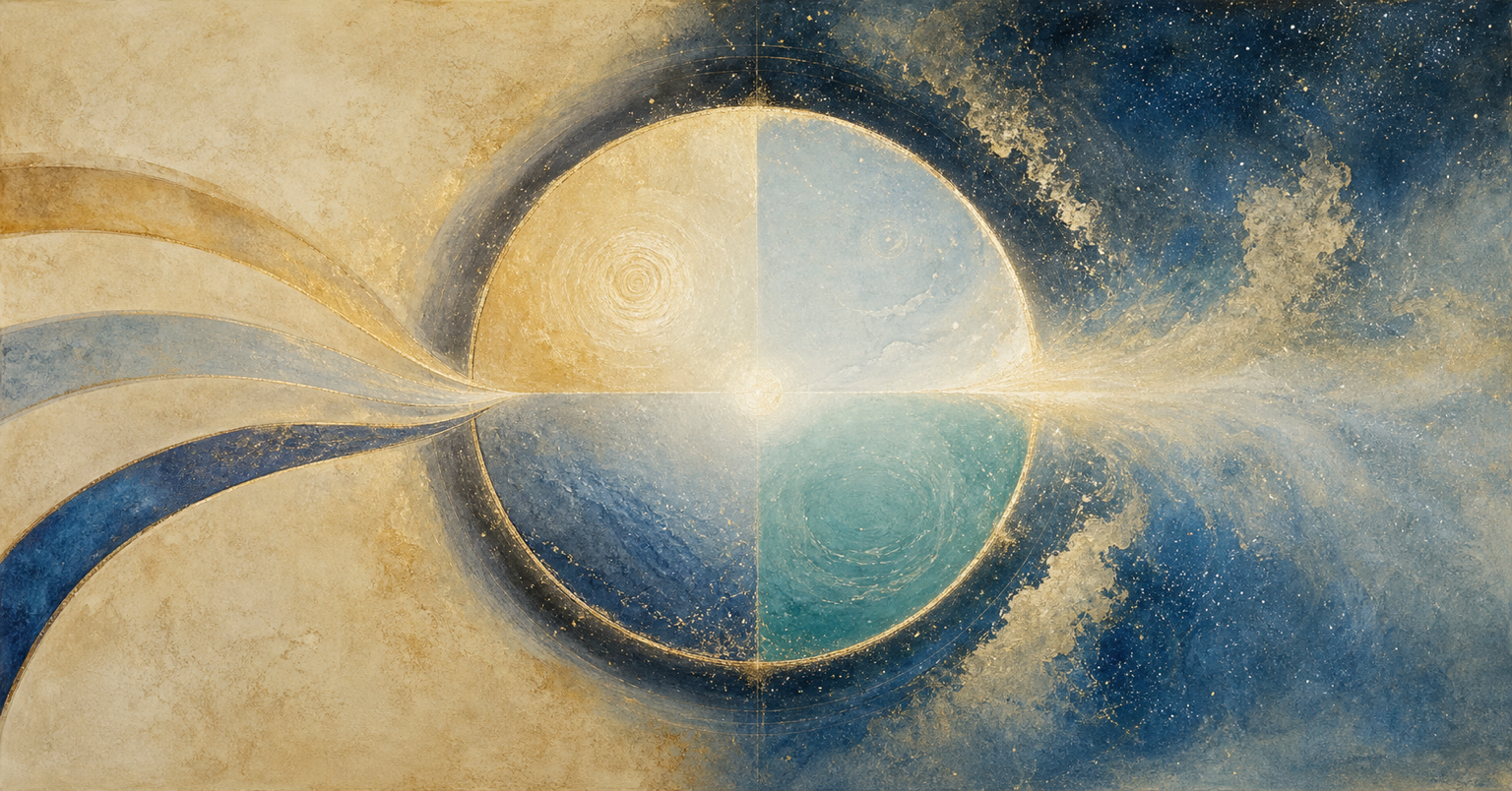
Three golden arcs of time flow into a fourfold circle of light before boundless space.

Om, Brahman, and the fourfold self

Om encompasses time and the timeless; all is Brahman, and the self is taught through four quarters.

Dr. Ronald Steiner Dr. Ronald Steiner Nils Jacob Liersch Nils Jacob Liersch
Māṇḍūkya Upaniṣad 1
ॐ इत्येतदक्षरमिदं सर्वं तस्योपव्याख्यानं भूतं भवद्भविष्यदिति सर्वम्ॐकार एव |
oṃ ity etad akṣaram idaṃ sarvaṃ tasyopavyākhyānaṃ bhūtaṃ bhavad bhaviṣyad iti sarvam oṃkāra eva | Analysis ▾ Analysis ▴
oṃ
oṃ
particle
Om
iti
particle
thus
etat
nominative singular neuter
pronoun dem
this
akṣaram
nominative singular
substantive neuter
syllable
idam
nominative singular neuter
pronoun dem
this
sarvam
nominative singular neuter
adjective
all
tasya
genitive singular neuter
pronoun dem
of it
upavyākhyānam
nominative singular
substantive neuter
explanation
bhūtam
nominative singular neuter past participle passive
verbal root
past
bhavat
nominative singular neuter present participle active
verbal root
present
bhaviṣyat
nominative singular neuter future participle passive
verbal root
future
iti
particle
thus
sarvam
nominative singular neuter
adjective
all
oṃkāraḥ
nominative singular
substantive masculine
Om
eva
particle
indeed
यच्चान्यत्त्रिकालातीतं तदप्य्ॐकार एव ||1||
yac cānyat trikālātītaṃ tad apy oṃkāra eva ||1|| Analysis ▾ Analysis ▴
yat
nominative singular neuter
pronoun rel
which
ca
particle
and
anyat
nominative singular neuter
pronoun quant
other
trikālātītam
nominative singular neuter past participle passive
numeral
substantive masculine
previx
verbal root
beyond the three times
tat
nominative singular neuter
pronoun dem
that
api
particle
also
oṃkāraḥ
nominative singular
substantive masculine
Om
eva
particle
indeed
Metre: none
Om (oṃ), thus (iti) [is called] this imperishable syllable (etad akṣaram | nom sg n): all this (idaṃ sarvam | nom sg n). Its explanation (tasya upavyākhyānam | nom sg) [is]: past (bhūtam | nom sg n), present (bhavat | nom sg n), and future (bhaviṣyat | nom sg n)—thus (iti) all (sarvam | nom sg n) [is] Om alone (oṃkāra eva | nom sg). And (ca) whatever (yat | nom sg n) else (anyat | nom sg n) lies beyond the three times (trikālātītam | nom sg n ppp), that too (tad api | nom sg n) [is] Om alone (oṃkāra eva | nom sg).
Dr. Ronald Steiner - 2026 - historically literal
Om—this imperishable syllable is all that exists. Its unfolding is this: whatever was, whatever is, and whatever will be is nothing but Om. Whatever lies beyond the three divisions of time is also Om.
Dr. Ronald Steiner - 2026 - modern transfer

Gaudapāda’s Kārikā reads the passage through ajāti (non-origination) and explains Om as the verbal symbol of time as a whole and of what transcends time. Its terms are treated as stages in recognizing the one Ātman, not as independent realities.

Gauḍapāda's Kārikā on the Māṇḍūkya Upaniṣad

Śaṅkara explains Om as the verbal symbol of time as a whole and of what transcends time. Its terms are treated as stages in recognizing the one Ātman, not as independent realities.

Śaṅkara's Bhāṣya on the Māṇḍūkya Upaniṣad

Ānandagiri sharpens Śaṅkara’s argument and emphasizes Om as the verbal symbol of time as a whole and of what transcends time. Its terms are treated as stages in recognizing the one Ātman, not as independent realities.

Ānandagiri's Ṭīkā on the Māṇḍūkya Bhāṣya

Śaṅkarānanda presents the passage in a meditative and systematic way and emphasizes Om as the verbal symbol of time as a whole and of what transcends time. Its terms are treated as stages in recognizing the one Ātman, not as independent realities.

Śaṅkarānanda's Māṇḍūkyopaniṣaddīpikā
om. LV1958 ] add. hariḥ oṃ Anand1900 ante oṃ ity etad

sarvaṃ tasyopavyākhyānaṃ Anand1900 ] sarvam | tasyopavyākhyānam | LV1958

sarvam oṃkāra Anand1900 ] sarvam oṅkāra LV1958

apy oṃkāra Anand1900 ] apy oṅkāra LV1958
Critical Apparatus
Om!—This syllable<1> is this whole world. Its further explanation is:—The past, the present, the future—everything is just the word Om. And whatever else that transcends threefold time<2>—that, too, is just the word Om.
<1: Inasmuch as akṣaram means also ‘imperishable,’ the word may in this connection be used with a double significance.>
<2: A similar phrase occurs at Śvet. 6.5b.>
Robert Hume - 1921
Om! Diese Silbe ist die ganze Welt. Ihre Erläuterung ist wie folgt: Das Vergangene, das Gegenwärtige und das Zukünftige, dieses alles ist der Laut Om. Und was außerdem noch über die drei Zeiten hinausliegend ist, auch das ist der Laut Om.
Paul Deussen - 1921
Aum is the word, all this is an explanation of its (meaning and power) past, present and future. All, indeed, is Aum; even all that is beyond the triple conception of time.
Manilal Nabhubhai Dvivedi - 1894
“Om” this is immortal. Its explanation is this all; what was, what is, and what will be, all is verily the word “Om;” and every thing else which is beyond the threefold time is also verily the word “Om.”
Edward Röer - 1853
Māṇḍūkya Upaniṣad 2
सर्वं ह्येतद्ब्रह्मायमात्मा ब्रह्म सो ऽयमात्मा चतुष्पात् ||2||
sarvaṃ hy etad brahmāyam ātmā brahma so 'yam ātmā catuṣpāt ||2|| Analysis ▾ Analysis ▴
sarvam
nominative singular neuter
adjective
all
hi
particle
for
etat
nominative singular neuter
pronoun dem
this
brahma
nominative singular
substantive neuter
Brahman
ayam
nominative singular masculine
pronoun dem
this
ātmā
nominative singular
substantive masculine
Self
brahma
nominative singular
substantive neuter
Brahman
saḥ
nominative singular masculine
pronoun dem
that
ayam
nominative singular masculine
pronoun dem
this
ātmā
nominative singular
substantive masculine
Self
catuṣpāt
nominative singular masculine
numeral
substantive masculine
four-quartered
Metre: none
For (hi) all this (sarvam etat | nom sg n) [is] Brahman (brahma | nom sg); this Self (ayam ātmā | nom sg) [is] Brahman (brahma | nom sg). This very Self (so ’yam ātmā | nom sg) has four quarters (catuṣpāt | nom sg m).
Dr. Ronald Steiner - 2026 - historically literal
All this is Brahman. This Self is Brahman. This Self has four quarters.
Dr. Ronald Steiner - 2026 - modern transfer

Gaudapāda’s Kārikā reads the passage through ajāti (non-origination) and explains the identity of Brahman and Self and their didactic division into four quarters. Its terms are treated as stages in recognizing the one Ātman, not as independent realities.

Gauḍapāda's Kārikā on the Māṇḍūkya Upaniṣad

Śaṅkara explains the identity of Brahman and Self and their didactic division into four quarters. Its terms are treated as stages in recognizing the one Ātman, not as independent realities.

Śaṅkara's Bhāṣya on the Māṇḍūkya Upaniṣad

Ānandagiri sharpens Śaṅkara’s argument and emphasizes the identity of Brahman and Self and their didactic division into four quarters. Its terms are treated as stages in recognizing the one Ātman, not as independent realities.

Ānandagiri's Ṭīkā on the Māṇḍūkya Bhāṣya

Śaṅkarānanda presents the passage in a meditative and systematic way and emphasizes the identity of Brahman and Self and their didactic division into four quarters. Its terms are treated as stages in recognizing the one Ātman, not as independent realities.

Śaṅkarānanda's Māṇḍūkyopaniṣaddīpikā
brahmāyam Anand1900 ] brahma | ayam LV1958

ātmā brahma so Anand1900 ] ātmā brahma | so LV1958
Critical Apparatus
For truly, everything here is Brahma; this self (ātman) is Brahma. This same self has four fourths.
Robert Hume - 1921
Denn dies alles ist Brahman, Brahman aber ist dieser Ātman (die Seele), und dieser Ātman ist vierfach.
Paul Deussen - 1921
For all this is Brahman, this Ātman is Brahman, and this Ātman has four quarters (pādas).
Manilal Nabhubhai Dvivedi - 1894
For this all (represented by “Om”) is Brahma; this soul is Brahma. This soul has four conditions.
Edward Röer - 1853

Continue with AYI Free

Illustrations: AI-generated.

Editor

Dr. Ronald Steiner

From 89075 Ulm

The "Yoga Doc" - Dr. Ronald Steiner is the founder of the AYI method. This method links traditional Ashtanga Yoga with innovative Yogatherapy and living Philosophy. This forms a practice that is personal for each and... more ›

Nils Jacob Liersch

Meine Begeisterung für Yoga, indische Philosophie und Sanskrit führte mich zum Studium der Indologie und Religionswissenschaft an der Universität Heidelberg. Seit 2004 befinde ich mich auf meinem persönlichen Yogaweg... more ›

Messages and ratings
0 messages

Please log in to write a message. Go to login

No messages yet.